








Introduction
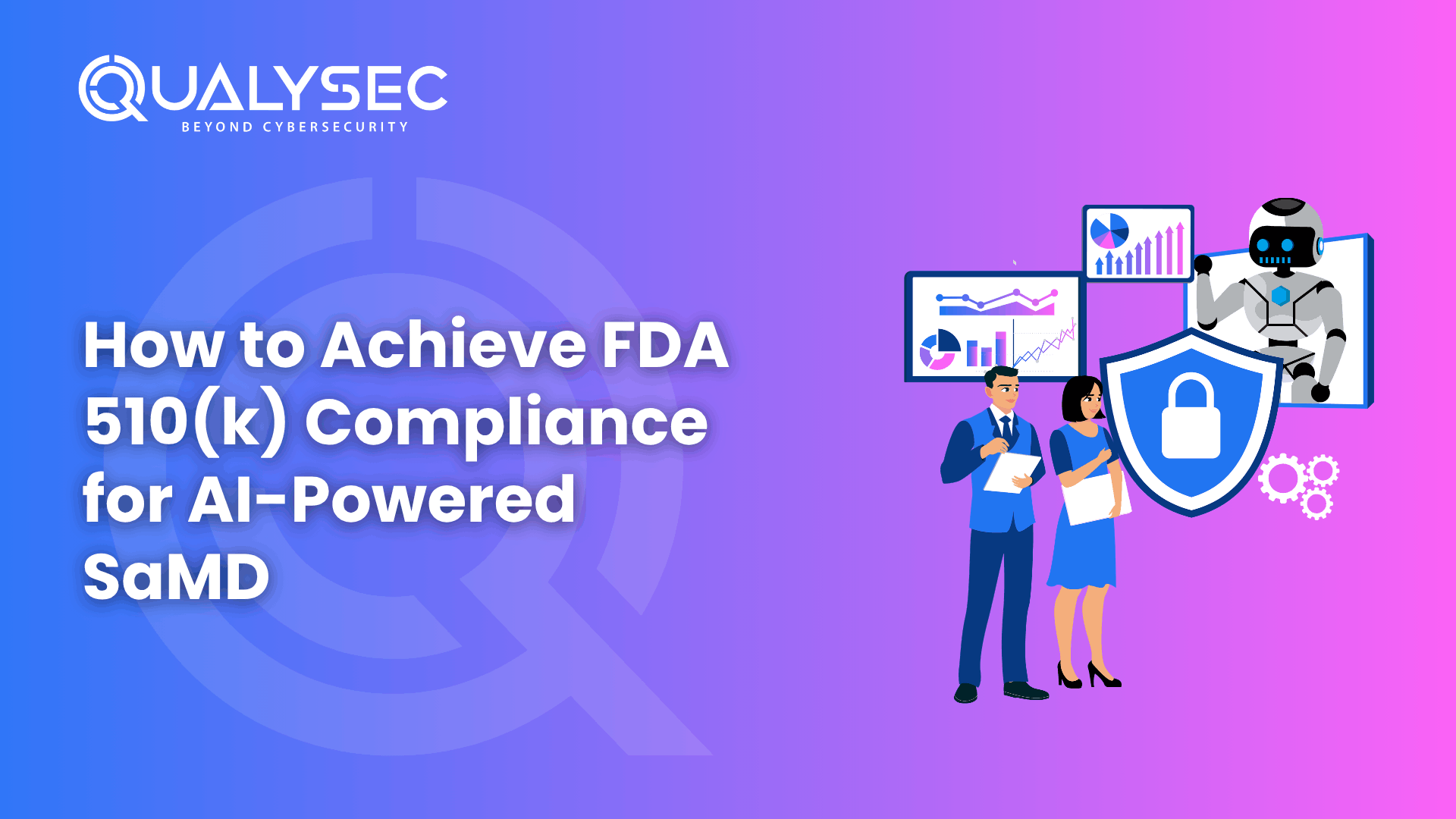
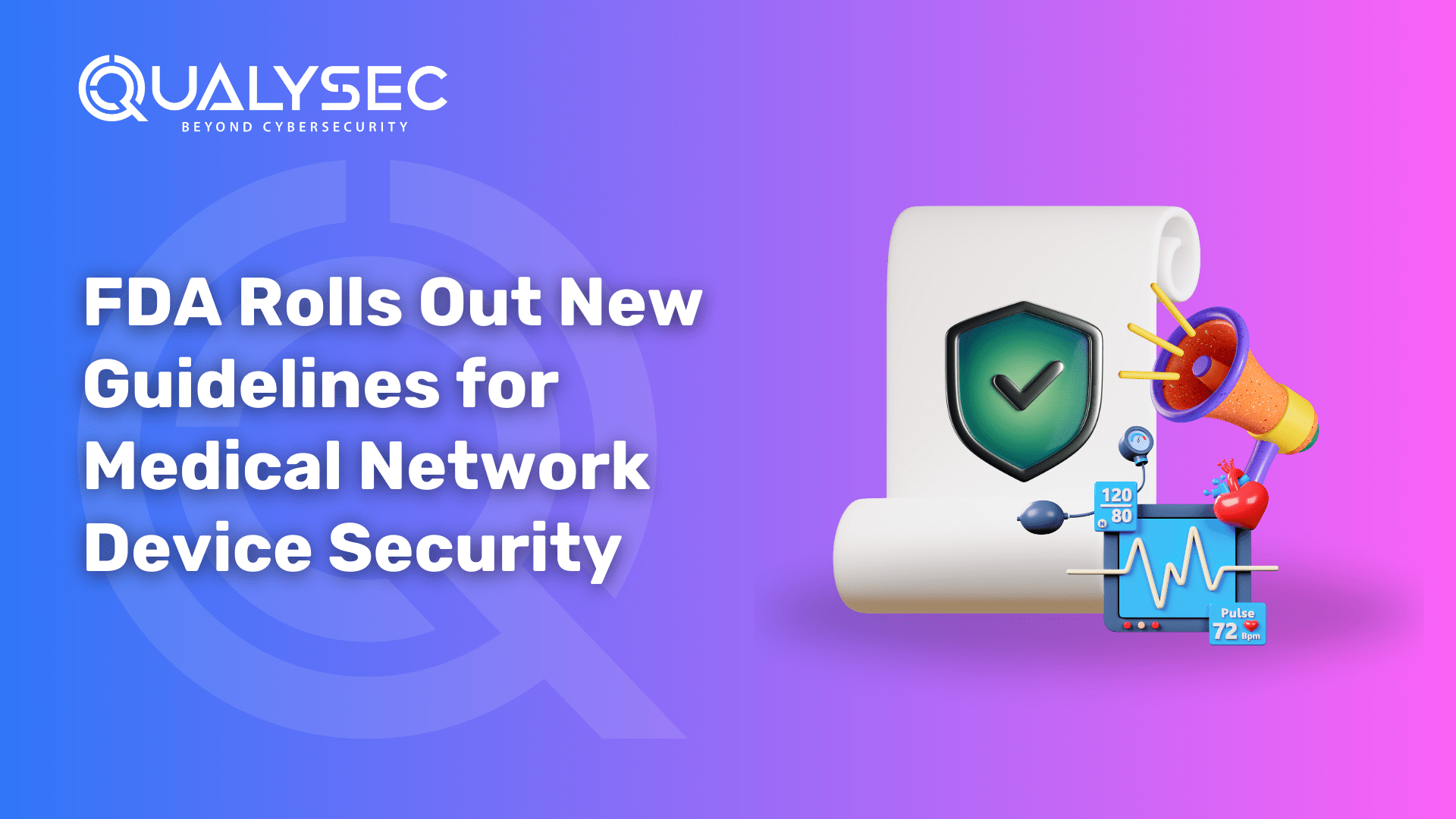
Following recent FDA QMSR updates aligned with ISO 13485, the FDA has intensified its refusal-to-accept (RTA) criteria for 510(k) submissions. Software Bill of Materials (SBOM) or a formal Secure Product Development Framework (SPDF) is required for devices classified as ‘cyber devices’ under Section 524B. FDA and CISA advisories show a consistent trend of high-severity vulnerabilities in medical devices. FDA submissions may face RTA if required cybersecurity documentation is missing or insufficient, with weak risk assessments among the top deficiencies. And this is why Qualysec Technologies is here to tell you about the FDA 510k Cybersecurity Gap Analysis.
This guide provides a practical framework to conduct an FDA 510k Cybersecurity Gap Analysis – an evaluation of the security of your device based on the Postmarket Management of Cybersecurity in Medical Devices guidance (as of 2025) and aligned with FDA QMSR (transitioning from 21 CFR Part 820 to ISO 13485:2016). We are going to understand some technical concepts and pro tips to develop your knowledge.
Pro Tip: Use gap analysis at the design stage – do not wait to find out about it during pre-submission audits.
Don’t let a formatting error derail your submission. Get our internal checklist for Section 524B compliance, including SBOM and VEX requirements for the latest eSTAR templates – Contact Qualysec Technologies Now!
Must-Haves for 2026 510(k) Submissions
To avoid a “Refusal to Accept” (RTA) or significant delays under the latest Section 524B compliance and QMSR standards, your submission must include:
- Comprehensive Software Bill of Materials (SBOM) – A machine-readable (SPDX or CycloneDX) list of all open-source and third-party software parts.
- Formal Threat Model – An analytical approach to determining the possible attack vectors and capturing the security controls that are in place to prevent them.
- Vulnerability Exploitability eXchange (VEX) – Documentation to help you understand which vulnerabilities you found in your SBOM can be exploited in your specific environment.
- Penetration Testing & Security Assessment Reports – Test evidence of stress-testing the defenses of your device, both hardware and software, and cloud interfaces.
- Postmarket Management Plan – The precise roadmap on how you will deliver patches and updates in time upon the device entering clinical use.
- eSTAR Cybersecurity Attachments – All documentation must be formatted for seamless integration into the FDA’s mandatory eSTAR electronic submission template.
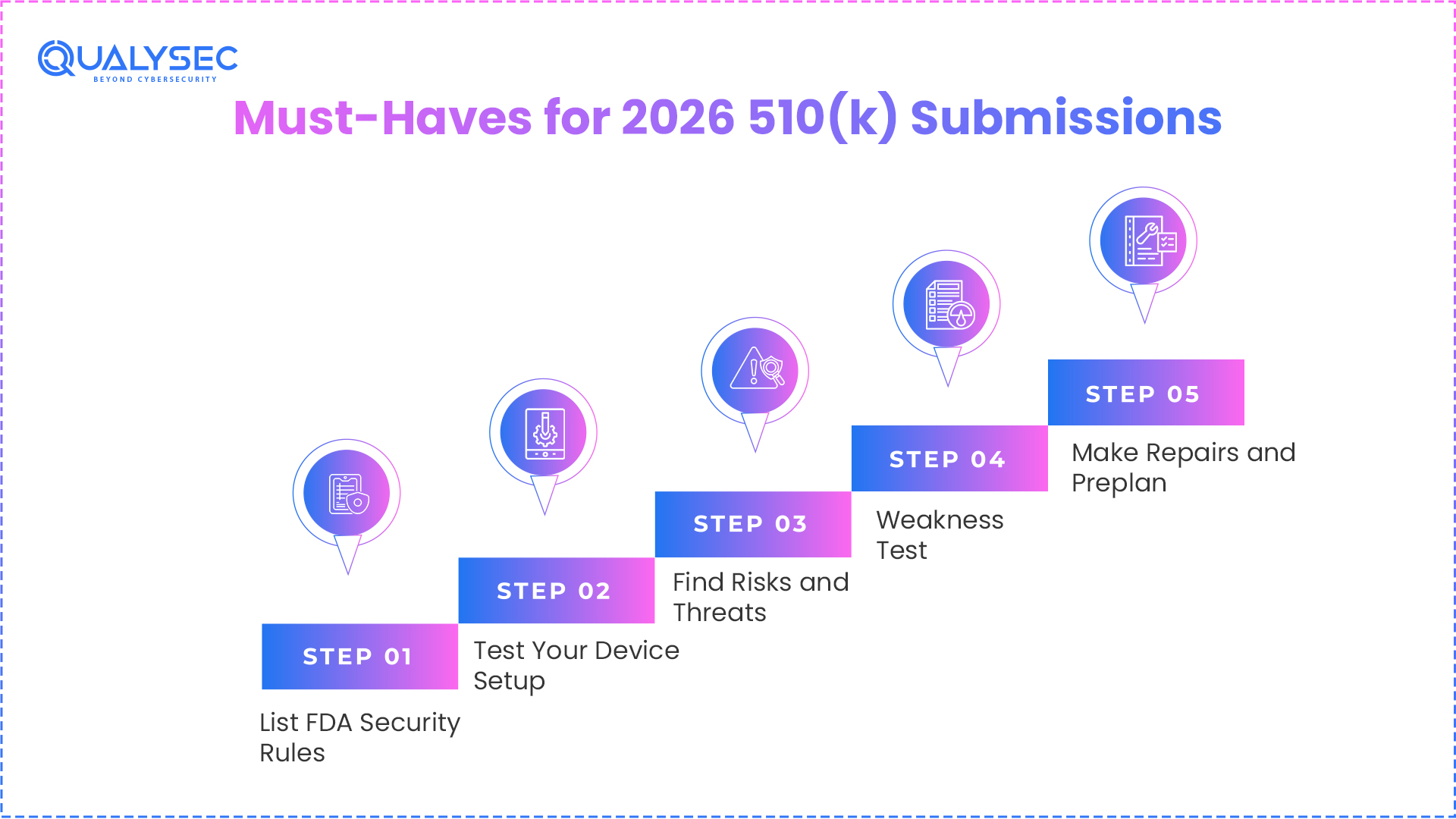
Step 1 – List FDA Security Rules
Start with the requirements of the FDA. Among others, essential areas are access control, data protection, and threat handling. The access control means that only the approved individuals can use the device, such as by using a password and a fingerprint. To protect data, powerful codes are used for Patient Safety Impact Analysis.
Start by mapping your device to the FD&C Act Section 524B requirements to prove your device is “Cybersecure by Design.” Write a list of basic rules of your device. As an example, a blood pressure monitor needs a safe Bluetooth link.
FDA Requirements Table:
| Area | What the FDA Asks | Simple Example |
| Access | Use two checks like a password + code | The doctor logs in to the app securely |
| Data Safe | Encrypt data at rest and in transit (e.g., AES-256, TLS 1.2+) | Patient data hides in the cloud |
| Threats | List all weak spots | Plan for hack attempts |
| Updates | Easy fix for bugs | Auto-download safe software |
Step 2 – Test Your Device Setup
Now, write down your device’s parts. Record device software (such as applications), and hardware (such as chips and Wi-Fi). For example, in the case of a wearable heart tracker, indicate the version of the app, the battery chip, and the phone connection.
Determine the presence of known bugs in parts using SCA tools and vulnerability databases (e.g., NVD). This listing indicates what is there and what is not. Fix simple things to start with, such as old software. A lot of devices fail at this point since teams do not take into consideration this list.
Step 3 – Find Risks and Threats
Imagine the worst that might occur, such as an attack by a hacker. Use easy models to see who attacks, how they do it, and what harm they can cause. Rate each from low to high. For example, in the case of a pump device, a remote dose change by a digital glitch or attack is of high risk.
Risk Scoring Table:
| Risk Example | Chance (1-5) | Harm (1-5) | Total Score | Quick Fix |
| Data stolen over Wi-Fi | 4 | 5 | 20 | Strong code layer |
| Wrong user access | 3 | 4 | 12 | Add biometric or multi-factor authentication |
| Bug in update | 2 | 5 | 10 | Test before send |
Step 4 – Weakness Test
Check your set-up. Check without executing code, such as scanning it with free tools, to detect holes. Test the network by observing data packets. Test a false attack, such as excessive logins, to determine whether it blocks or not.
In the case of hardware, insert plug-in testers in ports. Note what breaks. A real-life example – a monitor team discovered a Bluetooth leak in this manner and patched it in a short period of time. Make sure to record all the steps and dates.
Pro Tip: Think like an attacker and simulate realistic threat scenarios – attempt common tricks as you start.
Step 5 – Make Repairs and Preplan
Make a fix list of who fixes and when, per weak spot. Prepare a report with pre-fix and post- fix evidence. Track progress weekly. Finalize with FDA-ready documents, such as a risk summary. This roadmap ensures your project is on schedule.
Pro Tip: Announce fixes with your team as early as possible to avoid a last-minute rush.
How Qualysec Technologies Can Help You in 510k Cybersecurity Gap Analysis
Cybersecurity is now required to be stable in FDA 510k submissions. Qualysec Technologies can simplify this and make it stress-free for medical device manufacturers. Qualysec has a very clear and organized direction, and their 3 Stage Process has been proven for results.
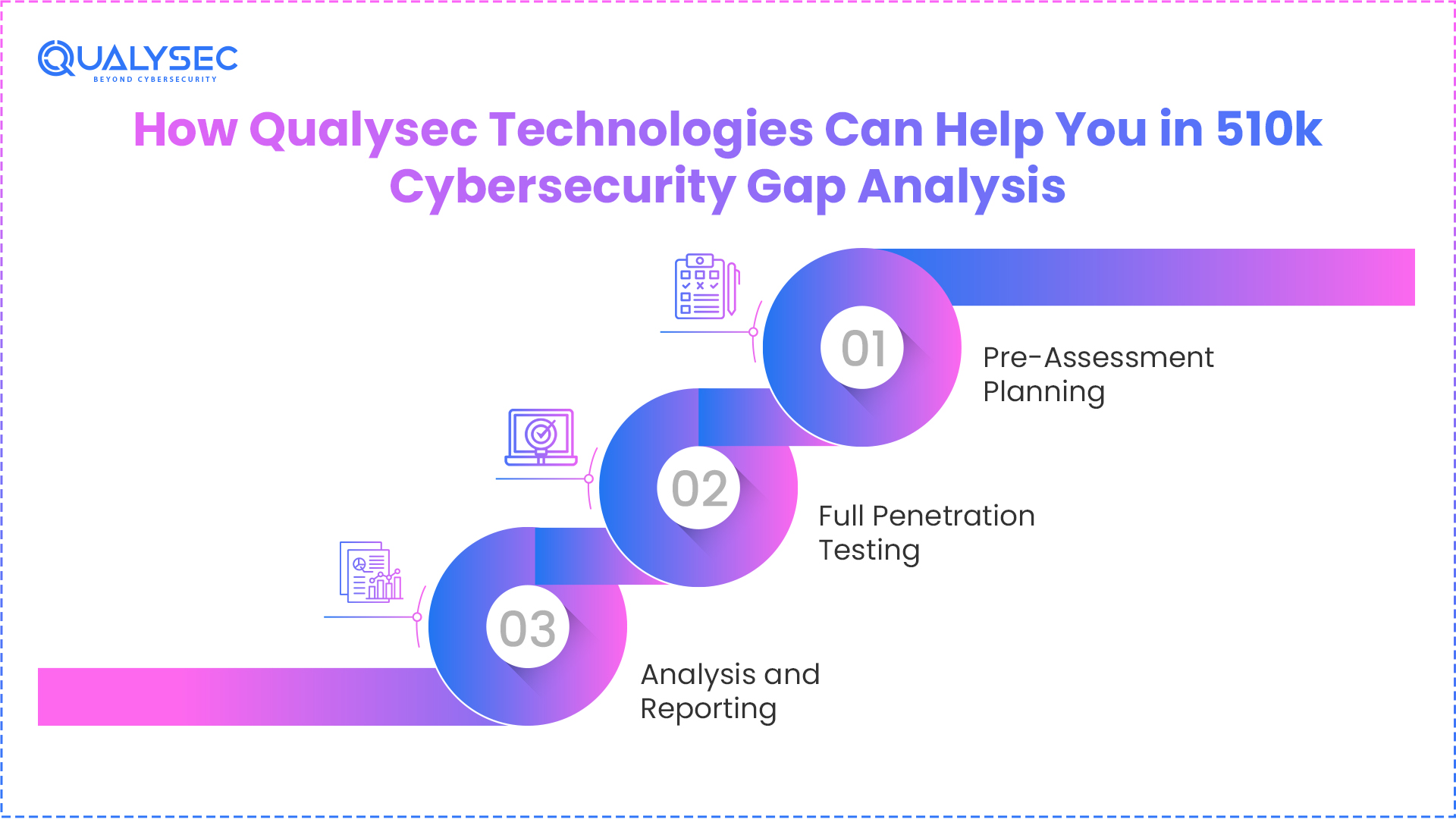
Stage 1 – Pre-Assessment Planning
The experts begin by knowing all about your device. The team audits your documents, functionality, and configuration. Subsequently, they develop a tailored test plan that complies with FDA cybersecurity regulations. No guesswork – a roadmap customized to your insulin pump, wearable, or diagnostic device.
Stage 2 – Full Penetration Testing
It is here that the experts start to find out the issues with comprehensive scans, simulation of cyber attacks, network, access control, data encryption, and update checks. They debug hardware, software, signals, and ports with a proprietary configuration. This reveals actual weaknesses that may thwart your 510(k) clearance.
Stage 3 – Analysis and Reporting
Risks are analyzed using the analysis of results. You are given a thorough report that includes findings, risk scores, and steps for fixing. The experts even assist in creating FDA-ready Premarket Cybersecurity Documentation (PCD) to submit to them. And everything is audit-proof and actionable.








































































































































































































































































































































0 Comments