








The issue of cybersecurity for law firms is a pressing concern in the modern digital landscape. Some of the most confidential information that can be thought of is that which is dealt with by law firms, such as financial records, intellectual property, and confidential client communications. In addition, legal practices are considered high-value targets by cybercriminals, as they are not necessarily well-equipped in terms of security infrastructure compared to financial institutions. Consequently, a single data breach might ruin client trust, cause regulatory fines and inflict irreversible damage on the reputation of a company. Thus, it is no longer a choice for lawyers to adopt the cybersecurity best practices for lawyers but more of a survival strategy.
Based on the latest statistics, 29% of law firms said they have suffered a security breach in 2023. Also in 2024, the average cost of a data breach in law firms amounted to 5.08 million, which is 10 per cent higher than it was last year. Moreover, customers will be increasingly seeking enhanced security, and 37% will be ready to pay a high price when companies focus on data protection for legal firms. It then follows that investing in cybersecurity is not a mere issue of not losing money, but rather developing a competitive advantage.
Why Are Law Firms Prime Targets for Cyber Attacks?
What Makes Legal Practices Attractive to Hackers?
Law firms can be regarded as one of the treasure troves of useful information, which cybercriminals are actively pursuing. In particular, lawyer services deal with Social Security numbers, estate plans, trade secrets, and merger and acquisition-related information. In the meantime, not all small to mid-sized law firms have IT security teams, as in the case of healthcare providers or banks. As such, legal practices would be easy targets with possibly huge payoffs to the hackers.
In addition, cybersecurity for law firms has its own special issues, as often lawyers work at home or check files on several gadgets. Also, there are occasions when the nature of legal work may force an attorney to deal with security requirements to beat deadlines. These vulnerabilities, consequently, provide several points of attack to bad actors.
The Law Firms of High-Value Data Protection
Criminals are targeting different forms of sensitive information in law practices:
- Client personally identifiable information (PII): Names, addresses and Social Security numbers.
- Financial records: Bank statements, tax filings and investment portfolios.
- Intellectual property: Patents, trade secrets and proprietary business strategies.
- Protected health information (PHI): Personal injury or malpractice medical records.
- Attorney-client privileged communications: Strategy and case information.
- Corporate transaction data: Merger, acquisition conditions, and filings.
In addition, the data can be helpful following the closure of the case. Thus, the files containing the historical financial data or personal information could be attacked by the cybercriminals.
| Threat Type | Frequency | Primary Impact | Average Cost |
| Phishing Attacks | 80% of firms targeted | Credential theft, malware installation | $150,000 – $500,000 |
| Ransomware | 45+ attacks in 2023 | File encryption, operational shutdown | $1.2M – $3.5M |
| Insider Threats | 30% of breaches | Data theft, accidental exposure | $250,000 – $750,000 |
| Cloud Vulnerabilities | 25% of incidents | Unauthorised access, data leaks | $300,000 – $900,000 |
What Are the Most Common Cyber Threats Facing Law Firms?
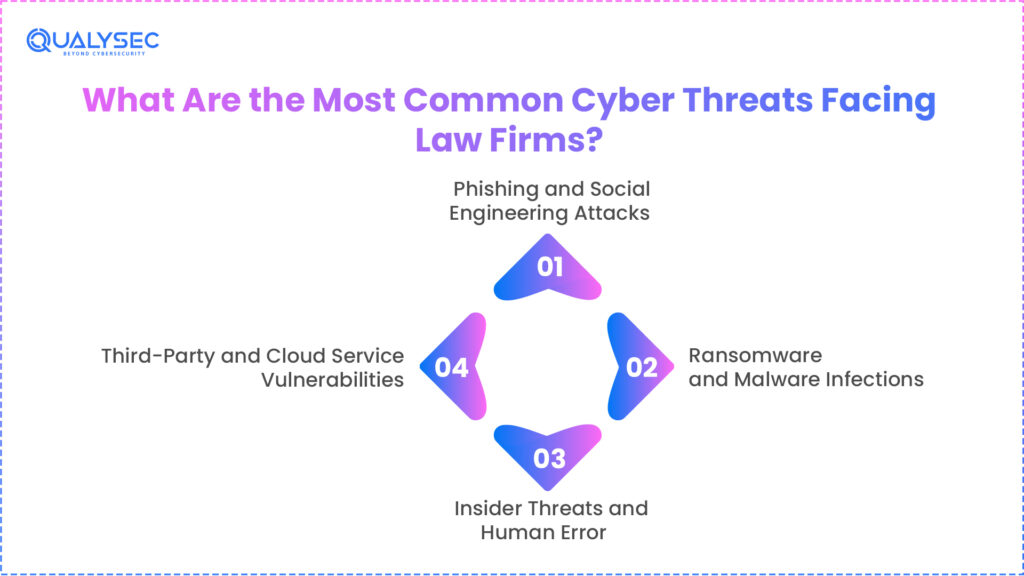
Phishing and Social Engineering Attacks
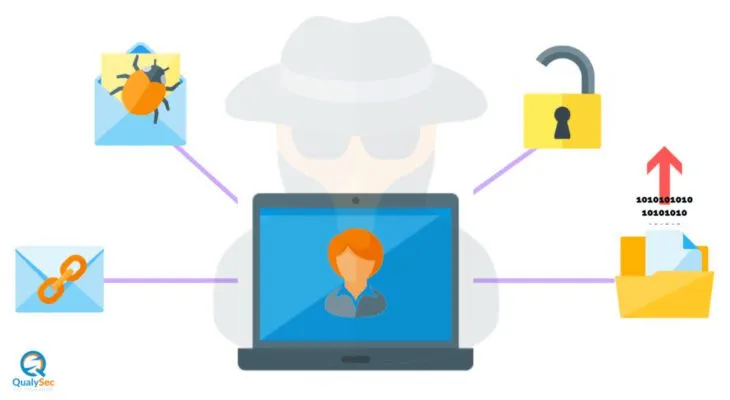
The most common cybersecurity risk that law firms face is phishing. In particular, cybercriminals use fraudulent emails that look like they have been sent by trusted persons (such as courts, clients, or banking institutions). Meanwhile, such messages are used to lure users into clicking on harmful links or exposing their confidential data.
Besides, spear-phishing is a personalised method of attack on particular individuals in law firms that includes the use of specific personal information. As an example, an attacker can pose as a managing partner who needs to send a wire transfer urgently. There is also the business email compromise (BEC), which has resulted in millions of dollars in losses in the legal sector.
Moreover, spam filters and filters are the main defence mechanism against phishing in 80% of law firms. Nevertheless, such tools cannot prevent advanced attacks. Thus, the extensive training is still critical to the best practices of cybersecurity among lawyers.
Ransomware and Malware Infections
The threat of ransomware on legal practice is existential since it will encrypt important documents and will not release them until a fee is paid. In particular, in 2023, over 45 ransomware attacks on law firms have been identified to compromise over 1.5 million records. In the meantime, legal deadlines are compelling firms to pay ransoms more than they would take the risk of missing court dates, or even deadlines for closing.
Moreover, ransom attacks usually entail information exfiltration prior to coding. It is because of this that criminals pose a threat of releasing sensitive information about clients in the event of default on the part of firms. Also, most companies do not completely recover their information, despite paying ransoms after being taken hostage.
To know more, read our latest article on Ransomware Penetration Testing
Insider Threats and Human Error
Outside hackers are not the only security risks. As a matter of fact, 30 per cent of data breaches are associated with insider activities, either intentionally or unintentionally. For example, employees might:
- Use weak passwords that are easily deciphered by criminals.
- Become victims of phishing fraud that can take down entire networks.
- Send confidential files to the wrong people without knowing it.
- Poor handling of sensitive documents by dropping them in open areas.
- Steal data intentionally upon departure from the company.
Besides, law firms tend to neglect the principle of least privilege. This has resulted in an over-availability of sensitive information to too many staff members who do not even need it in their job.
Third-Party and Cloud Service Vulnerabilities
Most law firms depend on cloud-based case management systems, document storage platforms, and communication tools. Although these services are efficient, they cause security threats. In particular, client data can become compromised well in advance of any breach of the systems of the law firm, in case a third-party vendor becomes exposed to it.
Moreover, improperly configured cloud storage is also a major weakness. As an example, access to thousands of legal documents has been made public due to companies not setting up access controls properly on publicly available databases. Thus, it becomes important to vet the vendors and have a high level of compliance with the legal industry standards.
Read our case studies to know how law firms prevent Costly Breaches with proactive security testing.
How Can Law Firms Implement Strong Cybersecurity Measures?
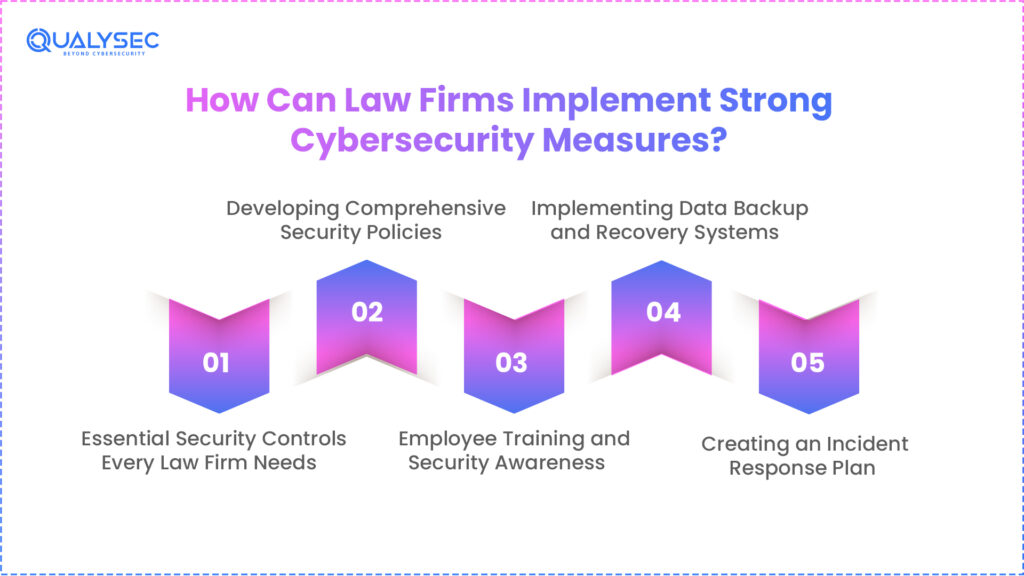
1. Essential Security Controls Every Law Firm Needs
A multi-layered approach is necessary to implement strong cybersecurity for law firms. The first and most important is that firms should develop an effective access control that restricts access to sensitive information. In particular, all system access must include multi-factor authentication (MFA) when accessing the system, particularly in the cloud-based platform.
Moreover, encryption must be applied universally across email communications, stored files, and backup systems. Additionally, firms should implement the principle of least privilege, ensuring employees only access data essential for their specific roles.
Additionally, encryption should be used everywhere in email communications, the stored files, and the backup systems. Moreover, companies ought to apply the principle of the least privilege, and employees receive only data that is necessary to perform their particular functions.
2. Developing Comprehensive Security Policies
All law firms require a written and constantly updated cybersecurity policy, which clearly outlines the acceptable standards of use. In particular, the following policies must be centred on:
- Laptop, smartphone, and tablet devices use procedures.
- Confidential file storage, sharing and deletion procedures.
- Suspected breach/unauthorised access response plans.
- Password complexity and management minimum requirements.
- Remote work and Wi-Fi in the streets policies.
- The guidelines on how to communicate with clients via safe means.
Moreover, the policies should be consistent with compliance for legal industry of the legal industry, such as the ABA Model Rule 1.6(c), which requires reasonable efforts to ensure that the information about clients is not disclosed unauthorisedly. Moreover, the companies that cater to European customers should be in accordance with the GDPR, whereas the companies that deal with health data should be in accordance with HIPAA.
Explore more about: Cybersecurity Compliance Services.
3. Employee Training and Security Awareness
Technology alone cannot protect law firms—people remain the strongest defense or weakest link. Therefore, comprehensive cybersecurity training must occur during employee onboarding and continue through annual refresher courses.
Specifically, training should focus on:
- Understanding phishing scams and questionable emails.
- The use of password managers and the creation of tough passwords.
- Determining social engineering techniques.
- Performing secure file-sharing practices.
- Immediate reporting of possible security incidents.
- Awareness of the effects of security breaches.
Besides, simulated phishing activities enable employees to practice threat identification within a secure setting. Besides, Continuing Legal Education (CLE) data protection courses are important to provide lawyers with new risks and legal requirements.
4. Implementing Data Backup and Recovery Systems
Ransomware attacks put a lot of emphasis on having efficient backups in place. In particular, law firms are advised to introduce automated daily backup of copies, which are stored in secure and off-site places or encrypted cloud services. The meantime, there is a wonderful rule, the 3-2-1 backup rule, which imparts excellent advice: to have three data copies on two types of media and one of them stored off-premises.
In addition, companies should administer frequent tests on backup restoration measures in order to have data restored promptly in case of an attack. Also, the backup systems themselves must be secured using encryption and access controls. Otherwise, the ransomware may be used by criminals to attack the backups.
To ensure your cloud backups stay safe, to know more explore qualysec cloud penetration testing
5. Creating an Incident Response Plan
Nevertheless, the breaches may still happen regardless of the best efforts. As such, law firms should have documented incident response plans which specify the step-by-step procedures on how to deal with security incidents. In particular, these plans are to define:
- Determining and verifying a security breach.
- Containment and prevention of further access steps.
- The notification of affected clients and regulators’ requirements.
- Processes of contracting cybersecurity professionals and lawyers.
- Intranet and Internet communication protocols.
- Legal and insurance documentation.
Additionally, the incident response plans should concern compliance with legal industry regulations that require a certain notification time. In a particular case, GDPR mandates reporting of breaches in 72 hours, whereas other state laws set a timeframe.
What Role Does Law Firm Penetration Testing Play in Security?
Understanding Penetration Testing for Legal Practices
There is a law firm through which security vulnerabilities well in advance, before the criminals have a chance to exploit them. Especially, the ethical hackers recreate in the real world attacks to test defences and explore vulnerabilities in systems, networks, and applications.
In addition, unlike automated vulnerability scans, penetration testing is performed by using human creativity and sophisticated methods that simulate the actions of actual threat actors. Consequently, companies gain important knowledge of the effectiveness of their security controls when they are attacked.
Additionally, the routine law firm penetration testing shows diligence to the client and the regulator. Besides, it can assist the firms in prioritising their security investments by determining the most severe vulnerabilities that need urgent focus.
Key Benefits of Regular Security Testing
Regular penetration tests will provide a variety of benefits to cybersecurity for law firms:
- Identify hidden vulnerabilities: Find missed security weaknesses by automation.
- Test incident response: Test the time of threat detection and response.
- Validate security controls: Make sure that firewalls, encryption, and access controls are functioning properly.
- Meet compliance requirements: Meet regulatory security assessment requirements.
- Reduce breach costs: Remediate issues before they are abused by criminals.
- Build client confidence: Show dedication to the data security of law firms.
In addition, penetration testing will show the way various vulnerabilities may be linked in complex attacks. There are also testing results that offer road maps on how to improve security postures systematically.
Choosing the Right Penetration Testing Partner
Cybersecurity is not something all security testers are familiar with the special needs of cybersecurity for law firms. Thus, to choose a suitable partner, it is necessary to consider various aspects very closely:
The first step to consider is finding a company that has the necessary experience in the field of legal field and is aware of the issues of attorney-client privilege and confidentiality. Second, ensure credentials such as CREST, OSCP or CEH, which are evidence of technical skills. Moreover, make sure that providers adhere to such recognised methodologies as OWASP or PTES.
Moreover, address scope thoroughly to make sure that all key systems, such as case management systems, email servers, cloud storage, and remote access solutions, are put into testing. In the meantime, ensure that the testing will take place when the legal work is not at its peak to ensure that it is not disrupted.
Why Is Qualysec the Best Partner for Law Firm Cybersecurity?
Specialised Expertise in Legal Industry Security
Regarding the issue of safeguarding sensitive legal information, Qualysec is the best cybersecurity ally of law firms in the USA and worldwide. Precisely, Qualysec comes with profound knowledge on the special security issues that impact the legal practices, such as the existence of strict confidentiality regulations, regulatory demands, and the valuable nature of client information.
Besides, the staff of Qualysec consists of certified experts with long-term experience in penetration testing of law firms and data protection of legal firms. Their specialists have reputable qualifications such as OSCP, CEH and CREST, which guarantee global security testing. Also, Qualysec knows the regulatory world, which assists companies to be in compliance with legal industry standards such as ABA Model Rules, GDPR, HIPAA, and state-specific regulatory standards.
Moreover, Qualysec understands that law firms cannot afford an interruption in undertaking a security assessment. Thus, their testing procedures have the least influence on operational tasks at the same time providing detailed security intelligence. Meanwhile, their reporting is very detailed and gives direct recommendations that are easy to understand and apply by legal professionals.
Comprehensive Security Services Tailored for Law Firms
Qualysec provides a full range of cybersecurity solutions that target legal practices:
- Advanced Penetration Testing: Entire evaluation of networks, applications, and cloud infrastructure with state-of-the-art methods that spot vulnerabilities before their misuse by criminals.
- Vulnerability Assessments: Consistent scans that find weak points in all the systems, with the severity and possible in terms of impact ranked.
- Security Audits: Comprehensive reviews of the security policies, procedures, and controls to ensure that they are aligned with the best practices in cybersecurity among lawyers.
- Compliance Consulting: Consulting services on addressing regulatory standards such as GDPR, HIPAA, CCPA, and ABA ethics.
- Incident Response Planning: Preparation of organisation-specific response procedures, which assist companies in promptly containing and recovering from security incidents.
- Security Awareness Training: Educational programs that educate attorneys and staff to be aware of threats and practice securely are to be engaged in.
Also, Qualysec offers continuous assistance and not a single evaluation. Their round-the-clock surveillance and regular retesting of the same make cybersecurity for law firms dynamic in relation.
Proven Track Record and Client Success
Qualysec has assisted many law firms in tightening their security position and guarding secret client information. The success stories provided by their clients show quantifiable changes in the level of security maturity, the number of vulnerabilities decreased, and the ability to comply with the requirements increased.
In addition, the transparent reporting of Qualysec offers comprehensive documentation, which can be shared with customers and insurance companies dealing with cyber. They also provide competitive pricing, which helps to make enterprise-level security affordable to such small and mid-sized legal practices.
Ready to strengthen your firm’s cybersecurity? Visit Qualysec’s website in order to learn more about their services in the field of law. Better yet, schedule a free consultation now and talk about your unique security requirements and find out how Qualysec may help you avoid high-priced breaches in your practice. It is not too late to deal with the problem, but now is the best time to make proactive efforts to win the whole trust of your clients and the reputation of your firm.
What Compliance Requirements Must Law Firms Meet?
Understanding ABA Model Rules and Ethics Opinions
Model Rule 1.6(c) is the one that sets fundamental ethical requirements of cybersecurity for law firms by the American Bar Association (ABA). Namely, this regulation holds that lawyers should engage in reasonable efforts to ensure that the inadvertent or unauthorised disclosure of, or the unauthorised access to, information concerning the representation of a client is avoided.
More so, ABA Formal Opinion 477R is a comprehensive one offering information on how to ensure preservation of electronic communication with clients. Also, Opinion 483 deals with the issue of the reaction of attorneys towards data breaches. These views indicate that reasonable efforts are determined by several factors, such as:
- Delicateness of the information at hand.
- Probability of non-disclosure with no extra protection.
- Expenses to use extra safeguards.
- Hardship of effecting protective measures.
- The scope of safeguards that have a negative impact on service quality.
Moreover, the definition of what is reasonable will change with the development of technology and the level of sophistication of the threats. The firms are, therefore, required to constantly improve security to ensure that they are adhering.
GDPR Requirements for Law Firms Serving EU Clients
The General Data Protection Regulation (GDPR) applies to any law firm that processes personal data of EU residents, regardless of where the firm operates. Specifically, compliance for the legal industry under GDPR requires:
- Obtaining explicit, informed consent before collecting personal data
- Implementing appropriate technical and organisational security measures
- Maintaining records of processing activities (ROPA)
- Appointing a Data Protection Officer (DPO) when required
- Honouring individual rights, including access, correction, and deletion requests
- Reporting breaches to supervisory authorities within 72 hours
Moreover, GDPR violations can result in fines up to €20 million or 4% of global annual revenue, whichever is greater. Additionally, the regulation applies extraterritorially, meaning US-based firms remain liable for protecting EU resident data.
HIPAA Compliance for Legal Practices
The General Data Protection Regulation (GDPR) is applicable to every law firm that deals with the personal information of EU residents, irrespective of the location where it is operating. In particular, legal industry under GDPR compliance should include:
- Execute Business Associate Agreements (BAAs) with covered entities
- Implement administrative safeguards, including risk assessments and security policies
- Deploy physical safeguards such as facility access controls and device security
- Apply technical safeguards, including encryption, access controls, and audit logs
- Report breaches affecting 500+ individuals within 60 days
Moreover, the penalties of HIPAA violations vary from $100 to $50,000 per violation and a maximum of 1.5 million per year. Thus, legal firms in this field must prioritise the protection of data, which process should be followed by firms that deal with any information related to health.
State-Specific Privacy Laws and Requirements
In addition to the federal regulations, law firms are faced with a complicated system of state privacy regulations. For example:
- CCPA/CPRA (California): Grants California residents rights to access, delete, and opt out of data sales, with fines up to $7,500 per intentional violation
- SHIELD Act (New York): Requires reasonable cybersecurity programs and mandates breach notifications “in the most expedient time possible”
- State Breach Notification Laws: Each of the 50 states has specific reporting data breaches.
In addition, the laws tend to be applicable depending on the location of the clients and not the firms. As a result, small firms might have to adhere to the requests of several jurisdictions.
Read our compliance guide about Penetration Testing for CCPA Compliance
Conclusion
Cybersecurity for law firms does not just constitute a mere technical problem but is a major ethical and business necessity. With the ever-growing sophistication and increasing occurrence of cyber threats, the legal practice should consider securing confidential client information as a main concern regarding providing extensive security measures. Regardless of the security investments involved, such as enforcing effective access controls and encryption, and even routine law firm penetration testing, all of these safeguard the reputation of your firm and the trust of your clients.
Furthermore, adherence to the laws such as ABA Model Rules, GDPR, and HIPAA is not a subject of choice, but the key to not being fined and preserving professional reputation. Through adhering to cybersecurity practices that lawyers should undertake, such as employee training, incident response planning, and vendor vetting, companies generate resilient security measures against the emerging dangers.
Take action today to protect your practice. Partner with Qualysec to assess your current security posture, identify vulnerabilities, and implement robust data protection for legal firms. Download helpful security resources to begin your journey, or contact their expert team for a personalised consultation. It is important to remember that an investment in cybersecurity today will eliminate catastrophic breaches tomorrow, not only the lives of your clients, but also your company.
Frequently Asked Questions
1. Why are law firms a top target for cybercriminals?
The information that is stored is precious and confidential, such as financial records, intellectual property and privileged communications. Furthermore, the infrastructure of law firms that have strong cybersecurity is not as established in most legal practices, which are thus easier subjects for attackers.
2. What cybersecurity measures should every law firm implement?
Multi-factor authentication and data encryption, periodic backups, training of employees through security, and incident response plans should be used by every law firm. Moreover, the companies should have effective access controls, current software, and safe communication channels in accordance with the best practices of cybersecurity among lawyers.
3. How can penetration testing help secure legal data?
Penetration testing of law firms is done to determine the security vulnerabilities that criminals can use before they do the actual attacks on the systems and networks. Also, periodic testing confirms security measures, proves compliance, and gives road maps to enhance the protection of data by legal firms.
4. What compliance requirements apply to law firms handling client data?
Law firms must follow ABA Model Rule 1.6(c), which requires reasonable security measures, as well as regulations such as GDPR when working with EU clients and HIPAA when handling health information. The state privacy laws and breach notification requirements also establish full compliance with legal requirements in the industry.























































































































































































































































0 Comments