







The FFIEC compliance has emerged as a vital pillar in the financial institutions in the United States. Additionally, banks, credit unions, and other federal financial supervisors should be familiar with FFIEC compliance. Nowadays, the world of the Internet is changing quickly and, therefore, security requirements imposed by regulatory authorities are harsh. Thus, the FFIEC compliance offers a multifaceted framework which assists financial organizations in securing sensitive information and sustaining the resilience of their operations. Moreover, the compliance with these standards not only provides the regulatory alignment but also develops customer trust. This paper will examine the meaning of FFIEC compliance, its major requirements and how institutions can be able to apply these guidelines.
Ensure your financial institution meets FFIEC cybersecurity requirements with expert support. Schedule a Free FFIEC Compliance Consultation
What is FFIEC and Why Does Compliance Matter?
The Federal Financial Institutions Examination Council (FFIEC) was formed in 1979 as a five-member interagency organization of the U.S. Government. Moreover, its main mission entails prescribing uniform principles, standards, and report forms to be examined by the federal financial institutions. This body is made up of the five banking regulators, namely the Board of Governors of the Federal Reserve System (FRB), the Federal Deposit Insurance Corporation (FDIC), the National Credit Union Administration (NCUA), the Office of the Comptroller of the Currency (OCC), and the Consumer Financial Protection Bureau (CFPB).
The compliance of the FFIEC stipulates that financial institutions comply with the standards of online banking technologies. Noteworthy, these standards were first released in October 2005 and have since changed greatly. Companies that comply with the FFIEC requirements are obliged to have a consistent, holistic audit of their internal environment. The main objective of these reviews is to identify the potential weaknesses of security and any threats.
Who Needs to Follow FFIEC Guidelines?
Several financial institutions have to comply with FFIEC:
- Member banks in the Federal Reserve System are state-chartered banks.
- Thrift holding companies and bank holding companies.
- Foreign banking organizations that have branch agencies, commercial lending subsidiaries or bank subsidiaries located in the United States.
- Subsidiaries, which are non-financial, of federally monitored financial institutions.
Moreover, non-compliance with FFIEC compliance may lead to huge financial fines. Even though the FFIEC provides recommendations, its member agencies have the power to impose fines. As a result, up to 2 million may be paid by the institutions as financial penalties. Furthermore, the breach of banking regulations by organizations may result in litigation in the federal court system.
Don’t risk penalties — Book your FFIEC risk gap assessment with Qualysec experts today to stay compliant.
What Are the Core Components of FFIEC Cybersecurity Guidelines?
The FFIEC cybersecurity guidelines have several areas that are very critical and need to be addressed by the financial institutions. Thus, one must be familiar with these elements in order to accomplish the total FFIEC compliance.
The FFIEC IT Handbook and Booklets
The FFIEC IT Handbook InfoBase is a rich source of materials in the form of work programs or IT booklets. It also contains the data on legislation, regulations, and advice. The InfoBase comprises 11 booklets that touch on issues of audit and business continuity planning in outsourced technology services. Specifically, these booklets address:
- Audit: The booklet helps organizations to adopt effective IT audit functions. It includes IT audit positions, independence, staffing and risk-based auditing strategies.
- Business Continuity Planning: This section helps financial establishments to be able to provide important operational services. In addition, it also covers business impact analysis, risk assessment, and risk management strategies.
- Information Security: This is a broad-based booklet that explains what financial institutions must do when they develop their Information Security Program. Moreover, it contains the elements of governance, such as establishing a security culture and distributing responsibility.
- Operations: It provides guidelines on the operational information security risks that the financial institution’s cybersecurity standards should address. As a result, it is target-oriented at the proactive process of threat management.
FFIEC Cybersecurity Assessment Tool
In June of 2015, the FFIEC issued the Cybersecurity Assessment Tool, helping financial institutions to get a maturity assessment of information security. Notably, through this tool, inherent risk profiles are measured in five categories:
Types of connection and technologies:
- Technologies and connection types
- Delivery channels
- Online/Mobile products and technology services
- Organizational characteristics
- External threats
Additionally, the assessment tool evaluates Cybersecurity Maturity Levels across five primary domains:
- Cyber risk management and oversight
- Threat intelligence and collaboration
- Cybersecurity controls
- External dependency management
- Cyber incident management and resilience
Consequently, through the assessment of the inherent risk, as well as the level of maturity, organizations will be able to identify whether their security measures are adequate. Thereafter, in case of imbalances, corrective actions may be taken by the enterprises.
To understand how structured cybersecurity frameworks work, read Penetration Testing Framework: Steps, Tools, and Best Practices
How Do Financial Institutions Conduct FFIEC Risk Assessment?
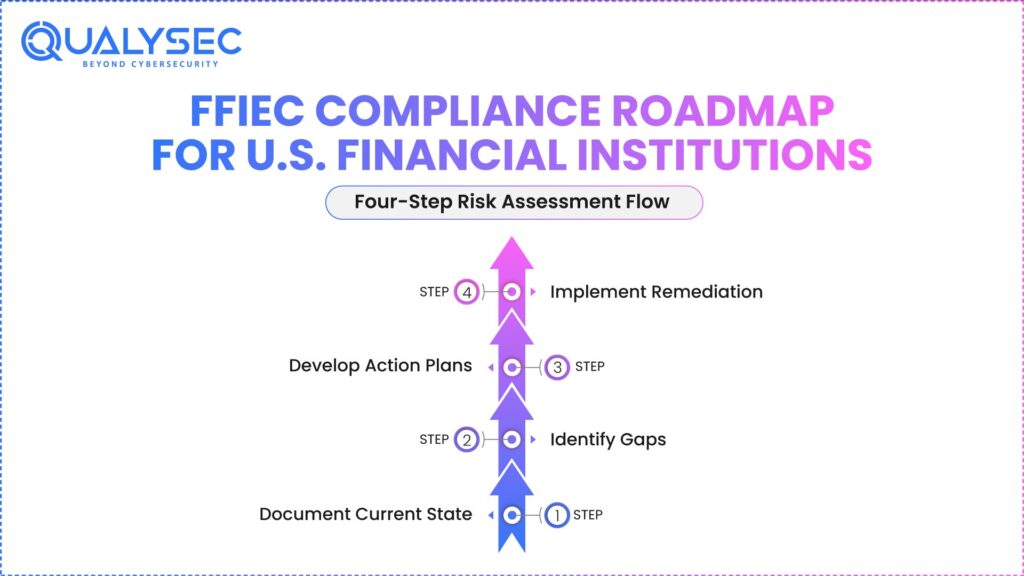
It will take a systematic approach to conduct an efficient FFIEC risk assessment. Furthermore, the organizations are expected to adhere to the set procedures that entail extensive assessment. Thus, the gap assessment methodology will be presented in the following steps:
Step 1: Document Current State
The initial one is the recording of the current cybersecurity posture of the financial institution. Organizations are able to use the FFIEC Cybersecurity Assessment Tool and other InfoBases. Moreover, they are able to develop templates of controls and processes, which are outlined in the FFIEC compliance requirements, using these resources.
Step 2: Identify Gaps
Then, the institutions perform the analyses of their present cybersecurity level. As a result, the comparison of the organizational processes to the required FFIEC cybersecurity guidelines prevents any gaps in compliance. Notably, the third-party vendors offering services to the institution should be included in the assessment.
Step 3: Develop Action Plans
After gap analysis, the organizations develop action plans in order to rectify the observed problems. Besides, businesses should pursue systematic steps to mitigate cybersecurity process failures. Thus, the use of such frameworks as NIST can be used to develop the required organization of this stage.
Step 4: Implement Remediation
Lastly, the institutions put action plans into practice, developed in earlier stages. The management will have to be at the forefront in spearheading these efforts. Moreover, the continuous assessment of cybersecurity is the procedure that guarantees continued improvement. As a result, a cybersecurity culture ensures that organizations and customers are not compromised.
Talk with Qualysec experts to get your FFIEC risk and cybersecurity posture assessed today.
What Are FFIEC Penetration Testing Guidelines and Requirements?
The FFIEC penetration testing guidelines form a significant part of an overall evaluation of security. Moreover, the guidelines allow financial institutions to recognize their vulnerabilities in advance before they are exploited by malicious actors.
Understanding Penetration Testing Under FFIEC
Although the FFIEC penetration testing guidelines do not specifically require penetration testing as an independent requirement, they provide a heavy emphasis on the frequency of security testing. Besides, the Information Security booklet addresses the need for independent security testing. Thus, a significant number of financial institutions include penetration testing as the usual element of their overall security programs.
FFIEC compliance requirements specify that organizations must:
- Conduct regular vulnerability assessments
- Perform independent security reviews
- Test incident response procedures
- Evaluate third-party vendor security
Moreover, the institutions can test the security controls effectively by means of penetration testing services. The weaknesses of systems, applications, and network infrastructure are therefore known through these tests.
Learn more about why ongoing testing matters — Automated Compliance Tools Vs Penetration Testing
Key Testing Areas
Financial institution cybersecurity standards require testing across multiple domains:
| Testing Domain | Purpose | Frequency |
| Network Infrastructure | Identify network vulnerabilities and misconfigurations | Quarterly |
| Web Applications | Test for OWASP Top 10 vulnerabilities | Annually |
| Social Engineering | Assess employee security awareness | Semi-annually |
| Wireless Networks | Evaluate wireless security controls | Quarterly |
| Physical Security | Test physical access controls | Annually |
| Cloud Environments | Assess cloud configuration and security | Quarterly |
In addition, penetration testing is expected to be structured. As such, the tests normally involve reconnaissance, identification of vulnerabilities, exploitation testing, and detailed reporting. Further, results should be recorded and remediation suggestions taken.
Why is Qualysec the Best Partner for FFIEC Compliance in the USA?
Financial institutions can have a difficult time navigating FFIEC requirements. As such, it is important to collaborate with knowledgeable cybersecurity specialists in order to ensure end-to-end compliance.
Qualysec is the best cybersecurity partner for financial institutions, aiming at compliance with FFIEC in the United States. Additionally, Qualysec offers a wide range of experience in cybersecurity requirements of financial institutions and FFIEC risk assessment processes. Their holistic style has seen organizations comply with all regulatory measures, as well as improve their overall security posture.
Why Choose Qualysec?
- Specialized FFIEC Expertise: The employees of Qualysec have extensive knowledge of FFIEC cybersecurity guidelines, requirements and rules. Moreover, they have been able to support many financial institutions to attain and remain compliant.
- Comprehensive Assessment Services: Qualysec provides an end-to-end FFIEC risk assessment services, which reveal the areas of gaps in the entire 11 IT booklet sections. As well, their tests are based on the FFIEC Cybersecurity Assessment Tool framework, which provides a comprehensive measurement of the inherent risk and maturity levels.
- Advanced Penetration Testing: In line with FFIEC penetration testing requirements, Qualysec performs advanced security testing. In addition, their penetration testing services encompass network infrastructure, web applications, mobile platforms, as well as cloud environments. As a result, organizations get practical information on how to enhance defenses.
- Ongoing Support and Monitoring: FFIEC conformity is not a one-process endeavor. Qualysec, therefore, offers ongoing tracking, periodic re-evaluation and strategic direction. Also, their team is informed about the changes in threats and regulations.
- Customized Remediation Plans: Qualysec establishes specific remediation plans that are based on the organizational priorities and available resources. In addition, they offer support on implementation in order to provide effective resolution of identified weak areas.
- Location: Qualysec is located in the USA, so the company is aware of the regulatory environment and the particular challenges that financial institutions in the USA have to deal with. In addition, they are close enough to provide responsive support and on-site services whenever necessary.
Services Offered:
- Comprehensive FFIEC gap assessments
- Vulnerability testing and penetration testing.
- Review and development of security policy.
- Incident response training and testing.
- Security testing of third-party vendors.
- Training on security awareness.
Organizations seeking FFIEC compliance excellence should discuss with Qualysec now. Furthermore, their professional staff can examine your existing security position and construct detailed compliance road maps. Besides, the best practices of Qualysec have assisted innumerable organizations to gain regulatory consolidation and a general increase in cybersecurity resilience.
Book a Free Consultation with Qualysec to discover how their specialized services can transform your FFIEC compliance journey. In addition, take their free initial assessment so that you can know the compliance gaps and priorities of your organization.
Chat with our intelligent AI Assistant and get tailored insights in seconds.
Conclusion
FFIEC compliance is not just a regulatory requirement of the U.S. financial institutions. Furthermore, it offers an elaborate blueprint for developing strong cybersecurity initiatives. In this paper, we have examined key elements in FFIEC compliance requirements, such as assessment tools, IT booklets, and risk assessment methodologies. Also, we discussed guidelines on FFIEC penetration testing and how this applies in the reconciliation of security controls.
Financial institutions should understand that FFIEC cybersecurity guidelines are excellent models of how sensitive data can be secured, as well as the resilience of operations. Also, the adoption of these financial institution cybersecurity standards enhances protection against the constantly changing cyber threats. Thus, the organizations must not think of compliance as a regulatory liability, but as a long-term security investment.
The full FFIEC compliance is a matter of complete dedication, professional instruction and organization. Therefore, collaborating with qualified providers, such as Qualysec, will help institutions to navigate complicated requirements.
Start your FFIEC compliance journey today with Qualysec’s expert guidance. Explore our Compliance Services to assess, remediate, and strengthen your organization’s cybersecurity posture.
FAQ
1. What is FFIEC compliance, and who needs to follow it?
FFIEC compliance means adherence to technology standards and cybersecurity and protection regulations that the Federal Financial Institutions Examination Council provides. These requirements must be adhered to by federally regulated financial institutions, such as state-chartered banks, bank holding companies, thrift holding companies, and foreign banking organizations, which could be operating in the United States..
2. What are the key components of the FFIEC Cybersecurity Assessment Tool?
The FFIEC Cybersecurity Assessment Tool scores inherent risk profiles using five categories and cybersecurity maturity using five domains. It also assists financial institutions in the calculation of whether their security levels of maturity are adequate in accordance to the risk profile that they have calculated.
3. How does FFIEC compliance help banks and credit unions improve security?
FFIEC compliance offers a thorough structure in terms of audit, business continuity, information security, and operations management. Furthermore, adherence to FFIEC cybersecurity guidelines assists the institutions in detecting the gaps, introducing sophisticated controls, and creating incident response teams that mitigate the dynamic cyber threats.
4. Is penetration testing mandatory under FFIEC guidelines?
Although penetration testing requirements are not clearly defined in FFIEC penetration testing guidelines, the guidelines highly emphasise frequent independent security checks. Thus, penetration testing is a part of the overall FFIEC compliance programs of most financial institutions to ensure the effectiveness of security controls testing.



















































































































































0 Comments