







By 2025, software companies will have streamlined code deployment more than ever, and more businesses throughout the globe are deploying open-source libraries, cloud-native applications, and remote development teams. This has, without a doubt, accelerated attacks on the exposed vulnerabilities. That explains why a software security audit has become utterly indispensable.
A security audit is not merely a report of an automated scanning tool. It is much more than that – evaluating the code, runtime behavior, and more. If done right, it provides actionable insight to reduce risk, improve resilience, and build customer trust.
In this guide, we delve into the details of a software security audit. We explain its importance, the process, the tools used, and the best practices that make audits effective.
What is a Software Security Audit?
A software security audit is a structured review of an application’s codebase, dependencies, and supporting configurations. It aids in determining the security vulnerabilities before exploitation.
A software system audit can be viewed in the following ways:
- Where are the vulnerabilities in our code and components?
- How do these weaknesses impact compliance, risk, and resilience?
At Qualysec, we combine automated scanning with expert manual validation. That way, businesses get an evidence-based assessment.
Book Your Software Security Audit With Qualysec Today.
Why is a Software Security Audit Important?
In today’s world, a software security audit is not merely something to be checked off a list.
Here are the reasons why choosing a software system audit is important:
- Active Risk Mitigation: SQL injection, flawed deserialization, or an exposed API are considered typical vulnerabilities that are exploited within days of publication of the knowledge. A properly designed audit proactively seeks out these vulnerabilities to exploit before the attackers can discover them.
- Regulatory and Compliance Requirements: Businesses in the United States are increasingly being put under the spotlight. No matter what the recognized frameworks are (HIPAA with healthcare data, PCI DSS with payment systems, or SOC 2 with SaaS systems), software security audits will help in demonstrating data security compliance with such standards.
- Customer Confidence: Just one violation can affect the reputation, lose customers, and trigger substantial economic losses. Customers and investors can be assured that security is a top priority when the company demonstrates that it undertakes security audit software on a regular basis.
- Operational Efficiency: Audits permit IT and development teams to direct their efforts towards resolving critical issues, thereby eliminating the fixing of low-priority issues.
Different Types of Software Security Audits
There are different types of software security audits. Not all of them are the same. Depending on the needs of the organizations, these software system audits are performed.
1. SAST and Manual Review Code Audits
- Exploits source code of vulnerable functions, unsafe logic, and frequent flaws (e.g., SQL injection, buffer overflows).
- Combines automated and human inspection of the static analysis.
2. Code and Dependency Reviews (SCA / SBOM)
- Looking into third-party libraries and packages.
- Distinguishes common vulnerabilities (CVEs), licensing issues, and components that are out-of-date.
- Generates an SBOM that is becoming a requirement in the U.S. with federal guidance.
3. Configuration and Infrastructure Audits
- Review of Infra as Code (IaC) and CI/CD pipelines.
- Identifies incorrect configurations, default passwords, open ports, or insecure TLS configurations.
4. Dynamic Audits (DAST and Fuzzing)
- Test applications that are already running to find runtime vulnerabilities like broken authentication, insecure session management, or memory corruption vulnerabilities.
- Fuzzing has shown great promise in finding exploitable input handling bugs as well as surprising crashes.
5. Compliance Audits
- Aligns software with particular regulatory or industry requirements.
- States whether it has a control in place to satisfy the requirements of either SOC 2, HIPAA, PCI DSS, or ISO 27001.
Common Risks and Gaps Identified in Software Security Audits
A good security audit software is more than running scans. It brings out weaknesses and areas with gaps that must be corrected immediately.
- Unsafe Coding Activity: Hard-coded credentials, invalid input validation, unsafe deserialization, and parameter checks are some of the most common audit findings.
- Configuration Mistakes: Cloud storage buckets left public, default credentials in containers, or open management ports are common audit discoveries.
- Gaps in Compliance Mapping: Even though technical risk is mitigated, audits have revealed documentation and process evidence gaps, which are a challenge to pass a SOC 2 or HIPAA audit.
- Lack of logging and monitoring: Most of the teams do not have proper logging of security events or have centralized it into SIEM tools, which makes it hard to detect the attack early.
Read also: recent article on cybersecurity risk assessments.
Software Security Audits: How to Proceed
An audit of security software has a firm structure to adhere to. This is a stepwise procedure:
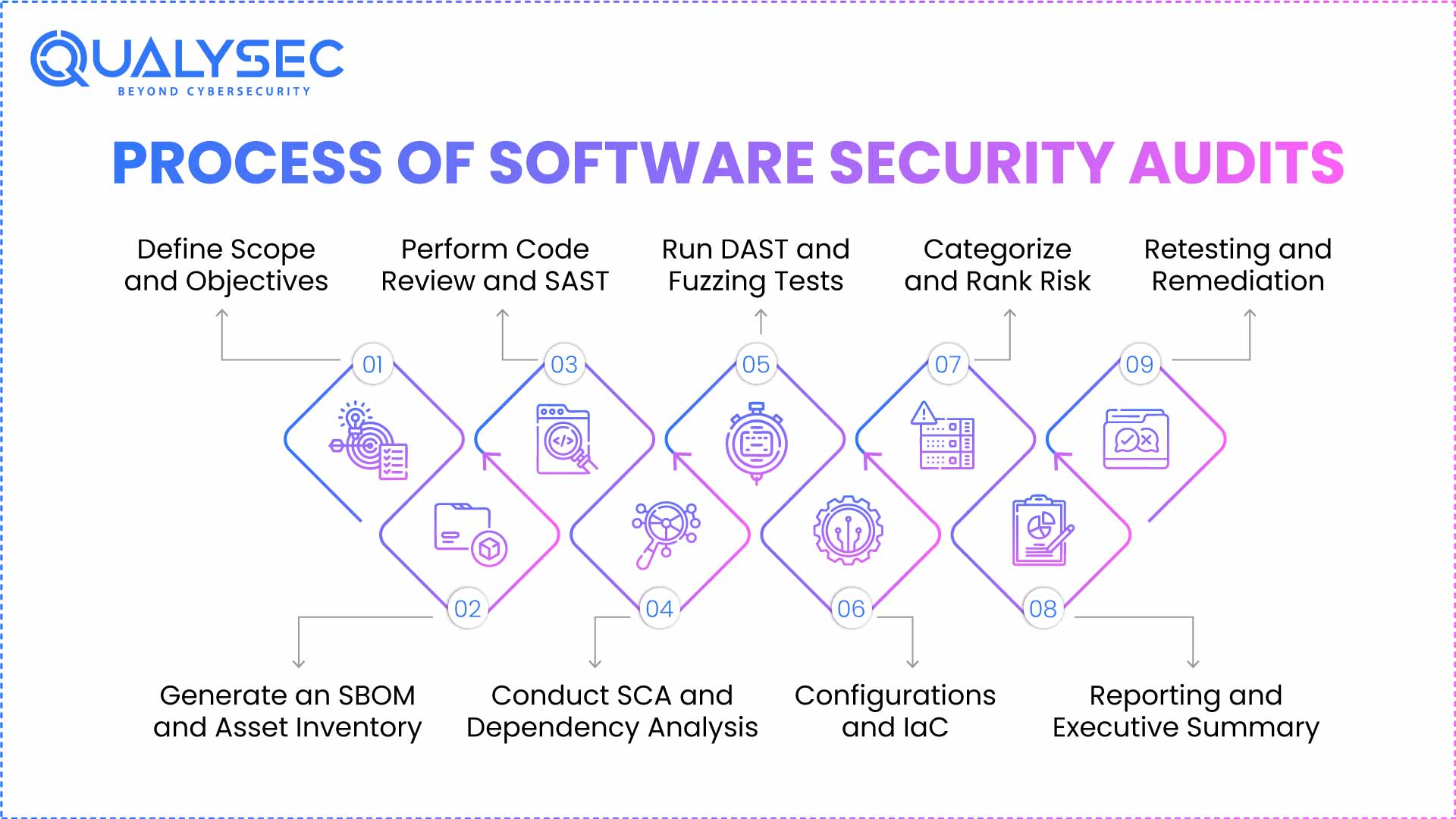
1. Define Scope and Objectives
- Identify systems, application(s), and compliance requirements (e.g., SOC 2, HIPAA, PCI DSS).
- Decide whether the audit covers only code or includes dependencies, cloud configs, and runtime behavior.
2. Generate an SBOM and Asset Inventory
- Build a Software Bill of Materials (SBOM) to map all third-party libraries and open-source dependencies.
- Classify assets by criticality and exposure.
3. Perform Code Review and SAST
- Use automated static analysis tools to flag insecure patterns.
- Manually validate findings for logic flaws that scanners may miss.
4. Conduct SCA and Dependency Analysis
- Cross-check libraries against CVE databases.
- Flag outdated or unlicensed components.
5. Run DAST and Fuzzing Tests
- Evaluate applications in a running state.
- Find runtime issues like a broken access control or injection, or misconfiguration..
6. Configurations and IaC
- Scan CI/CD pipelines, container images, and Infrastructure as Code to find security gaps.
- Make sure there is password management, enforcement of TLS, and following least-privilege principles
7. Categorize and Rank Risk
- Use CVSS scores and business impact to prioritize the vulnerability ranking.
- Remediation focuses on areas that have the potential to do maximum damage.
8. Reporting and Executive Summary
- Deliver two types of reporting:
- Executive Summary (compliance mapping, risk posture, and recommended action).
- Technical Summary (Full details of the vulnerable codes, proof of concept, mitigation advice).
9. Retesting and Remediation
- Have concrete steps for patching or reconfiguration.
- Re-test following fixes to be sure that it is closed and to make sure that no issue reoccurs.
Explore: What is Software penetration testing and how it helps to identify vulnerabilities in your applications and systems.
Common Software Security Audit Tools
Software security audits make use of both automated and manual procedures. The list below includes the names of different types of tools typically part of the software security audit process.
1. Static Application Security Testing (SAST)
- Scan source code or binaries to identify insecure patterns.
- Examples: SQL injection, XSS, and buffer overflow detection tools.
- Most helpful at the beginning of development.
2. Software Composition Analysis (SCA)
- Find open-source components and check against CVE and mitigate license risk.
- Delivers a Software Bill of Materials (SBOM) to assist with compliance and supply chain security.
3. Dynamic Application Security Testing (DAST)
- Test applications that are running against some of these vulnerabilities, including broken authentication, session management, or injection flaws.
- Couples SAST with validating vulnerability exploits in the wild.
Software Security Audits: Best Practices
Simply conducting a security audit software is not enough. Knowing how to keep the software secure is much more important.
Take a look at these best practices that will definitely help you maximize the effectiveness of the audit security software –
- Automation with Validation: Automation is scalable; however, it reports a lot of false positives. Automated scans should always be paired with manual code review & expert validation to ensure that results are both valid and remediated.
- Map Findings to Standards: Map it against frameworks such as NIST SSDF, OWASP ASVS, and compliance requirements (SOC 2, PCI DSS, HIPAA). This assists engineers as well as gives reassurance to auditors and executives that risks are being managed in a formal way.
- Prioritize Based on Risk: Don’t treat all vulnerabilities equally. Use CVSS scoring plus business context to prioritize remediation. Fix what attackers would target first, then move to other issues.
- Train Developers and Engineers: Audits shouldn’t only be about identifying flaws. They should inform developers. Use audit findings as teaching moments to upskill teams on secure coding and prevent repeat issues.
Request a Free Consultation Now!
Conclusion
Software security audits are no longer optional. The ever-increasing high-risk environment has made these audits a business necessity. By combining automated tools with manual expertise, audits help identify vulnerabilities in code, dependencies, and configurations.
At Qualysec, we opt for a hybrid approach when it comes to audits. Our experts are highly skilled in assessing the software, finding the gaps, and preparing a detailed report for the same. Till now, we have completed more than 600 assessments, serving 200+ clients in more than 21 countries.
If you are looking for a reliable software security audit partner, Qualysec is an ideal option.
Secure Your Software Against Cyber Attacks With Qualysec.

FAQs
Q: What are the key steps involved in a comprehensive software security audit?
The key steps involved in a detailed software security audit include –
- Defining the objectives of the audit
- Collecting data and inventory assets
- Technical analysis
- Finding the gaps
- A clear and detailed report
- Resolving the issues and creating a remediation plan
Q: Which tools are most effective for identifying software vulnerabilities?
Automated scanners such as Qualys, Burp Suite, OpenVAS, etc., are highly popular for identifying software vulnerabilities. On the other hand, manual testing methods like source code review and pen testing are absolutely essential.
Q: How can organizations implement audit recommendations to strengthen security?
Organizations can implement the audit recommendations by firstly understanding the priority of the risks. The gaps should be resolved based on their impact on the business. Then the next step is to create a remediation roadmap for the future.

























































































































0 Comments