






The concept of Ethical Hacking Penetration Testing is also no longer an option to modern enterprises but rather a core defense mechanism. The global cost of cybercrime will reach an ambitious 10.5 trillion dollars yearly by the year 2025, with updates showing that it may have reached 15.63 trillion dollars by the year 2029, with the latter being attributed to the rapidity of the digital transformation. Ransomware, phishing, and AI-enhanced cyberattacks have experienced rapid growth, with 72 percent of entities reporting that the risk of a cyberattack has increased over the last year alone. On a parallel note, the need for firm and reliable protection has skyrocketed: the ethical hacking certifications market has been valued at $2.9 billion in 2033, whereas penetration testing has been projected to reach over $7.36 billion in the year 2034, at a CAGR of 14.4%.
Changing sector-wide, the capacity to take a proactive approach to identifying and patching vulnerabilities is becoming seen as a survival requirement. With regulated landscapes (GDPR, PCI DSS, ISO 27001) as well as sensitive digital environments requiring continuous verification and validation, ethical hacking and penetration testing are in demand.
Ready to secure your business with verified testing? Connect with Qualysec Technologies for a consultation.
Brief of Ethical Hacking and Penetration Testing
Ethical Hacking Penetration Testing is an amalgamation of two key protective cyber activities: simulating cyberattacks in order to discover security gaps, and painstakingly examining systems to rectify protection against any conceivable scenarios. They are both important, yet they play somewhat different roles based on the overall defense strategy of modern organizations, as they form one complete and proactive picture.
Why Are These Important Today?
- Cyber attacks are more advanced – 2025 has witnessed an increase in the magnitude as well as sophistication of attacks, more so those that utilize AI and automation.
- Sectors vulnerable to attack – Healthcare, finance, and energy are easy targets because they have connected systems and depend on legacy systems.
- Regulatory requirement – The regulatory requirements enforce periodic penetration testing and risk assessment to ameliorate the regulatory and reputation risk.
- Organizational interest – 72 percent of business leaders worry about future cyber threats, especially as the attack surface increases as a result of the spread of remote or hybrid work.
What is Ethical Hacking?
Ethical hacking is the sanctioned act of circumventing a system’s security with the aim of revealing a possible data breach or exploit within a network. By imitating the tactics, techniques, and procedures of cybercriminals (but having their express permission to do so), ethical hackers can help an organization remediate the identified weaknesses before hackers can take advantage of them.
Types of Ethical Hackers
- Red Teams – Externals who specialize in high-level level of sophisticated attack simulations.
- In-house Security Teams – Employees who are specialized in daily security and close-down analyses.
- Bug Bounty Hunters – The Downside it is down to crowd-sourced experts to identify and report vulnerabilities to earn rewards.
Their responsibilities run the gamut of application inspection, infrastructure security evaluations and testing, and systems security assessment, all the way to complicated, advanced threat simulation functions.
What is Penetration Testing?
Penetration testing (pen testing) is a careful evaluation where competent experts engage in activities that are analogous to the real-world attacks by hackers on the online infrastructure of a company, namely web applications, networks, apps, and IoT, to gain a perspective on the gaps and modify them before those gaps are exploited by adversaries.
Types of Penetration Tests
- Black-Box Testing – The testing is like an external attack position in that the tester has no knowledge about the system.
- White-Box Testing – The testing is done with complete information about the system, and therefore, due to the thorough knowledge, testing in detail is possible.
- Grey-Box Testing – It is a combination of both methodologies where the tester possesses some knowledge but certainly not the whole picture, which portrays an insider threat or partially informed attacker.
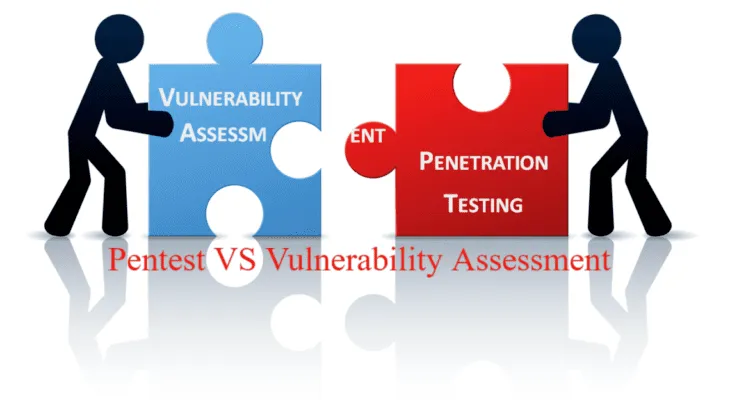
Ethical Hacking vs Penetration Testing: Key Differences
Ethical Hacking Penetration Testing incorporates both the imaginative, broad-scale, and the detail-oriented, process-driven requirements combination necessary in a cyber world as deep and encompassing as in 2025.
Advantages of Ethical Hacking and Penetration Testing
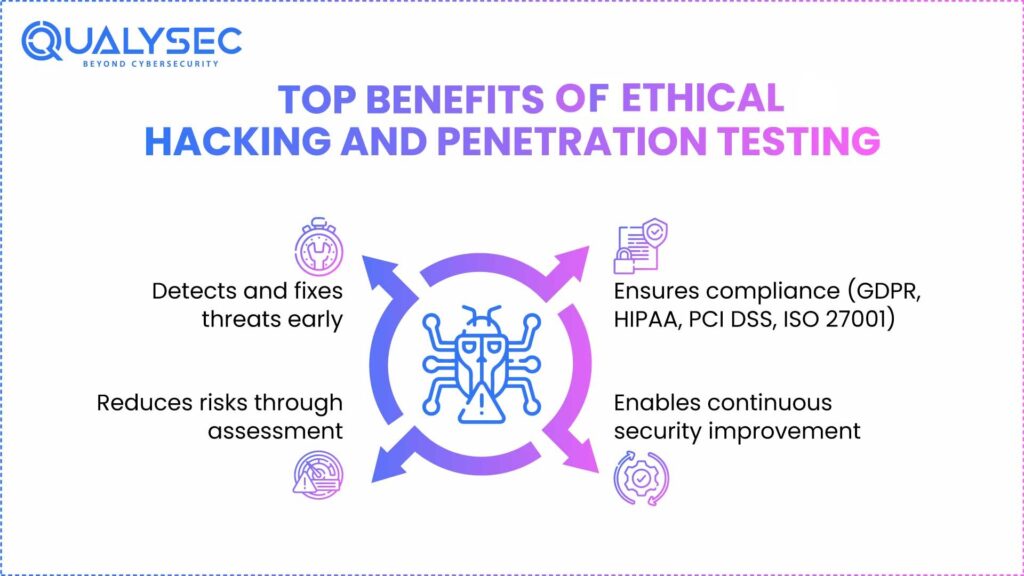
- Active Threat Detection – Ensures that the hackers cannot make use of the weak sections and identify and attack those weak areas before the hackers.
- Risk Assessment and Reduction – Measures exposure and offers practical guidance to reduce company risk.
- Compliance Requirement – Adheres to the regulatory scope to do regular testing and offer security (GDPR, HIPAA, PCI DSS, ISO 27001).
- Continuous Improvement – Supports the enhancement of a security position using a series of tests and adaptive threat modeling.
Detailed Phases of Penetration Testing
1. Reconnaissance
Passive – OSINT and social media collection of publicly available information.
Active – Interacting with targets directly (scanning ports, probing for open services).
2. Scanning & Enumeration
Tracking the search of live systems, open ports, services, and vulnerabilities using nmap, Nessus, or any custom script.
3. Exploitation
Trying to compromise systems with identified vulnerabilities, to imitate actual attack methods.
4. Post-Exploitation & Reporting
Determining the effect of successful attacks, escalating privileges, and creating full details of a report with findings, evidence, and steps of remediation.
Get your free sample security report now!
Best Practices in Penetration Testing
- Scoping and Rules of Engagement – Set clear parameters, parameters, and safety words with stakeholders before testing.
- Choosing Experienced Testers – Testers must be proficient, credentialed, and knowledgeable of modern threats and frameworks.
- Continuous Testing – It is necessary to migrate beyond annual/periodic evaluations to implement continuous or even rolling check examinations, especially due to the critical and fast changes of the cloud and application environments.
- Comprehensive Reporting – Report findings in a manner that is detailed, actionable, and can be used to target remediation, and processes need to be in place to retest and validate.
How Qualysec Technologies Helps
About
Qualysec Technologies provides reliable Ethical Hacking Penetration Testing services through a unique combination of deep, exhaustive manual testing and low-level automated tools.
Services
Specializes in web, mobile, cloud, API, IoT, AI/ML penetration testing, vulnerability assessments, compliance, and security consultancy for sectors such as fintech, healthcare, retail, government, and e-commerce.
Qualysec’s Unique Value
What truly separates Qualysec is our verified, process-based testing methodology – unlike generic approaches, our process ensures comprehensive threat coverage using a blend of manual expertise and automated technologies.
- An Industry-Recognized Testing Methodology – All engagements follow a repeatable process, including scoping, planning, execution, deep-dive exploitation, and detailed reporting to industry standards such as OWASP and NIST.
- Manual-Directed, Automated-Supported – We do not only run automated scans. Our cybersecurity specialists thoroughly examine all the layers, identifying obscured vulnerabilities that are overlooked by run-of-the-mill scanners.
- Regulatory and Compliance Focused – Tests are aligned with important regulations (GDPR, PCI-DSS, HIPAA, ISO 27001) to provide not only vulnerabilities, but also addressable-to-regulation reports.
- Complete, Practical Reports – Reports are concise yet elaborate, with risk ratings, evidence, and step-by-step recommendations aimed both at executive audiences as well as technical teams.
- Continuous Consulting and Periodic Retesting – Clients will maintain close contact with our expert consultants to receive ongoing assistance and periodic retesting, as necessary, to ensure the remediation has been successful and to maintain an effective defense posture.
- Global Track Record – Successfully secured over 450 assets with zero data breaches for clients in 18+ countries—testament to reliability and expertise.
- Client-Centric Process – Transparent communication, collaboration throughout each project, and adaptation to evolving threats.
Qualysec’s focus on verified, process-based testing means your organization receives the highest assurance of real-world security. Our comprehensive penetration testing and ethical hacking services fortify your business, address compliance, and protect customer trust.
Take the next step: Book a free security consultation with Qualysec Technologies and discover the difference process-driven, verified penetration testing can make.

Conclusion
Ethical Hacking Penetration Testing is of utmost importance in the digital space in 2025. It is an important defense mechanism against the emerging threats of AI-powered malware, advanced malware, and cyberattacks, and increasingly complex compliance requirements. Regardless of whether you operate a startup, a large corporation, or a regulated industry, all-inclusive, process-based penetration testing and ethical hacking will offer your best protection.
Want to know more about ethical hacking vs penetration testing for your business? Find out more by contacting Qualysec Technologies today and receive a thorough security evaluation, and see how validated, procedures-based penetration testing will help protect your business in the future.
FAQs
Q. How often should penetration testing be done?
Penetration tests must be conducted at least once a year, or as any significant changes are made to the IT environment (such as software launches, major software upgrades, or architecture improvements). The protection from continuous and rolling assessments is, however, most effective in the modern, fast-evolving digital world.
Q. Is ethical hacking legal?
Ethical hacking is legal as long as it is carried out with the legitimate permission of the asset’s owner. It is imperative that testing be well documented, and testers must follow a mapped-out scope and rules of engagement.
Q. What industries need pen testing the most?
Industries that engage in sensitive data will be most prone to it. Thus, to be on the safer side, regular penetration testing and ethical hacking should be done.
Q. How does Qualysec differ from other pen testing providers?
Qualysec employs its proprietary, proven process-driven approach that combines both hands-on testing techniques of knowledgeable professionals and intelligent automated technology. This allows for a more comprehensive, in-depth security audit, with comprehensive, ready-to-comply reporting, proactive support, and unprecedented visibility and foundational accuracy. In addition to retesting, continuous improvement, and proactive threat defense, Qualysec also focuses on some services not offered on the market.




















































































0 Comments