








Digital systems today are continuously under threat from new risks, errors in setup and changing attack patterns. Even though firewalls and scanners work well, they may not find all the risks, mainly when cases are specific or not very clear.
That’s where penetration testing comes into play. It is an active security check that tries to identify how a true attacker could take advantage of flaws in your applications, online networks or infrastructure.
Yet, the real benefit of a penetration test is connected to how it is carried out. An organized approach helps you learn more, achieve the same results and take useful steps forward. It also matches what regulators expect and helps secure the business in the long run.
We walk you through the complete penetration testing process from start to finish. The entire process, starting with scoping and ending with a report, is designed to uncover and prove that vulnerabilities exist within the system following sound methodology.
What Is the Penetration Testing Process?
Penetration testing is a method of testing a system by analyzing it as if it is being attacked just as it might be in the real world. General issues are usually flagged by scanners, but a real penetration test is done by ethical hackers to find out how authenticated exploitation works and how far a malicious attacker might get.
The process is carried out in a wide variety of environments:
- Online tools that allow people to manage money, manage businesses and make online purchases
- Applications for mobile users that let you log in with biometrics and work without the internet
- Services and applications made accessible by APIs using REST, GraphQL or gRPC
- Cloud networks created and run on AWS, Azure and GCP
- Internal networks, external networks and networks including AD, RDP, VPNs and segmentation
- From health devices to home automation, IoT and embedded systems are involved.
- CI/CD pipelines and DevOps systems are often misconfigured or under-secured.
Whereas scanning programs depend on computers, this step uses experienced experts who test, think like ethical hackers and assess if the flaw will cause problems.
Explore all advanced penetration testing services here →
Why a Structured Process Matters
A proper process is necessary for penetration testing to work and be safe. Using structures means you are sure to keep on track.
- Nothing major is left unnoticed
- All identified problems are confirmed to be exploitable.
- The results of the tests show how attackers usually work in the real world.
- All data are reported in a manner that is clear and replicable.
- Focus on impact that helps to decide how to arrange priority risks, not just on what theory might say.
This helps teams make informed remediation decisions and provides auditors with concrete evidence of security diligence.
Looking to secure your systems with expert-led, compliance-ready testing? Get a Free Consultation from Qualysec.

Step-by-Step Penetration Testing Process
The success of a penetration test is built on a routinely followed, complete methodology. Every stage is created to closely match actual attacks, locate issues and resolve them in order of importance and ease of exploitation.
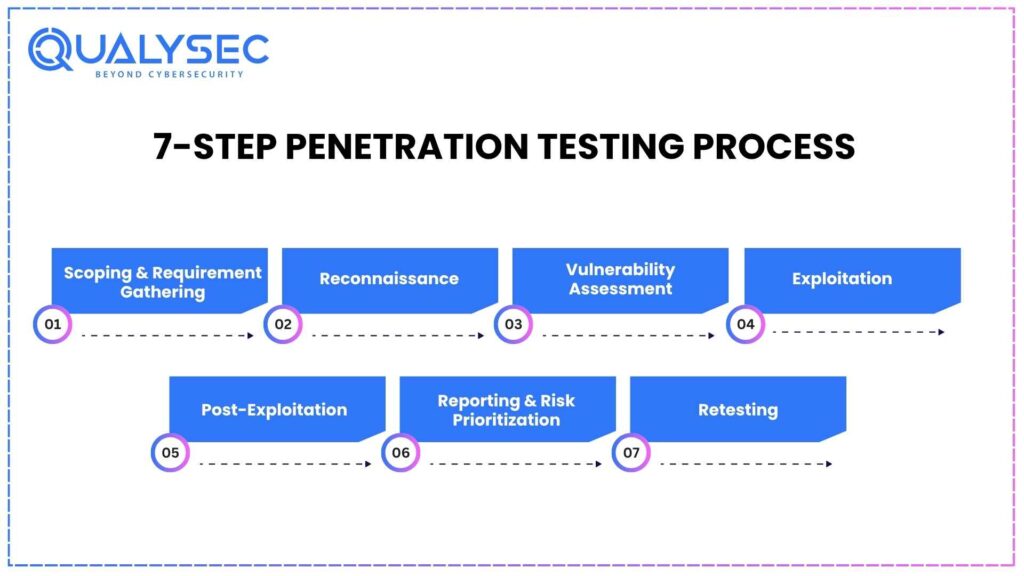
1. Studying requirements and designing the scope for the project
During this phase, it is determined which assets will be tested, what the business background is and what specific security or compliance goals are considered. This includes:
- Recording all applications, networks or systems that fall into scope
- There must be agreement with the business about complying with requirements (for instance, handling consumer data securely such as PCI DSS or ISO 27001)
- Defining the various data classification levels as well as the limits of the tests
Choosing what is to be tested:
- Black-box: Has behavior similar to a guest who doesn’t have access to the source code
- Grey-box: Acts as if an insider is carrying out an attack with some insider knowledge
- With a white-box model, everything about the system can be easily explored.
Part of scoping is to review the current security policies, diagrams of the network and what assets are in place. It makes sure everything from law, operations and technology is understood before testing.
Tools used: Threat modeling frameworks, architecture documentation, scoping templates
You might like to explore: Top Penetration Testing Methodologies & Standards in Cyber Security.
2. Reconnaissance
The attack surface is created by the tester gathering technical information. Passive methods simply gather data without their target knowing, but active methods actually check for live services and any issues.
Some of the top reconnaissance actions are:
- DNS and subdomain discovery
- Attempts to scan the target and find its services
- Technology detection
- Metadata and credential spills checks
Tools used: Amass, Subfinder, Nmap, Shodan, HTTPx, theHarvester
3. Vulnerability Assessment
When assets are finished being mapped, vulnerability scanning and an in-person search is carried out to identify known weak spots, insecure settings and unreliable elements. Unlike simple scanners, manual testing helps uncover situations in which an attacker could take advantage of flaws.
Focus areas:
- Old software and vulnerable ways of connecting
- Mistakes in how access controls are set up
- Problems with cross-checking user information
- The presence of low authentication and session management
Tools used: Nuclei, Nessus, Nikto, OWASP ZAP, Burp Suite Scanner, custom scripts
4. Exploitation
At this point, the tester proves the real risks of vulnerabilities with examples. All attempts to exploit the system happen under careful surveillance to ensure no problems happen.
Almost everyone attempts some of these common acts:
- Trying to use systems or databases that are not authorized for me
- Ability to gain greater rights than intended.
- The injection of code that can then be executed remotely
- Ability to move within network areas
Tools used: Metasploit, SQLmap, Burp Suite Intruder, Responder, CrackMapExec, Hydra
5. Post-Exploitation Analysis
When access is first made, testers determine the degree of compromise. Among this, analysts identify data that could be lost or exploited, assess the value of particular pivot points and evaluate the amount of time it would take for an attacker to be detected.
The activities carried out might involve:
- Using stolen and reused credentials
- Listing issues related to internal shared files and Active Directory settings
- Ensuring that persistence exists
- Simulating how data is taken outside an organization
Tools used: BloodHound, Mimikatz, PowerView, LinPEAS, Empire
6. Reporting and Risk Prioritization
All the findings are summarized and made available in a structured document with both technical and executive summaries. All vulnerabilities contain descriptions, proof of concept examples, effects analysis and proposed correction steps.
Reporting further contains:
- CVSS and other models for rating risks
- Relate the findings to industry best practices such as OWASP Top 10 and MITRE ATT&CK
- What needs to be done next and steps for installing updates
Tools used: Dradis, Serpico, Faraday, CVSS calculators
Want to see what a real pentest report looks like? Download Sample VAPT Report →































































































































































































































































































































































































0 Comments