







Cyber security companies in California are operating in a market that sees more cybercrime complaints than any other US state. The FBI’s latest IC3 data showed Californians reported more than $2.5 billion in losses tied to phishing, extortion, cryptocurrency scams, and related attacks. Across the US, reported cybercrime losses reached nearly $20.9 billion in 2025.
Much of California’s vulnerability stems from business density. The state has a massive number of SaaS companies, fintech firms, healthcare networks, ecommerce platforms, and defense contractors operating in the same environment. Attack surface grows fast in systems like that. So does third-party risk.
This article covers 10 cyber security companies in California, compared across core services, certifications, industry fit, and documented limitations. The intent is to give executives and security leads enough factual ground to narrow down their options, not to declare winners.
Why California Businesses Are Prime Cyberattack Targets in 2026
California’s cybersecurity pressure is no longer limited to large tech companies. Mid-market healthcare groups, ecommerce brands, logistics providers, and even regional manufacturers are dealing with increasingly aggressive attack activity tied to phishing, credential theft, vendor compromise, and ransomware operations. The state’s business density creates unusually large third-party exposure chains, especially in cloud-heavy environments.
Regulatory pressure increased as well after California’s CCPA cybersecurity audit regulations formally took effect on January 1, 2026. Businesses meeting the threshold requirements are now expected to complete annual independent cybersecurity audits reviewing whether security controls are operating effectively and whether consumer data protections are considered reasonable under the law.
The requirement applies strictly to data volume rather than company revenue brackets. Under California regulations, any business must undergo an annual independent audit if it meets either of the following conditions: processing the personal information of more than 250,000 California consumers, or processing the sensitive personal information of more than 50,000 consumers.
What complicates things for internal security teams is timing. The audit requirement may sound distant on paper, but the actual review period for larger organizations begins earlier. Security assessments, remediation cycles, documentation reviews, asset inventory validation, and third-party testing generally happen months before any certification gets filed.
State enforcement has already shown that financial penalties are not theoretical. California announced a $2.75 million settlement involving Disney and a separate $1.55 million settlement tied to Healthline over alleged CCPA violations and data handling practices.
What to Look for in a Cybersecurity Company in California
CCPA and Compliance Experience
California businesses are now under tighter cybersecurity scrutiny because of the state’s newer CCPA audit rules. That changes the selection process. A vendor handling healthcare data should already know HIPAA requirements. Payment environments usually bring PCI DSS into the conversation. SaaS companies tend to care more about SOC 2 readiness and evidence collection.
Certifications
A few certifications tend to matter more during vendor reviews:
- CREST for penetration testing
- ISO 27001 for security management practices
- SOC 2 Type II for operational controls over time
- CISSP or OSCP for technical staff involved in assessments
No certification guarantees good work, though. Some firms collect badges and still deliver weak reporting.
Security Services and Cost
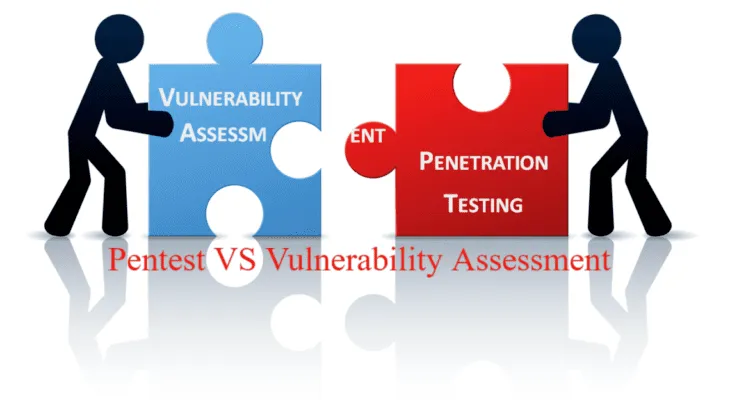
Penetration testing and managed security are not the same thing. One is a scoped assessment. The other is ongoing monitoring and response.
IBM’s 2025 breach research estimated the average time to identify and contain a breach at 241 days globally.
Most penetration testing projects land somewhere between $5,000 and $50,000, depending on scope. Managed services are usually billed monthly.
Top 10 Cyber Security Companies in California (2026)
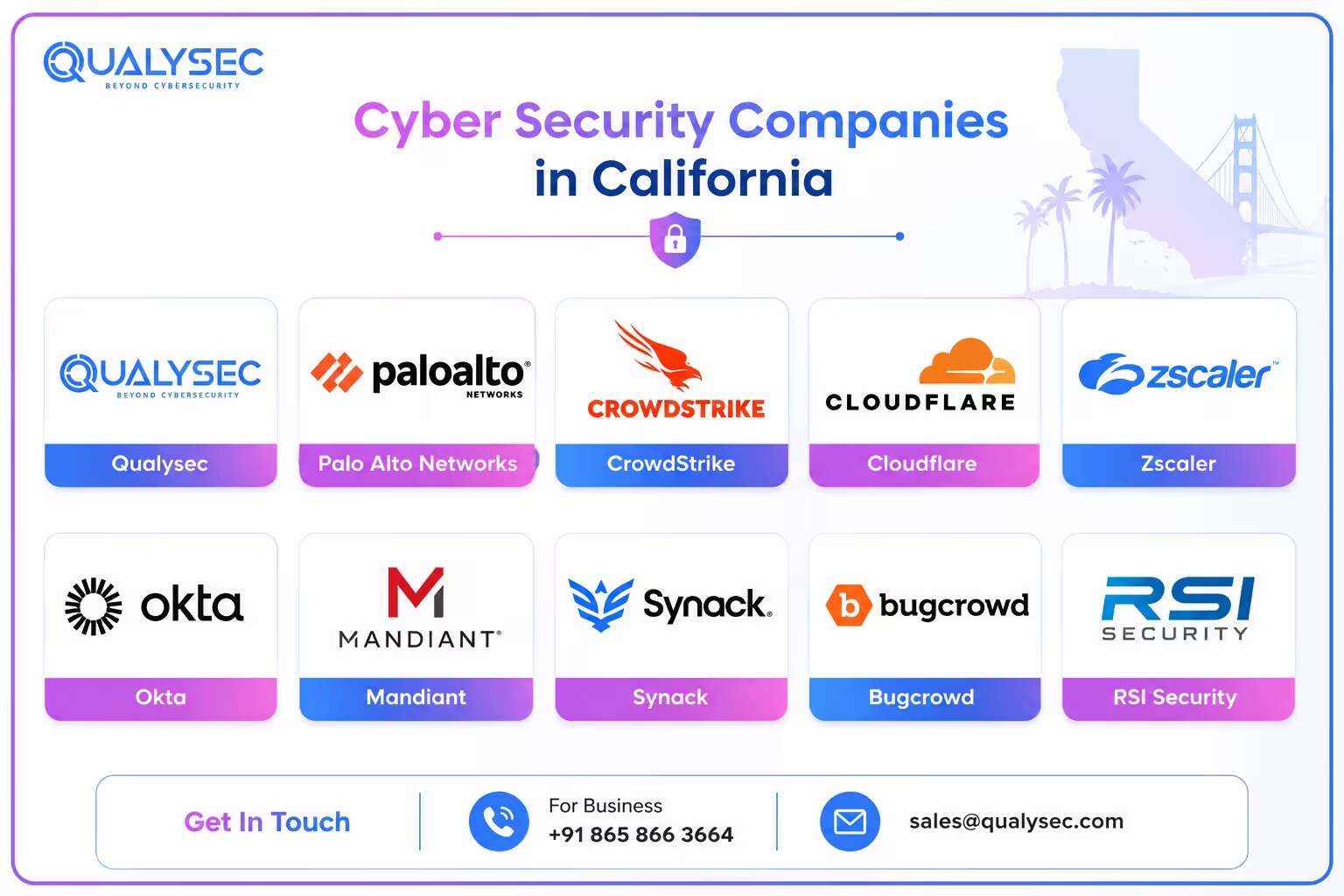
Qualysec (Global VAPT Partner)
Qualysec builds penetration testing around a three-layer approach. First layer runs automated tools for speed and coverage. Second layer deploys AI analysis, diving deeper into what tools found. The third layer brings human security experts, validating everything because automation and AI still miss critical details. That sequence matters because it’s not one method doing all the work. Each layer catches what the others might miss.
- Speed without cutting corners matters in real work. The live dashboard shows clients what’s happening across all three layers as testing progresses. Not waiting for final reports. Seeing progress in real time. SaaS companies, fintech startups, and mid-market businesses use them when compliance requirements such as HIPAA, PCI DSS, SOC 2, and ISO 27001 matter. Web applications, mobile apps, cloud infrastructure, APIs, IoT devices, networks. They test everything.
- Human-Led, AI-Powered describes the philosophy. Humans are directing the process. AI amplifying capability. Automated tools provide a foundation. Team holds CEH and other advanced certifications. Testing methodology aligns with OWASP, NIST SP 800-115, and other relevant standards. ISO 27001 penetration testing support included.
- Qualysec focuses on what they do exceptionally well: penetration testing and vulnerability assessments. Organizations seeking specialized offensive security expertise benefit from that focus. For broader managed security needs such as continuous SOC monitoring or threat intelligence, many enterprises combine multiple vendors. This layered approach is standard practice in enterprise security architecture. Explore Our Offensive Penetration Testing Services.
If you’re running SaaS, handling payments, or managing healthcare data, security testing can’t wait. Qualysec’s dashboard gives real visibility into what’s actually vulnerable. That matters more than hoping annual pentests catch everything. Start with an actual assessment of your current posture.
| Three Layers | Real-Time Visibility | Compliance Ready |
| Automated + AI + Human | Live Dashboard | HIPAA, PCI DSS, SOC 2 |
Get a Security Assessment from Qualysec
Palo Alto Networks
Palo Alto Networks is based in Santa Clara, California and has become one of the largest California-based cybersecurity companies measured by revenue. The firm sells an integrated platform covering network security, cloud protection, and security operations across enterprise organizations globally.
- The platform pieces work together. Next-generation firewalls sit at the network edge. Prisma Cloud handles cloud infrastructure where traditional firewalls can’t reach. Cortex XDR monitors endpoints and networks simultaneously for threats. Unit 42 provides threat intelligence. They run managed detection and response when organizations need human intervention.
- Large enterprises and multinational corporations use them because managing security across networks, cloud, and endpoints through one vendor reduces friction. Single console. Unified policies. Fewer integration problems than buying five different companies’ tools.
- The financial numbers show a strong market position. FY2025 revenue hit $9.2 billion, up 15% year-over-year. Their next-generation security recurring revenue jumped 32% to $5.6 billion. Those growth rates indicate enterprises are actually buying and keeping their platform.
Over 70,000 organizations worldwide use them. That’s real scale.
The limitation matters, though. Enterprise pricing makes this inaccessible for small businesses. Platform complexity assumes you have security teams already. Organizations needing specialist penetration testing or narrow security services find themselves overpaying for tooling they don’t use.
| FY2025 Revenue | NGS ARR | Global Users |
| $9.2 Billion | $5.6 Billion | 70,000+ Orgs |
CrowdStrike
CrowdStrike started in Sunnyvale, California, back in 2011. They moved their headquarters to Austin, Texas, in 2021, but kept major operations running in California. That’s worth knowing because the company still operates from both locations, not just Austin.
- Their Falcon platform is what people actually talk about. It’s cloud-delivered and built on AI from the ground up, not bolted on later. Runs on endpoints, monitors identity systems, and watches cloud workloads. Organizations deploy one agent instead of juggling multiple tools. Data feeds back to Falcon’s AI layer, which detects threats based on behavior patterns.
- Large enterprises use them because managing security across endpoints, identity, and cloud through one vendor reduces chaos. One interface. One vendor to deal with. Their dollar-based gross retention rate sits at 97%, which means people actually stick with them after deployment.
- They’re S&P 500 listed. ISO 27001 certified. Gartner and Forrester recognize them as leaders.
- Then July 2024 happened. A Falcon update broke 8.5 million Windows machines globally. Not a hack. Not data theft. Bad testing before release crashed systems worldwide. CrowdStrike acknowledged it, tightened testing processes, and added safeguards. The incident showed what happens when endpoint security concentrates that heavily with one vendor — one bad update affects millions of organizations simultaneously.
| Dollar-Based Gross Retention Rate | July 2024 Outage | Founded |
| 97%+ | 8.5M Windows Systems | 2011 |
Cloudflare
Cloudflare sits in San Francisco, running one of the world’s largest network infrastructure operations. Their business model is different from traditional security vendors. They don’t sell you software to install. They intercept traffic flowing through their global network and clean it before it reaches your systems.
- DDoS attacks hit your infrastructure constantly. Cloudflare sits between attackers and your servers. Traffic floods in, Cloudflare’s network absorbs the junk, and legitimate requests get through. That’s DDoS mitigation at the network scale.
- They also handle Zero Trust access. Instead of trusting everything inside your network perimeter, every connection gets verified before allowing access. Employees connecting remotely, applications talking to each other, APIs being called. Nothing moves without authentication.
- Web application firewall blocks malicious requests targeting your actual application code. CDN with security built in. SASE platform. API security. All running through their global network infrastructure.
- Web-heavy businesses and SaaS companies use them because DDoS protection and Zero Trust architecture require global infrastructure that most organizations can’t build internally. One company trying to defend against volumetric attacks loses. Cloudflare’s network absorbs that volume.
- Revenue hit $2.168 billion in 2025. Trailing twelve-month revenue is around $2.33 billion as of early 2026. That scale means millions of organizations routing traffic through their network.
- ISO 27001 certified. SOC 2 Type II. FedRAMP authorized for government work.
The limitation is real, though. Cloudflare protects network and infrastructure layers. They don’t do application penetration testing. Deep compliance auditing isn’t their thing. Organizations needing someone to test their code or audit internal security need different vendors.
| 2025 Revenue | TTM Revenue | Founded |
| $2.168 Billion | $2.33 Billion | 2009 |
Zscaler
Zscaler operates from San Jose, California and is building a new headquarters in Santa Clara, opening summer 2026. They signed a lease for over 301,163 square feet, which signals serious expansion. The company focuses on Zero Trust security for organizations with highly distributed or remote workforces.
- Traditional VPN architecture assumes your office network is safe and everything outside is hostile. You tunnel through a VPN to access internal systems. Zscaler flips that model. Every connection gets verified regardless of location. Employee in the office. Employee working from home. Contractor accessing systems. All were treated the same. Nothing is trusted by default.
- Their platform handles secure internet access. Employees browse the web through Zscaler’s infrastructure, which filters malware and blocks malicious sites before reaching devices. Private application access lets authorized users reach specific applications without exposing the internal network structure. Cloud Access Security Broker monitors what’s happening in cloud applications like Salesforce or Microsoft 365.
- Large enterprises with distributed workforces use them because traditional VPN breaks down when most employees work remotely. VPN was designed for occasional remote workers, not permanent remote-first operations. Zscaler architecture scales to thousands of locations.
- AI-powered threat protection. Data loss prevention stops sensitive information from leaking out. FedRAMP authorized for government deployments. ISO 27001 and SOC 2 Type II certified. Common Criteria recognition.
The limitation is straightforward. Cloud-only architecture. Organizations with massive on-premise legacy infrastructure find integration complex and expensive. Hybrid environments work. Pure on-premise doesn’t fit their model.
| New HQ Size | Opening Date | Headquarters |
| 301,163 sq ft | Summer 2026 | San Jose (Current) / Santa Clara (New) |
Okta
Okta operates from San Francisco, handling identity and access management for organizations globally. Their entire business is identity. Not security broadly. Not networks. Not endpoints. Identity specifically.
- Single sign-on solves a real problem. Employees remember one password instead of fifty different passwords across fifty different applications. IT doesn’t reset passwords constantly. One credential stored securely, multiple applications trust Okta’s verification. That’s SSO.
- Multi-factor authentication adds another layer. Password plus phone confirmation. Password plus hardware key. Attackers can’t get in with stolen passwords because they don’t have the second factor. Organizations managing remote workforces use MFA because attackers actively hunt compromised employee credentials.
- Identity governance and lifecycle management handle the boring stuff that actually matters. When someone gets hired, provision their accounts across all systems automatically. When they leave, deactivate everything simultaneously. No orphaned accounts lingering with access they shouldn’t have. That consistency prevents breaches more than fancy technology sometimes.
- Okta also handles customer identity, meaning organizations can let customers create accounts and log in through Okta instead of building identity systems themselves. Okta manages password resets, account recovery, and profile management.
They have introduced AI-powered capabilities for identity management. AI systems need credentials to access other systems. Managing those credentials at scale requires identity infrastructure.
CCPA compliance matters. Organizations collecting customer data in California need identity governance to prove they’re handling data according to the law. Okta’s platform supports that.
ISO 27001 certified. SOC 2 Type II. FedRAMP authorized for the government.
The limitation is clear. Okta handles identity. They don’t do penetration testing. They don’t monitor threats. Organizations need Okta plus other tools for complete security coverage.
| Focus Area | Primary Use | Headquarters |
| Identity & Access | Workforce + Customer | San Francisco |
Mandiant
Mandiant used to be based in Milpitas, California. Now they’re in Reston, Virginia. Google bought them for $5.4 billion in 2022, which fundamentally changed what the company is. They operate under Google Cloud’s infrastructure now. Mountain View handles some operations. Reston handles others. Understanding that matters because Mandiant isn’t independent anymore. It’s a Google subsidiary.
- Organizations hire Mandiant after breaches happen. Not before. When attackers are already inside systems, stealing data and moving laterally through networks, Mandiant investigates what actually occurred. They determine what was compromised, trace attacker movements, and understand which systems got touched. That forensic work comes from responding to thousands of breaches across decades.
- Threat intelligence tracking who’s attacking and what tactics they use. Red team exercises where Mandiant simulates attackers to expose vulnerabilities that organizations missed. Compromise assessments checking whether adversaries currently have hidden access. Consulting on rebuilding security after breaches.
- Two decades means they’ve seen everything. Government agencies are getting hit. Fortune 500 companies breached. Critical infrastructure compromised. That experience informs how they approach any situation.
Google (Mandiant) was named a Leader in the IDC MarketScape for Worldwide Incident Response 2025. Analyst firms take them seriously.
The pricing problem is real. Enterprise tier only. Government tier only. Organizations with serious resources and serious incidents. Small businesses and mid-market companies can’t access their services. Retainers demand pre-negotiated contracts and substantial commitments.
| Two Decades | IDC 2025 | Forrester Q2 2024 |
| Incident Response | Leader | Leader |
Synack
Synack operates from Redwood City, California, running a network of ethical hackers. Not employees. Independent hackers vetted and organized into what they call the Synack Red Team. Those hackers test systems for vulnerabilities on demand. Combine that with automated scanning and AI triage, and you get penetration testing at scale without hiring traditional consultants.
- The model is different from standard pentesting firms. Instead of booking a specific team for two weeks, you get continuous testing. Automated tools run constantly. Human hackers dig deeper into findings worth investigating. AI sorts through results, flagging what actually matters. That continuous cycle finds vulnerabilities that traditional annual pentests miss because attackers don’t wait a year between tests.
- Web applications. Mobile apps. APIs. Hosts. Attack surface management tracks what’s exposed across your internet footprint. They launched Sara (Synack Autonomous Red Agent), an agentic AI platform for penetration testing that works alongside human hackers. It became generally available in 2026. AI doesn’t replace humans. Works beside them.
- Enterprises and government agencies with mature security programmes use them because continuous testing catches drift. Systems change. Configurations slip. Vulnerabilities emerge. Annual pentests find problems from January. By December, those problems multiplied. Continuous testing keeps pace.
- CREST accredited. The US Department of Defense uses them. Federal cabinet-level agencies trust their platform.
The limitation matters. Everything flows through Synack’s platform. You don’t hire individual consultants. You don’t scope custom engagements. You engage the Red Team through their system. Organizations wanting traditional consultant relationships find this inflexible.
| Red Team Model | Sara Launch | Government Clients |
| Crowdsourced Hackers | August 2025 | DoD + Cabinet Agencies |
Bugcrowd
Bugcrowd operates from San Francisco, running a crowdsourced security platform. They connect organizations with security researchers globally. Those researchers hunt for vulnerabilities in exchange for bounties when they find something real.
- Bug bounty programs work differently from traditional pentesting. You don’t hire a firm for two weeks. You launch a program saying find vulnerabilities and get paid. Security researchers from everywhere compete to discover problems. Some find nothing. Some find critical issues. You only pay for actual findings. That’s a fundamentally different financial model from retainer-based consulting.
- Vulnerability disclosure programs let organizations handle researchers reporting security issues responsibly. Before bug bounties existed, researchers either kept vulnerabilities quiet or sold them to criminals. Bugcrowd’s platform provides a structured way for researchers to report findings directly to companies with responsible disclosure timelines.
- They added penetration testing as a service, meaning you can hire their platform for managed testing beyond pure crowdsourced bug hunting. Attack surface management tracks what’s exposed. AI triage sorts findings, deciding what matters. Tech companies and SaaS startups use them because flexibility matters more than rigid quarterly assessments.
- March 2026 brought FedRAMP Moderate Authorization, which opens government contracts. The Department of Defense uses them. Air Force. NASA. That authorization signals serious validation because FedRAMP review is brutal.
The limitation is cost unpredictability. The pay-per-finding model means you don’t know the total bill until researchers stop finding things. Organizations new to bug bounties sometimes get surprised by the final costs. Program design and researcher pool quality affect how many legitimate findings surface versus noise.
| FedRAMP Status | Authorization Date | Government Users |
| Moderate Authorized | March 2026 | DoD, Air Force, NASA |
RSI Security
RSI Security operates from San Diego, California, focused entirely on compliance. Not offensive security. Not threat detection. Compliance frameworks. Healthcare organizations need HIPAA. Defense contractors need CMMC. Financial services need PCI DSS. CCPA for anyone handling California resident data. RSI helps organizations navigate those regulatory requirements.
- CMMC matters significantly for defense contractors. Department of Defense requires contractors to meet Cybersecurity Maturity Model Certification. RSI is an authorized C3PAO, which means Certified Third-Party Assessment Organization. Only limited firms can officially conduct CMMC Level 2 assessments. That’s serious responsibility and serious validation. Defense contractors can’t get government contracts without CMMC certification. RSI conducts those assessments.
- PCI DSS compliance for payment processors and anyone handling credit cards. HIPAA for healthcare. SOC 2 for SaaS companies. HITRUST for healthcare specifically. CCPA advisory for organizations collecting California resident data. NIST AI Risk Management Framework for organizations deploying AI systems. ISO 27001 for information security broadly.
- Healthcare, defense contracting, and financial services organizations use them because regulatory frameworks demand specific security postures. Auditors review compliance. Fines reach millions when organizations miss requirements.
The limitation is straightforward. RSI focuses heavily on audit, compliance, and governance frameworks. While they perform scoped technical validation—such as the penetration testing required for PCI DSS or SOC 2 compliance—they do not act as an independent, full-scale offensive red-teaming agency, nor do they offer active 24/7 incident response. Organizations needing offensive security testing or threat detection need different vendors. RSI handles audit and governance.
| CMMC Authorization | Primary Focus | Headquarters |
| C3PAO Authorized | Compliance Frameworks | San Diego, CA (Main operations) |
Looking for the Right Security Provider?
Comparison Table: Top 10 Cyber Security Companies in California
| Company | HQ | Core Specialty | Best For | Key Strength |
| Qualysec | Remote / Global Operations | VAPT / Penetration Testing | SaaS, Fintech, Mid-Market | Three-Layered (Automation + AI + Human) Approach |
| Palo Alto Networks | Santa Clara, CA | Enterprise Network + Cloud Security | Large Enterprises | $9.2B Revenue, Integrated Platform |
| CrowdStrike | Austin, TX (Strong CA ops) | AI-Native Endpoint + Identity Security | Cloud-Native Enterprises | Falcon Platform, 97%+ Retention Rate |
| Cloudflare | San Francisco, CA | DDoS, Zero Trust, WAF | Web & SaaS Businesses | Massive Global Network Scale |
| Zscaler | San Jose, CA | Zero Trust Network Access | Remote & Hybrid Workforces | Cloud-Native ZTNA Leader |
| Okta | San Francisco, CA | Identity & Access Management | IAM & CCPA Governance | Leading Neutral Identity Platform |
| Mandiant (Google) | Reston, VA (Google Cloud) | Incident Response + Threat Intelligence | Post-Breach & High-Stakes IR | IDC MarketScape Leader 2025 |
| Synack | Redwood City, CA | Crowdsourced PTaaS | Mature Security Environments | CREST Accredited + DoD Trusted |
| Bugcrowd | San Francisco, CA | Bug Bounty + Crowdsourced Testing | Tech Startups & SaaS | FedRAMP Moderate Authorized (2026) |
| RSI Security | San Diego, CA | Compliance & Regulatory Security | Healthcare, Defense, Finance | Authorized CMMC C3PAO |
Key Cybersecurity Threats Facing California Businesses in 2026
Ransomware variants multiplied through 2025. The FBI documented dozens of strains targeting healthcare systems specifically. Hospitals can’t afford downtime. Attackers know this. Healthcare breaches hit hardest financially. Average cost reaches $7.42 million. That’s fourteen consecutive years healthcare ranks as the most expensive breach sector. While the overall global cross-industry average to identify and contain a breach sits at 241 days, healthcare networks face an elongated 279-day average lifecycle. By then, the damage compounds significantly.
AI-powered attacks entered mainstream criminal playbooks in 2025. Over 22,000 complaints specifically referenced AI-driven attacks. Nearly $893 million in losses were documented through IC3. That’s the first major year where AI attacks got tracked separately because volume justified it.
California businesses face steeper costs than anywhere globally. The US average breach cost sits at $10.22 million. Highest on the planet. California companies operate in sectors that attackers target most: tech, healthcare, and finance. That concentration means breach probability stays elevated.
Ransomware won’t disappear. AI attacks accelerate. Healthcare remains a prime target. California’s cost per breach exceeds the national average because organizations here operate at higher valuations and higher stakes. Prevention costs fractions of breach costs. The math remains simple.
How to Choose the Right Cybersecurity Company in California
- Define your primary need first. Are you looking for a one-time penetration test? Continuous monitoring throughout the year? Compliance audit for regulatory requirements? Incident response capability after breaches happen? Different vendors excel at different needs. Know which one matters most before evaluating firms.
- Confirm California-specific compliance experience. CCPA and CPRA cybersecurity audit readiness matters now. State breach notification laws require specific responses. Vendors must understand California’s regulatory environment specifically, not just general compliance frameworks.
- Verify the right certifications. Penetration testing firms should hold CREST accreditation. ISO 27001 certification indicates mature processes. SOC 2 Type II demonstrates independent audit validation. CMMC work requires C3PAO authorization. Certifications tell you what a firm is actually authorized to do.
- Ask for a sample report matching your industry and application type. Generic proposals mean nothing. Real reports show CVSS scores, proof-of-concept evidence, business impact assessment, and remediation steps. If vendors won’t show samples, walk away.
- Confirm their re-testing policy. After vulnerabilities get fixed, will they verify the fixes worked? Some firms charge for re-testing. Others include it. That difference affects your total budget significantly.
- Understand the pricing model completely. Fixed-scope engagements cost one amount. Pay-per-finding models create unpredictability. Monthly retainers spread costs over time. Each model has different budget implications. Know which one aligns with your purchasing process.
- Ask specifically about CCPA audit experience. Regulations took effect January 1, 2026. This isn’t a bonus skill anymore. This is a baseline requirement for California vendors.
- Review recent case studies and sample reports for your specific industry. Healthcare case studies matter if you’re in healthcare. Financial services examples matter if you’re in finance. Industry-specific experience beats generic experience every time.
Assess Your Security Posture
Conclusion
California’s cybersecurity market is probably the most developed globally. It’s also the most regulated. That combination means you have options but also complexity. CCPA mandates. CPRA requirements. Breach notification laws. Attackers are targeting aggressively because the money and data concentration justifies effort.
Picking the right partner depends on what your organization actually needs. Some businesses need proactive penetration testing to find vulnerabilities before attackers do. Others need 24×7 monitoring, catching threats as they happen. Some face compliance deadlines requiring documented audit trails. Some experienced breaches and need response expertise.
If structured penetration testing is your priority, Qualysec’s approach combines automated scanning, AI analysis, and human experts validating findings. That layered methodology catches vulnerabilities others miss. Real-time dashboard shows progress as work happens.
Your security posture matters. California’s threat environment won’t slow down. Pick a partner understanding your specific situation instead of treating you like a generic client.
Note – Data verified from FBI IC3 2025 reports, IBM Cost of a Data Breach 2025, official CCPA/CPRA regulations, and company disclosures as of 2026.
FAQs
Q1: What is the best cybersecurity company in California?
Depends entirely on what you’re actually trying to solve. Qualysec works great if you want real-time visibility into penetration testing. Palo Alto Networks dominates enterprise network security because they’ve built infrastructure at that scale. Okta handles identity if that’s your pain point. Match the vendor to your actual problem instead of picking based on reputation.
Q2: How many cybersecurity companies are in California?
Hundreds operate across Silicon Valley, Los Angeles, and San Diego. California hosts one of the densest concentrations of security firms anywhere in the US. That density exists because venture capital, tech talent, and target victims all concentrate here. It’s a self-reinforcing cycle. Startups launch here. Established firms expand here. The market keeps growing because customer density justifies it.
Q3: Is California the most targeted US state for cyberattacks?
California ranks number one consistently according to the FBI IC3 annual reports. Over $2.5 billion in losses were reported by Californians in the latest 2025 data cycles. That’s higher than any other state. The concentration of financial institutions, tech companies, healthcare systems, and high-net-worth individuals makes California an attractive target. Attackers follow the money and data. California has both.
Q4: What do California based cyber security company cost?
Penetration testing runs anywhere from five thousand to fifty thousand dollars, depending on what you’re testing. Managed security services for mid-market organizations typically run three to fifteen thousand dollars monthly. Bug bounty platforms charge per finding, so costs vary wildly based on how many vulnerabilities researchers actually discover. Enterprise platforms get custom quoted because the scope differs dramatically. Get multiple proposals before committing.
Q5: Do I need a cybersecurity company with CCPA experience?
CCPA cybersecurity audit requirements took effect January first, 2026. That’s mandatory now, not optional. If your business processes large volumes of California consumer data, you need partners understanding those audit requirements and what documentation regulators actually expect. Someone who’s done these audits before saves you from guessing about compliance.
Q6: What certifications should I look for in a California cybersecurity firm?
CREST accreditation matters for penetration testing. ISO 27001 shows information security maturity. SOC 2 Type II demonstrates that controls actually work. CMMC C3PAO authorization required if you’re a defense contractor. Then look at individual staff certifications. CISSP, OSCP, and CISA on actual people doing the work matter more than company certifications sometimes. Check LinkedIn. Verify credentials. Real people doing real work.
Q7: What is the difference between penetration testing and managed security services?
Penetration testing finds vulnerabilities one time or periodically through scoped engagements. You get a report. You fix things. Then you wait until next year’s test. Managed security services run 24×7 monitoring and respond to threats constantly. Some California firms offer both. Others specialize exclusively. Figure out which you actually need before hiring because mixing them up wastes money.





































































0 Comments