






Around 71% of organizations can fail their first security audit or face major delays due to inadequate control implementation and a lack of evidence. While many organizations develop security programs that are “compliant on paper”, they fail to have the level of detail, consistency and traceability needed to effectively prove that they are compliant. HITRUST compliance checklist solves this problem by providing a single, certifiable framework that systematically integrates key standards like HIPAA, NIST, ISO/IEC 27001, and PCI DSS. HITRUST is a maturity-based approach, which evaluates not just the presence of controls, but also their effectiveness, measurement and ongoing maintenance.
This article will explain who needs HITRUST certification, why it’s important and provide a step-by-step compliance checklist.
What is HITRUST Compliance?
HITRUST compliance refers to meeting all the requirements of the HITRUST Common Security Framework (CSF). The framework was established by the HITRUST Alliance is a US based organization that provides a certifiable framework for managing sensitive data. HITRUST CSF (Common Security Framework) integrates multiple standards like HIPAA, NIST, ISO, and PCI DSS into a single, risk-based approach to data security.
Who needs HITRUST Certification?
HITRUST certification is not legally mandatory, but it is widely adopted by organizations that handle sensitive or regulated data. This includes:
Organisations that deal directly with protected health information (PHI):
- Healthcare & Life Sciences
- Hospitals and healthcare providers
- Health insurance companies and payers
- Medical device and healthtech companies
- Laboratories and clinical research organizations
- Technology & SaaS Providers
Companies that store or process sensitive data on behalf of clients, including:
- Cloud service providers (IaaS, PaaS, SaaS)
- SaaS platforms handling healthcare or financial data
- Managed service providers (MSPs)
- Data processing and analytics companies
- Financial Services & Fintech
Organisations in finance, such as:
- Fintech startups and payment platforms
- Banking and financial service providers
- Organizations to which PCI DSS, HIPAA, ISO/IEC 27001, NIST Cybersecurity Framework, and GDPR are applicable
Third-Party Vendors & Partners:
- Vendors that work with the industries
- IT service providers and consultants
- Outsourcing and BPO companies
- Software vendors that support healthcare or finance clients
Need stronger security? Speak with our cybersecurity experts.
Need a compliance-ready security assessment?
HITRUST Certification Levels
HITRUST assessment level is the level of check that an organization undergoes to achieve certification. It offers various levels to allow companies to select one that fits their size, level of risk, and the extent of sensitive data they work with. Three primary levels exist: e1, i1 and r2, discussed below:
| Assessment Level | Control Count | Validity Period |
|---|---|---|
| e1 (Essentials) | ~44 controls (fixed) | 1 year |
| i1 (Implemented) | ~182 controls (fixed) | 1 year |
| r2 (Risk-Based) | 2,000+ controls (tailored) | 2 years (with 1-year interim) |
Requirements for HITRUST Certification Levels
Each HITRUST level builds on the previous one, but the depth and flexibility increase significantly. Instead of thinking in terms of just controls, it helps to understand what each level actually expects from your organisation.
1. e1 (Essentials)
This is the entry-level assessment, focused on basic cybersecurity hygiene. It is designed for startups or low-risk environments that need to demonstrate foundational security.
At this level, the focus is on:
- Managing user access and limiting admin privileges
- Enforcing strong passwords and secure logins
- Protecting against common threats like phishing and ransomware
The scope of e1 is, however, limited. It lacks privacy specifications and cannot be adjusted to other regulatory frameworks. It lacks sophisticated or organization-specific risk controls as well.
2. i1 (Implemented)
The i1 level goes one step higher, demanding a more organized and standard security program. It is appropriate for developing organizations that desire to demonstrate developed security practices.
In addition to e1 controls, i1 requires:
- Official information security management program
- Well-established access control policies
- Identity and access management processes
- Continuous security checks and user monitoring
i1 has a fixed set of controls, it is not customizable to particular regulatory requirements, and is therefore not quite suitable for high-complexity or high-risk environments.
3. r2 (Risk-Based)
The most comprehensive and flexible level is the r2 assessment. It suits large organizations or those that are in a high-risk or highly regulated environment.
This level includes everything from e1 and i1, along with:
- Risk assessment and ongoing evaluation.
- Business continuity and disaster recovery planning.
- organization-wide identity governance
- Powerful encryption and high confidentiality.
- Active security operations monitoring and Incident response.
- Complete management, policies, procedures and quantifiable measures.
R2 is completely customized to your organization, unlike the other levels. Risk is the basis upon which controls are chosen, and this makes it powerful and complex. It requires detailed scoping, deeper analysis, and significantly more effort to implement and maintain.
HITRUST Compliance Checklist
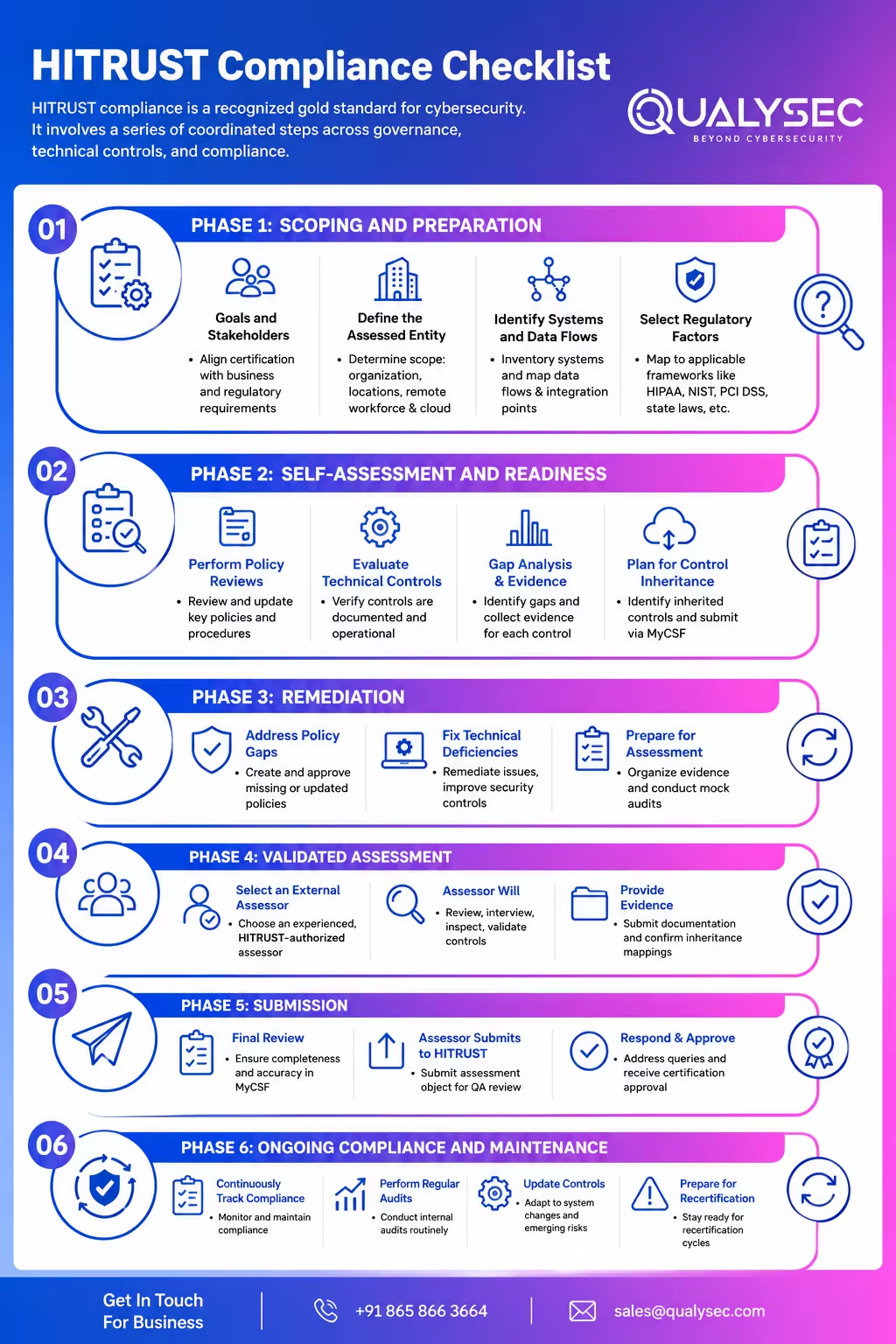
HITRUST compliance is considered one of the recognised gold standards for cybersecurity. Involves a series of coordinated steps across governance, technical controls, such as:
Phase 1: Scoping and Preparation
This phase defines the foundation of your assessment. You should have the following in phase 1:
Goals and Stakeholders
- Make sure the HITRUST certification aligns with business, regulatory, and customer requirements
- Identify executive sponsors and internal champions
- Assign a dedicated project owner responsible for timelines
- Educate leadership and teams on HITRUST expectations and impact
Define the Assessed Entity
- Check whether HITRUST Certification is applicable to the complete organization or to its specific business unit.
- Identify all physical locations, including offices and data centres
- Include remote workforce environments
- Document all cloud environments and regions in scope
Identify Systems and Data Flows
- Inventory all systems handling sensitive information or protected health information
- Include internal applications, databases, and third-party SaaS platforms
- Map upstream and downstream data flows
- Identify integration points and external dependencies
Select Regulatory Factors
HITRUST allows mapping to multiple regulatory frameworks. So, check the applicable requirements:
- HIPAA Security and Privacy Rules
- NIST Cybersecurity Framework 2.0
- PCI DSS v4.0
- State regulations such as CCPA or CPRA
- Any contractual or customer-driven compliance obligations
Phase 2: Self-Assessment and Readiness
This phase identifies gaps between your current state and HITRUST CSF requirements.
Perform Policy Reviews
HITRUST evaluates controls across five maturity levels: Policy, Process, Implemented, Measured, and Managed. Make sure to have the following policies in the organisation, and don’t forget to update them:
- Access Control policies
- Incident Response plans
- Disaster Recovery and Business Continuity plans
- Risk Management framework
- Asset Management procedures
- Vendor and third-party risk policies
Evaluate Technical Controls
Verify that controls are not only documented but also operational:
- Encryption for data at rest and in transit
- Multi-Factor Authentication for remote and privileged access
- Endpoint protection and monitoring
- Logging and monitoring systems
- Vulnerability scanning and remediation processes
Gap Analysis
- Compare current controls against HITRUST CSF requirements
- Identify missing or weak controls
- Prioritize gaps based on risk and audit impact
Collect evidence
- Screenshots, logs, and configuration files
- Maintain at least two pieces of evidence per control
- Ensure evidence demonstrates consistency over time
Plan for Control Inheritance
- Identify controls managed by cloud providers such as AWS, Azure, or GCP
- Document shared responsibility models
- Submit inheritance requests through MyCSF
Phase 3: Remediation
This phase focuses on closing gaps identified during security readiness.
Address Policy Gaps
- Draft missing policies, such as Mobile Device Management or Data Retention
- Obtain formal approval and distribute to employees
- Train staff on new or updated policies
Fix Technical Deficiencies
- Upgrade outdated encryption protocols
- Enforce MFA across all required systems
- Improve logging retention and monitoring coverage
- Patch vulnerabilities within required service level agreements
Prepare for Assessment
- Ensure all evidence is complete and organised
- Conduct internal mock audits
- Confirm readiness with your external assessor
Phase 4: Validated Assessment
This is the formal audit conducted by a HITRUST Authorized External Assessor.
Select an External Assessor
- Choose a firm experienced in your industry and technology stack
- Check if they are familiar with HITRUST CSF v11.x
The assessor will:
- Interview subject matter experts
- Review policies and procedures
- Inspect technical configurations
- Validate evidence
Provide evidence
- Submit all required documentation to the assessor
- Confirm inheritance mappings
- Address any identified issues during pre-submission review
Phase 5: Submission
After validation, the assessment is submitted to HITRUST for QA review.
Final Review Before Submission
- Check for inconsistencies in MyCSF
- Ensure naming conventions and terminology are correct
- Validate completeness of evidence
- The external assessor will submit the assessment object to HITRUST
Respond to Queries Certification Approval
- Provide additional evidence or clarification within two weeks
- Review the final report
- Approve certification results
Phase 6: Ongoing Compliance and Maintenance
HITRUST is not a one-time effort. Continuous compliance is required. Therefore:
- Continuously track compliance
- Perform regular internal audits
- Update controls as systems evolve
- Address newly identified risks or vulnerabilities
- Prepare for recertification cycles
Pro Tip
If your organization uses Large Language Models, include the HITRUST AI Security Assessment controls to protect against data leakage and prompt injection
How can Qualysec help
Qualysec is a cybersecurity company that provides a full-scale defence system through its own Three Layered Defence System. It combines the speed of automation with the deep human intuition to identify vulnerabilities during your HITRUST preparation. Manual and AI-driven solutions enable your organization to be both speedy and accurate.
Qualysec provides:
High-Scale Automated Scanning:
- Qualysec uses automated scanning software to quickly scan your entire environment at scale. This layer identifies known vulnerabilities in real time, which is necessary to assess risks across the systems and applications outlined in your HITRUST scope.
AI-Powered Pattern Analysis:
- Going beyond tools, the AI layer analyzes patterns and learns from data to uncover complex security gaps. This offers the enhanced risk management that organizations that seek the addition of the HITRUST AI Assessment as an add-on require.
Human-Led Checking:
- Experts’ knowledge and creative thought are the last and most important checkpoint to identify what machines cannot perceive. This will guarantee that your technical implementation is of high-quality operational maturity that is desired by the current versions of the HITRUST framework.
Speed AND Accuracy in Remediation:
- Qualysec solves the old problem of choosing between speed and accuracy by providing both. This makes sure that when you realize some technical shortcomings, they are fixed as fast as possible and with the highest level of human understanding.
Live Project Visibility:
- Clients can track their security testing in real time across all three layers through a dedicated dashboard. This openness serves as a trust signal and assists you in recording the evidence in your internal knowledge library.
Future-Ready Defence:
- Qualysec can help you attain a high level of risk mitigation by adopting repeatable, proven and measurable methods. This will make sure that your cybersecurity program is developed on a full and tested framework and not as a one-time audit picture.
Complete Vulnerability Protection:
Automated tools and AI cannot cover all vulnerabilities, so human professionals step in to guarantee the protection of your sensitive data. This three-layered funnel is what will make sure that your organization is ready to exhibit the best security posture to partners and stakeholders.
Get expert cybersecurity guidance for your business. Consult with our cybersecurity experts to secure your business.
Consult with our cybersecurity experts
Discuss your unique security requirements and discover how we can help your business.
Conclusion
HITRUST compliance checklist is sometimes seen as a complicated certification process, but it actually exposes the effectiveness of an organization’s security program. As described in this guide, it clarifies the scope, ownership, evidence, and effectiveness of security controls over time. For companies that deal with sensitive or regulated information, the HITRUST offers a framework to consolidate controls, ready processes for audits, and reassure customers and partners. When done right, it not only eliminates the guesswork of compliance but also offers a method to manage security as a business function.
Frequently Asked Questions (FAQs)
Q.What is HITRUST compliance?
HITRUST compliance is a certifiable framework that uses the HITRUST CSF to unify standards like HIPAA, NIST, ISO, and PCI DSS. It mandates organizations to have controls in place at specified maturity levels and successfully undergo a validated evaluation through an approved assessor via the MyCSF platform.
Q.What is the compliance checklist?
A HITRUST compliance checklist practical list of tasks and requirements that an organization must complete to achieve certification. It includes defining scope, documenting policies, implementing security controls, collecting audit evidence, remediating gaps, and preparing for assessor validation and HITRUST quality review.
Q.How do you prepare for a HITRUST audit?
Preparation involves defining the scope, conducting a readiness assessment, and remediating gaps before validation. Organizations need to document policies, have controls in place such as MFA and encryption, and gather evidence such as logs and access records. Internal mock audits and working with an external assessor are key to success.
Q.What is the difference between HITRUST and SOC2?
HITRUST and SOC 2 both deal with security. HITRUST follows a fixed set of controls with maturity scoring and a final review by HITRUST itself, so the process is more structured and standardized. SOC 2, on the other hand, is more flexible. Auditors evaluate your controls based on broader criteria, and there is no central body reviewing the final report.
Q.Is HITRUST based on NIST?
HITRUST integrates the NIST Cybersecurity Framework and other standards like HIPAA, ISO 27001, and PCI DSS into one unified structure. On top of that, it adds its own detailed control requirements and maturity levels.
















































































































0 Comments