







Healthcare is one of the main areas of cyber attack victims, and recent reports show the average healthcare data breach costs a record $10.93 million. In the year 2026, the issue of securing patient information has become more complex, as AI-based attacks are increasing by almost 40% annually. It takes more than mere software to keep up with these threats – it takes expertise. When you are a U.S. healthcare provider, payer, or SaaS vendor dealing with protected health information (PHI), a successful audit versus a seven-figure settlement can be a matter of hiring the right HIPAA compliance consultants.
Who are HIPAA Compliance Consultants?
HIPAA consultants are specialized cybersecurity and legal experts. These consultants help organizations secure sensitive patient data and comply with the strict regulatory requirements set by HIPAA.
Healthcare providers, fintech companies and SaaS vendors usually handle protected health information. This is where these consultants provide the requisite technical and administrative oversight to prevent data breaches and avoid legal penalties.
What do HIPAA Consultants do?
- Risk Assessment and VAPT: Consultants conduct specific Vulnerability Assessment and Penetration Testing (VAPT) to identify the open security gaps in networks and applications.
- Manual Security Validation: Consultant specialists usually opt for human-led testing processes to simulate real-world attackers. This helps them further in finding complex business logic flows that automated tools might miss.
- Remediation Support: They provide actionable reports with clear stepwise processes mentioned to fix the vulnerabilities.
- Policy and Procedure Review: These compliance specialists help draft and audit the internal documentation required to prove during an official audit.
Who needs them?
- Healthcare Providers: Hospitals and clinics maintaining digital patient records.
- SaaS & Fintech Vendors: Startups and established companies building applications that store or transmit health-related data.
- Business Associates: Any third-party service provider (like hosting companies or billing services) that has access to PHI.
List of HIPAA Compliance Consultants
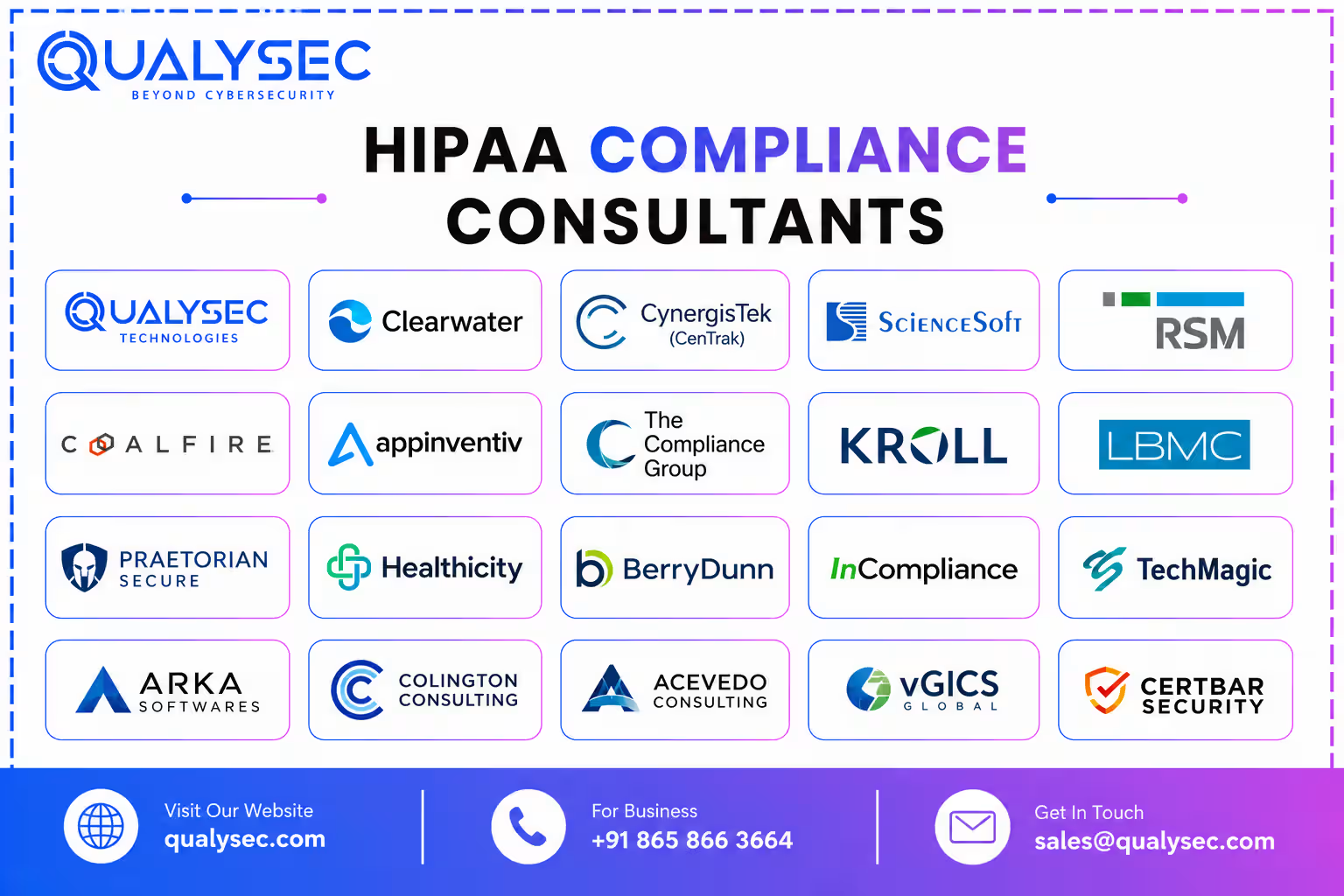
Qualysec Technologies
Qualysec is a leading collaborator to the organizations aiming to have a Human-Led, AI-Powered compliance strategy. They have a special three-layered defense system that includes automated scanning, AI intelligence, and manual testing by experts to make sure that nothing escapes their system. Traditionally, any HIPAA consultant would make a decision between Speed and Accuracy. Qualysec promises you to have both at the same time.
| Pros | Cons |
| Human-led, AI-powered three-layered defense system | Requires technical collaboration for full implementation |
| Combines speed and accuracy in compliance assessments | Premium pricing reflects advanced methodology |
| Automated scanning + AI intelligence + manual expert testing | Focus is primarily on security, not general IT services |
| Strong adaptability across modern, complex environments | May be more advanced than needed for very small clinics |
Reach out to expert compliance consultants today to secure your healthcare data with our signature three-layered defense system and get HIPAA documentation support – Connect now!
Clearwater
Clearwater is also well-known due to its risk-based methodology and, in particular, the HIPAA Security Rule. They offer high expertise in OCR quality risk analysis, which assists organizations in finding weaknesses in more complicated digital ecosystems. This approach can be helpful in large health systems with high volumes of Protected Health Information (PHI) that need a well-organized, defensible roadmap to long-term security.
| Pros | Cons |
| Strong risk-based methodology aligned with HIPAA Security Rule | The approach may feel complex for smaller healthcare organizations |
| Deep expertise in OCR-quality risk analysis | Implementation can require significant documentation effort |
| Ideal for large healthcare systems handling high PHI volumes | Higher cost due to specialized compliance focus |
| Provides a structured, long-term security roadmap | Less emphasis on rapid deployment compared to agile firms |
CynergisTek (CenTrak)
CynergisTek is a recognized healthcare cybersecurity leader that is interested in a comprehensive perspective on regulatory compliance and privacy. They provide consulting services that tend to involve readiness checkups and technical audits that are consistent with NIST frameworks. They imply a philosophy of continuous monitoring as opposed to a philosophy of audit once a year.
| Pros | Cons |
| Comprehensive compliance and privacy-focused consulting | A continuous monitoring approach may require ongoing investment |
| Strong alignment with NIST frameworks and industry standards | Not ideal for organizations seeking one-time audit solutions |
| Emphasis on proactive security rather than periodic audits | Resource-intensive for smaller teams |
| Expertise in healthcare-specific cybersecurity challenges | Implementation timelines may extend due to thorough assessments |
ScienceSoft
ScienceSoft is a good alternative for medical device manufacturers and software developers. Their consultants recommend a compliance-by-design approach, which promotes the inclusion of HIPAA protection into the software development life cycle. They deliver end-to-end advisory services, such as gap analysis at the start-up, technical controls, and employee training programs.
| Pros | Cons |
| Compliance-by-design approach integrated into SDLC | Requires early-stage involvement to maximize effectiveness |
| Ideal for medical device and healthcare software companies | Less focused on legacy system remediation |
| End-to-end services, including training and gap analysis | May require internal development team collaboration |
| Strong focus on technical controls and secure architecture | Not purely a consulting-only model; includes technical execution |
RSM US
Being a giant international organization, RSM US has an extensive governance, risk, and compliance (GRC) framework. Their consultants usually recommend that organizations should not see HIPAA as an isolated endeavor but rather as a component of an enterprise risk management approach. They provide scalability through automated testing and manual validation to find gaps.
| Pros | Cons |
| Enterprise-grade GRC framework with global expertise | May be overly complex for small to mid-sized businesses |
| Integrates HIPAA into broader enterprise risk management | Higher pricing due to the large-scale consulting model |
| Combines automated testing with manual validation | Less specialized focus solely on healthcare compared to niche firms |
| Scalable solutions suitable for large organizations | Implementation may involve multiple stakeholder layers |
Coalfire
Their consultants recommend that healthcare organizations consider technical safeguards and cloud security, particularly as an increasing amount of PHI is migrated to hybrid cloud settings. Coalfire assists engineering teams in becoming familiar with their place in compliance by offering a straightforward mapping of regulatory regulations to technical controls, to make sure that security frameworks are created in a way that can withstand advanced contemporary cyberattacks.
| Pros | Cons |
| Strong focus on cloud security and hybrid environments | May be overly technical for non-engineering teams |
| Clear mapping of regulatory requirements to technical controls | Requires internal engineering collaboration |
| Helps build resilient, attack-ready security frameworks | Implementation can be time-intensive |
| Ideal for organizations migrating PHI to cloud systems | Less emphasis on non-technical compliance aspects |
Appinventiv
Appinventiv focuses on helping digital health startups and fitness app developers to be HIPAA-compliant without losing speed to innovation. Their consultants propose a safety-first architecture that provides security of patient data in the mobile and API layers. They provide advice on how to encrypt data and provide safe user authentication, and new entrants in the healthcare sector can gain the confidence of their customers.
| Pros | Cons |
| Tailored for digital health startups and app developers | Less suited for large enterprise healthcare systems |
| Strong focus on mobile and API-layer security | Limited depth in traditional compliance consulting |
| Enables fast innovation without compromising compliance | May prioritize development speed over extensive audits |
| Guidance on encryption and secure user authentication | Requires active involvement from development teams |
Compliance Group
Compliance Group provides a distinct, streamlined method of compliance through their software, The Guard, and professional service. They give a clear direction of a way to a Seal of Compliance, which serves as a signal of reliability to partners and patients that the organization values privacy.
| Pros | Cons |
| Streamlined compliance approach using “The Guard” platform | Heavily reliant on proprietary software ecosystem |
| Clear path to achieving the Seal of Compliance | Less flexibility for customized compliance strategies |
| Combines software with expert advisory services | May not suit highly complex healthcare environments |
| Builds trust with partners and patients through certification | Limited focus on advanced technical security testing |
Kroll
Kroll consultants recommend paying attention to the area of defensibility and assisting organizations in developing a paper trail and technical evidence that they have undertaken due diligence. Being well-versed in forensic investigations and breach notification, they are a good partner when a company requires a high degree of credibility and maturity towards the external auditors or government agencies.
| Pros | Cons |
| Strong expertise in forensic investigations and breach response | May be more reactive than proactive in approach |
| Focus on defensibility and audit-ready documentation | Higher cost due to premium advisory services |
| Helps build credibility with regulators and auditors | Less emphasis on day-to-day compliance operations |
| Ideal for organizations handling investigations or audits | Not primarily focused on continuous compliance monitoring |
LBMC
LBMC is a balance between executive-level reporting and technical security. According to their consultants, compliance has to be a top-down effort, and they must make sure that the leadership knows the financial and reputational risks of HIPAA violations. Their reporting is crafted in a way that is easy to understand by the C-suite leaders.
| Pros | Cons |
| Strong alignment between executive leadership and compliance strategy | May lack deep technical implementation compared to niche firms |
| Clear, C-suite-friendly reporting and insights | Less focus on hands-on penetration testing |
| Emphasizes financial and reputational risk awareness | The approach may be more advisory than execution-driven |
| Balanced mix of governance and security consulting | Not ideal for highly technical security requirements |
Praetorian Secure
Praetorian Secure leverages multi industry security experience into the healthcare industry with a compliance strategy that is a defense-grade. According to their consultants, organizations should address the Human Element, which implies solid training programs, as well as technical remedies. They are very effective at threat hunting and policy development to assist healthcare providers and health plans in developing a resilient infrastructure.
| Pros | Cons |
| Defense-grade compliance strategy with multi-industry expertise | May be too advanced for smaller healthcare organizations |
| Strong focus on the human element through training programs | Training initiatives require time and internal commitment |
| Highly effective in vulnerability assessment and threat detection | Premium pricing due to specialized expertise |
| Supports both policy development and technical security | Implementation may involve multiple phases |
Stay Continuously HIPAA Compliant with Qualysec’s Expert Security Solutions.
Healthicity
Healthicity specializes in simplifying compliance management with easy-to-use software and consulting services. According to their consultants, organizations should ensure that they have an emphasis on audit preparedness at any given time by using tools of real-time monitoring and reporting. They offer a bundle of services that encompass the HIPAA Privacy as well as Security Rules that assist compliance officers in handling their workloads.
| Pros | Cons |
| User-friendly compliance software with consulting support | Heavy reliance on proprietary tools |
| Real-time monitoring and reporting for audit readiness | Less focus on deep technical security testing |
| Covers both HIPAA Privacy and Security Rules | May not suit highly complex IT environments |
| Helps reduce workload for compliance officers | Customization options may be limited |
BerryDunn
BerryDunn highlights the overlap of privacy and work processes. Their consultants propose that HIPAA compliance must not interfere with patient care but rather must be a part of daily clinical duties. Through attention to the data flow within a healthcare center, BerryDunn can assist clients in safeguarding PHI without any violation of the work of medical personnel.
| Pros | Cons |
| Integrates compliance into daily clinical workflows | Less focus on advanced cybersecurity measures |
| Strong emphasis on protecting PHI without disrupting care | May not suit highly technical infrastructure needs |
| Focus on data flow analysis within healthcare systems | Implementation may require workflow adjustments |
| Balances privacy with operational efficiency | More process-driven than technology-driven |
InCompliance
InCompliance is a legal-first HIPAA solution. According to their consultants, organizations should look at compliance in the context of legal risk reduction, paying attention to robust Business Associate Agreements (BAAs) and accurate wording of their policies. They assist in the intersection between federal rules on HIPAA and other state-specific privacy regulations.
| Pros | Cons |
| Legal-first approach to HIPAA compliance | Limited focus on technical security implementation |
| Strong expertise in Business Associate Agreements (BAAs) | May require additional vendors for technical controls |
| Aligns federal HIPAA with state-specific privacy laws | The approach may feel rigid for fast-moving organizations |
| Helps reduce legal and regulatory risks | Not ideal for organizations needing hands-on security testing |
TechMagic
TechMagic offers execution based compliance consulting to digital health firms and med-tech startups. Their consultants recommend that compliance requirements should be in line with current engineering trends, including DevOps and cloud-native workflows. They assist clients in introducing technical protective measures such as end-to-end encryption and safe data storage.
| Pros | Cons |
| Execution-focused consulting aligned with modern engineering practices | Requires active involvement from development teams |
| Strong expertise in DevOps and cloud-native environments | Less emphasis on traditional compliance documentation |
| Implements technical safeguards like encryption and secure storage | May not be ideal for non-technical healthcare providers |
| Ideal for digital health and med-tech startups | Focused more on execution than advisory-only services |
Arka Softwares
Arka Softwares is a HIPAA consulting firm that provides detailed compliance consulting based on ISO-certified software development procedures. They offer detailed HIPAA risk assessments and implementation guidelines, aiding customers with the security of sensitive data on a wide range of platforms. Their presence worldwide enables them to provide scalable solutions to both small and large organizations.
| Pros | Cons |
| ISO-certified development practices ensure structured compliance | May involve higher implementation costs |
| Detailed risk assessments and implementation guidance | Requires collaboration across multiple teams |
| Supports multi-platform data security | Less focus on niche healthcare-specific threats |
| Scalable solutions for both small and large organizations | Global models may feel less personalized for smaller clients |
Colington Consulting
Colington Consulting focuses on the needs of each organization. Their consultants recommend that areas of HIPAA that should be paid more attention to are physical security and vendor management. They have decades of experience and cooperate with clinics and small providers to create tailored risk management plans.
| Pros | Cons |
| Highly personalized compliance strategies | Limited scalability for large enterprises |
| Strong focus on physical security and vendor management | Less emphasis on advanced technical security controls |
| Extensive experience with clinics and small providers | May not suit complex digital health ecosystems |
| Tailored risk management plans | A smaller team may impact turnaround time |
Acevedo Consulting
Acevedo Consulting is also well known in the country regarding its expertise in healthcare regulatory issues. Their consultants recommend that organizations should think of compliance as a process, with frequent revision of the policies and procedures. They offer custom risk evaluation and management plans to meet the special needs of various medical specialities.
| Pros | Cons |
| Deep expertise in healthcare regulatory compliance | Limited focus on technical cybersecurity execution |
| Emphasizes continuous policy review and improvement | May require additional vendors for implementation |
| Custom risk assessments for various medical specialties | The approach may be more process-heavy |
| Flexible and tailored compliance solutions | Less suited for large-scale enterprise environments |
vGics Global
vGics Global is an IT/cybersecurity company that promotes a solution-based method of compliance. Their consultants work on cost-effective approaches that do not sacrifice the quality of security. They offer such services as SOC operations and infrastructure management, implying that a properly managed IT environment is the key to HIPAA compliance.
| Pros | Cons |
| Cost-effective, solution-driven compliance approach | Less specialization in healthcare-only compliance |
| Combines IT operations with cybersecurity services | May lack deep regulatory advisory expertise |
| Offers SOC operations and infrastructure management | The approach may be more IT-centric than compliance-centric |
| Focus on maintaining secure IT environments | Not ideal for organizations needing legal compliance guidance |
Certbar Security
Certbar Security is a penetration testing and security audit firm that aims to align with regulations. Their consultants recommend that the best method of ensuring that HIPAA is observed is by actively hunting vulnerabilities. They also offer detailed security tests that pinpoint possible points of attack by attackers, and propose particular corrective measures to seal the entry points.
| Pros | Cons |
| Strong focus on penetration testing and vulnerability assessment | Limited scope beyond security testing |
| Proactive approach to identifying attack vectors | May not cover the full compliance lifecycle |
| Detailed reports with actionable remediation steps | Requires follow-up implementation support |
| Helps strengthen security posture against real-world threats | Less focus on policy, legal, or administrative compliance |
How much does HIPAA consulting cost?
The cost of HIPAA consultants varies widely. They basically depend upon the scope of services and the organisation’s cybersecurity maturity. These costs are not just monetary; they could cost time and productivity of the employees, as there are a lot of conversations and consultations needed, and employees are burdened with several risks.
For instance, if an organisation only needs a quick policy review and some implementation guidance, then it will cost a few hundred dollars. But on the other hand, if you need comprehensive, full-fledged implementation support and security testing, then it might cost you thousands of dollars. If you want to know the HIPAA compliance consultants’ costs as per various platforms, then do check out our HIPAA documentation and get a clear notion of it.
Reduce HIPAA Compliance Costs with Qualysec.
Conclusion
Regardless of your focus on an AI-Enabled, human-centered approach or the established legal framework, the most successful HIPAA compliance consultants provide scalable solutions that can be adjusted to the changing healthcare environment. Choosing a HIPAA security consultant who is aware of not only high-speed automation but also manual accuracy, you will be sure that your organization will be resilient, efficient, and absolutely up-to-date with the modern privacy requirements.
Schedule your comprehensive HIPAA assessment now and track every step of your project live through our transparent client dashboard – Book Your Audit!
FAQs
Q.What is a HIPAA consultant?
A HIPAA compliance consultant is a specialized professional who guides healthcare organizations and business partners on how to safeguard patient information. The HIPAA security consultant carries out risk assessment, security policy development, and recommends technical controls to meet federal guidelines. They serve to bridge the gap between intricate legal requirements and routine processes, ensuring that your organisation maintains the highest level of data privacy and security without interfering with key clinical processes.
Q.How much do compliance consultants charge?
The HIPAA compliance consulting prices depend on the level of expertise and the scope of the project of the firm. The cost of specialized advice is roughly $200–$500 per hour, which is the fee of most HIPAA compliance consultants. When it comes to a flat-fee engagement like a risk analysis or gap assessment, it will generally cost between $5,000–$25,000. Greater health systems with a need to constantly monitor and implement multi-layered defense approaches will inherently have increased long-term investment needs.
Q.How much does it cost to get HIPAA compliance?
Compliance is not an immediate buy but a continuous investment. Depending on the size of the clinic, automated tools may cost as little as $2,000 and go upwards of $120,000 in big organizations. This encompasses costs of HIPAA compliance consultants, technical security improvements, employee training, and possible software subscriptions. The investment can be considered as a strategic requirement to prevent much greater expenses of fines imposed by the government and data breaches.
Q.Do you need a certification for HIPAA compliance?
There is no official HIPAA Certification required or recognized by the Department of Health and Human Services (HHS). Although a HIPAA compliance consultant may offer a Seal of Compliance or a letter of attestation, they are industry-only certifications. Nevertheless, they are the most recommended ones as a marker of trust to your partners and patients that you have been through a hardcore third-party audit and manual checks to confirm your security posture.
Q.What is not allowed under HIPAA?
HIPAA forbids the use or disclosure of Protected Health Information (PHI) in an unauthorized manner. This involves disclosing patient information through social media, gaining access to records without an appropriate professional justification, or sending unencrypted PHI via insecure networks. Moreover, companies cannot overlook the compulsory minimum necessary rule that states that the information shared or accessed by employees should be restricted to the exact information needed to accomplish a task.
Q.What is the golden rule of HIPAA?
The Principle of Minimum Necessary is the Golden Rule of HIPAA. It proposes that health practitioners and business partners must only use, share, or seek the least amount of covered health information that is necessary to achieve the desired purpose. Regardless of whether you are outsourcing HIPAA compliance consultants or internal teams, the best solution to unintended breaches is the maintenance of data access to the barest minimum, to ensure patient trust.























































































0 Comments