






Key Takeaways
- CTEM solutions is a continuous, risk-based cybersecurity program, not a single tool.
- Focus shifts from “what is vulnerable” to “what is exploitable.”
- Validation (BAS, AEV, pentesting) is the most critical CTEM phase.
- Enterprises need a stack of integrated tools, not isolated solutions.
- Real CTEM success depends on mobilization (fixing issues), not just detection.
Introduction
Most enterprises do not realize how exposed they have become until a real incident forces them to ask that question. Over time, systems spread across cloud, APIs, SaaS tools, and connected environments, each adding another point of access that is easy to overlook.
Security teams are not short on data. They are flooded with it. The problem is knowing what actually matters. Long vulnerability lists create movement, but not always progress. That is why many organizations are turning to ctem platforms and tools, often supported by a CTEM solution focusing less on volume and more on exposures that can lead to real impact.
If your current efforts feel heavy but outcomes remain uncertain, there is a gap worth examining. In the sections ahead, you will see how this shift is changing enterprise security and what it takes to implement it effectively.
What is CTEM?
CTEM, or Continuous Threat Exposure Management, is a continuous program that helps you identify, validate, prioritize, and remediate exposures across your environment. It is not limited to a single tool or activity. It works as an ongoing process that keeps your security efforts aligned with actual risk.
An exposure includes more than just vulnerabilities. It covers misconfigurations, identity risks such as excessive access, and attack paths that connect multiple weaknesses. These are the conditions that can be used in a real attack scenario. It is important to separate the two ideas. A vulnerability does not always mean risk. An exposure represents something that is both exploitable and capable of causing impact.
CTEM cybersecurity solutions bring these elements together into one continuous program, so you are not managing risks in isolation but addressing them as part of a complete picture.
Benefits of Implementing CTEM in Enterprises
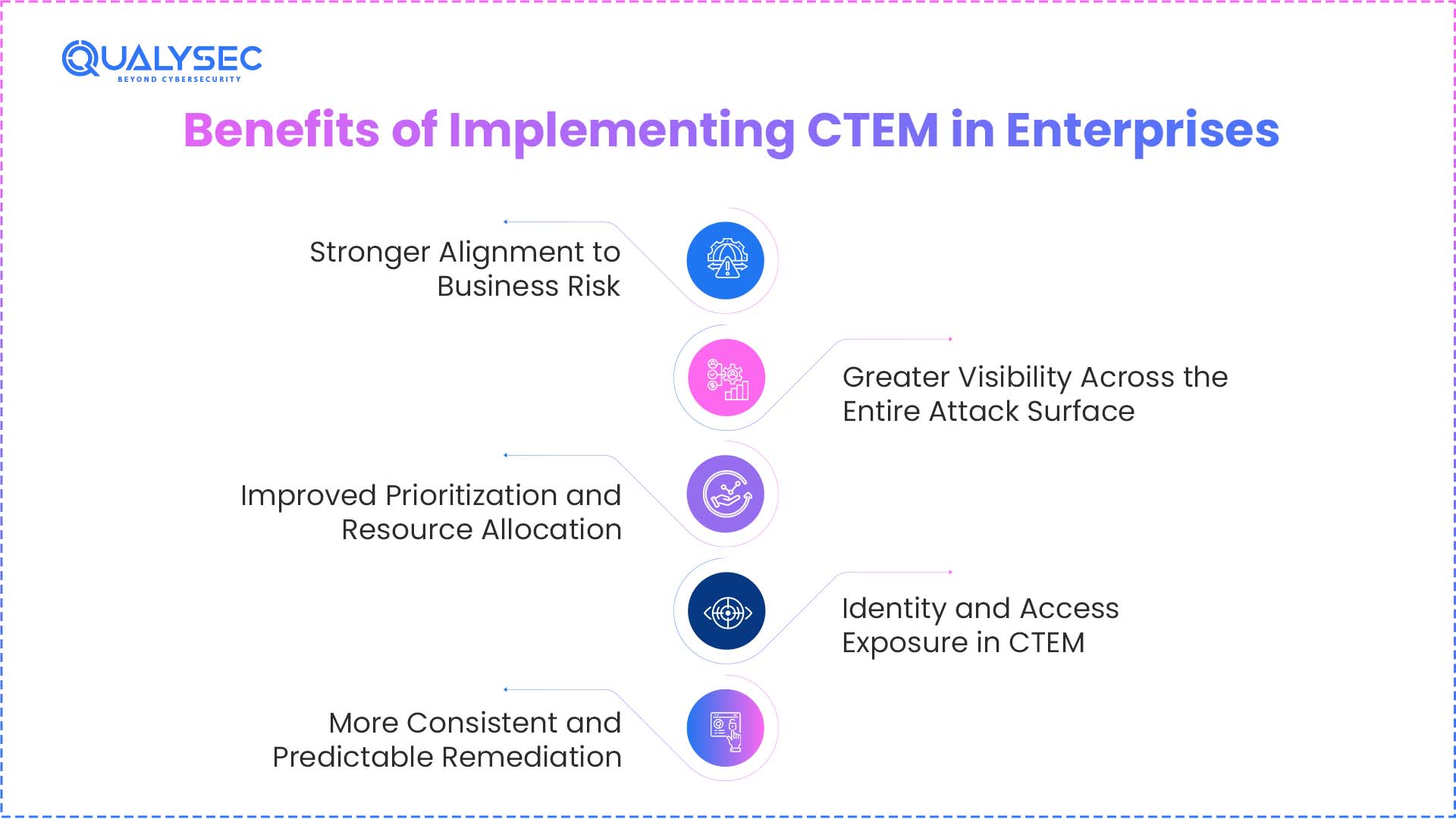
1. Stronger Alignment to Business Risk
Severity scores have their place, but they rarely tell you what actually puts your business at risk. A high score does not always mean high impact. What matters is how an exposure affects your revenue or compliance.
That is where risk-based vulnerability management starts to make sense. Instead of trying to fix everything, the focus shifts to exposures that can:
- Interrupt critical systems
- Affect customer-facing services
- Lead to regulatory issues
This keeps your team from getting pulled in too many directions. It also helps you stay focused on what actually needs attention.
It also makes conversations easier outside the security team. You are not just sharing technical details, you are explaining what those issues mean for the business. That clarity helps leadership make decisions faster with the right enterprise security solutions in place.
2. Improved Prioritization and Resource Allocation
Most security teams are not short on findings. They are short on clarity. Backlogs grow because everything looks important on paper.
With that clarity, planning becomes simpler. Security teams can allocate time and resources with confidence, avoid unnecessary work, and maintain steady progress using the right cyber risk reduction tools.
3. More Consistent and Predictable Remediation
Remediation often depends on urgency rather than process. One week is filled with high-priority fixes, the next slows down with little follow-through. That inconsistency makes it difficult to track progress or measure improvement over time.
When handled as an ongoing function, remediation becomes easier to manage and follow. Instead of ad hoc fixes, teams work within a clear structure:
- Defined workflows that outline how issues move from discovery to resolution
- Clear ownership across DevOps, IT, and security teams
- Shared visibility so nothing gets lost between handoffs
This brings better control to the process. Issues are resolved faster, tracking becomes straightforward, and accountability is no longer unclear. Teams can rely on consistent execution, supported by effective security operations solutions.
4. Greater Visibility Across the Entire Attack Surface
In most enterprises, visibility is fragmented. Different teams look at different parts of the environment, which leaves gaps that no one fully owns. That is how assets get missed, and risks go unnoticed.
A more complete view brings everything into one place, so you are not relying on partial data. This includes:
- Cloud environments and workloads
- SaaS applications in active use
- Identities and access controls across systems
- On-premises infrastructure that still supports core operations
When these areas are connected, common blind spots become easier to catch:
- Shadow IT that was never formally tracked
- Orphaned assets that remain exposed without ownership
This level of clarity helps leadership see actual exposure instead of isolated findings, especially when supported by the right exposure management platforms.
5. Identity and Access Exposure in CTEM
In most enterprise breaches today, identity is the initial entry point. Attackers do not always exploit software vulnerabilities. They exploit access.
CTEM expands visibility beyond systems to include identity-based exposures such as:
- IAM misconfigurations that grant excessive or unnecessary permissions
- Privilege escalation paths that allow low-level accounts to gain administrative access
- Stale or orphaned accounts that remain active without ownership
- Service accounts and machine identities with long-lived credentials
- Token misuse and credential leakage across APIs and cloud services
These identity risks often connect multiple systems and create hidden attack paths.
By including identity analysis within CTEM, organizations move closer to a Zero Trust model, where every access request is verified and continuously evaluated based on risk.
6. Measurable and Continuous Risk Reduction
Security reports can easily have a snapshot of a given time, but they seldom indicate whether the situation is getting better. This makes it hard to know whether or not your risk reduction efforts are effective.
By taking a continuous approach, you are able to monitor the alterations in exposure with time. This will provide you with better insight into whether risks are escalating or are being controlled.
It also supports practical needs across the business:
- Demonstrating progress when justifying budgets
- Tracking how your security program is maturing
- Aligning with governance and reporting expectations
Connect with our experts to see how CTEM works with real-world validation and measurable outcomes.

Types of CTEM Solutions (Tool Stack Breakdown)
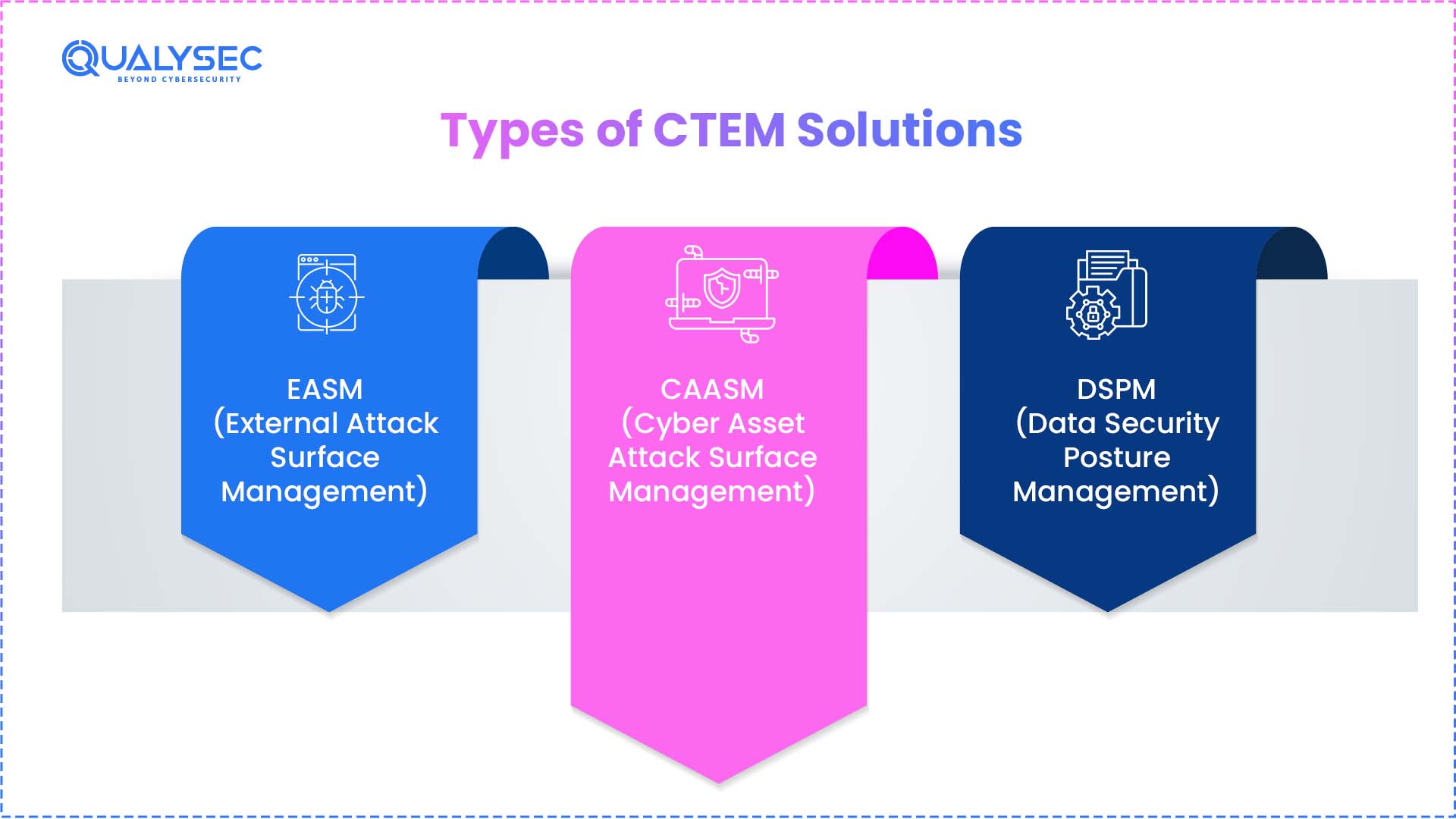
Modern Exposure Management Categories
As CTEM evolves, several specialized categories have become critical:
- EASM (External Attack Surface Management)
Focuses on discovering and monitoring internet-facing assets, including unknown or shadow systems - CAASM (Cyber Asset Attack Surface Management)
Provides a unified view of all assets across cloud, on-prem, and SaaS environments - DSPM (Data Security Posture Management)
Identifies where sensitive data resides and how it is exposed across systems
These categories strengthen CTEM by improving visibility across assets, identities, and data.
You are not dealing with a single product here. CTEM solutions come together as a mix of tools, each solving a specific part of the problem.
| Category | What It Does |
| Attack Surface Management | Finds external exposures, tracks internet-facing assets, and uncovers shadow IT that often goes unnoticed |
| Vulnerability Management | Identifies known vulnerabilities using CVEs and keeps systems under continuous scanning |
| Risk-Based Vulnerability Management | Prioritizes issues based on exploitability and business impact using risk-based vulnerability management |
| Breach and Attack Simulation | Runs automated attack scenarios to test how your defenses respond |
| Adversarial Exposure Validation | Validates real attack paths by connecting multiple weaknesses into practical scenarios |
| Continuous Pentesting | Combines human testing with automation to uncover deeper, less obvious issues |
| Remediation Orchestration | Automates workflows, assigns tasks, and tracks fixes through ticketing systems |
Best CTEM Solutions for Enterprises (2026 Comparison)
No single tool covers everything. What you choose depends on where your gaps are, whether that is validation or execution. The tools below are grouped by what they actually help you solve.
Continuous Validation and Exposure Testing
Cymulate
If you want to see how your defenses behave under pressure, Cymulate does that well. It runs ongoing simulations across different parts of your environment. It shows where controls hold up and where they do not.
Teams often use it to move beyond assumptions. Instead of guessing whether something works, you get direct feedback from simulated attack scenarios. It also connects easily with existing tools, so results do not sit in isolation.
Picus Security
Picus is more focused on cutting through noise. It helps you check which findings can actually be used in an attack and which ones are not worth chasing.
This becomes useful when your team is dealing with too many alerts. Rather than reacting to everything, you can narrow down to what is worth fixing based on real validation.
Full CTEM Platforms
XM Cyber
XM Cyber looks at how an attacker would move through your environment. Instead of isolated issues, it shows connected paths across systems.
This makes it easier to understand how a small gap in one place can lead to something bigger. It is especially helpful for environments where everything is interconnected.
Tenable One
Tenable One brings together asset data, vulnerabilities, and context into a single view. It helps you understand which issues actually matter in your setup.
Teams often rely on it when they need more than just scan results. It gives a clearer picture of risk by combining multiple data points in one place.
Attack Surface Discovery
IONIX
IONIX focuses on what exists outside your internal view. It continuously discovers internet-facing assets, including those that may not be tracked properly.
It also highlights risks tied to third-party services, which can easily be missed but still affect your overall exposure.
Risk Prioritization and Intelligence
Rapid7
Rapid7 adds context to vulnerability data. Instead of showing a long list, it helps you understand which issues attackers are more likely to target.
This makes prioritization less about guesswork and more about what is actually relevant in the current threat landscape.
Remediation and Execution
Reclaim Security
Reclaim Security is built for getting things fixed. It connects findings with workflows so issues do not sit unresolved.
For teams that struggle with follow-through, this kind of setup helps keep remediation on track. It ensures work moves forward without constant manual coordination.
Check this Comparison Table
| Category | Tool | What Stands Out |
| Continuous Validation | Cymulate | Ongoing attack simulations across multiple layers with strong integrations |
| Continuous Validation | Picus Security | Clear validation of exploitable issues reduces unnecessary alerts |
| Full Platform | XM Cyber | Attack path visibility and lateral movement mapping |
| Full Platform | Tenable One | Combines asset data, vulnerabilities, and context in one place |
| Attack Surface Discovery | IONIX | External asset discovery with third-party risk visibility |
| Risk Prioritization | Rapid7 | Adds threat context to help prioritize what matters |
| Remediation | Reclaim Security | Automates workflows and keeps remediation on track |
CTEM Platform vs Tool Stack: What Enterprises Should Choose
Most teams face this question once they start building their approach. Do you rely on a single platform or put together your own set of tools?
Platform approach
- Everything is managed in one place
- Easier for teams to adopt and operate
- Faster setup with less coordination required
- Depth can be limited in areas like validation or advanced testing
Tool stack approach
- You choose tools based on what each one does best
- Stronger capabilities in specific areas
- Requires effort to integrate and maintain
- Data and workflows can become fragmented
Explore our case studies, see how enterprises are reducing real-world security risks with CTEM.






















































0 Comments