






Cloud adoption has made vendor risk harder to manage than ever. You rely on multiple providers, yet getting clear answers about their security practices often feels inconsistent and time-consuming. Each vendor responds differently, which slows down procurement and leaves gaps in decision-making.
This concern is not theoretical. In recent years, nearly 45% of data breaches have occurred in cloud environments, and public cloud incidents cost an average of 5.17 million dollars per breach. When security visibility is limited, the risk becomes difficult to control.
To bring structure into this process, the consensus assessment initiative questionnaire CAIQ helps you evaluate vendors consistently and reliably across SaaS, PaaS, and IaaS. It is important to note that CAIQ is not a certification. It is a standardized self assessment framework designed to simplify security reviews.
In the next sections, you will see how it works and how it compares with other approaches.
Key Takeaways
- The consensus assessment initiative questionnaire (CAIQ) provides a consistent way to review cloud security using a structured set of questions based on the Cloud Controls Matrix
- Includes around 261 questions mapped to nearly 197 controls in version 4
- Commonly used to assess vendor risk and understand how security is handled
- Works as a self-assessment tool, not a certification or audit
- Plays a key role in enterprise procurement and CSA STAR submissions
- Reduces the need to create separate security questionnaires for every vendor
What is CAIQ?
The consensus assessment initiative questionnaire (CAIQ) is a security questionnaire that comes as a downloadable spreadsheet. It includes a list of questions, mostly answered with yes or no, along with a small space where vendors can explain their response if needed. This keeps things simple but still gives you enough context to understand what is actually in place.
The main idea behind the CAIQ questionnaire is to show how a vendor handles security in practice. Instead of vague promises, it focuses on whether specific controls exist and how they are managed across their cloud environment.
When you are reviewing vendors, the CAIQ assessment helps you ask the same questions to everyone. This makes it easier to compare answers, spot missing controls, and avoid surprises later. It brings more clarity to a process that usually feels scattered and inconsistent.
Why CAIQ Exists
If you have ever been part of a vendor review process, you already know the problem. Every organization sends its own set of security questions. Some are detailed, and some are vague. Vendors end up answering the same things again and again, just in slightly different formats.
This lack of consistency creates real friction. You spend more time sorting through mixed responses than actually evaluating security. It also slows down procurement, especially when answers need follow-ups or clarification.
The CAIQ was introduced to bring order to this process. Instead of reinventing questionnaires each time, it gives you a common set of questions that vendors can respond to in a structured way.
Need to validate vendor security beyond CAIQ answers?
Talk to Qualysec for expert penetration testing and real-world security validation.
How CAIQ Works
1. Mapping to Cloud Controls Matrix
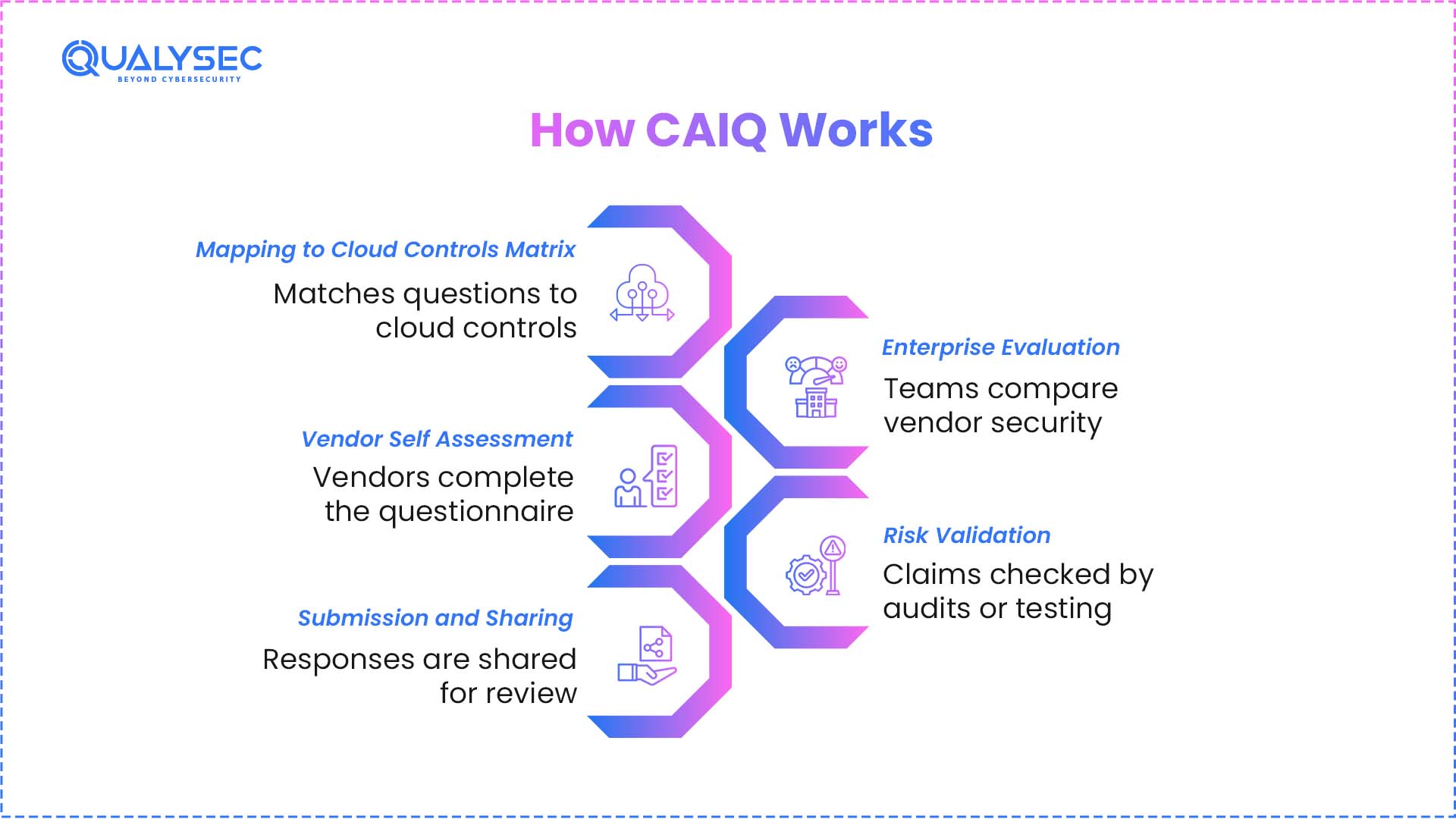
To understand how this framework works in practice, you need to look at its connection with the Cloud Controls Matrix or CCM. CCM acts as a reference framework that outlines which security controls should be present in a cloud environment. It brings structure by organizing controls into key areas such as:
- Governance
- Risk management
- Operations
This structure ensures that critical security areas are not missed during evaluation.
CCM also aligns with widely accepted standards and regulations, which helps you stay consistent with broader compliance expectations.
You can use CCM as a reference point when reviewing a provider or even when shaping your own cloud security approach. It gives you a structured view of the risks involved and the controls required to manage them.
This is where the questionnaire comes in. It takes those defined controls and turns them into practical questions. Instead of just listing what should exist, it focuses on how those controls are actually put into place. That shift from theory to real implementation is what makes the process more useful during vendor evaluation.
2. Vendor Self Assessment
At this stage, the cloud service provider completes the questionnaire based on their current setup. Most responses are marked as yes, no, or not applicable, depending on whether a control is in place.
To support these answers, vendors often include relevant details such as:
- Internal policies that guide their security approach
- Architecture level information to explain how systems are designed
- Day to day security practices followed across their environment
This step gives you a closer look at how things actually run behind the scenes, not just what is claimed on the surface.
In many organizations, this process is no longer fully manual. Some organizations are beginning to use AI-assisted tools to streamline responses by referencing existing policies and documentation, though human validation remains essential. These suggestions are then reviewed and validated by subject matter experts before submission. This reduces repetitive work while still keeping accuracy in check.
3. Submission and Sharing
Once completed, the CSA CAIQ is usually shared with customers during the vendor evaluation process. This helps you review a provider’s security posture without starting from scratch every time. Some providers also choose to publish their responses in the STAR Registry managed by the Cloud Security Alliance. When submitted to the CSA STAR Registry, CAIQ responses form part of a STAR Level 1 self-assessment listing.
When the Cloud Security Alliance CAIQ is already available in the registry, you can check it yourself without waiting on the vendor. It cuts down a lot of back and forth and makes the whole review process quicker.
4. Enterprise Evaluation
This is where your security team goes through the responses carefully. They look at what the vendor has actually put in place and where things seem missing or unclear.
Since every vendor answers the same questions, you can compare them directly. It becomes easier to see which ones meet your requirements and which ones do not.
Many enterprises map CAIQ responses to internal risk scoring models to prioritize vendors based on criticality and exposure.
5. Risk Validation
What vendors share in their responses still needs a closer look, especially for critical systems. In some cases, teams choose to validate this through:
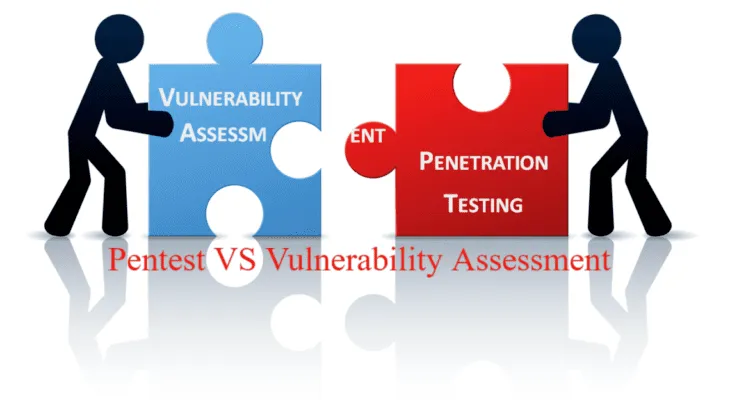
- Penetration testing to understand how the system behaves under real-world attack scenarios
- Security audits to review whether controls are actually in place and working
Not every situation calls for deep testing, but when the risk is higher, this step helps you rely on more than just documented answers.
CAIQ Structure Explained
The CAIQ t follows a clear structure so you can review cloud security. In version 4, it includes:
- Around 261 questions
- About 197 control mappings
- 17 security domains
Each domain focuses on a specific area of cloud security.
Below is a breakdown of what each domain looks at and the kind of questions you can expect.
| Domain | What It Covers |
| Audit Assurance and Compliance | How audits, certifications, and regulatory requirements are handled |
| Application and Interface Security | Protection of applications and APIs from common threats |
| Business Continuity and Operational Resilience | Preparedness for disruptions and ability to maintain operations |
| Change Control and Configuration Management | How system changes are tracked, approved, and maintained |
| Cryptography, Encryption and Key Management | Use of encryption and handling of cryptographic keys |
| Datacenter Security | Physical security measures within data centers |
| Data Security and Lifecycle Protection | Protection of data from creation to deletion |
| Governance, Risk & Compliance |
|
| Human Resources Security | Employee screening, training, and onboarding practices |
| Identity and Access Management | User access control, authentication, and privilege management |
| Infrastructure and Virtualization Security | Security of
|
| Interoperability and Portability | Ability to move and integrate data across systems |
| Mobile Security | Management of mobile devices and bring your own device setups |
| Incident Management/ Forensics | Detection and investigation of security incidents |
| Supply Chain and Accountability | Risks related to third parties and vendor dependencies |
| Threat/Vulnerability Management |
|
| Universal Endpoint Management | Device tracking, updates, and patch management |
CAIQ vs Cloud Controls Matrix
This is where many teams get confused. Both are closely related. But they serve different purposes. At a simple level, one defines what should be in place, while the other helps you check if it actually is.
| Component | Role |
| Cloud Controls Matrix | Defines the security controls expected in a cloud environment |
| CAIQ questionnaire | Helps assess whether those controls are implemented in practice |
The Cloud Controls Matrix acts as a blueprint. It lays out what a secure setup should look like. The CAIQ works more like an inspection checklist. It helps you verify if that blueprint has actually been followed.
CAIQ Versions and Evolution
The CAIQ has changed quite a bit over time. Each update reflects how expectations around CAIQ security have become more detailed, especially when it comes to clarity and ownership.
CAIQ v3.1
This version was widely used before 2021 and had a more basic structure. It included 310 questions across 16 domains and aligned with CCM v3.0.1.
- Worked as a simple spreadsheet
- No clear way to show who owns each control
- Limited visibility for customers reviewing vendor responses
It did the job at the time, but left gaps when it came to accountability.
CAIQ v4.0
The 2021 update brought noticeable changes. The number of questions dropped to 261, but the structure became more useful. One extra domain was added, taking the total to 17.
- Introduction of Shared Security Responsibility columns
- Clear indication of whether the provider, customer, or a third party owns a control
- New focus on logging and monitoring
- Became the standard for STAR Level 1 submissions
This version made reviews more practical since you could finally see who is responsible for what.
CAIQ v4.1
The latest version continues in the same direction, with more depth and better integration options.
- 283 questions and 207 mapped controls
- Same 17 domains, but expanded coverage in key areas
- Supports formats like JSON, YAML, and OSCAL for easier integration
- Can be connected with GRC tools and automated workflows
There is also a transition timeline in place. New STAR submissions will move to this version starting July 2027, and existing listings will need to follow by January 2028.
CAIQ Lite
Not every situation needs a full-scale assessment. That is where CAIQ Lite fits in.
- Shorter version with around 71 to 124 questions, compared to 261 in the full version
- Still touches all control domains
- Useful for quicker reviews or lower-risk vendors
It was created to support faster procurement cycles without skipping the basics.
CAIQ Variants You Should Know
Different situations call for different levels of detail. Over time, a few versions have come up to make CAIQ security more practical, depending on the type of vendor and how quickly you need answers.
CAIQ Lite
CAIQ Lite keeps things shorter, with around 124 questions instead of the full set. It is useful when you are working with smaller vendors or when time is limited. You still get coverage across all domains, just without going too deep into each one. This makes it easier to move forward without getting stuck in long reviews.
Emerging AI CAIQ
This one comes into play when vendors are using AI or machine learning. A regular questionnaire does not always cover risks tied to models or training data. This version looks into areas like how models are protected, whether data can be tampered with, and how those systems are managed over time. It helps you ask questions that actually match how the technology is being used.
Machine Readable CAIQ
Some teams prefer not to handle everything manually. This version supports formats that can plug into existing tools, so responses do not stay limited to a spreadsheet. It allows you to run automated checks and keep track of updates without repeating the same review again and again.
Benefits of CAIQ
For Enterprises
When you are reviewing vendors, the biggest challenge is dealing with different formats and scattered answers. Each provider explains things in their own way, which makes it harder to compare them fairly.
A structured questionnaire solves that. You get responses in the same format, so you can go through them without second guessing what each answer means. It becomes easier to line things up and see where each vendor stands.
It also saves time during evaluation. Most of the required details are already documented, so there is less need to keep asking follow up questions. This keeps the process moving and reduces the effort spent on checks.
For Cloud Providers
For vendors, one major advantage is reuse. Once the questionnaire is filled, it can be shared with multiple customers. It also makes conversations easier. When your responses are clear and structured, customers can understand your setup without needing extra clarification.
Another benefit is around compliance. Since the format already reflects industry expectations, it becomes easier to show how your controls are managed without preparing separate explanations for each request.
Limitations of CAIQ
- A common mistake is treating CAIQ as proof of security rather than an initial screening tool.
- Based on self-reported answers, so accuracy depends on what the vendor shares
- Responses are often marked as yes without supporting proof
- No built in way to verify whether controls are actually implemented
- Requires separate validation if you want confirmation
- Can take time to review, especially when dealing with multiple vendors
CAIQ shows claims—testing proves controls.
Book a free consultation with Qualysec to assess your cloud, web, and API security posture.
How to Use CAIQ Effectively
Filling or reviewing the questionnaire properly makes a big difference. If it is treated like a checkbox exercise, it loses value. If handled carefully, it gives you clear insight into how security is actually managed.
How Vendors Should Fill CAIQ
- Avoid marking everything as yes without context
- Add short explanations where needed so answers do not feel incomplete
- Refer to actual documents, such as policies or internal guidelines
- Make sure responses reflect what is truly implemented, not what is planned
- Mature vendors often support CAIQ responses with evidence such as policies, certifications, or audit reports to improve trust and reduce follow-up.
How Enterprises Should Review CAIQ
- Watch for answers that feel vague or too broad
- Check if supporting details or references are missing
- Notice repeated use of not applicable, especially in important areas
- Focus more attention on critical controls instead of treating all responses equally
Red Flags to Watch
- “Yes” marked without any explanation
- No clear details about encryption practices
- Weak or unclear access control setup
- No defined incident response plan
These signals do not always mean something is wrong, but they are worth a closer look before moving forward.
CAIQ vs Other Security Questionnaires
There is no single questionnaire that fits every situation. Different frameworks are used depending on the type of vendor and the level of risk involved.
CAIQ vs SIG Lite
SIG Lite is usually picked when the risk is lower and a full scale review is not needed. It keeps things shorter, with under 200 questions, and covers the basics without going too deep.
In comparison, the consensus assessment initiative questionnaire (CAIQ) is more focused on cloud environments. It connects directly to cloud controls, which makes it more useful when you are dealing with SaaS or other cloud services.
CAIQ vs SOC 2
SOC 2 is an audited report. It involves an independent auditor reviewing a company’s controls and confirming whether they meet defined criteria over a period of time. The consensus assessment initiative questionnaire (CAIQ) works differently. It is a self-assessment where the vendor provides answers about their security practices without a formal audit.
In simple terms, SOC 2 gives you validated assurance, while CAIQ gives you visibility into how controls are described.
CAIQ vs HECVAT (Higher Education Cloud Vendor Assessment Toolkit)
HECVAT was created for colleges and universities. It looks at risks that are common in that space, especially around student data and research systems.
Some of its questions still apply outside education, but the focus stays tied to that sector. The CAIQ questionnaire, on the other hand, is not limited to one industry. It is built around cloud systems, so it fits a wider range of use cases.
CAIQ vs VSA
The Vendor Security Alliance provides two versions, one detailed and one shorter. The full version goes deep into security practices, while the core version sticks to the essentials.
These questionnaires are used by many companies and help avoid creating custom assessments every time. They also cover privacy and compliance areas in a structured way.
How Qualysec Strengthens CAIQ-Based Security Validation
Answers in the questionnaire only show what is claimed. They do not confirm if those controls actually work in real conditions. This is where Qualysec helps by validating those claims through testing.
Where Qualysec Fits
Qualysec acts as a validation layer by checking whether security controls are properly implemented across applications, APIs, and cloud environments.
- Web application testing checks if application-level protections are actually in place
- API testing verifies access control and data exposure risks
- Cloud testing reviews the infrastructure-level security and configurations
Testing Approach
Qualysec uses a three-layer approach to improve coverage and accuracy:
- Manual testing to find complex issues and business logic flaws
- AI-driven agents to simulate real attack scenarios and uncover hidden risks
- Automated scanners to detect known vulnerabilities quickly
This approach helps you rely less on stated answers and more on actual results. It also makes it easier to support compliance requirements such as SOC 2 and ISO 27001, since controls are tested and not just documented.
Partner with Qualysec for human-led AI penetration testing and deeper cloud security assurance.
Conclusion
The consensus assessment initiative questionnaire makes vendor reviews less chaotic. You are no longer dealing with scattered answers or guessing what each response means. It gives you a clean starting point. What it does not do is prove anything on its own. A well filled questionnaire can still hide gaps if no one checks what is actually happening behind it.
That is why teams are moving toward a mix of structured reviews and hands on validation. It is a more grounded way to understand risk, and it is quickly becoming the standard for building real trust in cloud environments.



















































































0 Comments