







Key Takeaways
- CDSCO does not call out VAPT directly, but its requirements around risk, software checks, and safety make security testing part of the process
- VAPT is not just a technical step. It supports your approval by showing that the team has properly checked all risks.
- Testing cannot be limited to one stage. It needs to be part of both pre-submission work and what you do after the device is in use
- Since the guidelines are not always explicit, how you interpret and apply them can make a real difference during review
Introduction
If you manufacture or supply medical devices in India, regulatory expectations are already part of your daily operations. The Central Drugs Standard Control Organization governs these requirements under MDR 2017. They ensure devices meet safety and quality standards before reaching patients. Connected systems, software-driven tools, and smart healthcare technologies are now part of everyday clinical use.
This shift has opened the door to a new kind of risk. Recent findings from connected medical devices expand the attack surface across firmware, APIs, and hospital networks, highlighting that Indian organizations face thousands of cyberattacks every week, with healthcare among the most targeted sectors. Understanding CDSCO VAPT requirements is becoming a critical part of that, which puts medical devices directly in the line of fire.
Here is where things get confusing. You will not find a direct statement that VAPT is mandatory under CDSCO. Still, cybersecurity expectations strongly point in that direction.
So what does CDSCO actually expect from you when it comes to security testing? Let’s break it down.
CDSCO Regulatory Framework for Medical Devices
The CDSCO regulates medical devices in India under the Medical Device Rules 2017. These rules define how the CDSCO approves and monitors your device once it enters the market. You need to focus on:
Regulatory role of CDSCO
- Reviews and approves medical devices before market entry
- Issues with manufacturing and import licenses
- Monitors compliance through audits and post-market checks
Device classification and risk levels
- Class A: Low-risk devices
- Class B: Low to moderate risk
- Class C: Moderate to high risk
- Class D: High-risk and critical devices
As you move from Class A to Class D, expectations increase. Higher risk devices face deeper evaluation, which includes how well you handle potential security weaknesses, especially if your device processes or transmits data.
The scope of regulation has expanded to include software-driven and connected technologies. Software as a Medical Device now falls within CDSCO VAPT requirements oversight, which means the agency may evaluate your product even if it does not exist as traditional hardware. The CDSCO reviews devices that rely on cloud infrastructure more carefully.
Unlike global regulators such as the U.S. Food and Drug Administration, the Central Drugs Standard Control Organization does not yet prescribe detailed cybersecurity testing frameworks, but expects manufacturers to demonstrate security through risk management and validation.
Where CDSCO Implies VAPT Requirements
CDSCO does not directly state that VAPT is mandatory. That said, several regulatory requirements expect you to prove that your device can handle security risks in real conditions. When you connect those expectations, security testing becomes part of compliance rather than an extra step.
The relationship between CDSCO clauses and VAPT looks like this:
| CDSCO Requirement | What You Are Expected to Do | Role of VAPT |
| Essential Principles of Safety and Performance | Ensure the device remains safe against all possible external risks | Detects weak points that attackers could exploit |
| Software Validation Requirements | Confirm that the software works as intended under all conditions | Checks how the system responds to attempted breaches |
| Risk Management aligned with ISO 14971 | Identify and reduce risks across the device lifecycle | Confirms whether existing controls actually prevent attacks |
| Post Market Surveillance | Continue monitoring safety after the device is in use | Finds new vulnerabilities as they emerge over time |
Safety is not only about hardware working as expected. If someone can access your device through a network and change its behavior, that risk counts too. Testing helps you catch such issues early. Software checks should not stop at basic functionality. You need to see how it reacts when someone tries to misuse it.
Schedule your free Compliance Consultation with Qualysec Today.
What CDSCO Expects from VAPT in Medical Devices
CDSCO looks for proof that you have tested your device for security, not just statements in documents. You need to demonstrate clear evidence that the team identified, tested, and managed risks appropriately.
From a practical standpoint, your VAPT process should demonstrate:
- Identification of vulnerabilities present in the device
- Assessment of how easily an attacker can exploit those vulnerabilities
- Classification of risk based on severity and impact, often supported by standardized scoring models such as CVSS, to ensure consistency and audit clarity.
Testing should not be limited to one layer. It needs to cover the full environment around your device:
- Device software and internal logic
- Communication interfaces such as APIs, ports, and data exchange points
- Backend systems, including servers and cloud components
Along with testing, documentation plays a key role in the review process. You should be prepared to provide:
- Detailed test reports with findings
- Steps taken to fix or reduce identified risks
- Validation results showing that fixes are effective
The focus remains simple. The CDSCO expects you to prove that you have tested your device properly and that you have addressed any gaps identified during the process.
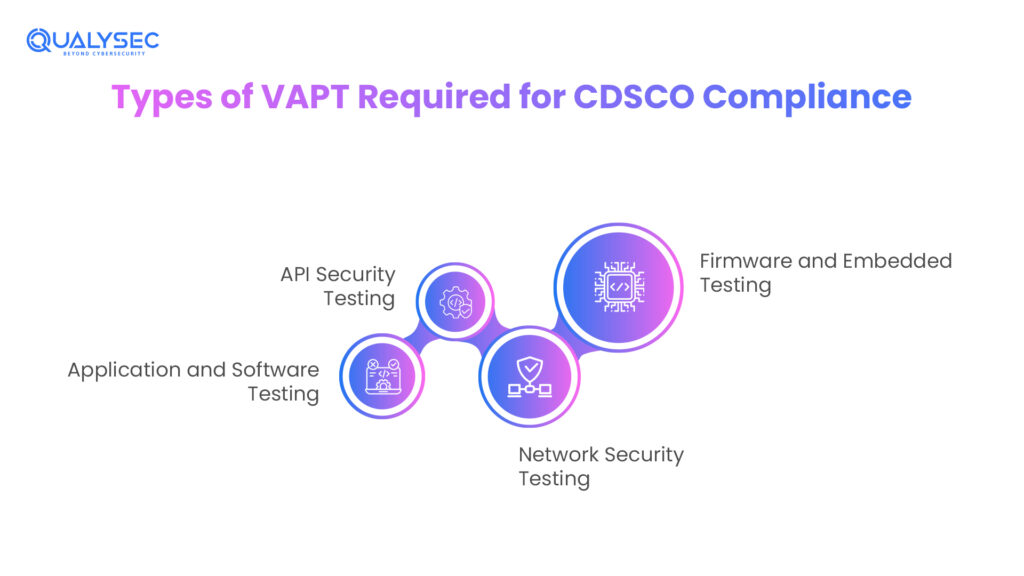
Types of VAPT Required for CDSCO Compliance
1. Application and Software Testing
Software within a medical device plays a direct role in its operation. This includes SaMD solutions, user panels, and systems used to control or monitor the device. Testing assesses what happens when someone attempts to use the system incorrectly—for example, trying to log in without proper access or entering unusual data.
When you perform VAPT for healthcare devices, this step helps you uncover problems that could affect both control and safety before you deploy the device. When you perform VAPT for healthcare devices, this step helps you uncover problems that could affect both control and safety before you deploy the device.
2. API Security Testing
When your device connects with a mobile app or a cloud system, APIs handle that communication. These connections need proper checks. The focus is on whether data stays private and reaches only the intended user. Access control is another area to review. Make sure no one can get in without valid permission.
Since many devices rely on these connections to function, a gap here can affect device behavior and system data handling.
3. Network Security Testing
Medical devices connect with other systems inside hospital networks. The team should check this communication carefully. Medical devices Testing looks for open ports that should not be accessible. It also reviews the protocols you use, since weak or outdated ones can expose data or allow interference.
4. Firmware and Embedded Testing
Firmware is what runs the device in the background. If something is wrong here, it affects everything. Along with this, secure boot mechanisms should be verified to ensure only trusted firmware can run on the device. Firmware integrity validation is also critical to confirm that no unauthorized modifications have been introduced during updates or deployment.
During testing, the team opens up and checks this layer for hidden threats. For example, anyone who finds fixed usernames or passwords built into the system can use them. The team also reviews the update process. If attackers can bypass proper checks to install or modify updates, they can compromise the device from the outside.
Learn more: IoT and Healthcare Device Penetration Testing
When VAPT is Required in the CDSCO Approval Lifecycle
Pre-Market Stage
Before you submit your device for approval, the CDSCO expects you to show that the team has properly studied and addressed all risks. This process covers more than just functional or clinical risks. Security also becomes part of that review, especially if your device includes software or connectivity.
At this stage, risk assessment helps you identify where things can go wrong. VAPT supports this by showing how those risks can be exploited in real conditions. It gives you clear proof of what exists and how serious it is.
This directly feeds into your technical documentation. If you state that your device is secure, there should be clear test results to support that claim. Without that, your safety claims remain incomplete.
For many manufacturers, this step becomes a key part of CDSCO VAPT compliance, as it helps demonstrate that security has been considered before the device reaches the market.
Post Market Stage
Once your device is in use, the work does not stop there. New risks can appear as systems change or updates are introduced.
You have to track newly reported vulnerabilities and understand how they affect your device. After any update or change, the team should perform testing again to confirm everything remains secure. This also falls under CDSCO VAPT requirements, where you check devices again after updates or when you identify new risks.
During Product Updates
You change something in the software, and it rarely stays limited to just that one part. A small fix can affect another function. Something you already solved can show up again. It does not always break immediately, which makes it harder to catch later. So every update has to be checked before release. You look at what changed and what it might have touched.
In addition to testing changes, update mechanisms themselves should be validated. This includes verifying signed updates and ensuring patch integrity so that only authorized and untampered updates are applied to the device.
VAPT Methodology Expected for Medical Device Compliance
When CDSCO reviews your submission, they are not looking for a checklist. They want to see how you actually looked at the device from a security angle.
- Threat modeling: You first start by thinking like someone trying to get in. What can they reach, what can they control, and what would they go after first? This depends on how your device is used and where it sits.
- Attack surface identification: Then you trace every point where the device connects or accepts input. APIs, firmware, communication channels, anything that opens a path from outside.
- Vulnerability identification: Tools will give you a list, but that is just the start. You go deeper and check how the system behaves, where inputs are not handled properly, or where logic can be pushed in the wrong direction.
- Exploitation testing: At this stage, you simulate attacks to check those weak points. This shows which problems can actually affect the device.
- Risk classification: Once you see what works, you judge how serious it is. Some issues are minor, and some can directly affect device control or safety.
- Reporting and remediation: Everything is written clearly. What was found and how it was fixed. When fixes are applied, they are checked again to confirm the issue is resolved.
In India, this approach aligns with how teams carry out medical device vulnerability assessment in India, focusing on what can actually impact the device rather than just listing issues.





































































































































































































































0 Comments