







CDSCO Cybersecurity Audit Services assists the Indian medical device manufacturers in obtaining clearance by identifying issues and ensuring that they comply with the CDSCO regulations. These controls are also crucial since there has been an increased attack on health care. India in the year 2026 recorded 265 million cyber attacks, with nearly half of the attacks targeting the health care, education, and manufacturing sectors. Cases of ransomware saw 30% increase in 2025, and breaches can result, as in the case of AIIMS, which revealed 40 million patient records.
Are you willing to secure your medical device? Contact Qualysec Technologies today to get the professional services of a CDSCO cybersecurity audit!
CDSCO Overview
The agency that regulates medical devices in India is CDSCO, which is governed by the Medical Devices Rules, 2017 (MDR). It has also been revealed that in 2026, CDSCO has emphasized more on software and connected devices by releasing draft guidance late in 2025.
The CDSCO Cybersecurity Audit Services technique applies risk-based classes of Class A (low risk) to Class D (high risk). It includes AI diagnostics and implantation. To the approved, manufacturers have to submit technical documentation, such as cybersecurity risk management.
Preparing for Submission
Carry out audits 6-12 months before filing them. Append them early into your Quality Management System (QMS).
Steps –
- Form a cross-functional staff (development, regulatory, security).
- Test your current security status.
- Solve the issues with proven solutions.
- Prepare an audit report that you will put under your CDSCO file.
This is in line with the digital licensing updates of CDSCO in 2026.
Medical Devices Cybersecurity Risks
There are also many more CDSCO cybersecurity requirements that can be linked, such as pacemakers that can be checked remotely, AI imaging machines, and they are also susceptible to difficult cyber attacks.
Healthcare IoT devices increased 28% in 2025 in India, but 32% are yet to be filled, such as poor encryption or default passwords. The number of ransomware attacks in hospitals rose. In early 2026, one of the facilities in Delhi was offline, and important surgeries were delayed due to the fact that the facility was offline for 72 hours.
These are not only threats of data theft. A hacker may manipulate dosages of insulin pumps or the settings of a ventilator and endanger lives. Bluetooth and Wi -Fi are common targets as demonstrated by international instances of hackers receiving patient information during their procedures.
The threat is aggravated by the internal issues of India. In the national cyber incidents, the old systems in tier-2 cities do not separate networks. Supply-chain attacks, such as the altered parts, increased by 40 percent last year. One out of every five imported devices fails to pass basic security checks once imported, regulators say.
Deep dive into IoMT Security (Internet of Medical Things)
CDSCO Cyber Security Requirements
The CDSCO cybersecurity requirements must have full cybersecurity as per the 2017 Medical Devices Rules, with software as a medical device (SaMD) draft guidance released in 2025. These regulations address the entire aspect of the device life: design, development, launch, and post-sale surveillance.
Risk management with ISO 14971 and cybersecurity controls with ISO 27001 are the most important aspects. Form MD-15 requires companies to submit a Software Requirements Specification, architecture drawings, and vulnerability checks. In the case of Class B-D, they should demonstrate secure design, threat modeling, and secure boot.
Both devices with high risk require post-sale change evidence and penetration testing, and AI models in particular. The DPDP Act 2023 is another legislation that CDSCO pays attention to, regarding the safe handling of data, where patient data is encrypted. Failure to meet regulations may lead to a ban on importation of the device or withdrawal of the license, as was the case in three 2026 heart monitor cases.
The PLI program in India provides funds in exchange for good cybersecurity, where local makers are encouraged to employ well-known controls. Audits of the integrity of software and verification of over-the-air updates.
Significance of CDSCO Cybersecurity Audit Services
CDSCO Cybersecurity Audit Services transform paper compliance into actual safety and ensure that effort is not lost by refusing submission and making the market entry through the delay of 6-18 months. By 2026, one out of five applications will have broken down due to a vulnerability in cybersecurity.
They replicate actual attacks, where issues such as incorrect API settings that are self-checking are missed. In the case of Indian companies, they meet global standards on exports.
Provisional licenses are issued to devices more quickly. They also minimize the possibility of fines. Mumbai diagnostics companies that relied on audits did not experience incidents after launch.
According to experts, auditors encourage early testing, which is likely to reduce the cost of fixing it. As the medtech market is set to reach 1.5 lakh crore in India by 2027, such services will give a company an edge in a market that is closely observing security.
Critical Elements of a Medical Device Security Audit in India
In India, auditors conduct medical device security audits step by step using a standards-based approach to fulfill CDSCO requirements.
1. Reconnaissance
The reconnaissance concludes the investigation and is the procedure for collecting detailed data about the vulnerability. To begin with, map the device ecosystem – firmware, APIs, wireless protocols (BLE, Zigbee). Identify useful resources, such as flows of patient data.
2. Vulnerability Assessment
Then, check Vulnerability Assessment by both static and dynamic scans. These detect CVEs in libraries and in keys that are hard-coded. Many of the known problems are identified with the help of the tools.
3. Penetration Testing
Ethical hackers then attempt intrusion, e.g., fuzz injection of infusion pump control or privilege escalation by imaging software.
4. Firmware and Code Review
Examine firmware binary backdoors and check source code backdoors.
5. Network Testing
Network testing involves testing the network’s reliability by applying a load to the server and its resources, thereby determining these resources’ capacity. The network medical device security testing of your hospital can be performed by simulating man-in-the-middle attacks on hospital Wi-Fi and ensuring updated systems work.
6. Compliance Validation
Compare it all with the medical device security testing India rules and make the MD-15 annexes. Fixes are verified with post-audit retests, which means that there are no critical vulnerabilities submitted.
CDSCO Compliance Audit Process of Medical Devices
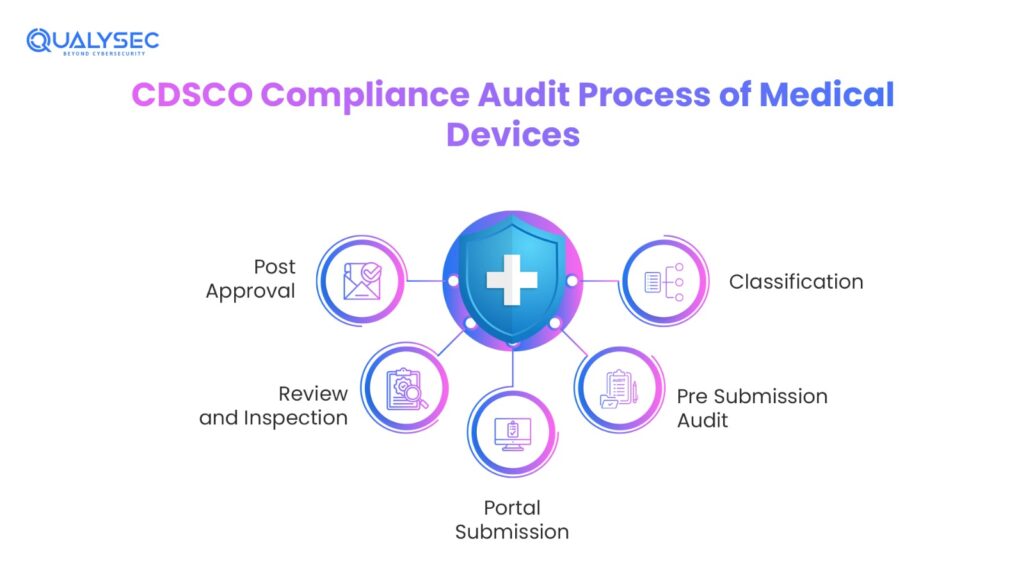
The CDSCO audit procedure provides security to the four licensing phases, namely, classifying, applying, reviewing, and approving.
1. Classification
Classify under the First Schedule; in case there are network risks on the device, it can be classified under Class C or ⁙D, such as networked defibrillators.
2. Pre‑Submission Audit
Before submitting, outsource experts to evaluate gaps in accordance with CDSCO cyberspace security standards. Prepare a technical folder that contains test reports approved by STQC in case of necessity.
3. Portal Submission
The filing is done via the SUGAM portal, with a section on cybersecurity included in Form 10/11. New regulations in 2026 will enable you to perform digital audits.
4. Review and Inspection
The file is reviewed by the CDSCO panels. They may perform on-site inspections of high-risk imports.
5. Post‑Approval
Upon authorization, submit annual safety reports, which involve incident data. Another audit is required in case you make changes to the algorithms.
Timelines – Class A or B approval takes approximately 90 days. Class C or D may take as long as 180 days, with the requirement of audits. You can be advised or denied if you are not compliant.
India insight – The state licensing bodies in Maharashtra have audited local products. Monitor the status of trucks on the CDSCO Cybersecurity Audit Services dashboard.
How Qualysec Technologies Can Help You with CDSCO Cybersecurity Audit Services
Qualysec Technologies assists the medical device manufacturers in India to achieve CDSCO approval without much strain through its special audit services. The team ensures that the devices are compliant with all tight CDSCO Cybersecurity Audit Services, reduces the approval time, and minimizes the risk.
1. Customized Medical Device Security Audit in India
Qualysec carries out a complete security inspection of a device. It begins with a threat model, which examines the self-risks of the device. The team then feigns attacks on the real-world interfaces, firmware, and APIs of IoMT. It identifies vulnerabilities such as open Bluetooth or DICOM ports, which are typical in India. Fixes are confirmed by means of manual tests, and Qualysec provides reports that demonstrate that the device can pass the CDSCO of Class B-D devices.
2. Smooth CDSCO Compliance Audit on Medical Device
In case you require a CDSCO compliance audit, Qualysec integrates the audit within your Quality Management System at the onset. They apply a tested process that has line-by-line checks, which reduces the occurrence of false alarms through rechecks. The team relates findings to the MDR technical file, architecture, and after-market monitoring. Makers receive a vivid repair plan, submit it through the CDSCO 2026 portal, and avoid rejection due to cybersecurity issues.
3. Professional Healthcare Cybersecurity Audit Services
The audits performed by Qualysec address the special problems of India, such as the increase in ransomware. They both test AI/ML software on bias and supply-chain gaps, based on draft rules starting in 2025. They conduct the audit, but after that, they conduct simulations of safety notices to assist exporters in aligning with international healthcare cybersecurity audit services standards.
4. Unique Process-Based Testing
Qualysec is unique, as all the findings are verified, with no exceptions, in the CDSCO compliance audit of medical devices. The outcome would be a vivid audit trail with risk score, fix endorsement, and the file you require in CDSCO.
Ready to secure approval? Contact Qualysec Technologies to obtain CDSCO audit services for cybersecurity today!































































































































































0 Comments