Key Security Control Areas
Below are the areas of critical control that organisations have to handle:
- Access Control: Use multi-factor authentication (MFA) and role-based access control (RBAC).
- Network Security: Implement firewalls, Internet intrusion detector systems and segmentation of the network.
- Data Protection: Encourage rest and transit data encryption.
- Incident Response: Have official procedures of preparation, detection, containment, and recovery.
- Risk Assessment: Do periodic analysis through quantitative and qualitative analysis.
- System Integrity: Install anti-malware and prompt patching processes.
Need expert guidance on implementation? Download Qualysec’s comprehensive NIST 800-53 implementation guide to see detailed control implementation strategies.
How Does NIST Cybersecurity Framework Implementation Improve Your Security Posture?
In addition to basic compliance, there are a lot of benefits derived from the NIST cybersecurity framework implementation. As a result, organisations can benefit from more secure operations and increased levels of efficiency.
Significant Value of NIST 800 53 Adoption
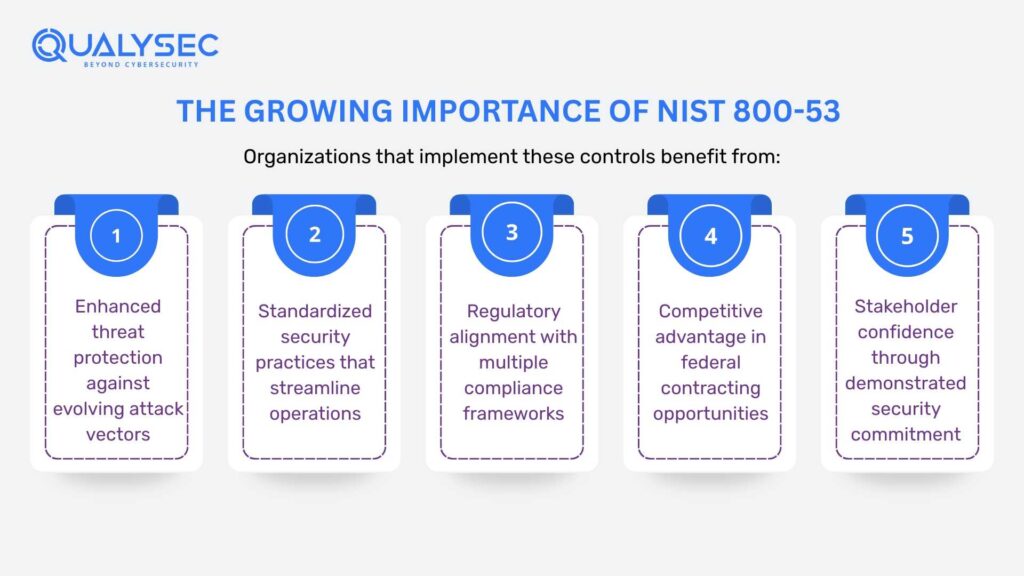
- Improved Security Posture: NIST 800-53 controls organisations offer significantly more defence against cyber attacks. Additionally, the framework encompasses contemporary assets, including IoT and IoT devices. Thus, full protection is extended to different system environments.
- Federal Market Access: This is achieved through compliance, which results in government contracts. Indeed, it usually becomes a prerequisite to conducting business with the federal government. In this way, organisations will have access to lucrative market opportunities.
- Detailed Risk Analysis: The Risk Management Framework by NIST facilitates the overall risk examination. In addition, it helps to establish standards of baseline security. Moreover, organisations will be able to shorten the maturity of the processes themselves in the long run.
- Trust and Credibility: Security is maintained through adherence to acceptable standards. Consequently, it builds trust amongst partners and customers. Thus, organisations enhance their image within the markets.
- Correlation with Other Standards: The breadth of it renders it central in other compliance standards. In particular, it is positively correlated with PCI DSS, CMMC, NIST 800-171, and ISO 27001. Multi-framework compliance is also made easier and quicker since compliance framework crosswalk software is available.
Tools and Resources for Success
To achieve compliance with NIST 800-53, the appropriate tools and resources are necessary:
- Automated compliance Software: Requirement translation to actionable requirements.
- Security Information and Event Management (SIEM): Monitoring and analysis in real-time.
- Configuration Management Database (CMDBs): Refers to approved configurations.
- Professional Consulting services: It is the advisory service of expertise throughout the compliance process.
- Training Programs: This involves training the employees on security best practices.
Tools should be selected depending on the dimensions and character of the organization and its current security posture. Also, solutions should be able to adapt to changing threats and regulations.
Why Qualysec Leads in NIST 800-53 Compliance Services
In terms of strong NIST 800 53 compliance, Qualysec is the top partner for organisations throughout the United States. In addition, their holistic approach balances technical expertise with a thorough understanding of federal IT compliance standards.
Unmatched Expertise in Federal Compliance
Qualysec has a long history of implementation of the risk management framework NIST and security control assessment. In addition to this, their team of certified security experts are well aware of the intricacies of government compliance requirements. As a result, they offer you solutions that are specially tailored to your specific needs.
Key Services Offered:
- Comprehensive Vulnerability Assessment for NIST 800 53 Compliance: Finds security gaps across all 20 control families.
- Penetration Testing for NIST 800 53 Compliance: Simulates realistic attacks to test control efficacy
- Security Control Assessment: Assesses the implementation of all necessary controls
- Risk Assessment Services: Complete analysis using NIST methodologies
- Continuous Monitoring Solutions: Guarantees Continuous Compliance and Security
See our work in action: Download a sample Qualysec penetration testing report to understand our thorough methodology and actionable findings.
Why Organizations Choose Qualysec
- Proven Track Record: Qualysec has successfully assisted many federal agencies and contractors to meet NIST 800 53 compliance. In addition to that, their clients report a consistent increase in security posture and streamlined audit processes.
- Comprehensive Approach: Rather than focusing on compliance as a check-box exercise, Qualysec focuses on creating sustainable security programs. Further, they also integrate the implementation of the NIST cybersecurity framework into your current operations smoothly.
- Advanced Testing Methodologies: Their penetration testing for NIST 800 53 compliance is more than a simple scan. Specifically, they use sophisticated methods to find hidden vulnerabilities that are not found by automated tools. Thus, you get authentic assurance regarding the security posture.
- Customised Solutions: Every organisation has different challenges. As a result, Qualysec creates custom strategies to fit with your risk profile, business environment and compliance goals.
- Continuous Support: Compliance is not a destination, but a journey. Therefore, Qualysec offers ongoing compliance support to ensure that you are always compliant as threat and compliance standards change.
- Strategic Location and Accessibility: Qualysec is based in the USA and is aware of the particular compliance landscape that American organisations face. In addition, their staff is easily accessible to offer in-home evaluations and consultations throughout the country.
Schedule Your Free NIST Compliance Assessment with Qualysec →
- Assess your current compliance status
- Identify critical gaps and vulnerabilities
- Provide a customized roadmap to compliance
- Offer transparent pricing with no hidden costs
- Answer all your questions about the NIST framework
Conclusion
NIST 800 53 compliance is not just a compliance activity. Indeed, it creates a holistic foundation for safeguarding sensitive information and creating resilient information systems. In addition, the risk management framework offered by NIST allows organisations to approach the problem of cybersecurity systematically.
Implementing NIST 800-53 controls is not a simple task that requires commitment, resources and expertise. However, the investment is far outweighed by the benefits received, including improved security, federal market access and stakeholder trust. Additionally, the use of proper tools and working with experienced partners like Qualysec can make the whole process much easier.
Keep in mind that initial compliance is only the start. After that, organisations need to be constantly up for monitoring, assessment and updating. Therefore, the adoption of a good security culture and the ability to utilise automation tools become a key to long-term success.
Whether you are a federal agency, contractor or private organisation looking at ways to strengthen security, the NIST approach to implementing the framework is a proven roadmap for cybersecurity. Insufficient compliance with NIST now may cost your organisation money and could cost you your future.
Contact Qualysec today to begin your journey toward robust NIST 800 53 compliance and superior cybersecurity.
Frequently Asked Questions (FAQ)
Q. 1: What is Nist 800-53 and why is it important for Cybersecurity?
Ans: NIST 800-53 is a general framework for cybersecurity created by the National Institute of Standards and Technology that is in place to provide security and privacy controls for federal information systems and organizations. It is important for cybersecurity as it offers holistic guidelines on how to defend against a variety of threats, including cyber attacks, natural disasters, and human error, and it is the basis for federal compliance requirements, such as FISMA and FedRAMP.
Q. 2: How can organizations implement NIST 800-53 controls effectively?
NIST 800-53 controls can be implemented effectively by three means: common control implementation (common controls managed centrally), system-specific implementation (system-specific controls managed by system owner) and hybrid implementation (a mixture of the two managed together by security and system owners). In addition to these, organizations should conduct gap analyses, prioritise critical vulnerabilities, train staff and ensure that things are monitored for good implementation.
Q. 3: What are the main differences between NIST 800-53 and NIST CSF?
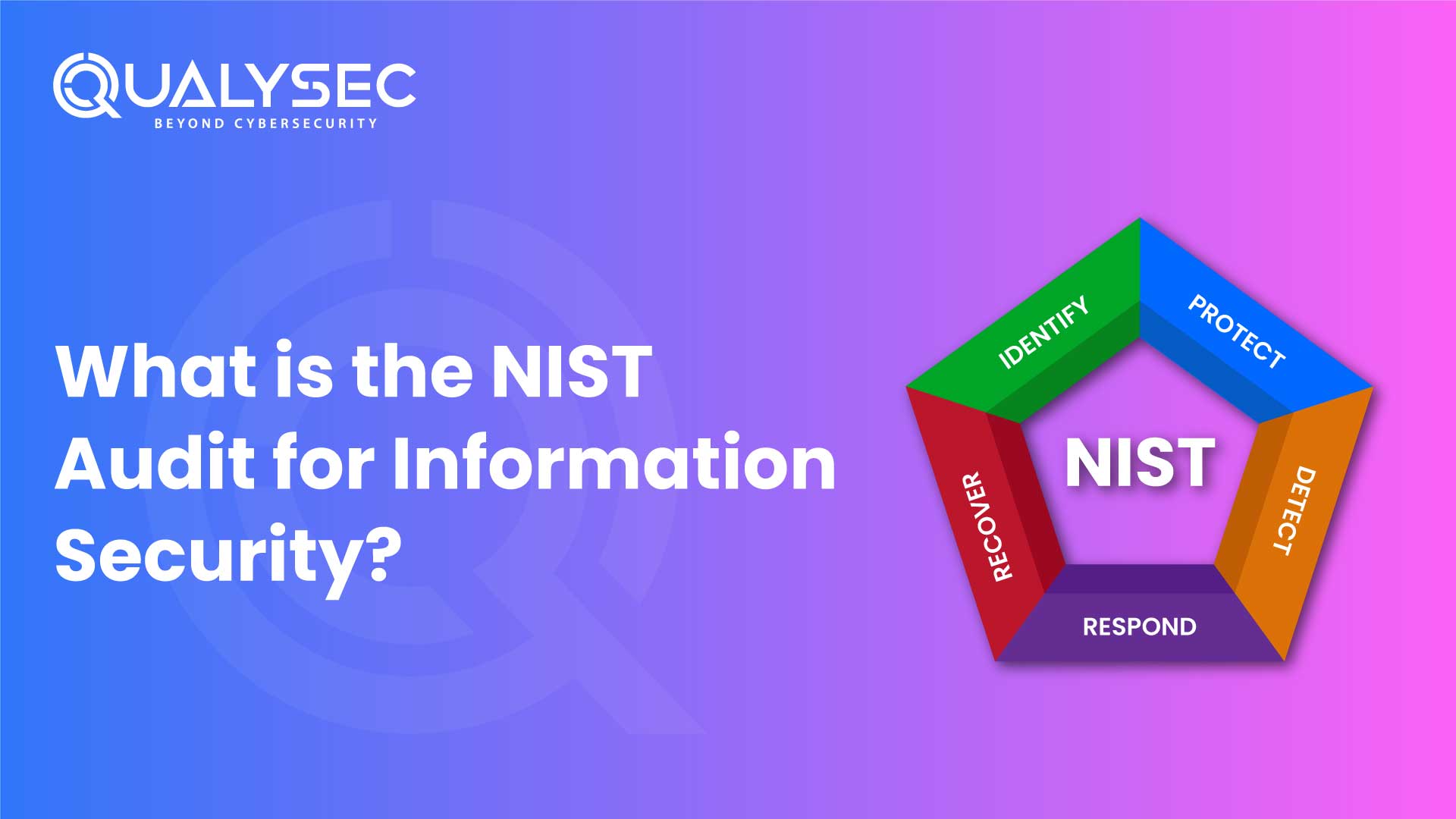
NIST 800-53 is an extensive catalogue of security controls, primarily for federal information systems, and contains more than 1,000 controls broken up into 20 families. The NIST Cybersecurity Framework (CSF) is a more flexible framework that is organised around 5 high level functions (Identify, Protect, Detect, Respond, Recover) and is more general and simpler than the other frameworks, so it is likely to be a good choice for organisations of any size and sector.
Q. 4: How does NIST 800-53 help meet federal and industry compliance standards?
NIST 800-53 is utilized to comply with federal compliance standards and industry compliance standards as the basis for compliance requirements for FISMA and security standards for federal contractors and cloud service providers as FedRAMP. Its comprehensive nature also means it’s workable for adherence to many other compliance requirements such as HIPAA, PCI DSS and CMMC, so organisations can align a number of compliance efforts through framework crosswalking.




















































































































































































































































0 Comments