







Cloud computing has revolutionized how businesses and individuals access, store, and manage data. By offering scalable, on-demand resources over the internet, cloud computing has become a key driver of innovation, enabling companies to reduce costs and improve efficiency. However, as cloud adoption grows, so does the need for standardization to ensure security, interoperability, and reliability.
This is where the NIST Cloud Computing Architecture comes into play. Defined by the National Institute of Standards and Technology (NIST), this framework establishes a common understanding of cloud computing components, service models, and deployment methods, providing a structured approach for organizations to adopt cloud technology securely and efficiently.
This blog will explore the NIST architecture of cloud computing, breaking down its components, service and deployment models, key characteristics, and why it matters for businesses today.
Understanding NIST Cloud Computing Architecture
What is the NIST Definition of Cloud Computing?
NIST defines cloud computing as a model for enabling convenient, on-demand network access to a shared pool of configurable computing resources (e.g., networks, servers, storage, applications, and services) that can be rapidly provisioned and released with minimal management effort or service provider interaction.
Overview of the NIST Cloud Computing Reference Model
The NIST reference model for cloud computing service is a blueprint to guide stakeholders—including cloud consumers, providers, and auditors—in understanding how cloud environments function. It outlines key roles, relationships, and standards needed to ensure secure, efficient, and interoperable cloud services. The framework also acts as a common language for discussing and managing cloud computing systems.
Key Components of NIST Cloud Computing Architecture
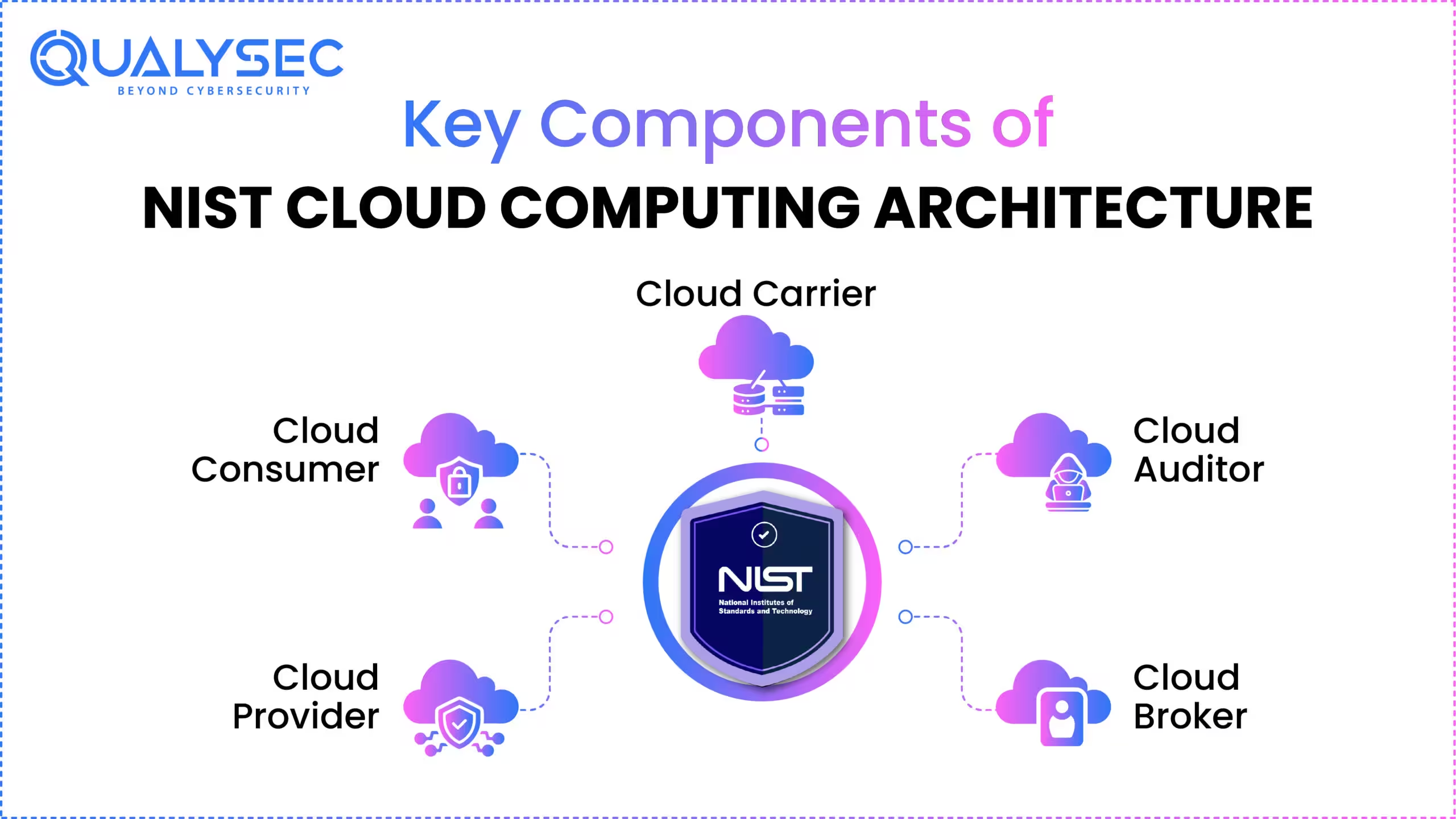
The five fundamental services in the cloud ecosystem are designated in the NIST architecture of cloud computing. These functions create clarity when it comes to structuring, operating, and securing cloud environments through the reduction of confusion and facilitating the alignment with regulations.
1. Cloud Consumer
Cloud consumer refers to any person or body that uses the cloud-based services. This can be anything, from local startups using AWS EC2 to deploy secure virtual machines, to an enterprise customer running their customer analytics on Google BigQuery, or an independent freelancer using Dropbox to store files.
The typical cloud consumers are:
- The model, whether IaaS, PaaS, or SaaS, should be selected according to requirements
- Access policy and workload, control configuration
- Securing their data in the shared responsibility model falls under their responsibility
2. Cloud Provider
Cloud services that the cloud provider provides include storage, network, compute power, and applications. They include such huge platforms as Amazon Web Services (AWS), Microsoft Azure, and Google Cloud Platform (GCP).
Providers handle:
- Data center use
- The ability and availability of resources
- In-Nature Security, Backup, and Infrastructure Adherence
3. Cloud Auditor
A cloud broker places itself between the providers and the consumers to assist organizations in the management of the multi-cloud or hybrid cloud approaches. They provide a universal perspective in any setting and settle prices, performance, or usage contracts.
Examples: A fintech firm seeking to be cost-efficient in AWS and Azure thanks to using a broker, having the ability to enforce a formal policy on AWS and then on Azure, and dealing with issues of policy consistency.
4. Cloud Broker
The cloud auditor, independent of the implementers, evaluates the security, privacy, performance, and compliance of pushing cloud services. They give the stakeholders confidence in compliance of the infrastructure level with both internal requirements and external laws such as HIPAA, GDPR, or ISO 27001.
Auditors typically:
- Regularly, VAPT and compliance reviews should be conducted
- Produce risk and audit trails
- Make sure that cloud deployments meet the NIST cloud computing reference architecture and systems, such as SP 800-53
5. Cloud Carrier
The network backbone between the cloud consumers and the cloud providers is what is termed the cloud carrier. Consider telecommunication companies, the internet service providers (ISPs), or just dedicated leased line providers that provide low-latency connectivity to cloud offerings.
The role of the carriers is:
- Safe and sound traffic transfer
- Bandwidth provisioning
- Monitoring of network performance
The NIST model of cloud computing prescribes responsibilities for these roles of cloud computing; therefore, it does provide guidelines that every PARTICIPANT in a cloud setting be educated on their roles and assigned responsibility for the same achievement in securing, scaling, and compliant cloud adoption.
NIST Cloud Computing Service Models Explained
The NIST cloud computing architecture has identified at least three main models of service that are beneficial in ensuring organizations make use of the cloud in an orderly and scalable manner. Each model represents different levels of control, responsibility, and abstraction.
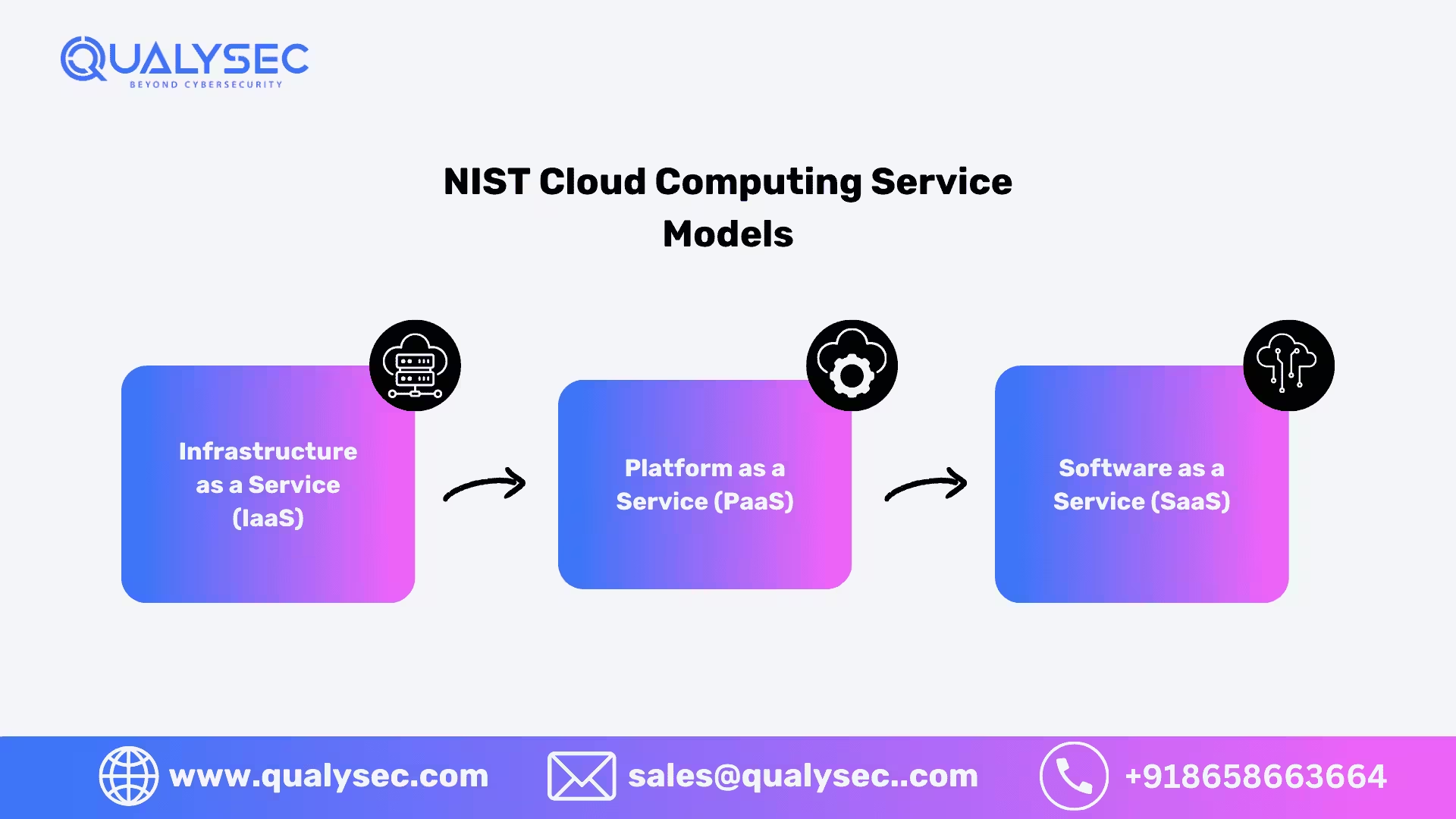
| Service Model | What It Offers | Who Manages What | Real-World Examples |
| IaaS (Infrastructure as a Service) | Provides virtualized computing resources like servers, storage, and networking | Consumers manage OS, apps, and data. Provider handles infrastructure | AWS EC2, Microsoft Azure Virtual Machines, Google Compute Engine |
| PaaS (Platform as a Service) | Offers a ready-to-use platform to develop, run, and manage applications | Consumers focus on the app. Provider handles OS, runtime, and infrastructure | Heroku, Google App Engine, AWS Elastic Beanstalk |
| SaaS (Software as a Service) | Delivers ready-to-use software applications over the internet | Provider manages everything, including updates and maintenance | Dropbox, Salesforce, Microsoft 365, Google Workspace |
NIST Cloud Models for Deployment
There are four cloud deployment models in the NIST cloud computing reference architecture. They all provide varying degrees of control, privacy, and scalability depending on the needs of an organization. The proper selection of the model can assist you in aligning the IT strategy with business and compliance objectives.
1. Public Cloud
- Owned and managed by a third-party provider such as AWS, Azure, or GCP
- The resources are shared between two or more organizations (multi-tenant)
- Significantly economical and easy to enlarge
- Best Suited Applications: New, development/test, and non-classified applications
2. Private Cloud
- The infrastructure is loyal to one organization
- It can run in-house or be third-party-hosted
- This is more controllable, safe, and compliant
- Most suitable in: A finance, healthcare, or government-related company
3. Hybrid Cloud
- This merges the public and private clouds to enhance flexibility
- The workloads may be transferred between environments depending on the requirement
- Allows cloud bursting, backup, and disaster recovery
- Appropriate to: A company that has a variable nature or a non-modern system
4. Community Cloud
- Commissioned by those organizations that have common objectives or regulatory codes to be met
- Supports collective projects, collective compliance requirements, and joint costs
- Appropriate for university organizations, research groups, or governmental establishments
Usually, the focus of the NIST architecture in cloud computing encompasses these models. They direct the design of the cloud environment to address the expectations in security, performance, and compliance.
Related Content: Read our guide to Cloud Penetration Testing or Cloud Security VAPT service to secure your cloud infrastructure effectively!
Get a Free Sample Pentest Report

5 Defining Characteristics of NIST Cloud Computing
The NIST cloud computing architecture provides some of the five characteristics that make up the definition that marks authentic clouds. Such principles assist in achieving the assurance of cloud services to offer the kind of scalability, efficiency, and control that modern businesses demand.
1. On-Demand Self-Service
Users are also able to provision computing resources such as virtual machines, storage, or applications without involving a human when dealing with the provider. Consider creating an AWS EC2 machine via a console; just click, and it’s automatic and immediate.
2. Broad Network Access
Cloud services can be used through networks with network access on different devices such as laptops, tablets, or smartphones. When you use Salesforce by browsing through it or maintaining your infrastructure through the use of mobile applications, the NIST model of cloud computing guarantees uninterrupted access.
3. Resource Pooling
With the multi-tenant model, the computing resources are assigned and reassigned dynamically according to demand. The sharing is a fundamental component of the NIST architecture of cloud computing, which facilitates the improvement of resource exploitation and cost reduction in scale.
4. Rapid Elasticity
Depending upon the needs of the workload, resources may be scaled up or down at a high rate, either automatically or manually. The example is that cloud providers such as Azure or GCP have auto-scaling groups to make sure that the applications remain responsive even in the case of changing user traffic.
5. Measured Service
The presence of cloud systems maintains itself with the automatic monitoring, control, and optimization of resources. Transparency is provided to the providers and consumers through detailed metering. It is by design that cost tracking and performance management become part of the architecture.
Check out our guide on Infrastructure Security in Cloud Computing!
Why NIST Cloud Computing Architecture Matters for Your Cloud Security
The NIST cloud architecture of computing is not simply a technical structure. A practical framework to make sense, consistent, and resilient to realize your cloud journey, be it in the process of migrating to the cloud or scaling a current environment. This is the way NIST assists current-day operations of companies in enhancing the security position, keeping them flexible at the same time.
1. Establish Clarity and Consistency
One of the biggest challenges organizations face when adopting cloud computing is the lack of a standardized language. The NIST framework provides a common terminology and conceptual model, ensuring everyone, including IT teams and C-suite executives, is on the same page. Defining terms like “on-demand self-service” or “community cloud” eliminates misunderstandings and creates cohesion across departments.
Think of it as providing a “cloud dictionary” to streamline communication, regardless of the organization’s size or technical expertise.
2. Align Technology with Goals
Implementing cloud computing successfully requires aligning technology with an organization’s business objectives. The NIST architecture emphasizes the importance of choosing the right service and deployment models to support scalability, cost-efficiency, and security.
For example, a healthcare firm handling sensitive patient data might prioritize private or hybrid cloud models to meet stringent compliance standards. Conversely, a startup focused on rapid growth may opt for public cloud services to scale affordably.
3. Allow Smarter Investment Decisions
With its clear breakdown of service and deployment models, the NIST framework empowers businesses to make informed decisions about where and how to invest. Organizations can assess their unique needs and match them with appropriate cloud offerings, ensuring a balanced approach that minimizes waste while maximizing ROI.
For instance, a team requiring high computing power for a limited period, like during product testing, can take advantage of the rapid elasticity offered by IaaS without overspending.
4. Strengthen Cybersecurity
Today’s interconnected world puts cybersecurity at the forefront of every business conversation. The NIST framework highlights the importance of resource and risk monitoring, particularly in hybrid or private environments. It recognizes that cloud adoption often intersects with regulatory compliance requirements (like GDPR or HIPAA), making it a vital foundation for industries handling sensitive data.
Additionally, organizations can use this model to create strategies for privacy, access controls, and data encryption, ensuring their platforms meet best practices.
5. Build Innovation
Cloud computing isn’t just about efficiency; it’s also a springboard for innovation. The NIST architecture, with its flexible service models, enables organizations to experiment with new tools, technologies, and workflows.
For example, businesses can use PaaS to prototype new applications without the overhead of managing infrastructure. This freedom to innovate helps industries ranging from retail to finance push boundaries, explore new business models, and maintain a competitive edge.
Want to align your cloud architecture with the NIST framework? Book a Free NIST Compliance Review Call.
Talk to our Cybersecurity Expert to discuss your specific needs and how we can help your business.

Want to Build a NIST-Guided Cloud Strategy?
The procedure of creating a secure and compliant cloud infrastructure does not stop at plugging in tools. It is all about putting all the pieces together, all the way down to deployment models to access controls that have been tested, such as the NIST cloud computing structure.
Qualysec comes in at that point.
Qualysec, being an expert in manual-first VAPT and cloud security tests, can assist an organization in mapping the NIST cloud model, which aids businesses in making what has been documented a working, auditable system. And no matter which AWS workloads you are scaling or which hybrid cloud environments are protecting, every level, including IaaS implementations, SaaS integrations, etc., will be benchmarked against both the NIST SP 800-145 and the NIST SP 800-53.
Get a NIST-Aligned Audit Report from Qualysec
With Qualysec, you get:
- NIST-based roles and categories of risks in comprehensive Cloud Penetration Testing
- Compliance and NIS control supportive reports that are audit-ready
- Safe-by-design advice based on observed misconfigurations that we discover
- Architecture evaluations to fit any public, private, or combined cloud arrangements
- A consultative model that suits SaaS, fintech, and regulated companies that are growing at a rapid pace
Most companies are grappling with ambiguous cloud security investors that fail to pass scrutiny in the audits. The helpful clarity offered by Qualysec is the direct mapping of the results to the architecture of cloud computing built by NIST, and your respective technical and compliance departments find it easier to proceed with any actions with certainty.
Ready to see where your cloud setup stands against NIST standards? Book a NIST-aligned Cloud Security Audit with Qualysec Now!
See How We Helped Businesses Stay Secure

Frequently Asked Questions (FAQs)
Q1: What is NIST in cloud computing?
A: NIST in cloud computing means the efforts of unifying the framework of cloud services by the National Institute of Standards and Technology. NIST also came up with some key guides within which organizations can gain information on how to use secure and efficient cloud computing systems.
Q2: What is the NIST cloud computing reference architecture?
A: NIST cloud computing reference architecture has a defined structure because it outlines the important players and building blocks in a cloud environment. There are five primary actors in it, and they include cloud consumer, cloud provider, cloud auditor, cloud broker, and cloud carrier. Such architecture will assist the stakeholders to recognise their roles and relationships in the cloud ecosystem.
Q3: What is the NIST model of cloud computing?
A: The NIST model of cloud computing describes the required attributes of a cloud system, and these include on-demand self-service, extensive network access, shared resources, rapid elasticity, and metered service. It also specifies service models such as IaaS, PaaS, and SaaS, as well as deployment models such as public, private, hybrid, and community clouds.
Q4: What are the five characteristics of cloud computing according to NIST?
A: NIST cloud computing standards say that the five essential characteristics are:
- On-demand self-service
- Wide access to a network
- Resource pooling
- Rapid elasticity
- Measured service
The properties render cloud computing scalable, flexible, and effective in contemporary businesses.
Q5: What is NIST cloud computing architecture?
A: NIST cloud computing architecture is a top-view picture that tells you how cloud components and roles interact. It assists in the systematic implementation of cloud infrastructure by well-defining the service model, the deployment model, and associations among ecosystem players.
Q6: What is NIST architecture in cloud computing?
A: NIST architecture in cloud computing defines an organized way of cognizing cloud systems. It facilitates the process of decision-making by organizations through its description of the interactions of various entities involved in cloud services, as well as the technology that is involved in cloud adoption.
Q7: What is the NIST architecture of cloud computing used for?
A: NIST architecture of cloud computing is applied in the direction of development, deployment, and management of cloud services. It assists organizations to align with the most current good practices in security, interoperability, and service specifications, and minimizes the risk involved in the adoption of cloud usage.
Q8: What is the NIST standard for cloud computing?
A: The NIST standard on cloud computing, which has been developed mainly in NIST SP 800-145, clarifies important terminologies, service models, deployment models, and essential features of cloud systems. The industry standard is primarily used in the design and evaluation of cloud-based products.
Q9: What is reference architecture in cloud computing according to NIST?
A: Reference architecture in cloud computing, according to the definition provided within the framework of NIST, is an outline or a plan for creating and managing cloud services. It uniforms the way different roles and parts operate so that they work together, and integration of them can be minimized in cloud environments.
Q10: What is the NIST system architecture in cloud computing?
A: The cloud system architecture at NIST has all the technical and operational factors that require cloud service delivery. It will facilitate efficient deployment and security monitoring, as well as role-based access, and allow scalability and optimization of resources.









































































































































































































































0 Comments