








The web of wireless networks is the foundation of the contemporary interconnection, and it serves a whole range of applications, including remote employment and IoT devices. With ease, however, comes danger. NordLayer researched 6,000 Wi-Fi users and found that 18 percent of them had an experience of a cybersecurity incident caused by a public network. This indicates how weak wireless networks remain, despite the increasing use of standards such as WPA3. By the year 2026, wireless penetration testing will have become an optional exercise.
What is Wireless Penetration Testing?
Wireless penetration testing, also called Wi-Fi pentesting, is penetration testing applied to wireless networks to identify vulnerabilities that may be targeted by assaults before exploitation. The vision is that data transiting through Wi-Fi or any other type of wireless system is to be secure and unreachable to unauthorized viewers.
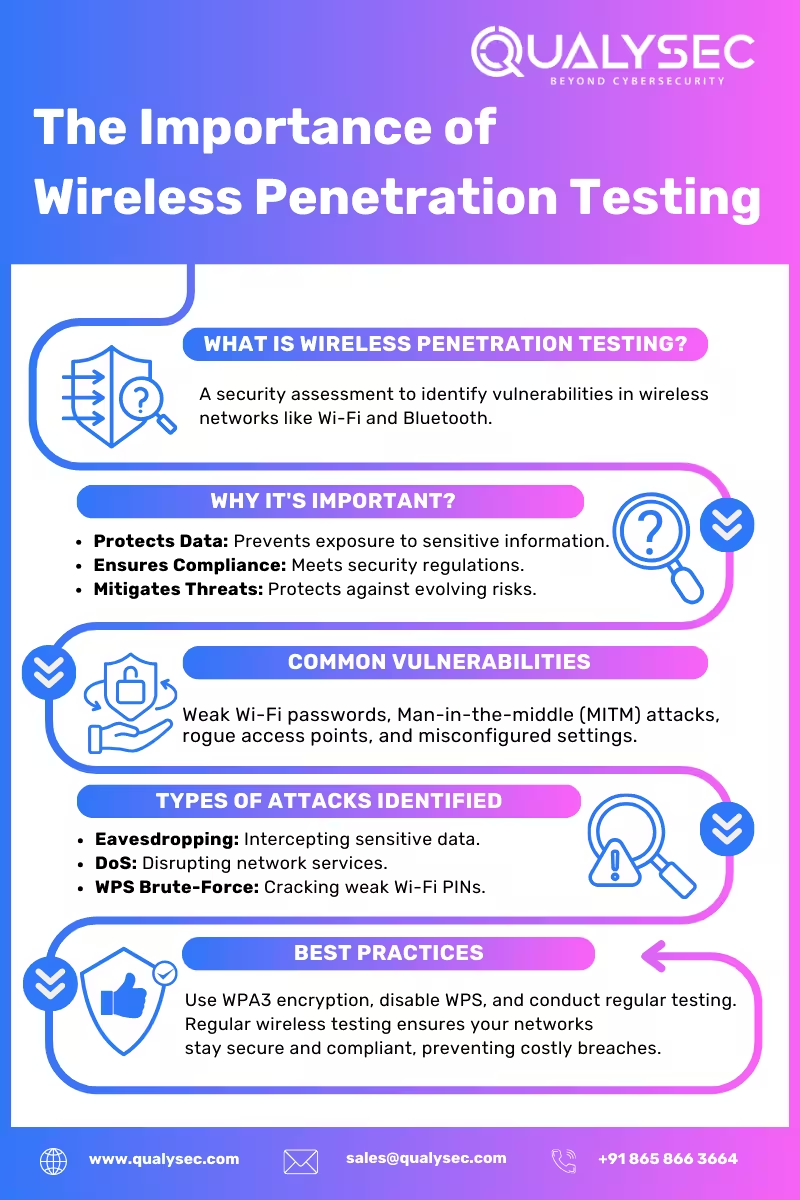
Key Objectives of Wireless Penetration Testing
- Identify points of breakage within Wi-Fi settings, encryption technology, and authentication.
- Identify rogue access points or unauthorized devices connecting to the network.
- Test the resilience of wireless traffic against any sniffing, spoofing, or man-in-the-middle attacks.
- Deliver actionable insights to harden wireless infrastructure prior to actual adversaries getting to the point of exploitation.
Benefits of Wireless Penetration Testing
Wireless penetration testing does not provide only technical validation. It offers business assurance, compliance preparedness, and customer confidence. The following are the most vital advantages:
- Protect confidential information: A properly conducted Wi-Fi pentest determines the weak aspects, like improper encryption, weak passwords, or configurations that can be used by attackers before they can be taken advantage of. Early resolution of such problems aids in eliminating unauthorized hacking of customer records, financial dealings, or proprietary information.
- Provides Compliance: DOTS such as GDPR, HIPAA, and PCI DSS demand that organizations must show to have securely handled wireless communication. Professional penetration tests deliver reports that can be used to directly map findings into compliance requirements so that businesses are never left without an audit.
- Minimize the Impact of breaches: Wireless vulnerabilities are frequently used as an initial point of entry by attackers. By identifying these risks beforehand, organizations prevent expensive service interruptions, downtime, and reputational damage. An effective pentest minimizes the risk of operational paralysis due to compromised wire networks that are compromised.
- Develops Business Trust: Enterprise customers and vendors are increasingly demanding security validation as a component of purchase. An effective and professional pentest report will ensure that the stakeholders have the confidence that the organization is taking responsible actions to secure its wireless infrastructure, which will help boost the trust and competitive edge.
After understanding the potential cost of a breach, explore pricing details to see what prevention costs.
See our pricing, then talk with an expert to choose the best solution for your organization.

How Wireless Penetration Testing Differs from Traditional Penetration Testing?
- Focus Area: Traditional pentesting is done on applications, servers, and on wired networks, but this form of wireless penetration testing focuses on Wi-Fi communication layers and Protocols.
- Attack Surface: Hidden access points (retrieved through Wi-Fi networks and IoT devices) are usually overlooked in regular pentests.
- Techniques: This entails brute-forcing of weak passwords, attacking WPA/WPA2/WPA3-encrypted networks, emulating deauthentication attacks, and testing rogue access point probes.
Scope of Wireless Penetration Testing
- Wi-Fi Networks: Excellence in Testing WPA2 and WPA3 installations.
- OT Devices: Making sure that connected devices rigorous IoT penetration testing do not act as vectors for attackers.
- Corporate Wireless: Evaluation of enterprise-level access points and the connectivity of employees.
- BYOD Environments: Assessing risk introduced by personal devices on the business networks.
The pen-testing of wireless pays off by ensuring that firms eliminate unauthorized access, prevent unauthorized access to data of particular significance, and maintain overall organizational viability with regard to the global security benchmarks.
Common Wireless Vulnerabilities
Wireless networks are disadvantageous as they are an insecure route, yet essential to business, and unless secure, they will become one of the weakest links. In contrast to wired networks, Wi-Fi has the additional risk of exposing your organization to risks that extend well beyond the confines of your office. The following wireless vulnerabilities are the most urgent ones that organizations should take note of:
- Weak or Outdated Encryption Protocols: Even the WEP and WPA2 protocols are now deemed insecure. The weaknesses of these standards can be used by attackers with commodity tools to break encryption keys in a few hours.
- Rogue Access Points: Rogue APs are rogue wireless points that employees install without the authorization or authorization of the IT department, or attackers use to represent a legitimate network. When the users connect, malicious actors are capable of capturing credentials, planting malware, or stealing sensitive information.
- Man-in-the-Middle (MITM) Attacks: Attacks of the left hand, such as IM attacks on wireless networks, also enable hackers to steal, modify, or inject malicious data between a user device and the internet. Unsecured Wi-Fi hotspots or incorrectly exposed enterprise networks are the best targets.
- IoT Device Exploits: The IoT devices are typically linked to the corporate Wi-Fi systems with little security measures, old firmware codes, and poor passwords. Once infected, such devices can turn into portals of lateral attacks in the organization’s network.
Why Wireless Penetration Testing Matters in 2026
Wireless networks are now the bread and butter of business processes, but are equally the most targeted attack surface. Wi-Fi security is a non-negotiable issue due to the emergence of IoT, the use of clouds, and the use of hybrid workforces.
Key Reasons It Matters
- IoT Growth Increases the Attack Surface: There are 16.6 billion IoT devices present in the globe as of 2023 (with a projected 18.8 billion in 2024), with the count projected to rise as the IoT continues to grow. Each connected sensor, printer, or camera opens a possible point of attack by the attackers.
- Rising Cost of Breaches: The International Cost of a Data Breach Report 2025 by IBM indicated the average breach cost in the world at USD 4.44 million. Shadow AI incidents contributed to this amount on average of USD 670,000. One Wi-Fi misconception can now cost consequences in the millions of dollars.
- Compliance Drivers: Laws like PCI DSS, HIPAA, and GDPR oblige companies to protect their wireless network. A failed wireless security audit may attract penalties and in most cases, loss of vendors/client contracts by the businesses.
- Business Impact: In addition to direct costs, an organizational reputation is lost when a Wi-Fi breach is publicized. A compromised wireless network in customer-facing businesses like retail and healthcare can lead to diminished trust and slower vendor onboarding, and even churn of existing customers.
Wireless penetration testing in 2026 is not a choice. It is imperative in the safeguarding of sensitive data, the standards of compliance, and the credibility of customers and partners in an age where wireless vulnerability is one of the most abused.
Key Methodologies in Wireless Penetration Testing
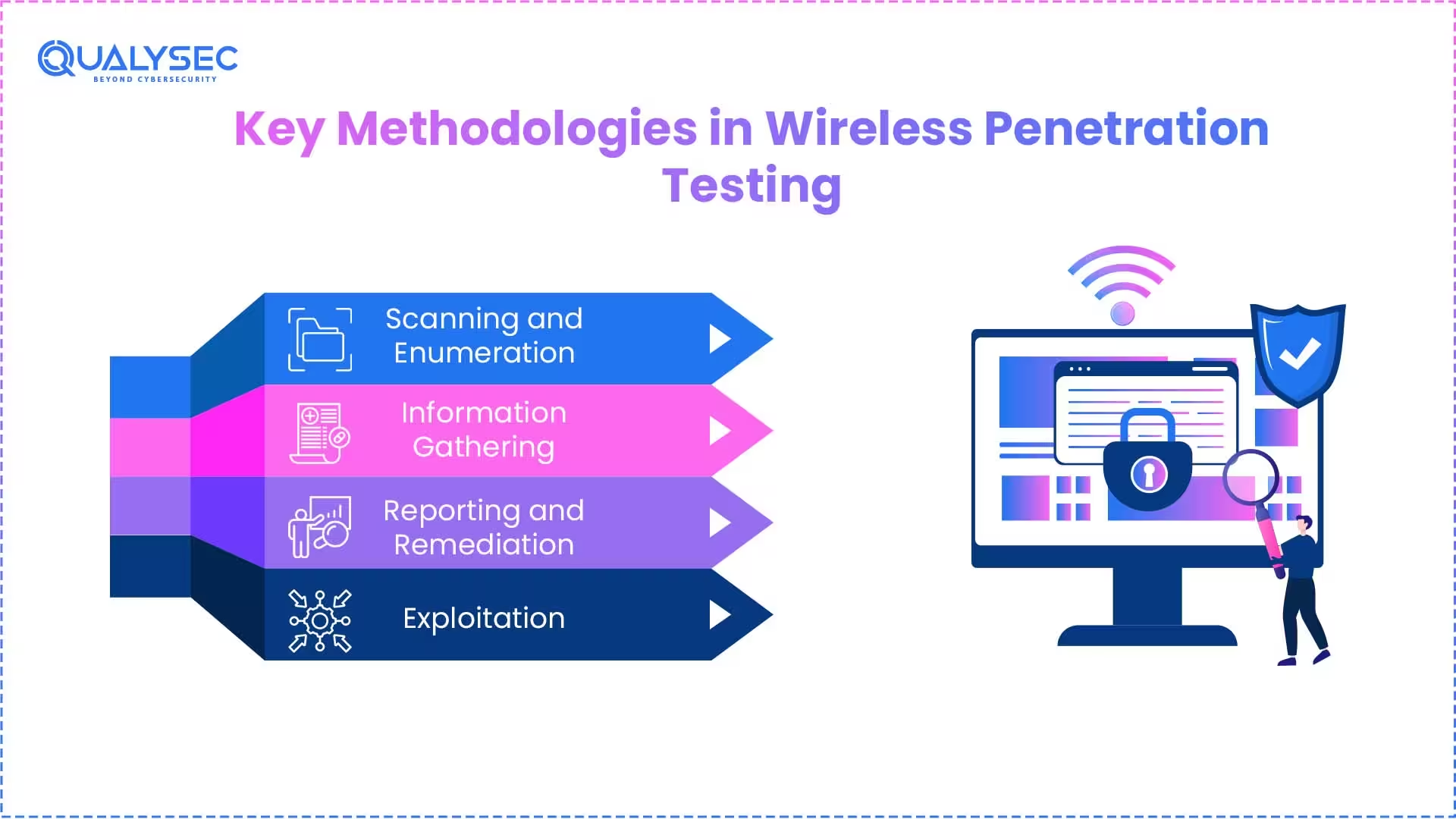
The methodology of wireless penetration testing is structured to reflect real-life cyberattacks. Wi-Fi pentest execution is also directed to the communication layers and encryption protocols, and the devices that are connected, in contrast to the conventional pentests that have the primary focus on applications or wired networks.
1. Information Gathering
The initial one is mapping the wireless environment:
- Identify available access points (APs), SSIDs, and channels in use.
- Collect data on authentication methods such as WPA2 or WPA3
- Recognizes related devices, such as smartphones, IoT sensors, and laptops.
- Note potential targets like guest Wi-Fi or BYOD devices.
2. Scanning and Enumeration
Following reconnaissance, testers attempt to find vulnerabilities in the network.
- Scan to detect encryption vulnerabilities, out-of-date firmware, or ineffective authentication.
- Enumerate default configurations, such as unchanged admin credentials or open management interfaces.
- Perform a traffic analysis to find vulnerable protocols that are sending sensitive information.
3. Exploitation
It is in this case that simulated attacks are conducted to verify risks within a secure wireless network. Common techniques include:
- Password cracking: An attack on weak Wi-Fi keys by use of captured WPA2/WPA3 handshakes to brutally force or dictionary-attack passwords.
- Deauthentication attacks: Forcing clients out of the network to reconnect handshakes or disrupt.
- Packet sniffing: Hacking unsecured or weakly secured communications.
- Denial of Service (DoS): Stress-testing wireless infrastructure by flooding it.
4. Reporting and Remediation
The last is as important as the testing itself.
- Document each vulnerability with evidence, severity ratings, and business impact.
- Provide practical advice, e.g., use WPA3, strong passwords, and watch out for rogue APs.
- Stabilize reports in line with compliance requirements such as PCI DSS, HIPAA, and GDPR to aid in audit preparedness.
Example Flow of a Wireless Pentest
- The tester identifies an invisible AP that is transmitting outdated WPA2.
- Makes a deauthentication attack in order to intercept handshake traffic.
- Runs Aircrack-ng to crack weak pre-shared keys.
- Gains access to the internal corporate Wi-Fi.
- Discovers documents and advises the migration to WPA3 with stronger key handling.
The professional pentester needs to work with the IT team to complete their tasks. In 2026, we’ve seen that de-authing a network would cause old IoT sensors and manufacturing equipment to freeze up until someone performed a physical reset. The professional audit testing procedure requires assessment of system resilience beyond basic breakage testing.
Secure your systems—get a comprehensive Penetration Testing Report today.
Get a Free Sample Pentest Report

Must-Have Tools for Wireless Penetration Testing in 2026
Network testing is wireless and therefore needs special tools to identify weaknesses in encryption, rogue access points, and traffic processing. The following Wi-Fi penetration testing tools in 2026 remain the most reliable for simulating real-world wireless attacks.
| Tool | Use Case | Strengths | Best For |
|---|---|---|---|
| Kali Linux | Full wireless pentesting environment | Ready-to-use with hundreds of penetration testing tools; Wi-Fi and IoT friendly, as well as corporate. | Penetration testers and security professionals are in need of a complete Linux distribution. |
| Aircrack-ng | Hacking Wi-Fi passwords and encryption power. | Proficient in handshaking, brute-forcing WEP/WPA2/WPA3, and key strength auditing. | Pentesters evaluating password robustness in enterprise and public Wi-Fi |
| Wireshark | Packet capture and protocol analysis | The standard of the industry to examine wireless traffic, identify anomalies, and identify MITM attempts. | Network engineers, compliance auditors, and forensic investigators |
| Kismet | Wireless monitoring and rogue AP detection | Exposes concealed SSIDs, rogue devices, and channel jamming; operates silently without notifying the attackers. | Companies that have extensive Wi-Fi areas and are interested in identifying rogue access points. |
| Metasploit | Advanced exploitation of wireless flaws | Supports automation of wireless exploits, integration with other testing tools, and reporting | Red teams and security consultancies simulating full attack chains |
Why These Tools Matter in 2026
- Complete Reconnaissance to exploitation: Although Kismet (reconnaissance) and Aircrack-ng (exploitation) represent two poles of the wireless penetration testing process, these tools span it entirely.
- Revised to meet Modern Standards: WPA3 is more secure, compared to WPA2, though tools such as Aircrack-ng and Wireshark are still undergoing development to challenge more recent encryption standards.
- Compliance Support: Wi-Fi penetration testing tools in 2026 are used to address the needs of GDPR, HIPAA, and PCI DSS.
- AI-Assisted Improvements: The various tools with AI-based analytics in Kali or Metasploit now provide ease of vulnerability detection and reporting.
Best Practices in Wireless Penetration Testing
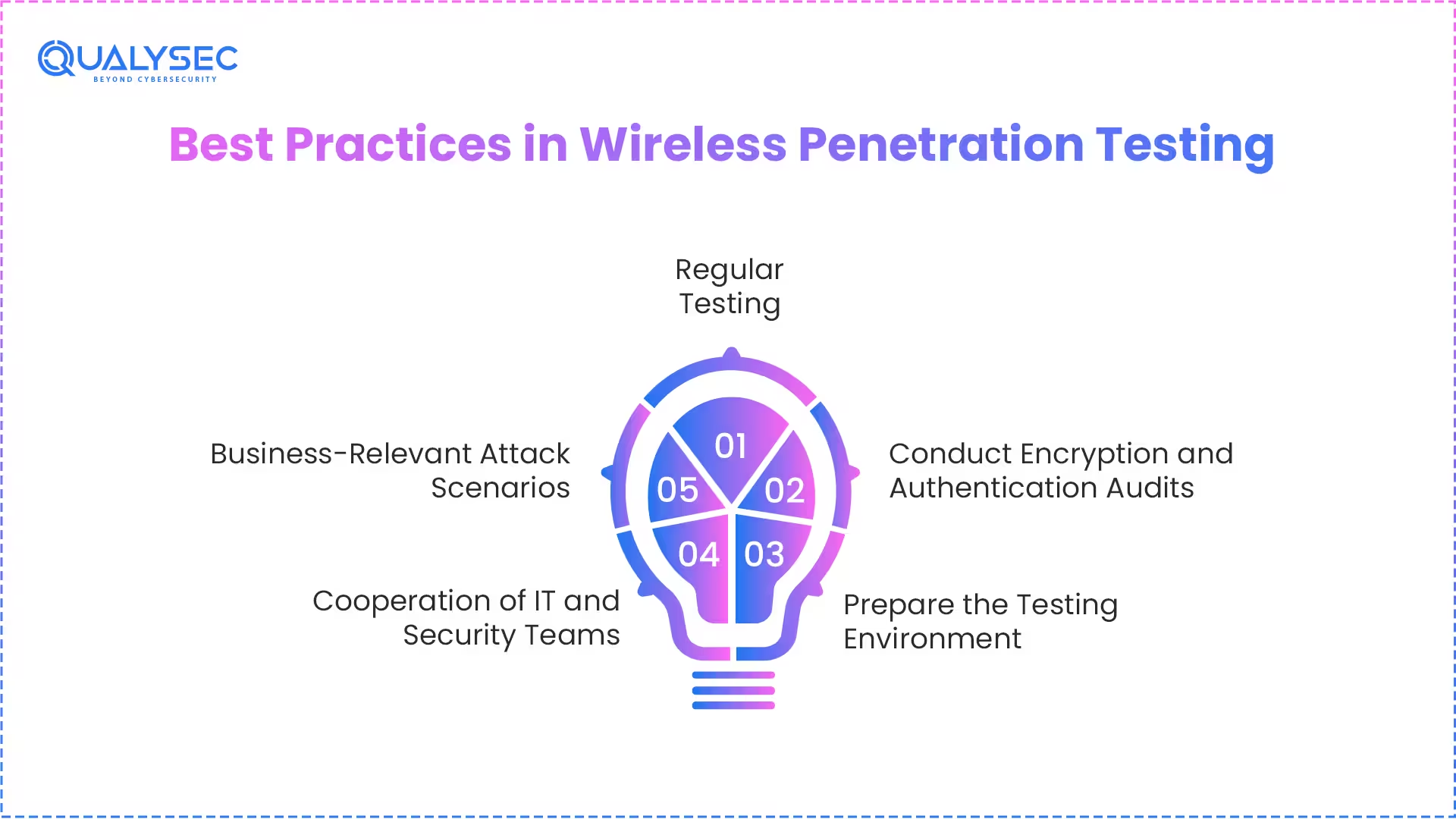
1. Provide periodical, not one-time Assessment
Wireless networks are in a state of continuous development, as employees add new devices, IoT grows, and new firmware releases are published. It is not sufficient to test annually anymore. Mature security teams conduct regular quarterly wireless penetration testing, or following significant changes to infrastructure or the acquisition of new devices. This rate assures that the vulnerabilities are identified prior to the attackers exploiting them.
2. Conduct Encryption and Authentication Audits
Although the use of WPA3 is becoming more common, a large number of enterprises still operate WPA2 or even WEP-based legacy in some areas of their infrastructure (guest Wi-Fi, IoT environments). Encryption audits should always be part of a wireless pentesting checklist to highlight outdated protocols, weak passphrases, and improperly configured authentication schemes, including the reuse of PSK.
3. Prepare the Testing Environment
Wireless pentesting is a disruptive practice, including deauthentication and packet sniffing. Avoiding downtime or inadvertent data leakage, security testing must only be done in a controlled and previously authorized environment with network isolation and executive authority.
4. Cooperation of IT and Security Teams
The advent of vulnerability discovery is not the culmination. To resolve problems, IT departments have to patch the firmware, re-architect the access point, or swap out insecure IoT hardware. Joint task forces between pentesters and IT staff accelerate remediation and prevent miscommunication.
5. Documentation and Compliance Reporting
Best practices in wireless penetration testing should encompass detailed reporting in which each finding is associated with the compliance requirements, such as PCI DSS, HIPAA, or GDPR.
6. Business-Relevant Attack Scenarios
The most useful reports are not generic. As an illustration, it is possible to simulate a man-in-the-middle attack during the video call conducted by the CFO and see how the misconfigured wireless access point can pose a significant financial and reputation risk in practice.
Challenges for Wireless Penetration Testers in 2026
I. IoT Devices complexity
IoT endpoints, be it a smart camera or a manufacturing sensor, tend to be on insecure wireless protocols or old-fashioned firmware. It is challenging to test all devices in a large enterprise, and an infected IoT can be an access point to internal corporate networks.
II. WPA3 and New Protocols
WPA3 added security features such as SAE (Simultaneous Authentication of Equals) that thwart brute force cracking. However, side-channel and downgrade attacks are already being investigated by attackers. Pentesters will have to adjust to these current encryption schemes in light of sophisticated fuzzing and AI-assisted cracking methods.
III. Legal and Ethical Limitations
Packet sniffing or interception of data is strictly regulated by legal and ethical considerations, including GDPR and HIPAA. Testers may find themselves overstepping the legal boundaries, even without intention, without a well-scoped authorization. It is now essential to have clear contracts and written approvals.
IV. Shadow Wireless Networks
Staff normally connect to unauthorised hotspots, tethered devices, or even personal access points without the IT department’s understanding of it. The so-called shadow networks are difficult to track and may disclose sensitive data in the absence of monitoring.
V. A tradeoff between Realism and Safety
Simulation of strong denial-of-service or deauthentication attacks may interfere with business processes when not restricted. The Pentecostals have to work the line between rigor mortis testing and keeping the doors open.
If you’re exploring these challenges, it may help to see how others have dealt with them. Read real success stories.
See How We Helped Businesses Stay Secure

Future Trends in Wireless Penetration Testing
1. Ultra-Dense Networks and Connection
As 6G is coming in later in the decade, the networks will provide ultra-low-latency and be able to service billions of devices at once. This scale opens up new attack surfaces, whether it is satellite-based connections or smart edge computing, and advance pentesting approaches are needed.
2. AI-Assisted Wireless Pentesting
AI in Wi-Fi penetration testing is already being factored in to detect anomalies, detect rogue access points more quickly, and to create adversarial traffic. Pentesters will utilize the AI-based engines to simulate the behavior of attackers on a large scale in the future, which will reduce human effort but result in more vulnerabilities.
3. Zero-Trust Wireless Environments
Organisations are migrating to zero-trust environments where no one can be trusted, whether it be a device or user, even in the network. To ensure that these models are effective, Pentecostals will have to test continuous authentication, identity-aware routing, and micro-segmentation.
4. Next-Generation Standards in Encryption
Where WPA3 Buys the Night to Sleep: Researchers are looking into quantum-resistant wireless traffic encryption. Pentesters are about to go through the trying period of deciding whether organizations are prepared to attack with quantum-level attacks that are likely to crack the present standards.
5. Cloud and Hybrid Security Integration
As cloud-native and hybrid environments become the new norm, wireless pentesting will be more and more implemented with cloud security tests, which would guarantee visibility through the device layer to the cloud backend
Why Choose QualySec for Wireless Penetration Testing
The selection of an appropriate partner in the testing of Wi-Fi security is important in terms of continuity of business, business compliance, and trust. Qualysec provides an extra option to a checklist process. Our approach is a blend of technical rigor and business-oriented deliverables that assist organizations in remaining safe and audit prepared.
- Manual First Testing: The vast majority of providers are relying on automated scanners, which frequently fail to detect logic errors of sophisticated misconfigurations. In QualySec, all the findings are checked manually by qualified security engineers. This guarantees accuracy, elimination of false positives, and exposure of vulnerabilities that can only be identified through the use of tools.
- Compliance Ready Reporting: Our reports are formatted to serve as audit reports. All findings are also aligned to regulatory frameworks, including ISO 27001, PCI DSS, HIPAA, and GDPR, assisting your organization in showing preparedness when it is audited or in vendor testing.
- Knowledge of Complex Wireless Environments: Whether it’s corporate Wi-Fi systems or BYOD environments and IoT-intensive ecosystems, our staff tailors the approach to your specific environment. Doing this makes sure that no backdoor is neglected or a poorly-configured protocol.
- Actionable Remediation with Revalidation: We do not just list risks. Our team will offer practical remediation measures and will revalidate to ensure vulnerabilities have been addressed. This makes businesses have confidence that the risks are not just recorded, but are actually eliminated.
- Enterprises Worldwide Trusted: Organizations in BFSI, healthcare, SaaS, and retail rely on QualySec to conduct wireless penetration testing. Customers also appreciate the lucidity of our reports, the velocity of the implementation, and the possibility of converting technical problems into business risks.
Not only is wireless penetration testing with QualySec about finding weaknesses. It is the resilience construction, making sure your compliance, and demonstrating to your customers and regulators that your systems are reliable.
Curious how this works in real scenarios? See how others approached wireless security testing.
Conclusion
Imagine the extent to which your business relies on wireless networks on a daily basis. It is neither idle nor safe as long as workers are working on their computers remotely, and IoT gadgets quietly humming in the background can operate. It only takes one weak spot and an attacker to slip through.
Compliance or a checklist does not automatically make wireless penetration testing. It is knowing just how safe your network is, before someone discovers it the hard way. That awareness can be the difference between gaining trust among customers and downtimes and losses in 2026.
When you are serious about keeping yourself safe, it’s time to give the right partner a chance.
Begin the discussion with Qualysec and get us to secure your wifi networks.
Talk to our Cybersecurity Expert to discuss your specific needs and how we can help your business.

Frequently Asked Questions
1. What is wireless network penetration testing?
A: Wireless network penetration testing is a security test where attacks on Wi-Fi and other related wireless systems are simulated in order to identify vulnerabilities. It makes sure that unwarranted users cannot use poor configurations or encryption vulnerabilities.
2. What are the three types of penetration testing?
A: Primary ones are black box, white box, and grey box testing. These strategies in wireless penetration testing determine the extent of information testers possess prior to determining the Wi-Fi network and associated devices.
3. Which tool is used for wireless network penetration testing?
A: Common wireless pentesting tools are Aircrack-ng, Wireshark, Kismet, and Kali Linux. These devices assist hackers in examining traffic, breaking weak Wi-Fi encrypted passwords, and identifying rogue access points.
4. What are the five best practices for securing a wireless network?
A: The main practices to observe are the WPA3 encryption, strong authentication, the SSID being disabled, observing rogue access points, and regularly performing wireless security penetration testing using professional services.
5. Why should businesses invest in wireless penetration testing services?
A: Professional wireless penetration testing services can assist organizations in remaining in compliance, safeguarding crucial data, and preventing expensive breaches. Wi-Fi pentesting enables practical observations that fortify wireless infrastructure and develop customer confidence.



















































































































































































































































































































































































































































































































































0 Comments