

Key Takeaways
- RBI’s Cyber Security Framework in Banks (2016) mandates a standalone, board-approved cybersecurity policy distinct from general IT policy.
- Every bank needs a full-time CISO reporting to the board, not buried under the CTO or COO.
- A 24/7 Cyber Security Operations Centre (C-SOC) isn’t optional for institutions of meaningful scale.
- Incidents must reach RBI’s CSITE cell within two to six hours of detection.
- Annual VAPT by CERT-In empanelled auditors is baseline, not best practice.
Every scheduled commercial bank in India operates under a single foundational document most customers have never heard of: RBI/2015-16/418, issued June 2, 2016. The circular, formally titled Cyber Security Framework in Banks, requires your bank to maintain a board-approved cybersecurity policy separate from its general IT policy, requires you to appoint a named CISO who doesn’t also run the IT department, and Requires your branch to report any breach to RBI’s CSITE cell within a fixed window rather than whenever someone gets around to it.
The reporting window itself tells you how seriously RBI treats this. Under the framework, banks must report cyber incidents within two to six hours of detection, a timeline built for a threat landscape where minutes matter. And the cost of getting the underlying compliance wrong isn’t abstract either: procedural violations tied to cybersecurity governance fall under Sections 46(4)(i) and 47A(1)(c) of the Banking Regulation Act, 1949, carrying penalties from ₹10 lakh up to ₹1 crore.
This guide breaks down what’s actually in this banking cybersecurity framework, who it applies to, and how banks move from “we have a policy” to a security programme that survives an actual audit.
Where This Framework Came From
RBI didn’t write this framework in a vacuum. Cybersecurity guidance for Indian banks goes back to 2001, revised in 2011 following the Gopalakrishna Committee’s recommendations on information security and technology risk management. Those early versions were reasonable for their time, but they predated smartphone banking almost entirely. By 2015, mobile banking volumes had exploded past ₹5,000 crore a month, and incident numbers were climbing without any standardised bank-side response playbook. The 2016 framework was the RBI’s answer to that gap, and it shows in how the document is structured.
| Year | Development |
| 2001 | Original RBI cybersecurity guidelines issued |
| 2011 | Guidelines revised post-Gopalakrishna Committee review |
| June 2016 | Cyber Security Framework in Banks notified (DBS.CO/CSITE/BC.11/33.01.001/2015-16) |
| 2024 | IT Governance, Risk, Controls and Assurance Master Directions layered on top |
You should understand this history because the RBI didn’t build the framework as a static checklist. The RBI assumes breaches happen or will happen in cybersecurity for banks, and it structures the document around detection and response as much as prevention.
The Nine Control Domains Banks Get Assessed Against
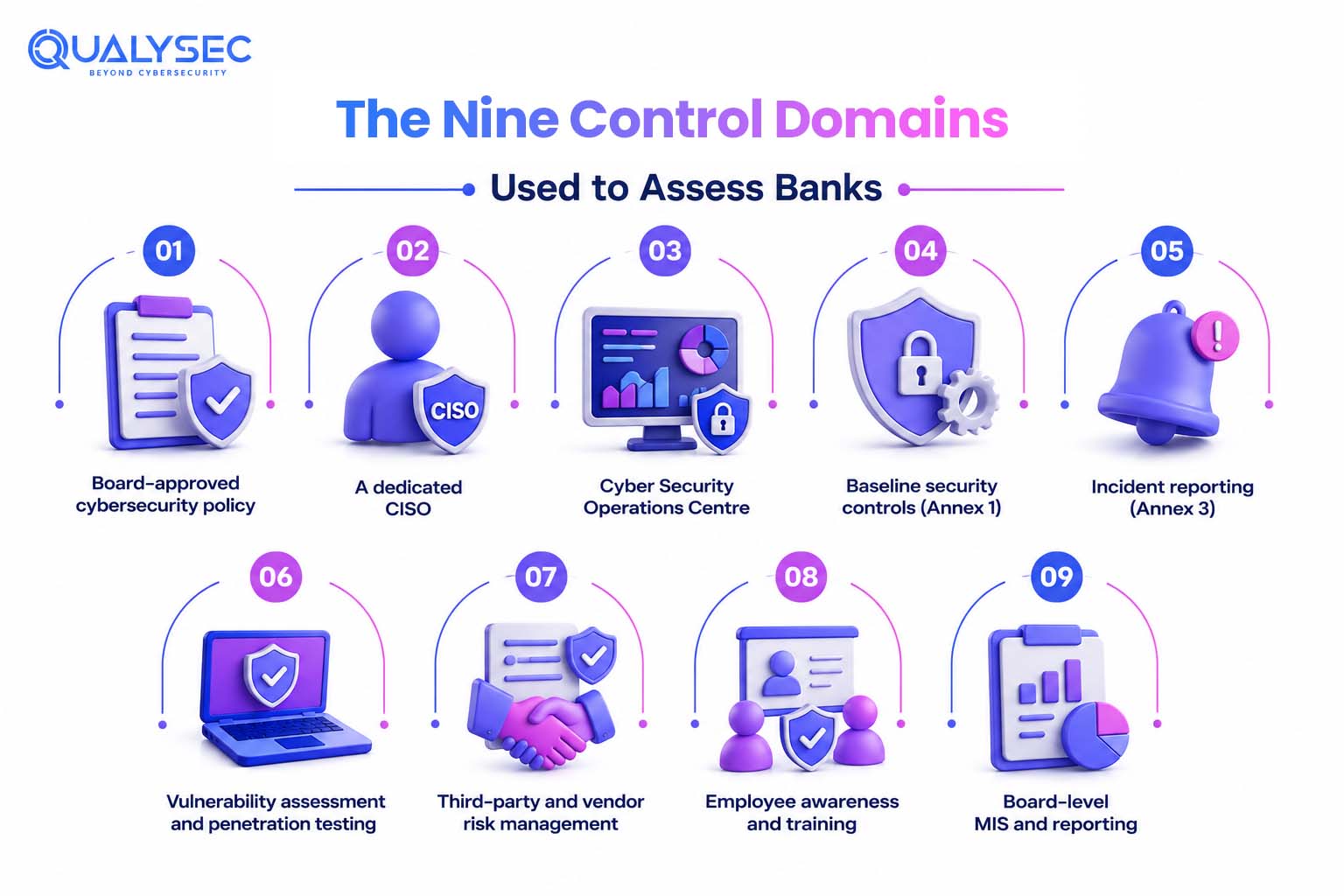
- Board-approved cybersecurity policy. Separate from the general IT policy, reviewed at least annually, and formally communicated to RBI’s CSITE cell. Banks that fold this into their broader IT policy document tend to get flagged for it.
- A dedicated CISO. Full-time, budget-holding, with a reporting line to the board or its Risk Committee, not to the CTO or COO. Dual-hatting security leadership with IT operations creates exactly the conflict of interest RBI is trying to design out of the system.
- Cyber Security Operations Centre. Continuous, 24/7 monitoring with log correlation and automated alerting isn’t a nice-to-have here. It’s the mechanism that turns “we got breached” into “we caught it in minutes.” Smaller banks sometimes outsource this to a managed provider, which RBI allows, but the bank still owns accountability for how well it actually works.
- Baseline security controls (Annex 1). Network segmentation, patch management, endpoint hardening, encryption at rest and in transit, and data leak prevention, all scaled to the bank’s digital footprint. A branch-heavy regional bank and a fully digital neobank get evaluated against different risk baselines even under the same annex.
- Incident reporting (Annex 3). A standardised template and a hard 2-to-6-hour clock for notifying CSITE once an incident is detected.
- Vulnerability assessment and penetration testing. Annual, at minimum, by CERT-In empanelled testers, with documented remediation and re-testing to confirm the fix actually worked, not just that a ticket got closed.
- Third-party and vendor risk management. Vendors touching customer data or core systems need independent assessment, not a signed NDA and a handshake. This extends to cloud providers, core banking software vendors, and any fintech partnership built on API access to the bank’s systems.
- Employee awareness and training. Recurring, not a one-time onboarding module nobody remembers by month three. Phishing simulations, in particular, tend to reveal more about actual readiness than any policy document ever will.
- Board-level MIS and reporting. Regular cybersecurity metrics reaching the board in a form directors can actually act on, not just the IT team’s internal dashboard that never leaves the department.
Who’s On the Hook
| Institution Type | Obligation Level |
| Scheduled commercial banks (public, private, foreign) | Full framework, all nine domains |
| Urban cooperative banks | Full framework under IT Governance Master Directions |
| Small finance banks and payments banks | Framework applies, controls scaled to complexity |
| NBFCs | Separate but parallel IT Framework for NBFC Sector |
A foreign bank already compliant with DORA back home still has to separately satisfy RBI’s requirements for its Indian operations. There’s no equivalence clause here, no mutual recognition that lets one jurisdiction’s paperwork cover another’s. Each market gets its own compliance work, built to that regulator’s specific expectations.
Implementation: Where Banks Actually Struggle
Reading the framework is the easy part. Building it, and keeping it running, is where most gaps show up. A handful of patterns come up again and again in bank readiness work.
- Start with a genuine gap assessment, not a policy rewrite. Banks often update the cybersecurity policy document and assume that’s compliance. It isn’t. RBI examiners check whether the policy reflects what’s actually happening operationally.
- Fix the CISO reporting line before anything else. If your CISO reports to the CTO, that’s a finding waiting to happen. This is a structural fix, not a technical one, and it’s usually the fastest to correct.
- Treat the C-SOC as a living capability, not a project you finished. A SOC that was properly built two years ago and hasn’t been tuned since is quietly degrading. Threat patterns change; your detection rules should too.
- Don’t let VAPT become a scan. RBI wants manual penetration testing with remediation evidence, not an automated vulnerability scanner’s output rebranded as a pentest report. The two look similar on paper and produce very different levels of protection.
- Build vendor risk into procurement, not after onboarding. Retrofitting vendor assessments after a vendor already has system access is backwards and, frankly, how a lot of incidents start. Ask the security questions before the contract is signed, not after something goes wrong.
How Qualysec Helps Banks Align With the RBI Cyber Framework
Gap Assessment Against All Nine Domains
Qualysec maps a bank’s existing security posture against each of the framework’s nine control domains, flagging where documentation and operational reality have drifted apart, which is where most RBI findings actually originate.
CERT-In Aligned VAPT
Manual penetration testing, not automated scanning, covering core banking applications, mobile and internet banking platforms, and API infrastructure, with remediation verification built into the engagement rather than tacked on afterwards.Reports are structured the way RBI examiners actually expect to see them, findings tied to severity, tied to fixes, tied to proof the fix worked.
C-SOC Design and Tuning
For banks building or refreshing their Security Operations Centre, Qualysec helps design detection logic, log correlation rules, and alerting thresholds calibrated to the bank’s actual threat exposure, not a generic template.

Conclusion
RBI’s Cyber Security Framework in Banks has been in force for nearly a decade now, and it’s not going anywhere. Enforcement has changed. Examiners no longer just check whether a policy document exists; they now check whether the CISO actually reports where they should, whether the C-SOC actively catches things, and whether teams fix VAPT findings or just file them away in a spreadsheet nobody revisits. Banks that treat this framework as a living operating model, reviewed and rebuilt as threats shift, spend a lot less time explaining gaps to RBI examiners than banks that treat it as a document they finished once and filed.
Frequently Asked Questions
What is the RBI Cyber Security Framework for banks?
It’s a regulatory directive, RBI/2015-16/418, issued June 2, 2016, requiring every scheduled commercial bank to adopt a board-approved cybersecurity policy, run a 24/7 Security Operations Centre, report incidents within 2 to 6 hours, and undergo annual penetration testing. It’s distinct from a bank’s general IT policy and covers governance, technical controls, and incident response as one connected system rather than three separate compliance exercises.
Which financial institutions must comply with RBI cybersecurity guidelines?
Scheduled commercial banks, including public sector, private, and foreign banks operating in India, fall under the full framework. Urban cooperative banks and small finance banks are covered too, with controls scaled to their complexity. NBFCs follow a parallel but separate IT framework issued by the RBI.
What are the key components of the RBI Cyber Security Framework?
Nine core domains: a standalone board-approved policy, a dedicated CISO reporting to the board, a 24/7 C-SOC, baseline technical controls under Annex 1, a standardised incident reporting process under Annex 3, annual VAPT, third-party vendor risk management, ongoing employee training, and regular board-level cybersecurity reporting.
How often should banks perform vulnerability assessments and penetration testing (VAPT)?
At minimum, annually, using CERT-In empanelled testers, with additional testing after major system or infrastructure changes. RBI expects manual testing with documented, verified remediation, not just an automated scan report.
How can banks ensure compliance with RBI cybersecurity regulations?
Start with an honest gap assessment against all nine framework domains, correct structural issues like CISO reporting lines early, keep the C-SOC actively tuned rather than treating it as a finished project, and build vendor risk checks into procurement instead of bolting them on later. Documentation has to match operational reality, since that’s exactly what examiners check, not what the policy binder says.
What are the penalties for non-compliance with RBI cybersecurity guidelines?
Procedural violations fall under Sections 46(4)(i) and 47A(1)(c) of the Banking Regulation Act, 1949, with penalties ranging from ₹10 lakh to ₹1 crore. Beyond fines, the RBI can direct remediation timelines and, in serious or repeated cases, restrict specific business activities until gaps are closed.