






Quick Answer: Why do Indian businesses require VAPT and cybersecurity audits in 2027?
Indian businesses need VAPT and cybersecurity audits in 2027 to satisfy applicable RBI, SEBI, CERT-In, DPDP and industry requirements, protect sensitive information, prevent financial fraud and demonstrate security to global clients. Regular penetration testing identifies exploitable weaknesses, validates remediation and provides technical evidence for regulatory reviews, enterprise procurement, funding decisions and operational resilience.
Why Is 2027 a Turning Point for Cybersecurity Audits in India?
As Indian enterprises finalize their 2027 compliance budgets, cybersecurity assessment is moving beyond an annual activity performed simply to obtain a certificate.
The difference is accountability.
Regulators increasingly expect evidence that security controls work. Enterprise customers want proof that vendors have tested their systems. Investors examine technology exposure before committing capital. Meanwhile, application development teams continue releasing new APIs, cloud services and AI-enabled features faster than traditional audit cycles can accommodate.
The numbers support a more disciplined approach.
According to India’s Ministry of Electronics and Information Technology (MeitY), CERT-In handled 29,44,248 cybersecurity incidents in 2025, compared with 20,41,360 in 2024. The 2025 total represents approximately 44% year-on-year growth. CERT-In also issued 1,530 security alerts, 390 vulnerability notes and 65 advisories during 2025.
These figures represent incidents reported to or handled by CERT-In, not necessarily confirmed data breaches or successful intrusions. Nevertheless, they demonstrate the scale of India’s security monitoring challenge.
For 2027, another significant consideration is the phased implementation of India’s Digital Personal Data Protection framework, including security safeguard obligations scheduled for May 2027.
For business leaders, the question is no longer whether security testing deserves a budget.
It is which systems require testing, when testing should occur, and what evidence will withstand scrutiny.
Which Five Categories Should Drive Your 2027 VAPT Budget?
| Trigger category | Business urgency | Recommended assessment frequency | Relevant auditor qualifications |
| Indian regulatory mandates | Critical | As specified by the applicable regulation; otherwise risk-based | CERT-In empanelment where required; relevant technical competence |
| Global and export compliance | High | Annual, contractual, certification-driven or after material changes | CREST; ISO 27001 experience; ISO 13485 competence for MedTech |
| Funding and commercial growth | High | Before investment, major deals, renewals or acquisitions | Independent assessment experience; CREST |
| Product and infrastructure changes | High | Before critical releases and after significant architecture changes | CREST; application, API, cloud and specialist testing capabilities |
| Threat prevention and incident response | Critical when triggered | Immediately after significant incidents; periodic preventive testing | Incident-specific expertise; CERT-In empanelment where applicable |
How to interpret this matrix: These are planning recommendations, not universal legal frequencies. CERT-In empanelment, CREST accreditation, ISO 27001 certification and ISO 13485 certification serve different purposes. None automatically replaces another.
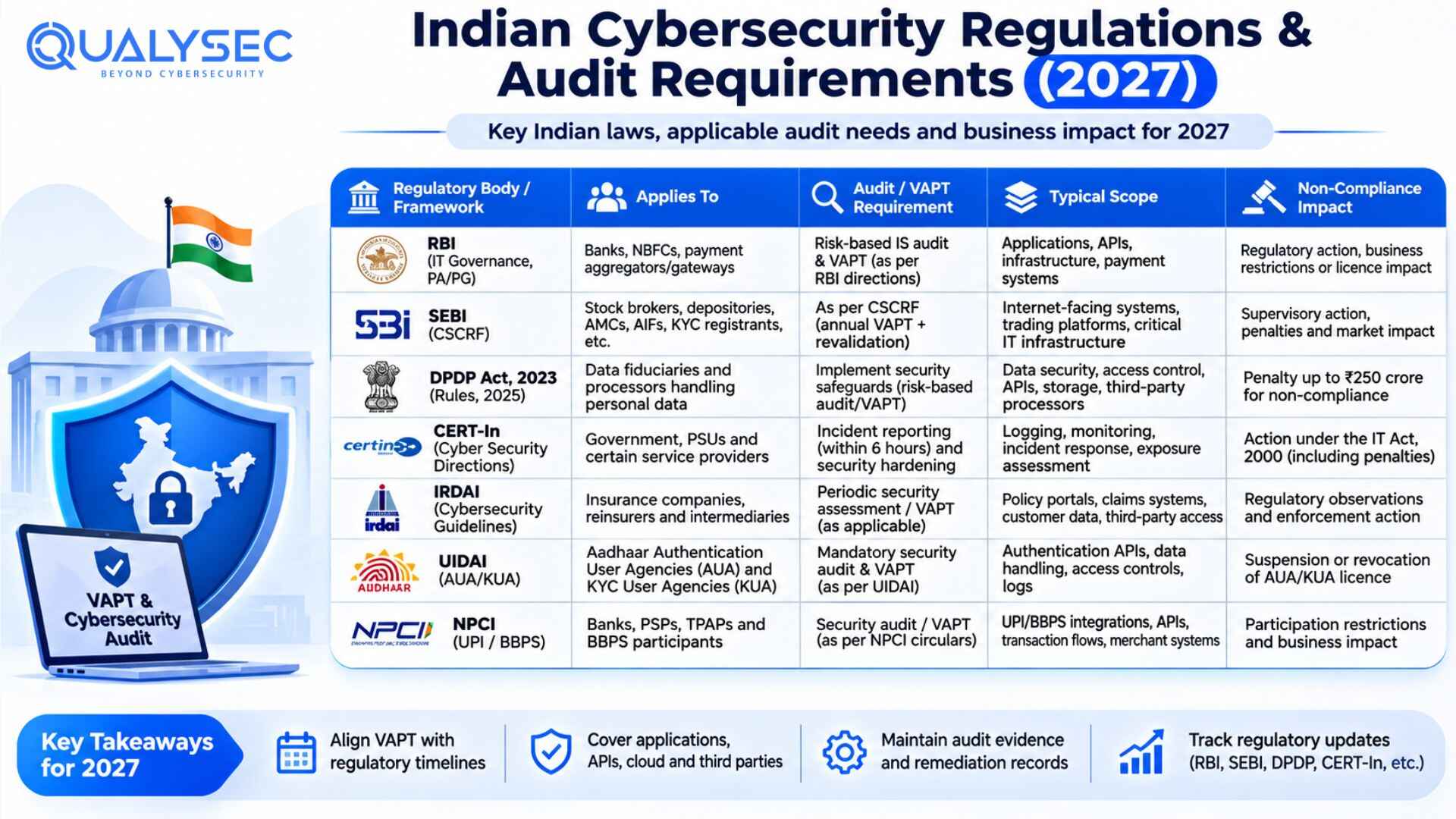
1. Which Indian Regulatory and Government Requirements Trigger VAPT in 2027? (Reasons 1–12)
1. RBI IT Governance and Information Security Assurance
Regulated financial institutions must demonstrate effective technology risk controls.
The RBI’s Information Technology Governance, Risk, Controls and Assurance Practices Directions, 2023 establish governance and assurance expectations for covered regulated entities. In 2027, banks and other applicable institutions should align infrastructure VAPT, application security assessments, information systems audits and remediation tracking with their approved risk-based audit plans.
Testing must cover more than the public banking website. Privileged access, internal network segmentation, critical applications and outsourced technology dependencies also deserve attention.
2. RBI Payment Aggregator and Payment Gateway Security
Payment businesses cannot treat transaction security as a checkout feature alone.
The RBI’s Regulation of Payment Aggregators Directions, 2025 and relevant payment system security instructions create security and governance obligations for covered entities. Payment gateways and technology vendors should also examine requirements flowing through their regulated partners.
A 2027 assessment should test payment APIs, merchant onboarding, settlement workflows, callback authentication, transaction integrity and sensitive payment information exposure.
3. SEBI Cybersecurity and Cyber Resilience Framework
SEBI-regulated entities face documented cybersecurity assurance requirements.
The Cybersecurity and Cyber Resilience Framework (CSCRF), introduced in August 2024 and subsequently clarified, establishes requirements according to regulated entity categories. Applicable entities must follow their category-specific VAPT, remediation, revalidation and reporting provisions.
For 2027 planning, covered businesses should map internet-facing applications, trading systems, APIs, identity systems and critical infrastructure against the current CSCRF control requirements rather than applying a generic annual checklist.
4. DPDP Act and Personal Data Security Safeguards
India’s privacy obligations create a direct business case for technical security validation.
The Digital Personal Data Protection Act, 2023 and Digital Personal Data Protection Rules, 2025 introduce phased obligations, with major security safeguards scheduled to become operative in May 2027.
Section 8(5) requires applicable data fiduciaries to implement reasonable security safeguards. The Act provides for penalties of up to ₹250 crore for failure to observe this obligation, subject to statutory enforcement provisions.
A DPDP-focused security assessment should examine access control, encryption, API authorization, personal data exposure, logging and processor-related security. The Act does not impose one universal annual VAPT frequency on every business.
5. CERT-In Six-Hour Cyber Incident Reporting
A vulnerability report is useful only if the incident-response process works.
CERT-In’s 2022 Cyber Security Directions require covered entities to report specified cybersecurity incidents within six hours of noticing them or being brought to notice of them, in accordance with the directions and official clarifications.
Penetration testing supports this obligation by identifying weaknesses in log collection, intrusion detection and response workflows. However, a VAPT report alone cannot demonstrate six-hour reporting readiness; organizations also need rehearsed escalation procedures, evidence preservation and authorized reporting responsibilities.
6. IRDAI Cybersecurity Requirements for Insurance Entities
Insurance systems contain valuable financial, identity and health information.
IRDAI’s information and cybersecurity requirements apply to regulated insurance sector entities according to their regulatory obligations. Insurers must evaluate technology risk across policy administration, digital onboarding, claims processing and third-party distribution systems.
A suitable VAPT scope includes customer portals, agent APIs, document repositories, cloud workloads and access to sensitive underwriting or claims information.
7. UIDAI AUA/KUA Security and Aadhaar Authentication
Aadhaar-integrated platforms require strict authentication and data-handling controls.
Authentication User Agencies (AUAs) and KYC User Agencies (KUAs) must follow applicable UIDAI information security, onboarding, contractual and audit requirements.
Security assessments should validate authentication API integrations, cryptographic controls, access permissions, transaction logs and the handling of Aadhaar-related information. Testing must respect UIDAI rules and the authorized boundaries of the authentication ecosystem.
8. NPCI UPI and BBPS Ecosystem Security
Payment integrations introduce risks beyond the core banking platform.
NPCI’s applicable UPI and Bharat Bill Payment System requirements, circulars and participation agreements can impose security assessment obligations on participating institutions and technology providers.
For 2027, VAPT should examine merchant applications, PSP integrations, callbacks, transaction references, authorization logic, and reconciliation workflows. NPCI’s specific security audit requirements should be checked for the participant’s role and the latest applicable circular.
9. Government and PSU Safe-to-Host Requirements
Government websites often require security clearance before production deployment.
Central and state government departments, public sector organizations and their implementation partners may require security assessment by CERT-In empanelled auditors under applicable procurement, hosting or departmental policies.
Testing commonly covers OWASP vulnerabilities, authentication, exposed services, configuration weaknesses and application functionality. Following remediation and successful verification, the authorized auditor may issue the relevant security audit clearance or Safe-to-Host documentation where required by the engagement.
10. NCIIPC and Critical Information Infrastructure Protection
Systems supporting essential national functions face heightened security responsibilities.
The National Critical Information Infrastructure Protection Centre (NCIIPC) addresses the protection of critical information infrastructure under India’s legal framework.
Organizations operating notified protected systems or supporting designated critical infrastructure should assess privileged access, network segmentation, remote management, resilience and supplier connectivity. Security testing must follow applicable restrictions and authorization procedures for sensitive operational environments.
11. TRAI and DoT Telecommunications Cybersecurity Requirements
Telecommunications security extends across networks, platforms and connected services.
The Department of Telecommunications’ Telecom Cyber Security Rules, 2024 and related directions establish requirements for applicable telecommunications entities. TRAI requirements may also affect regulated operational practices.
A 2027 audit roadmap should evaluate network-facing services, subscriber-management interfaces, remote administration, authentication infrastructure, signaling-related exposures and third-party integrations according to the entity’s regulatory obligations.
12. ABDM and National Digital Health Infrastructure
Healthcare interoperability increases the consequences of weak authorization.
Organizations participating in the Ayushman Bharat Digital Mission (ABDM) ecosystem must account for applicable National Health Authority requirements, health information security policies and participation conditions.
Security testing should focus on health-data consent flows, healthcare professional permissions, API authentication, patient-record access and audit trails. For healthcare platforms, a technical weakness can create patient confidentiality and operational risks even without a confirmed regulatory breach.
2. Which International and Export Requirements Make VAPT Necessary? (Reasons 13–22)
13. SOC 2 Type II Customer Assurance
International SaaS buyers frequently request independent security evidence.
SOC 2 Type II evaluates the design and operating effectiveness of relevant controls over a defined observation period. It does not prescribe a universal annual penetration test for every organization.
However, enterprise customers and auditors may expect technical testing that supports the organization’s risk assessment and control objectives. SaaS providers should assess tenant isolation, authentication, APIs and cloud infrastructure before major assurance reviews.
14. ISO/IEC 27001:2022 Information Security Certification
A certified management system must reflect actual technical exposure.
ISO/IEC 27001:2022 requires organizations to identify, evaluate and treat information security risks. Annex A includes controls relevant to technical vulnerability management and security testing.
Although ISO 27001 does not prescribe one fixed VAPT interval for all certified organizations, risk-based testing helps demonstrate that vulnerabilities are identified and managed. Scope should cover assets, applications and infrastructure included in the information security management system.
15. PCI DSS v4.0.1 Payment Card Security
Cardholder data environments require specific technical validation.
PCI DSS v4.0.1 includes penetration testing requirements for applicable entities, generally requiring internal and external testing at least every 12 months and after significant infrastructure or application changes.
Testing should examine the cardholder data environment, segmentation controls, authentication, application vulnerabilities and relevant attack paths. Requirements 11.4 and related provisions should guide scope and evidence collection.
16. GDPR Security for Indian Companies Serving Europe
Processing European personal data can create cross-border obligations.
Indian companies subject to the EU General Data Protection Regulation must implement security appropriate to the risks under Article 32.
Penetration testing can provide evidence of measures addressing unauthorized access, data exposure and application compromise. GDPR does not impose a universal annual VAPT requirement, but security testing may be appropriate based on processing risk and contractual commitments.
17. HIPAA Requirements for US Healthcare Contracts
Indian technology providers may inherit contractual healthcare security responsibilities.
Indian companies acting as business associates or subcontractors within HIPAA-regulated arrangements must assess applicable Security Rule obligations and contractual requirements.
A healthcare VAPT should examine electronic protected health information, identity controls, cloud storage, audit logging and interfaces with clinical systems. HIPAA requires risk analysis and safeguards; penetration testing frequency depends on risk and applicable commitments rather than a universal annual mandate.
18. FDA 510(k) Cybersecurity Submission Expectations
Medical device security must be supported by lifecycle evidence.
The US FDA’s February 2026 cybersecurity guidance addresses security considerations for medical devices and Section 524B requirements for applicable cyber devices.
Indian medical device manufacturers planning US submissions in 2027 should assess device software, mobile applications, cloud services, wireless interfaces and attack surfaces. Threat models, vulnerability testing, SBOMs, risk documentation and remediation records can support the relevant premarket submission.
19. ISO 13485:2016 and Medical Device Software Quality
Medical device cybersecurity must connect to product quality processes.
ISO 13485:2016 defines medical device quality management system requirements; it is not itself a standalone penetration testing mandate.
For connected devices, VAPT findings can feed design verification, supplier controls, corrective actions and documented product risk management. Testing should cover interfaces that could affect data integrity, device availability or safety-related functions.
20. SWIFT Customer Security Programme
Financial messaging environments demand targeted control assessment.
Organizations subject to the SWIFT Customer Security Programme must assess applicable Customer Security Controls Framework requirements and comply with the programme’s attestation and independent assessment arrangements.
Security work may include penetration testing of connected infrastructure, privileged accounts, network separation and access pathways. The exact assessment programme must follow the applicable SWIFT CSP requirements, not a substitute generic certificate.
21. Enterprise Vendor Risk Management
One unresolved vulnerability can delay a major contract.
Large international enterprises frequently request recent penetration testing reports, remediation status, security questionnaires and independent assurance before approving vendors.
Indian SaaS, BPO, IT services and technology providers should prepare assessment evidence covering customer-facing applications, APIs, hosting environments and third-party dependencies. Testing before procurement reviews reduces last-minute remediation pressure.
22. TISAX Requirements for Automotive Suppliers
Automotive customer relationships increasingly depend on information security assurance.
TISAX supports information security assessments across the automotive supply chain, with assessment objectives determined by the relevant business relationships.
Indian engineering, software and automotive suppliers should review systems handling prototypes, design information, manufacturing data and customer intellectual property. Targeted penetration testing complements the information security assessment but does not independently confer a TISAX label.
3. What Business, Investment and Financial Events Justify VAPT? (Reasons 23–30)
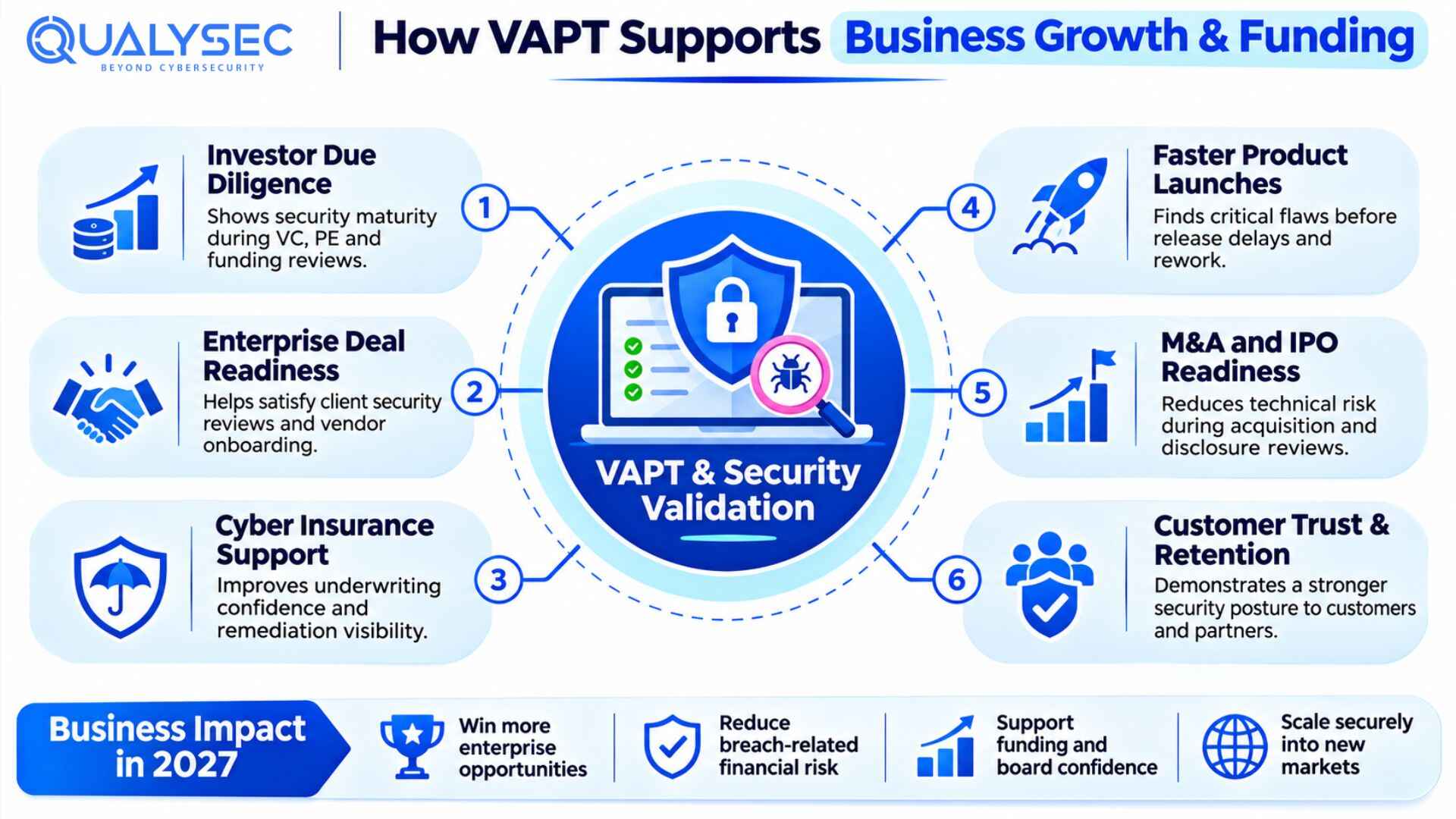
23. Venture Capital and Private Equity Due Diligence
Investors increasingly examine security liabilities before committing capital.
An unresolved authorization flaw or exposed production database can complicate technical due diligence and influence transaction terms.
Before fundraising in 2027, startups should commission assessments of their principal product, cloud infrastructure, privileged access and sensitive customer information. A current remediation register gives investors evidence that identified risks are being managed.
24. Mergers and Acquisitions Technical Security Audits
An acquisition can introduce vulnerabilities into the buyer’s environment.
M&A reviews should examine legacy applications, unsupported operating systems, third-party access, identity infrastructure and exposed credentials.
A pre-acquisition VAPT helps identify technical liabilities and integration risks. Post-acquisition testing should verify whether newly connected networks and identity environments have introduced additional attack pathways.
25. Pre-IPO Technology and SEBI DRHP Readiness
Material cybersecurity risks can affect investor disclosures and governance.
An IPO does not automatically impose a universal penetration testing certificate requirement on every issuer. However, material technology and cybersecurity exposures may require consideration during risk assessment and disclosure preparation.
Companies preparing a 2027 Draft Red Herring Prospectus should evaluate important applications, data protection controls and incident history. Findings should be considered by legal and disclosure teams according to materiality and applicable securities requirements.
26. Cyber Insurance Underwriting Requirements
Insurers may request evidence of security maturity before providing coverage.
Cyber insurance underwriting questionnaires often examine MFA, backups, endpoint security, incident response, privileged access and vulnerability management.
A recent VAPT report can support answers about externally exploitable weaknesses. It does not guarantee coverage, and testing scope should reflect the systems and controls relevant to the proposed policy.
27. Cyber Insurance Renewal and Premium Negotiations
Documented improvements may strengthen an insurance renewal submission.
Businesses seeking favorable renewal terms should demonstrate that previously identified critical vulnerabilities have been remediated and independently verified.
Confirmatory re-testing provides stronger evidence than a spreadsheet marked “fixed.” Premium outcomes remain subject to insurer models, claims history, exposure and market conditions; no testing provider can promise a particular reduction.
28. Enterprise and BFSI Sales Expansion
Security assurance can determine procurement eligibility.
Enterprise banks and large businesses may require suppliers to provide recent penetration testing reports, security certificates and remediation evidence before production integration.
Organizations expanding BFSI sales in 2027 should test APIs, customer portals, authentication controls and infrastructure supporting proposed engagements. Preparing evidence early prevents security reviews from becoming commercial bottlenecks.
29. Expansion into the US, EU, UAE and Singapore
Operating across jurisdictions creates overlapping security expectations.
An Indian company entering international markets may face GDPR obligations, US customer security clauses, sector-specific requirements and local cybersecurity or data protection laws.
The right assessment maps products and infrastructure against actual market exposure. It should examine regional deployments, identity federation, cross-border data flows and contractual security requirements rather than treating one VAPT report as universal compliance.
30. Board and Audit Committee Cybersecurity Oversight
Security spending should produce measurable risk reduction.
Boards and audit committees need more than a count of detected vulnerabilities. They need visibility into material business risks, remediation ownership, testing coverage and unresolved exceptions.
For 2027, security leaders should present a prioritized VAPT programme with critical asset coverage, remediation deadlines, retest outcomes and trends across repeated assessments. This connects technical assurance directly to governance decisions.
Plan Your 2027 Cybersecurity Budget
Preparing for funding, enterprise procurement, insurance renewal or international expansion?
Request a 2027 VAPT Scope & Cost Estimate based on your applications, APIs, cloud infrastructure, compliance obligations and expected release schedule.
Get Your 2027 VAPT Budget Estimate Today.
4. Which Product Launches and Technology Changes Require Security Testing? (Reasons 31–41)
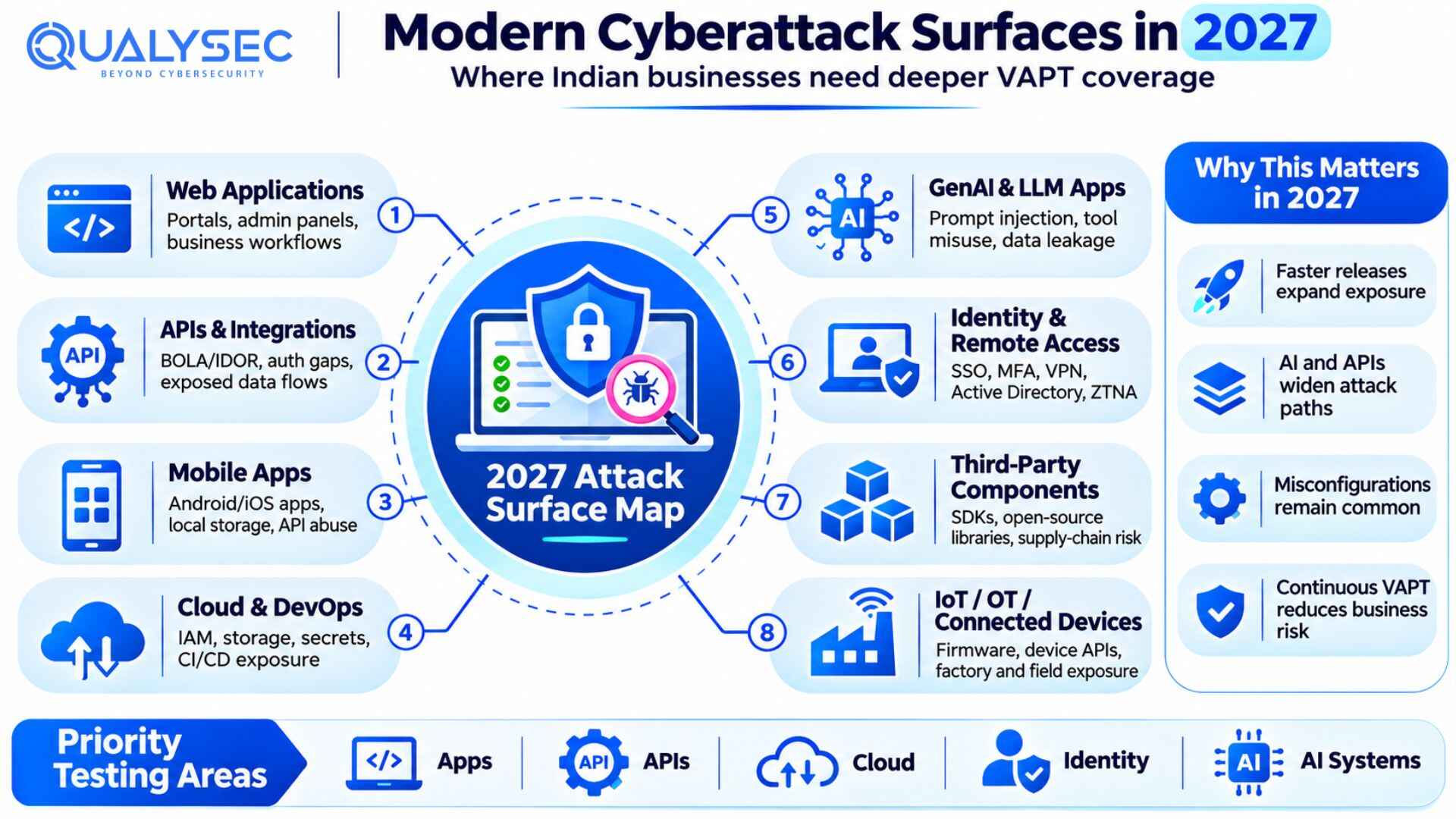
31. Launching New Web Applications
A successful functional test is not a security test.
New web applications may expose injection vulnerabilities, weak session controls, insecure file uploads and authorization failures.
Before production release, teams should perform manual and automated testing aligned with OWASP ASVS and relevant application security requirements. The final report should distinguish exploitable vulnerabilities from low-impact configuration observations.
32. Releasing Android and iOS Applications
Mobile security depends on both the application and its backend.
Mobile releases can expose insecure token storage, certificate validation weaknesses, excessive permissions and sensitive data leakage.
A 2027 mobile VAPT should examine application binaries, runtime behavior, local storage, API communication and platform-specific protections. Testing should also evaluate whether server-side controls remain effective when the client application is modified.
33. Open Banking and Public API Integrations
An API can authenticate users correctly and still expose another customer’s records.
Automated scanners frequently miss broken object-level authorization (BOLA), also known in many implementations as insecure direct object reference (IDOR).
Consider an Indian fintech API that accepts a loan application identifier. A legitimate borrower changes the identifier and retrieves another customer’s record because the backend checks login status but not ownership.
A proper API penetration test uses multiple roles and test accounts to validate authorization on every sensitive object and operation.
34. Migrating to AWS, Microsoft Azure or Google Cloud
Cloud migration changes the attack surface immediately.
Misconfigured IAM permissions, public storage, exposed secrets and insecure network rules can create risks even when the underlying cloud platform is secure.
Cloud assessments should examine identity policies, workload permissions, infrastructure-as-code, exposed endpoints, logging and segmentation. Testing should occur before migration completion and after major architecture changes.
35. Deploying Generative AI and LLM Applications
Traditional application scanners cannot fully evaluate AI-specific abuse.
AI-enabled products introduce threats such as prompt injection, sensitive information disclosure, unsafe tool execution, excessive agency and retrieval-based data exposure.
Security testing must assess system prompts, retrieval pipelines, external tools, model-connected APIs and authorization boundaries. For agentic systems, testers should examine whether manipulated instructions can trigger actions beyond the user’s permitted scope.
36. Upgrading ERP and CRM Platforms
Business platform upgrades can silently change access permissions.
ERP and CRM systems often store commercial records, payroll details, financial transactions and customer information.
A targeted VAPT should examine role-based access control, custom extensions, APIs, administrator privileges and integrations. Regression testing is particularly valuable after major upgrades or changes to workflow authorization.
37. Connecting Factory OT, ICS and SCADA Systems
Operational technology security requires a different testing strategy.
Industrial controllers and supervisory systems may not tolerate aggressive scanning or uncontrolled exploitation.
Manufacturing organizations should prioritize asset discovery, architecture review, safe configuration assessment and controlled testing in approved environments. Where active penetration testing is appropriate, it must use documented safety boundaries and coordination with plant operations.
38. Deploying IoT and Connected Hardware
Connected devices expand exposure into firmware and physical interfaces.
IoT products may contain hardcoded credentials, insecure update mechanisms, exposed debug interfaces and unprotected device-to-cloud communication.
A suitable assessment covers firmware, hardware interfaces, mobile companions, management APIs and cloud services. In connected healthcare and industrial products, testing must also consider operational and safety consequences.
39. Expanding Hybrid Work and Zero Trust Access
Remote access controls are common paths into internal systems.
VPNs, ZTNA services, endpoint configurations and identity systems can create unintended access when policies become inconsistent.
A 2027 infrastructure assessment should test MFA enforcement, device trust, session restrictions, conditional access and lateral movement opportunities. Active Directory hardening and privilege escalation checks are especially relevant for hybrid enterprise environments.
40. Introducing New Payment Checkout Flows
Payment logic flaws can exist without a classic injection vulnerability.
A checkout may handle input securely while allowing price manipulation, coupon abuse, duplicate refunds or payment confirmation bypass.
Penetration testers should assess server-side price validation, callback signatures, transaction states, concurrency and refund authorization. High-value payment workflows need business-logic testing with controlled test transactions.
41. Integrating Third-Party SDKs and Software Components
External libraries can become internal attack paths.
Analytics SDKs, payment modules, authentication libraries and open-source packages can introduce vulnerable dependencies or excessive permissions.
Security reviews should include software composition analysis, dependency provenance, secret exposure and application integration testing. High-risk components require closer review when they process sensitive information or execute privileged operations.
5. Which Cyber Incidents and Emerging Threats Should Trigger Immediate VAPT? (Reasons 42–50)
42. Verification After a Security Breach
Restoring a compromised service does not prove that it is secure.
After incident containment and forensic investigation, businesses should verify the affected attack paths, compromised configurations and remediated vulnerabilities.
Post-incident penetration testing must be coordinated with the response team to avoid destroying evidence. It should confirm that the original entry point and related weaknesses can no longer be exploited.
43. Ransomware Exposure and Active Directory Weaknesses
Attackers frequently exploit identity weaknesses to expand access.
Privileged account misuse, weak service-account controls, exposed remote administration and poor network segmentation can increase ransomware impact.
An internal security assessment should examine Active Directory permissions, Kerberos-related attack paths, local administrator exposure, backup access and lateral movement controls. Results should inform hardening and recovery exercises.
44. DDoS and Automated Bot Attacks
Application availability can fail under abusive traffic.
Retail, fintech, gaming and public-service platforms face risks from bot-driven account attacks, application-layer floods and resource exhaustion.
A defensive assessment should review WAF policies, rate limits, caching, authentication throttling and failover design. Authorized capacity exercises can validate resilience, but uncontrolled stress testing must never target production systems.
45. API Scraping and Business-Logic Abuse
A technically valid API request can still violate business rules.
Attackers may exploit unlimited pagination, weak object authorization, predictable identifiers or insufficient anti-automation controls.
Manual API testing should examine transaction sequences, entitlement checks, enumeration resistance and abuse thresholds. These weaknesses often survive conventional scanner-based testing because individual requests appear legitimate.
46. Security Reviews Following a Competitor’s Breach
A sector-specific breach should trigger exposure validation, not panic.
When another company reports an incident involving a shared technology, supplier or attack technique, organizations should determine whether the same weakness affects their systems.
The response should include targeted vulnerability assessment, exposure review and controlled exploitation where authorized. Testing must follow verified threat information rather than unconfirmed breach speculation.
47. Phishing, Social Engineering and Red-Team Exercises
Technical controls must withstand realistic attacker behavior.
Attackers may use stolen credentials, malicious attachments or convincing social engineering to gain initial access.
Authorized phishing simulations and red-team exercises can evaluate detection, endpoint protection, credential handling and escalation procedures. Exercises should follow agreed rules of engagement, protect employees and avoid unsafe operational disruption.
48. Dark Web Credential Exposure
A leaked password may remain useful long after the original breach.
Credential exposure can support account takeover, password spraying and unauthorized access to administrative systems.
Organizations should identify affected accounts, revoke sessions, reset credentials and investigate suspicious authentication activity. Targeted VAPT can then assess MFA bypass, account recovery weaknesses and credential-based access pathways.
49. Shadow IT and Unknown Internet-Facing Assets
Unmanaged applications often escape routine audit scope.
Old staging servers, forgotten subdomains, exposed dashboards and abandoned cloud resources can remain accessible for years.
External attack surface discovery should identify unknown assets and classify their ownership and business impact. Confirmed in-scope systems should then undergo targeted vulnerability assessment and authorized penetration testing.
50. Festive Sales, Major Launches and IPO-Related Traffic Events
Peak business periods create pressure on security controls.
High-traffic events can expose weaknesses in authentication, checkout logic, session handling, rate limits and infrastructure capacity.
Before a major 2027 campaign, businesses should combine application VAPT with authorized performance and resilience testing. Critical findings must be fixed and independently retested before the change freeze.
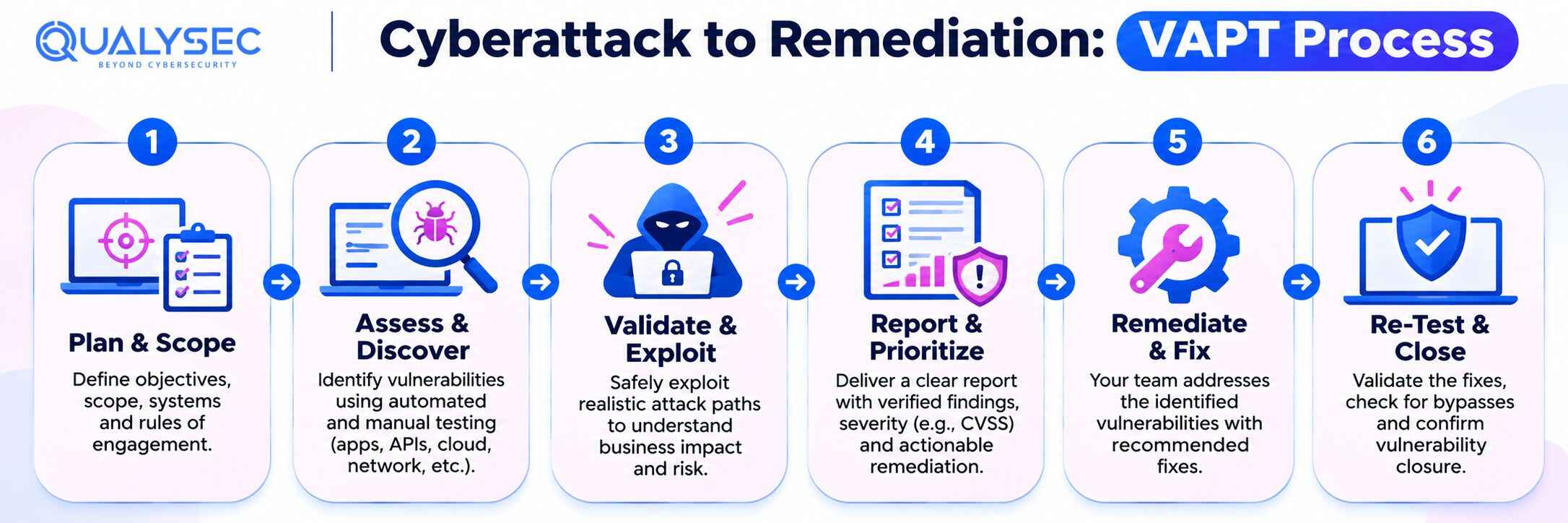
Validate Security Before Your Next Critical Event
Responding to an incident, preparing a major product release or entering a high-traffic business period?
Qualysec can help define a risk-based testing scope, identify exploitable vulnerabilities and verify remediation before production exposure increases.

What Does Each Major Regulation Actually Require in 2027?
The following matrix separates binding requirements from commonly adopted assurance practices. It should be used alongside the latest applicable regulatory circulars, contracts and entity classifications.
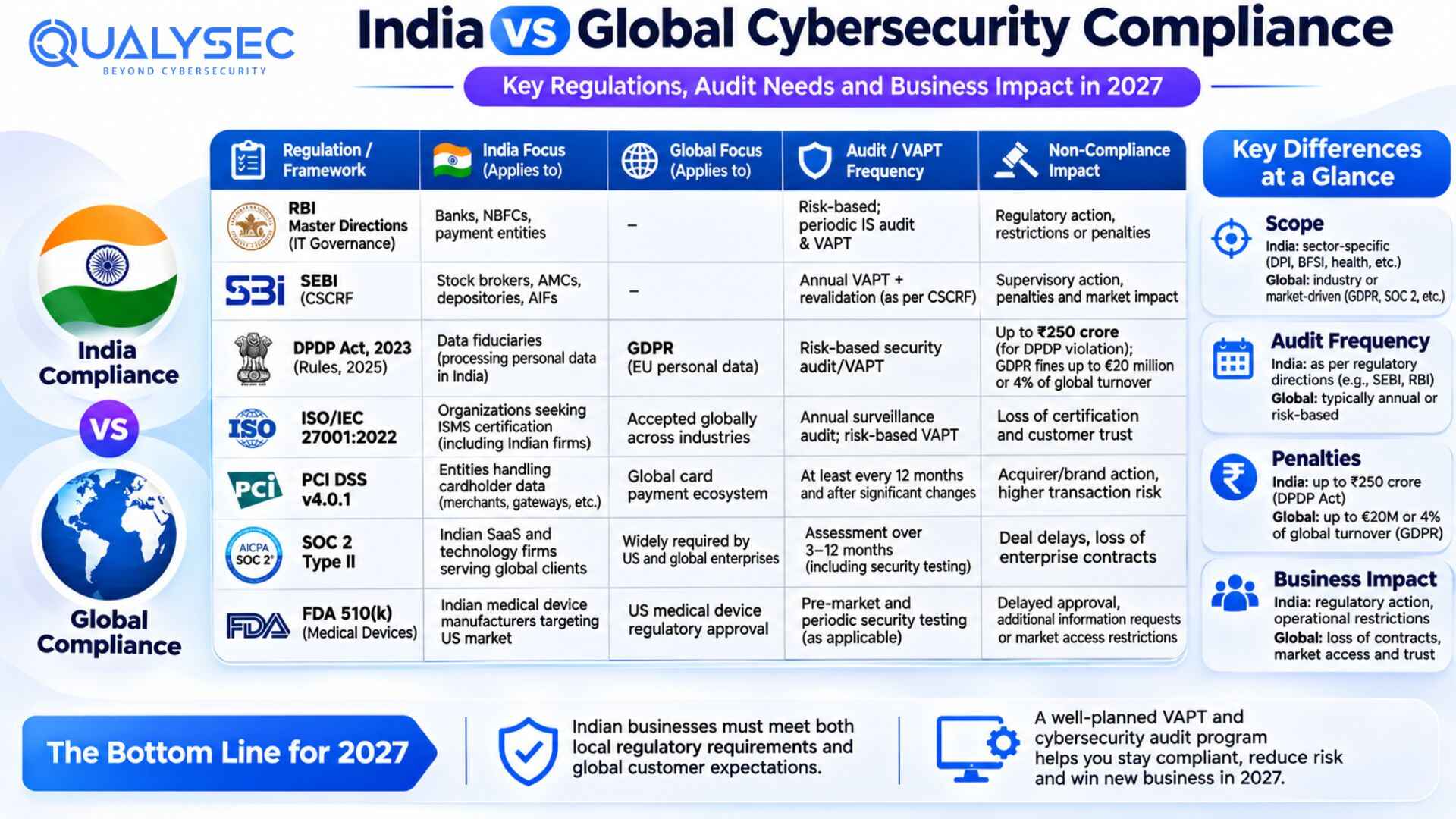
| Regulation / framework | VAPT or security assessment frequency | Typical assessment scope | Consequences of non-compliance |
| RBI IT Governance Directions | Risk-based IS audit plan for covered entities; no universal VAPT interval across all systems | Banking applications, IT infrastructure, critical systems, third parties | Supervisory findings, directions and applicable regulatory action |
| RBI PA Directions / payment systems | According to applicable PA/PSO instructions and system audit requirements | Payment APIs, merchant systems, settlement, cloud, fraud controls | Regulatory restrictions, supervisory action or authorization consequences |
| SEBI CSCRF | Category-specific; applicable VAPT provisions include at least annual testing and revalidation requirements | Critical systems, networks, applications, APIs | Supervisory and enforcement action under applicable SEBI provisions |
| DPDP Act / Rules | No universal annual VAPT mandate; risk-based safeguards required from applicable commencement | Personal data, access control, encryption, logging, processors | Up to ₹250 crore for breach of reasonable security safeguard obligation |
| CERT-In Directions | No universal annual VAPT requirement under the six-hour reporting direction | Monitoring, incident response, logs, relevant systems | Applicable consequences under the IT Act |
| IRDAI requirements | Risk-based and according to current applicable insurance-sector requirements | Insurance portals, policy systems, claims, third parties | Regulatory observations and applicable action |
| ISO/IEC 27001:2022 | Risk-based testing; certification surveillance typically annual | ISMS scope, vulnerabilities, access, technical controls | Certification nonconformities, suspension or withdrawal |
| SOC 2 Type II | No universal mandatory penetration testing frequency | Systems and controls within the examination scope | Qualified report findings or customer assurance concerns |
| PCI DSS v4.0.1 | Generally at least every 12 months and after significant changes, as applicable | Cardholder data environment and segmentation | Acquirer/payment-brand consequences, contractual assessments |
| FDA 510(k) cybersecurity | No universal annual premarket VAPT interval | Applicable cyber device, software, interfaces, threat and vulnerability evidence | Submission deficiencies, review delays or other applicable regulatory consequences |
Regulatory interpretation based on primary materials from RBI, SEBI ,MeitY, CERT-In and FDA.
How Should Indian Businesses Choose an Accredited VAPT Partner for 2027?
Choosing a penetration testing company in India requires more than comparing price quotations. The quality of the testing methodology, auditor qualifications and remediation evidence determines whether the engagement actually reduces risk.
1. Verify CERT-In Empanelment
Begin with CERT-In empanelment – If your regulator, government customer or procurement contract requires a CERT-In empanelled information security auditor, verify the firm’s current status through CERT-In’s official directory. Empanelment should be checked at the time of procurement because validity can change. A company presenting an old certificate should not be accepted without verification.
2. Check CREST Accreditation
Next, examine CREST accreditation – CREST accreditation is an independent industry credential for relevant cybersecurity services, but the specific accredited service and entity must match the engagement. CREST does not replace statutory Indian requirements or guarantee that every tester has identical capabilities.
3. Evaluate Testing Depth and Methodology
The third consideration is testing depth.
Automated vulnerability scanners help identify known CVEs, outdated components, exposed services and common configuration problems. They cannot reliably understand every business authorization rule.
For example, a scanner may successfully authenticate to a fintech application without noticing that changing an account identifier exposes another customer’s transactions. A skilled tester examines application behavior, user roles, workflow sequence and server-side authorization.
Ask the provider to explain its methodology for OWASP ASVS, API BOLA/IDOR, CVSS severity assessment, cloud privilege escalation and manual business-logic testing.
4. Ensure Confirmatory Re-testing
Finally, require confirmatory re-testing. A finding should not be considered resolved merely because a developer has changed the affected code. The tester should validate the fix, examine related bypass opportunities and document the result.
5. Assess Organizational Certifications and Testing Capabilities
Qualysec combines CERT-In empanelment, CREST-accredited security testing capabilities, automated and manual assessment techniques, and confirmatory re-testing. Its ISO 27001 and ISO 13485 certifications add organizational assurance relevant to information security and MedTech engagements.
6. Review Procurement Documentation and Remediation Commitments
For procurement, request the current accreditation evidence, proposed scope, testing methodology, sample report, remediation commitments and written confirmation of any complimentary re-testing entitlement.
The best VAPT engagement ends with fewer exploitable weaknesses, not simply another PDF in the compliance folder.
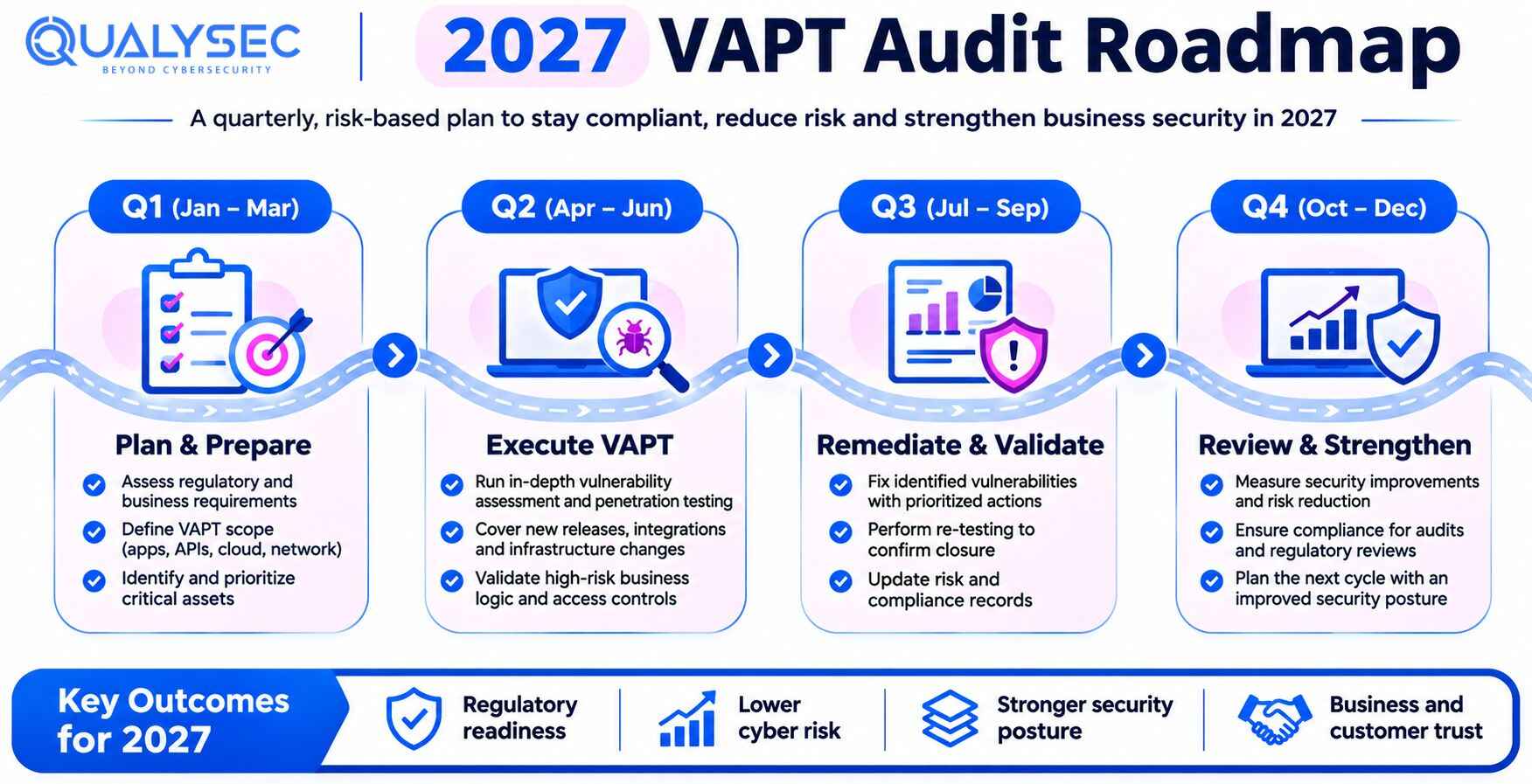
What Should a Practical 2027 VAPT Roadmap Look Like?
| Timeline | Recommended activity | Expected evidence |
| Q4 2026 | Identify regulated entities, critical assets, contracts and 2027 launch plans | Asset inventory, applicability matrix, audit budget |
| Q1 2027 | Conduct baseline application, API, cloud and infrastructure assessments | Initial findings, risk ratings, remediation ownership |
| Q2 2027 | Validate applicable DPDP safeguards and high-priority remediation | Safeguard evidence, access reviews, confirmatory retest results |
| Q3 2027 | Review major releases, vendor dependencies and incident readiness | Updated VAPT reports, response exercises, supplier reviews |
| Q4 2027 | Review outstanding findings and prepare next-year assurance plans | Risk acceptance records, board reporting, 2028 testing plan |
This schedule is illustrative. Regulated organizations must preserve prescribed audit windows and reporting deadlines rather than substituting a quarterly commercial testing plan.
Frequently Asked Questions About VAPT in India for 2027
1. Is VAPT mandatory for every company in India in 2027?
No. India does not impose one universal VAPT requirement on every registered business. Mandatory assessments depend on applicable regulations, sector-specific directions, government procurement conditions and contractual obligations.
2. How often should Indian businesses conduct VAPT in 2027?
Annual testing is a common baseline, but frequency depends on regulatory requirements, business risk and system changes. Critical applications should also be tested after significant modifications, incidents or newly identified exposures.
3. What is the difference between VAPT and a cybersecurity audit?
VAPT identifies vulnerabilities and verifies whether weaknesses can be exploited. A cybersecurity audit evaluates broader controls, policies, governance, procedures and compliance evidence; both may be necessary.
4. Is a CERT-In empanelled auditor mandatory for DPDP compliance?
No. The DPDP framework does not universally require every data fiduciary to use a CERT-In empanelled VAPT provider. Such an auditor may nevertheless be required under another applicable rule or customer contract.
5. How much does VAPT cost in India in 2027?
There is no official fixed national price. The cost depends on application complexity, API endpoints, infrastructure size, testing depth, compliance reporting requirements and the scope of confirmatory re-testing.
6. Does ISO 27001 certification eliminate the need for penetration testing?
No. ISO 27001 establishes requirements for an information security management system, while penetration testing assesses whether technical weaknesses can be exploited. Testing may be an appropriate risk treatment and assurance activity within an ISO 27001 programme.
7. What should a business receive after a VAPT engagement?
A professional engagement should provide an executive summary, scope and methodology, validated findings, severity ratings, technical evidence, remediation guidance and a retesting record. Regulatory or customer-specific reports should additionally include the required auditor declarations and supporting documentation.
Conclusion: Make 2027 the Year Security Evidence Drives Decisions
Indian businesses entering 2027 face greater expectations from regulators, enterprise customers, investors and their own boards.
Yet the strongest reason to conduct VAPT remains straightforward: unknown exploitable weaknesses are expensive to discover during an incident.
Regulatory compliance establishes the minimum applicable obligations. Effective penetration testing goes further by exposing weaknesses in applications, APIs, identity systems, cloud environments and business workflows before attackers can exploit them.
Whether the trigger is SEBI CSCRF, RBI technology assurance, DPDP security safeguards, an international customer contract or an upcoming product launch, the objective should remain consistent: identify risk, assign ownership, implement corrective measures and verify the results.
For organizations preparing their 2027 cybersecurity budgets, Qualysec offers a practical starting point—independent testing aligned with the systems, compliance obligations and commercial risks that matter most.
Plan your 2027 VAPT and cybersecurity audit programme: Connect with Qualysec.
Official Regulatory Sources and 2026 Threat Intelligence
The following sources support the legal requirements, incident figures and cybersecurity recommendations discussed in this guide.
| Authority | Official source and relevance |
| MeitY | 2025–26 Annual Report — CERT-In incident statistics and cybersecurity activities |
| CERT-In | Cybersecurity Directions FAQs — six-hour incident reporting |
| CERT-In | Government Entity Security Guidelines — pre-hosting, annual and major-change audit expectations |
| RBI | Payment Aggregator Directions, 2025 — payment security and risk governance |
| SEBI | CSCRF Technical Clarifications — updated implementation guidance |
| MeitY | DPDP Rules Gazette Notification — phased commencement and security safeguards |
| UIDAI | AUA/KUA Audit Compliance Checklists — authentication ecosystem controls |
| NPCI | UPI Security Audit Circular — applicable system and application audit requirements |
| FDA | February 2026 Medical Device Cybersecurity Guidance — premarket security evidence |