






Search for FSMA requirements, and the answers are most likely not about the rules a Singapore bank must follow but about American food safety. This same scenario applies to the UK, which has its own FSMA since 2000, so a CISO in Singapore can waste an afternoon reading the wrong law.
This is a guide to the Singapore Omnibus Law, the FSMA 2022, which enables the Monetary Authority of Singapore (MAS) to impose binding cyber duties on licensed firms. They are set out in MAS notices with concrete figures such as 1 hour to report incidents, 4 hours of downtime, and up to S$1 million in penalties per year. The majority of those duties came into effect on 10 May 2024, and MAS has since discussed the following more stringent technology risk regulation for critical systems.
Those notices do not mention penetration testing, but MAS expects it through guidelines that supervisors use when evaluating firms. The next sections follow that track from the Act to the test plan, and a working clock check, as well as a real case from Singapore.
What Is the Financial Services and Markets Act Singapore, and Why Should Security Teams Care?
The Financial Services and Markets Act Singapore (FSMA) 5 April 2022 is an omnibus law that consolidated cross-cutting powers of MAS across various sectors. It sits on top of, but does not replace, the banking, insurance, securities and payments acts, making almost every licensed firm covered by one legal basis.
Table 1: What the Act brought together
| Power | What it means for security teams |
| Technology risk management | One legal basis for cyber duties across sectors |
| AML/CFT powers | Sector-wide supervision of financial crime controls |
| Control and resolution | MAS can step in when a firm fails |
| Prohibition orders | Individuals can be barred from the industry |
| Digital token service providers | Any crypto company providing services to foreign clients should be licensed. |
The powers can cover systems, if not in regulated activities, at least in interconnection, which presents the risk of contagion, say Rajah & Tann. This implies that the Financial Services and Markets Act Singapore can cover shared middleware or group identity services without any contact with customers.
Is FSMA the Same as a Financial Services Act?
Not quite, as the law is usually referred to by the shortened Financial Services Act, which already has a place in other laws. The contract name is the same for both Malaysia’s 2013 statute and UK’s 2021 statute, so it can be confusing in contracts and searches. If a vendor agreement does not specify a country, ask what the Financial Services Act refers to before anyone signs.
FSMA Singapore Timeline: Which Parts Are in Force in 2026?
The FSMA Singapore rollout has been gradual, meaning a policy may not contain the technology duties if they were introduced a year later.
Table 2: Commencement phases of the Act
| Date | What commenced |
| 28 April 2023 | AML/CFT powers, dispute resolution schemes, inspections, offences |
| 10 May 2024 | Technology risk powers, control and resolution, FSM-N notices |
| 31 July 2024 | Part 3 and further specified sections |
| 30 June 2025 | Part 9, digital token service provider licensing |
The majority of security duties are from 10 May 2024, when MAS’ two parallel notices on technology risk and cyber hygiene became effective for each licence class. Also on the same day, MAS withdrew the old banking notices 644 and 655, meaning that policies referencing these numbers should be updated to refer to the FSM-N series. The date of that gap review is therefore the starting point for any FSMA Singapore gap review and is further complicated by the introduction of the crypto regime in June 2025 when tokens are involved. When auditing, refer to the commencement table on Singapore Statutes Online as it lists all subsequent amendments and commencement dates in one location.
Financial Services and Markets Regulations and MAS Notices: Which Rules Bind Your Licence Class?
The four layers are located beneath the Act’s title, and are not all equally important for an inspector to consider when assessing your technology controls.
Table 3: The four layers and their legal force
| Layer | Examples | Legal force |
| The Act | Section 29 powers, offences, Part 9 | Primary law |
| Regulations made under the Act | Dispute scheme rules (2023), token provider rules (2025) | Binding subsidiary law |
| MAS notices under section 29(1) | FSM-N03 to FSM-N26 | Binding on the named class |
| MAS guidelines | TRM Guidelines, January 2021 | Expectations, not law |
The procedure (including notice schemes and token licensing) is regulated by the Financial Services and Markets Regulations, with the technical duties being carried out by the notices. The maximum fines for violations of the notices or the Financial Services and Markets Regulations range up to S$1 million, which was first proposed in MAS’ explanatory brief.
MAS has published 26 notices (FSM-N03 to FSM-N26) mostly in pairs, with technology risk and cyber hygiene text for each licence class.
Table 4: Notice pairs for common licence classes
| Licence class | TRM notice | Cyber hygiene notice |
| Banks | FSM-N05 | FSM-N06 |
| Credit and charge card licensees | FSM-N07 | FSM-N08 |
| Finance companies | FSM-N09 | FSM-N10 |
| Payment system operators and digital payment token providers | FSM-N13 | FSM-N14 |
| Capital markets institutions | FSM-N21 | FSM-N22 |
| Financial advisers | FSM-N23 | FSM-N24 |
Before quoting paragraphs, remember that money brokers are only carrying a technology risk notice, and designated financial holding companies are only carrying a cyber hygiene notice.
What Do the Cyber Hygiene Notices Require?
FSM-N06 is the bank’s cyber hygiene notice that came into effect on 10th May 2024 and outlines 6 brief duties, each of which can fail undetected on a large estate. These six duties are repeated in the other licence classes’ hygiene notices (check the numbers in your copy).
Table 5: The six cyber hygiene duties in FSM-N06
| Para | Duty | Evidence an assessor expects |
| 4.1 | Administrative accounts secured against unauthorised use | Using named accounts, no shared credentials, and logged-in use. |
| 4.2 | Patches applied within a risk-based timeframe | Written timeframe by severity, patch-age reports |
| 4.3 | Written security standards for every system | Standard mapped to each system; recorded exceptions |
| 4.4 | Perimeter controls restricting unauthorised traffic | Rule reviews with approval per inbound rule |
| 4.5 | Malware protection where implementable | Coverage report: reasons for any gaps |
| 4.6 | MFA on critical system admin accounts and internet access to customer data | Enrolment reconciled to the account inventory |
Notice that in paragraph 4.2, no number of days is mentioned, so each firm must pick its patch time frame, record it and justify it. Paragraph 4.5 is similar, since it allows a system without malware protection only where such protection genuinely can’t be implemented. All six of those paragraphs are silent regarding how to prove a control works, and that’s where the value of a configuration review and penetration testing comes in.
What Do the Technology Risk Management Notices Require?
The technology risk notices are added to the technology, and they are explicitly described in paragraphs 5–8 of FSM-N07 (card licensees).
Table 6: The four clocks in the TRM notices
| Para | Requirement |
| 5 | Unscheduled downtime of each critical system no more than 4 hours in any 12 months |
| 6 | Recovery time objective of 4 hours or less, validated every 12 months |
| 7 | MAS notified within 1 hour of discovering a relevant incident |
| 8 | Root cause and impact report within 14 days of discovery |
The downtime cap can be easily exceeded by three minor outages, just like a single long outage on a busy Saturday. The one-hour clock starts at discovery, not at the outage, making monitoring speeds count and slow detection count. Fast monitoring pays, slow detection pays, as the one-hour clock begins at discovery, not at the outage.
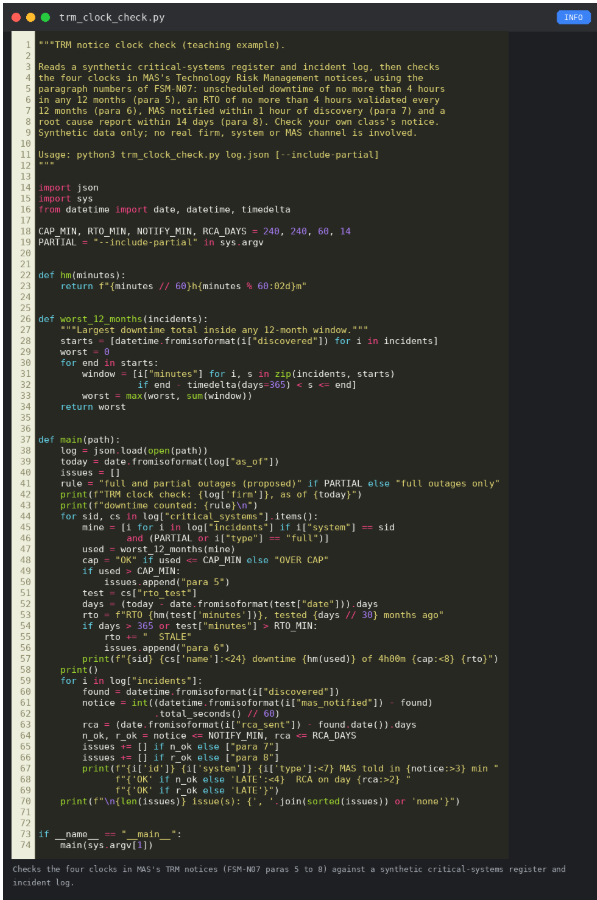
MAS also provided comments on the amendments to these notices, which are scheduled to be effective from 10 June to 31 July 2026, where it suggested that partial disruption could be counted towards the 4 hours. By the end of November 2026, no final text was available, and changes would be implemented 12 months after publication; hence, the script below represents both readings.
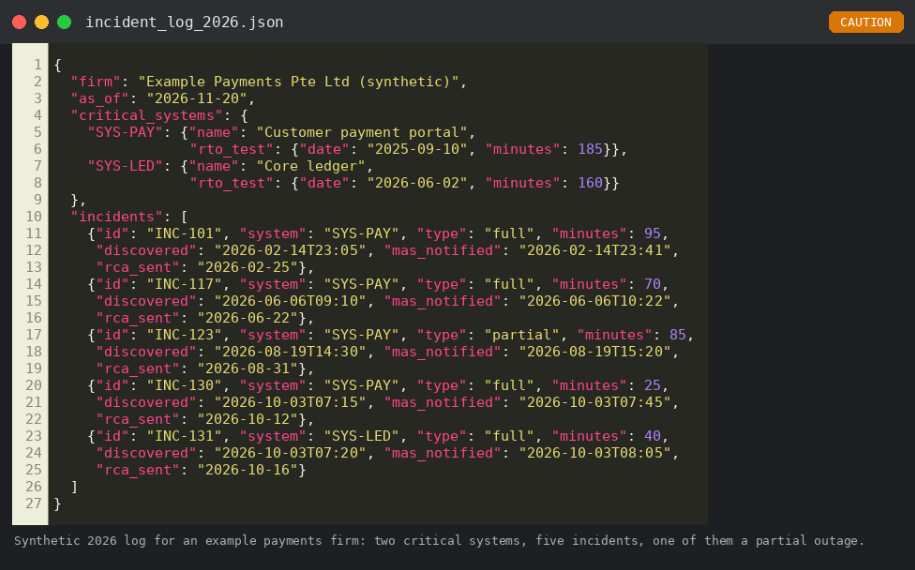
Code example: trm_clock_check.py
Synthetic incident log:
incident_log_2026.json
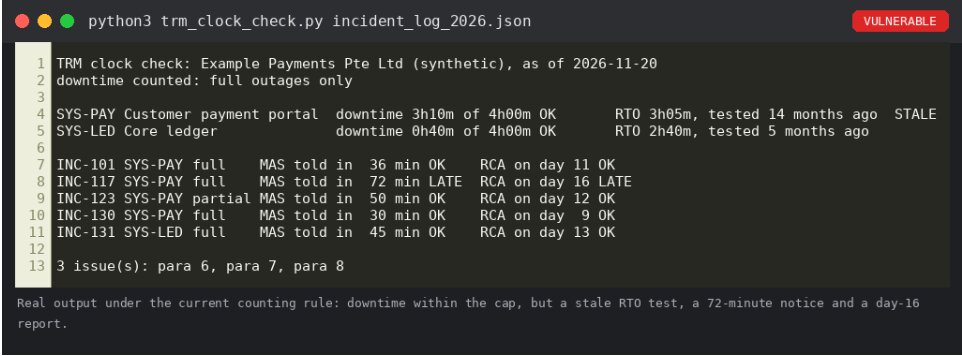
Output, current counting rule:
Output, partial outages counted:
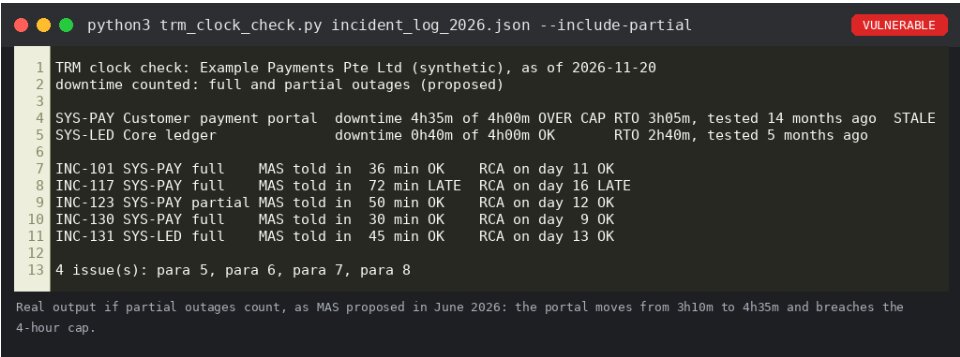
Under current counting, the portal stays at 3h10m, but counting the partial outage pushes it to 4h35m and past the cap. Both runs also catch a stale recovery test, a 72-minute notification and a day-16 report, which no penetration test would ever reveal.
Is Penetration Testing Mandatory Under the Financial Services and Markets Act 2022?
On its face, there is no reference to ‘penetration testing’ in the Financial Services and Markets Act 2022, a discovery which comes as a shock to a lot of teams. This is based on the MAS TRM Guidelines of 18 January 2021, which, although they are not binding laws, influence the estimation of the controls by the supervisors.
Table 7: Testing expectations in the MAS TRM Guidelines
| Guideline | Expectation |
| 13.1 | Vulnerability assessments at a frequency matching system criticality |
| 13.2.1 | Black-box and grey-box testing for online financial services |
| 13.2.4 | Penetration testing of internet-facing systems at least annually and after major changes |
| 13.4 | Adversarial attack simulation, with the ABS AASE guidelines as reference |
| 13.6.1 | Remediation timeframes set by severity |
| 6.1.1 | Secure coding, source code review and application security testing |
The guideline 13.2.3 also requires tests to be performed on production systems, while ensuring that live customer services are resilient during the tests, through agreed beforehand safeguards. Red teaming in guideline 13.4 works well for bigger institutions, and smaller institutions typically conduct annual testing, re-testing and secure code review. So the answer is that, in reality, it is not a requirement to test but an expectation, however, a firm without testing will find it difficult to prove its notice compliance. The annual internet facing test is thus the minimum practical under the Financial Services and Markets Act 2022, where retests will close each finding.

What Should an FSMA-Ready Security Testing Programme Cover?
A sound programme links every test to the duty it assesses, and the evidence file answers inspectors’ questions before they ask them.
- Internet-facing apps and APIs: At a minimum, test once per year (according to guideline 13.2.4), and after significant releases and architecture revisions. Intruders typically attempt these checks first, so teams should test them thoroughly and give them the broadest possible scope.
- Admin access and MFA: Try to access administrative functions without MFA, paragraphs 4.1 and 4.6 of the hygiene notice. Finally, reconcile MFA enrolment with full list of accounts, as forgotten service accounts don’t often appear on a vendor’s compliance dashboard.
- Perimeter and patch posture: External and between network zone scans; use a record of approval for each open inbound posture. Check the ages of all open vulnerabilities with your own written timeframes – paragraph 4.2 makes those numbers all yours.
- Recovery and detection: Perform a timed failover for 4 hours, and introduce a benign test indicator for timed detection. Both exercises demonstrate if your team is capable of accomplishing the TRM notice clocks in an actual incident at an inconvenient time.
Tester’s note: The most common gap I end up finding is an untested assumption, such as a failover which no one has run end to end. The other is the MFA-everywhere estate, where a user’s forgotten service account still has admin privileges and continues to log on with a password.
Case Study: What Did MAS’s Response to the 2023 DBS Outages Signal to Singapore FIs?
MAS’s media release in November announced disruptions to DBS on 29 March, 5 May, 26 September and the last two days of October 2023.
Table 8: MAS measures after the 2023 DBS disruptions
| Measure | Detail |
| Six-month pause | Any upgrade or change to IT systems, other than security, regulatory or risk related, that will not help achieve the goals of the business plan. |
| Business restrictions | No new business acquisitions; no branch or ATM cuts |
| Capital charge | The operational risk weight is 1.8 times. |
| Shortcomings cited | Resilience, incident management, change management, governance |
| Outcome | Pause ended 30 April 2024; multiplier kept |
Banking rules introduced these measures before MAS issued the FSMA notices. However, they show what MAS expects when attackers repeatedly compromise critical services. In April 2024, MAS confirmed substantive progress but retained the higher capital charge until it gained confidence in the service’s reliability.
The findings came not from an exotic attack but from change management and incident handling, so it’s time to rehearse the Section 5 clocks. A firm that continues to do that today would be subject to the four-hour limit, one-hour time and an S$1 million fine.
Does FSMA Reach Crypto and Digital Token Service Providers?
Yes, from 30 June 2025, Singapore-based companies providing digital token services to overseas customers must obtain a licence. In fact, there was no transition period, and MAS stated that it would only consider granting such licences in “limited circumstances”, according to Rajah & Tann. Payment token providers already have their own notice period, and the wallet systems, key management and exchange APIs share the same six hygiene chores. These companies should also undergo testing for key-handling and wallet authorisation issues, as there are no close parallels in traditional banking.
How Can Qualysec Help MAS-Regulated Firms?
Qualysec is a provider of penetration testing services that tests Web applications, APIs, mobile applications, and cloud services against MAS hygiene responsibilities and the TRM Guidelines. The team assigns each finding to the affected paragraph, retests it after remediation, and closes it with a letter of attestation. MAS does not accredit testing vendors. However, your report will follow the defined scope, not the bank’s scope. A payments firm’s report will refer to its notice period, not the bank’s.
Case Study: Testing a Regulated Crypto Exchange (VARA, Dubai)
Our testers identified 18 vulnerabilities (including a wallet endpoint that revealed other users’ balances) for a Middle East cryptocurrency exchange regulated by Dubai’s VARA. The team successfully retested all fixes. Although the work was not a MAS engagement, it still reflects the exchange infrastructure that Singapore token providers now have to protect.

Conclusion
MAS has placed cyber responsibilities on a single footing, imposed a S$1 million blacklist on the notices and has placed the onus of proof with each firm. Those firms that remain calm are ones with registers, patch timeframes and retest reports that already answer an inspector’s first question. This week, bring both notices about your licence class and review all the paragraphs against evidence that you could show to an inspector tomorrow morning.
Talk to Qualysec about testing scoped to your MAS notices, or review a sample report to see how findings map to each paragraph.
FAQs (Frequently Asked Questions)
1.What does Singapore’s FSMA require for cybersecurity?
MAS legislates on secured admin accounts, risk-based patching, security standards, perimeter controls, malware protection and multi-factor authentication through section 29. There are additional technology risk notices, including a critical systems register, a 4-hour downtime limit, a 4-hour recovery objective, and a 1-hour incident reporting requirement. Violating these notices can result in fines of up to $1 million, so legal and security teams should co-own the evidence files.
2.Who must report incidents to MAS, and how fast?
Each institution subject to a technology risk notice must immediately notify MAS of any applicable incident.The institution must notify MAS no later than one hour after the incident occurs.Within 14 days of receiving the R&I analysis, the institution must submit the root cause and impact analysis report. MAS may allow a delay for complex investigations. Since the clock starts at discovery, firms should practice who to contact at MAS and which facts to provide before an incident occurs.
3.Does a penetration test prove compliance with MAS notices?
No single test is definitive. Notice requirements also cover governance, patch timeframes, recovery exercises, and reporting. A penetration test does not assess all these areas.Even when teams scope and retest the test properly, the test provides strong evidence. This becomes especially valuable when teams clearly link evidence for each notice paragraph to the relevant requirement. Include the test in the evidence file along with recovery drills and patch reports, and the signed critical systems register.