






SaaS Security Posture Management (SSPM) is a security capability that uses automated monitoring to assess and help mitigate risks related to SaaS applications, including misconfigurations and excessive permissions. Integrations with SaaS applications offer considerable value but expand the organization’s attack surface. Automated monitoring can also help identify gaps in security controls that affect compliance.
Some teams moving to cloud-based software assume that, under the Shared Responsibility Model, security of the SaaS application is entirely the vendor’s responsibility. Customers are typically responsible for configuring and managing security features, user access controls and permissions, connected third-party applications, and other policies governing access to their data within the SaaS application. SaaS vendors such as Microsoft also make clear that customers remain responsible for their data. This creates a potentially risky situation, especially as companies adopt more SaaS applications. Tracking permissions and configurations for hundreds of users across dozens of SaaS applications can become unmanageable.
Why SaaS Posture Management Matters for Modern Enterprises
Today’s enterprises have employees in various departments, from engineering to sales, each using different SaaS applications. A single enterprise may use dozens of different applications, including those used in HR, finance, and other departments. Each application has its own way of managing access controls and permissions. Sensitive customer data, source code, or financial data may be stored in these applications. SaaS app testing helps identify security weaknesses in these applications, while a SaaS posture management program addresses four risks that traditional perimeter security may not adequately detect:
I. Configuration Drift and Default Permissiveness
SaaS applications may allow more permissive settings to encourage collaboration and increase productivity. Security settings and policies may be locked down from day one, but other application administrators may relax those settings to grant users greater sharing and access permissions for convenience and productivity. As a result, sensitive information may be left exposed.
II. Shadow IT and Other Unsanctioned AI
Employees often use productivity tools and other unapproved applications, including generative AI tools. This increases the risk of sensitive data being exposed to applications and services that have not gone through a security review. The CSA State of SaaS Security Report 2025, commissioned by Valence Security, found that 55% of surveyed organizations reported that employees are adopting SaaS tools without security’s involvement.
III. Privilege Creep and Non-Human Identities (NHIs)
User permissions are often left unmanaged when employees change roles or leave an organization. Security teams are also challenged with managing access through APIs, service accounts, OAuth tokens, and other credentials. According to the State of SaaS Security Report 2025, 56% of surveyed organizations reported concerns about overprivileged API access, including access held by third-party vendors and GenAI tools.
IV. Continuous Compliance
Teams implementing and maintaining security and GRC controls may be assessed by auditors against various standards, assurance frameworks, and regulatory requirements, including ISO 27001, SOC 2, PCI DSS, HIPAA, and GDPR. Manually capturing screenshots of tenant settings once a year during an audit leaves sensitive settings unmonitored and potentially exposed to changes for the remainder of the year.
How Does SaaS Security Posture Management (SSPM) Work?
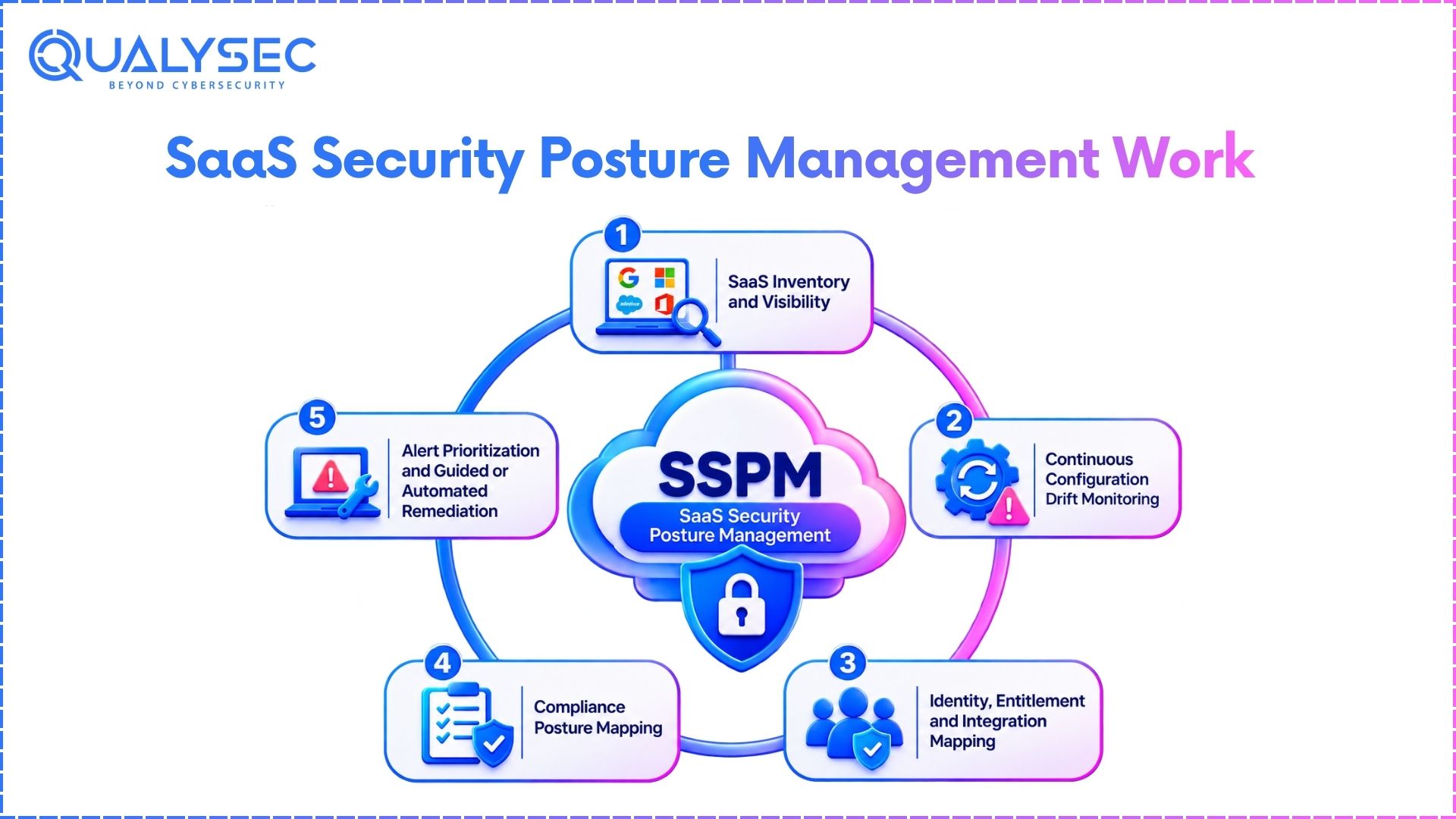
SSPM security solutions differ from traditional network security tools. Traditional network security tools, such as inline firewalls and intrusion prevention systems, examine network traffic to detect and block threats. On the other hand, SSPM solutions use vendor APIs to connect to specific SaaS applications. Different platforms use different architectures to achieve the same goal, and coverage depends on the APIs and checks each vendor supports. Generally, there are five stages in an SSPM solution.
1. SaaS Inventory and Visibility
An SSPM solution connects to identified SaaS applications using vendor APIs and inventories their administrative settings. Connecting to known applications does not necessarily reveal unapproved SaaS tools used across the organization.
2. Continuous Configuration Drift Monitoring
The SSPM solution continuously evaluates various settings in the application against controls and guidelines defined in available CIS Benchmarks and the vendor’s security recommendations to assess their security. Since recommended settings may depend on an organization’s requirements, some solutions provide explanatory text to help users understand the relevant security controls. Depending on the architecture and the limits of the APIs employed by each SaaS vendor, there may be a delay between successive scans.
3. Identity, Entitlement and Integration Mapping
Misconfigurations can affect both application settings and user access. Using SSPM can help identify the roles of not just humans but other access mechanisms as well, to assess who or what has access to sensitive data. SSPM solutions can reveal risky third-party OAuth integrations and flag dormant admin accounts and over-privileged users to assist teams in implementing least-privilege access.
4. Compliance Posture Mapping
The platform also maps application settings to various controls across standards (ISO 27001), cybersecurity frameworks (NIST), assurance frameworks (SOC 2), and regulatory requirements (HIPAA, GDPR) to indicate where control gaps may exist. This mapping may vary based on the SSPM vendor and supported SaaS applications. During an audit, consider the compliance dashboard as a source of evidence. Having a good posture score does not mean all framework controls have been met.
5. Alert Prioritization and Guided or Automated Remediation
Lastly, the tool can prioritize findings and may integrate with SIEM and SOAR tools, as well as collaboration and workflow platforms like Slack and ServiceNow, to provide guided or fully automated remediation. Vendor API permissions and policies set by administrators determine whether users can automatically revoke public file-sharing links and OAuth tokens.
A Common Mistake to Avoid
Don’t turn on aggressive auto-remediation for every SaaS app on day one. One example would be immediately revoking an OAuth token or narrowing an API scope. If this happens unexpectedly, it can break a critical integration, for example, with Finance, CRM, or HRIS apps. Begin with your integrations in monitor-and-alert mode to give users of those integrations the opportunity to review and manually remediate issues. Once you’ve confirmed the integrations and their business requirements, gradually enable automatic remediation for publicly shared links where business requirements permit.
CSPM vs. SSPM vs. CASB: Key Differences Explained
CSPM, SSPM, and CASB solutions address different layers of the cloud security architecture:
| Evaluation Dimension | CSPM | SSPM | CASB |
| Primary Security Focus | Cloud infrastructure configuration and compliance (IaaS/PaaS) | SaaS tenant settings, user permissions and application integrations | Visibility into cloud application traffic, access control and DLP |
| What the Solutions Monitor | Cloud infrastructure configurations and permissions, network exposure, serverless configurations, and IAM policies | SaaS administration consoles and settings, user and non-human identities, OAuth grants | User activity and data transfers across cloud services |
| Deployment and Integration | Cloud provider APIs | SaaS vendor APIs, IdPs, and workspace telemetry | Proxies, endpoint agents, and API connectors |
| Risks Typically Identified | Publicly accessible S3 buckets and databases, open ports | Over-privileged and dormant SaaS admin accounts, risky OAuth tokens | SaaS data loss, malware, and other threats involving cloud services |
| Examples | AWS Security Hub, Wiz, Prisma Cloud, Orca Security | AppOmni, Obsidian Security, CrowdStrike Falcon Shield | Netskope, Zscaler CASB, Microsoft Defender for Cloud Apps (CASB and SSPM capabilities) |
These products are typically used in conjunction with one another because they address different needs. CSPM solutions, along with CIEM solutions, assist with the configuration and control of cloud resources and their identities. CASB solutions help secure data in motion and at rest across various cloud applications, depending on their deployment mode and supported capabilities. SSPM solutions provide controls to secure SaaS applications.
Top SSPM Solutions and What to Look for When Choosing One
Not all SSPM vendors solve the same problem. A few other SaaS-based products related to integration security and identity management also include similar functionality to some extent. Instead of assuming products provide identical solutions or that every feature is offered with the base package, align the vendor’s strongest suit with your biggest SaaS blind spot:
| Vendor | Primary Focus | Key Capabilities and Differentiators |
| AppOmni | SaaS application security | Threat detection, configuration auditing, and compliance for SaaS applications, including Salesforce, ServiceNow, Microsoft 365, Workday, and Google Workspace |
| CrowdStrike Falcon Shield | SaaS security posture management | Integration with the Falcon platform to provide configuration checks, posture assessment, user and application risk scoring, and compliance mapping |
| Grip Security | Identity governance and SaaS risk analysis | Identity-first Shadow SaaS discovery, SaaS risk indexing, and access governance with offboarding workflows |
| Nudge Security | SaaS and AI discovery | Uses email metadata to discover Shadow IT, inventory SaaS applications used by employees, and nudge employees to improve their security practices |
| Obsidian Security | SaaS threat detection and security | Monitors configuration changes, SaaS-to-SaaS integrations, and activity to help identify potential threats |
| Valence Security | SaaS integration and non-human identity (NHI) security | Governs API keys and OAuth tokens, discovers non-human identities, assesses permissions, and addresses integration risks |
What to Look for When Choosing an SSPM Solution
- Native API Coverage: Look past integration counts to assess the depth of API configuration available for your core business apps like Salesforce, M365, Google Workspace and GitHub.
- Shadow SaaS and AI Discovery: Employees using unauthorized AI applications increase the risk of sensitive data being exposed outside the organization. Focus on platforms that review browser telemetry, email metadata, and/or OAuth grants instead of relying solely on pre-connected APIs.
- Non-Human Identity and OAuth Visibility: Ensure the solution inventories and assesses API keys and access tokens based on the sensitivity of the data they can access.
- Approval-Based Remediation: Choose solutions that integrate with other work management applications to remediate configuration drift in a safe and effective manner without disrupting other business processes.
- Licensing and Scalability: Evaluate the solution’s pricing model based on the number of users and custom applications developed by the organization to integrate with industry-specific SaaS applications.
How Qualysec Helps Secure Your SaaS Ecosystem Beyond Configuration Checks
Even when an organization implements an SSPM solution and achieves a favorable posture score, there is an important consideration every security leader should take into account. SSPM solutions should not be substituted for application and API-level penetration testing.
SSPM solutions assess the configurations of SaaS applications. What they are not designed to do is test custom applications created by the organization for coding flaws, business logic weaknesses, and application-level vulnerabilities. Cloud-hosted applications can contain undiscovered vulnerabilities in their code, design, and implementation that penetration testing may uncover.
These often-undetected flaws include, but are not limited to:
- Broken Object-Level Authorization (BOLA/IDOR) and Business Logic Flaws: Weaknesses that allow attackers to access other users’ records or exploit application workflows.
- Authentication and Session Bypasses: Flaws in custom SSO implementations, JWT validation, and password-reset logic.
- Multi-Tenant Isolation: Design and implementation flaws in tenant isolation that permit users to access another tenant’s data or functionality.
SaaS Application Penetration Testing with Qualysec
Qualysec is listed in the official CREST Marketplace for penetration testing and provides manual, human-led testing along with automated testing to identify and exploit vulnerabilities in SaaS applications and APIs, as well as cloud environments within the agreed engagement scope. Each engagement includes the following deliverables, depending on the selected package:
- Prioritized Proof of Concept: Rather than providing raw, unorganized data dumps from a scanner, results include severity ratings, examples, and reproduction details to help development teams understand and fix the issues.
- Structured Verification of Tests: Within the scope of the engagement, customers on different tiers get different levels of post-fix validation to confirm vulnerabilities have been remediated. Starter plans include one retest within a month, Growth plans include two retests within two months, and Business and Enterprise plans include unlimited retests.
- Formal Letter of Attestation (LoA): Available on Growth plans and above. It confirms that third-party penetration testing has been performed. The LoA should not be represented as a statement on the overall security or compliance of the system.

Conclusion
When implementing a secure SaaS environment for an organization, it is important to assess both application configurations and application security. SaaS Security Posture Management solutions help detect configuration changes, excessive permissions, and access control issues. Penetration testing can complement these assessments by identifying vulnerabilities in applications, APIs, and their integrations.
Ready to validate your SaaS platform against real-world attack paths? Explore Qualysec’s Penetration Testing for the SaaS Industry to scope a tailored web application, API, and cloud security assessment.
Common Questions
1. What is SaaS Security Posture Management (SSPM)?
SSPM is a security automation capability that provides information about potential issues with SaaS applications, user permissions, risky OAuth integrations, and other compliance-related control gaps.
2. How does SSPM identify SaaS misconfigurations?
SSPM integrates with SaaS applications through vendor APIs to retrieve administrative and sharing settings and compares these against security best practices, available benchmarks, and vendor recommendations.
3. What is the difference between SSPM, CSPM, and CASB?
CSPM focuses on securing cloud infrastructure and its configurations, while CASB governs access to cloud applications and helps protect data moving through them. SSPM focuses on SaaS application settings, user permissions, and third-party integrations.
4. Do businesses still need penetration testing if they use SSPM?
Yes. SSPM focuses on the configuration of SaaS tenants, including security settings, user permissions, and third-party integrations. Penetration tests evaluate the security of applications and APIs, including their business logic, access controls, and other vulnerabilities within the agreed testing scope. They help identify business logic flaws, authentication weaknesses, and other vulnerabilities in custom APIs and SaaS application components that SSPM may not detect.