






Advanced endpoint protection (AEP) builds detection, investigation, and response capabilities on top of the blocking provided by antiquated antivirus. It monitors the behaviour of software on a laptop, server, or cell phone, rather than the appearance of a file. That’s the reason why it’s important because if the attackers steal the credentials or use the built-in tools, there isn’t any malicious file to correspond.
This guide provides a breakdown of what the category represents, how it differs from previous tools, how to understand an evaluation, and the implications of the 2024 CrowdStrike outage on the risk an agent poses.
Quick answers
- What is it? A suite of endpoint controls that integrates prevention, behaviour-based detection, investigation and automated response.
- What is the difference between it and antivirus? Antivirus is based on known signatures. AEP is responsible for behaviour analysis, visibility and response.
- Does it take the place of a security team? No. Detection tools raise alerts, which must be triaged by someone.
- What can go wrong? Bad updates, missed attacks and false positives. On July 19, 2024, a defective CrowdStrike content update brought down approximately 8.5 million Windows devices.
- How to compare products? Run tests with your systems. While MITRE’s evaluations are helpful, they do not rank vendors, according to MITRE.
Do you want to see what an attacker can reach around your endpoints? Schedule a complimentary consultation with Qualysec’s security professionals!
What is Advanced Endpoint Protection?
Advanced endpoint protection is a multi-layered protection for devices like laptops, servers, virtual machines, and cell phones. It prevents known threats, notifies analysts of suspicious activity, and provides them with the information to analyse and mitigate an incident.
Palo Alto Networks’ list for the Cyberpedia guide to advanced endpoint security vs. antivirus contains the usual suspects. These consist of behavioural analysis, AI and machine learning, endpoint detection and response, threat hunting, automated response, and central management. Also noted on the same page is that it is more expensive than antivirus.
Because vendor labels overlap across the market, buyers often face confusion when comparing tools. Table 1 sorts these layers by their intended function and primary limitation.
Layered AI-driven endpoint security
| Layer | What it does | Typical limit |
| Antivirus | Designed to block malware by signature | Fails to recognise new/unknown attacks or fileless attacks |
| Endpoint protection platform (EPP) | Prevents threats with antivirus, firewall, encryption and allow or block lists | Poor visibility after intrusion. |
| Endpoint detection and response (EDR) | Logs endpoint interactions and enables investigation and response | Requires human interaction to read the alerts |
| XDR (extended detection and response) | Integrates endpoint information with other data sources like email, network and cloud | Based on the sources that you connect to |
| Managed detection and response (MDR). | A third-party provider monitors alerts and responds on your behalf | You expect the provider to be fast and able to provide you with a large volume of data. |
Typically, AEP refers to EPP plus EDR within the same product, and sometimes, AEP is EPP plus EDR plus XDR or via managed services.
How Is Advanced Endpoint Security Different From Antivirus?
Antivirus queries whether a file is a match to something it recognises. Advanced endpoint security questions whether the behaviour is legitimate or not, regardless of whether there is a file. Businesses can strengthen this protection through endpoint security services, which help identify suspicious activity, detect threats, and respond to endpoint-based attacks.
Consider the following two attacks:
- A known ransomware sample is detected. It is prevented by antivirus through signature. Both approaches work.
- Built-in admin tools were run by a stolen logon. A malicious file is not found. There is no signature to match, but behaviour analysis can detect the sequence of commands that makes no sense.
The advantages of going beyond AV:
- Visibility. A record of processes, connections, and file changes to investigate.
- Response. The power to remotely isolate a device or prevent a process.
- Hunting. Information to check for indications of a previous compromise.
How much it costs:
- Slightly more expensive than antivirus, according to the Palo Alto page.
- More tuning. Behavioural rules result in false positives until adjusted.
- More staffing. There has to be an owner of the alerts.
How is it different from EPP, EDR and XDR?
EPP is the prevention, EDR is the investigation, and XDR is the expanded perspective.
According to Paul Kirvan’s October 24, 2024, article in TechTarget titled “EDR vs. EPP: What is the difference?” EPP is a signature-based, preventive solution. He says EDR is about visibility and response, and it’s typically controlled by a security operations centre (SOC). They are referred to in the article as “complementary technologies.”
It assists in the purchase decision process. Endpoint detection and response is not a substitute for prevention. It includes everything that prevention does not get. A team with only EPP has little to go on once an attacker gets in. An endpoint detection and response team relies on analysts to get everything.
Where XDR fits:
- Gathers endpoint alerts and email, network, and cloud signals.
- It is helpful in case the attack spanned multiple systems.
- As good as the data sources you link!
But when they don’t have a SOC, smaller teams tend to choose MDR. A provider monitors the alerts and responds to them, thus making the product into a service.
What is included in Advanced Endpoint Threat Protection?
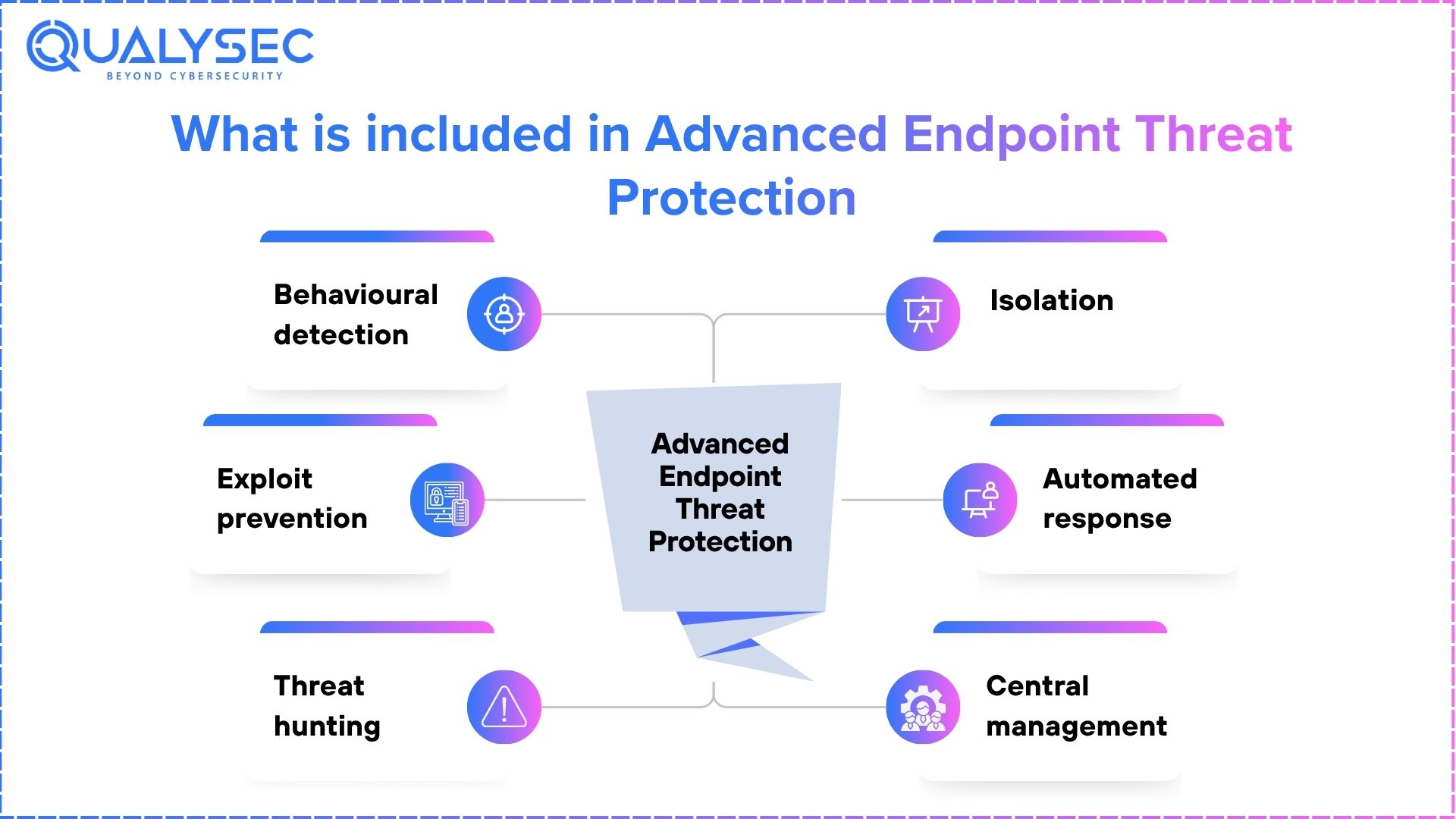
There are typically multiple capabilities that are embedded within advanced endpoint threat protection. Vendors refer to them by various names, so be sure to find out what’s in the box.
- Behavioural detection. Raises a flag if a document opens a command shell.
- Exploit prevention. Prevents exploitation of software weaknesses.
- Threat hunting. Lets analysts perform searches of stored data from endpoints for suspicious patterns.
- Isolation. Cuts a compromised device off from the network while keeping a management link.
- Automated response. Quarantines a file or stops a process when a rule is fired.
- Central management. One console to set policy and view alerts.
Some of these will only benefit where a trained person is available. Analyst time is required for hunting and investigation. A rule that isolates the wrong server can lead to the server’s failure, so automated response needs to be carefully tuned.
So, is cloud-based endpoint protection more effective than on-premises?
Cloud-based endpoint protection is best for most teams, as the console, updates and analysis are all located in the vendor’s cloud. For environments where it’s not possible to send telemetry off-site, on-premises deployment still works.
The table below outlines the characteristics of some deployment models.
Deployment models
| Model | Benefit | Risk |
| Cloud-managed console | Fast rollout with remote devices covered, with minimal infrastructure. | Requires vendor uptime and an Internet connection |
| On-premises console | Data remains in your environment. | You maintain, update and expand the servers |
| Hybrid | Support for mixed environments. | There is more to deal with and record. |
Three Questions to Ask Every Vendor:
- What are the endpoints of telemetry, and how long is it stored?
- When the device is not online, what does the agent do?
- How is the agent/content updated, and do you have control over the time of the update?
Content updates are delivered to the cloud-based endpoint protection from the vendor’s cloud. In 2024, the outage section below brings this last question to the forefront.
How Does AI-Powered Endpoint Security Work, and Where Does It Fall Short?
AI-based endpoint security is based on a series of machine learning models that are trained with massive quantities of benign and malicious behaviour and then used to rate the activities that a device is performing. If the score is high, an alert or a block will be issued. Can detect variants of known malware and unusual activity that is not defined in the rule.
Limits worth knowing:
- False positives. A legitimate admin script can be identified as malicious by a model.
- Evasion. An attacker learns how to detect and changes tactics.
- Opaque decisions. Without an explanation of why, seeing an “alert: score 92” doesn’t tell an analyst anything.
- Marketing claims. AI-powered is not an arbitrary measurement, but rather a designation.
Regardless of any other advanced endpoint threat protection claim, treat AI features as one more claim to verify. Request proof of independent testing from vendors, and find out how a product interprets an individual detection.
How to Measure Advanced Endpoint Protection?
Test with your own systems, staff, and attacks. A feature list does not give you any information about its fit in your environment.
A practical checklist:
- Coverage. Does it work with all your operating systems and server types?
- Detection evidence. What did independent testing show for any AI-driven endpoint security products?
- Response actions. Isolating, killing, and rolling back from the console?
- Integration. Does it get ingested by your SIEM and ticketing applications?
- Update controls. Are updates able to be staged before impacting all devices?
- Support and staffing. Where are the 2 am alerts sent?
- Cost model. Is it per device, per user, or included as part of a service?
There’s one public source: MITRE’s ATT&CK Evaluations. The 11 vendors that were covered in the December 10, 2025 round were: Acronis, AhnLab, CrowdStrike, Cyberani, Cybereason, Cynet, ESET, Sophos, Trend Micro, WatchGuard and WithSecure. It carried out two scenarios. One was inspired by Scattered Spider and the first to contain attacks within cloud infrastructure. The other was Mustang Panda, an espionage group sponsored by the government. Microsoft, Palo Alto Networks and SentinelOne pulled out, SecurityWeek reported.
Clearly, the evaluations are not designed to compare vendors, says MITRE. Read these rather as evidence of what each product detected and not as a leaderboard.
Results of MITRE – what it shows and doesn’t show
| Shows | Doesn’t show |
| What an item found in a specific situation | Its function in your network. |
| Which attack steps did the product see? | The number of false positives it generates per day |
| A vendor summary of results on the same test. | A rank, as MITRE does not provide one. |
| Number of the attack groups tested. | Vendors that did not participate |
So what did this 2024 CrowdStrike Outage teach you about Advanced Endpoint Protection Risk?
It revealed that there is also another single point of failure, namely that of an endpoint agent that’s installed deep in the operating system. A defective content update that CrowdStrike pushed to Windows devices running its sensor caused them to crash on July 19, 2024. Microsoft estimated that some 8.5 million Windows devices were impacted, TechCrunch reported in a blog post by Microsoft’s David Weston.
An endpoint security audit can help organisations assess the reliability of endpoint agents, review update management practices, and identify potential risks that could affect system availability.
On August 6, 2024, CrowdStrike released its root cause analysis. The update was expecting 20 input fields, but received 21, as stated in the executive summary. That resulted in an out-of-bounds memory access and system crash. CrowdStrike also claims that a third-party review showed that a threat actor was not able to exploit the bug. It wasn’t a cyber attack.
These were the mitigations CrowdStrike included in their list. This is like a checklist for the buyer:
- Staged deployment. Updates will go through successive deployment rings to production.
- Customer control. Users have control over the deployment of Rapid Response Content.
- Input validation. A check prevents the crash in the event that malformed files of this type are encountered.
- Stronger testing. There are automated tests for all the possible template types.
- Independent review. The sensor code and release procedure will be examined by two third-party vendors.
How to use that lesson:
- Put your own update rings in place. Try out a group trial first.
- Inquire with all the vendors about how the content is being tested and if it can be postponed.
- Maintain a recovery plan that is not reliant on the failed tool.
How can Qualysec help endpoint adjacent security testing?
Qualysec does not sell endpoint protection software; we test the environments surrounding your endpoints to show what an attacker can actually reach once a single device is compromised.
Across 3,700+ penetration testing engagements, our offensive security team consistently observes a critical reality: even well-tuned EDR/AEP agents only monitor the host they are installed on. Once an attacker phishes a user or hijacks a session token, they pivot into adjacent systems where endpoint agents have zero visibility.
- What we test: web applications, APIs, mobile applications, cloud configurations and the networks that endpoints connect to.
- Attack path: each test shows the sequence of steps an intruder would take once a device is breached, including where they move next.
- What you receive: a report for each engagement with severity ratings, reproduction steps and remediation guidance your team can act on.
- Retesting: Qualysec retests after fixes to confirm they hold.
- How it fits with endpoint tools: endpoint response tools detect and react to threats, while penetration testing finds the weaknesses an attacker would exploit before they do. Used together, they cover both sides.
Endpoint response tools identify and react. Penetration testing identifies the vulnerabilities that an attacker would exploit, prior to their discovery. Both act in tandem and in conjunction with each other.
Looking for a 3rd party perspective on the systems endpoints communicate with? Talk to Qualysec’s experts!

Conclusion: Where does the Buyer begin?
Begin with the things you need to preserve and the individuals who will monitor the alerts. Then narrow down the products to 2 or 3 and try them out yourself. When an advanced endpoint protection solution sends an alert to someone who can take action, it pays off.
Before you sign, make sure that there are three factors you can check: independent test evidence, control over updates, and a plan for the day that the agent dies. The third is too important to overlook after the 2024 outage. Advanced endpoint security is a good line, but it’s still a single line.
Looking to test the systems on your endpoints? Schedule a meeting with Qualysec’s security experts!
Frequently Asked Questions
1. What is advanced endpoint protection?
Advanced endpoint protection is a set of device controls that combines prevention, behaviour-based detection, investigation, and response. It goes beyond signature-based antivirus by recording endpoint activity and letting analysts isolate a device or stop a process. Most products bundle endpoint protection with EDR, and some add managed services or extended detection on top.
2. Is AEP the same as EDR?
No. EDR focuses on visibility, investigation and response after something suspicious happens. AEP usually includes EDR alongside prevention features such as antivirus, firewall rules, and exploit blocking. Think of EDR as one component and AEP as the broader package. Some vendors use the terms loosely, so check which features a product really includes.
3. Does AEP replace antivirus?
In most products, it absorbs antivirus rather than replacing it. The antivirus engine still blocks known malware by signature, and the added layers handle behaviour, investigation and response. You shouldn’t run two competing agents on one device, because they can conflict. Pick one product, confirm it covers prevention, and turn on the detection and response features.
4. Can AEP stop ransomware?
It can reduce the risk by flagging suspicious behaviour such as mass file changes or odd command sequences, and by isolating a device quickly. It can’t guarantee a stop. Attackers test against common products, and a missed alert can let an attack run. Backups, patching, access controls and a trained responder still matter alongside the tool.
5. How should a small business choose an endpoint protection product?
Start with staffing. A small team without a security analyst gets more from a managed service, where a provider watches alerts and responds, than from a tool that produces alerts nobody reads. Then check operating system coverage, update controls, price per device and whether the vendor shows independent test evidence. Pilot on a few devices before rolling out.
6. What risks do endpoint agents add?
Agents run with high privileges, so a bug or bad update can have a large effect. The July 19, 2024 CrowdStrike incident crashed about 8.5 million Windows devices, according to Microsoft’s estimate, without any attack involved. Reduce the risk by staging updates in rings, asking vendors how content is tested, and keeping a recovery plan that doesn’t rely on the agent.