






SDLC security best practices determine whether a weakness is identified during design review or in a breach report. There was a twist in 2026 for U.S. teams. On January 23, 2026, the Office of Management and Budget (OMB) withdrew its requirement for software security attestations. The NIST Secure Software Development Framework (SSDF) continues to be the standard buyers refer to. This guide explains how to construct a program based on it.
Secure software development life cycle processes aren’t a separate track. They are the same stages your team already goes through, plus a control, an owner and evidence added to each stage.
Quick answers
- Which framework guides secure software development? NIST SP 800-218, the Secure Software Development Framework (SSDF) v1.1, published on February 3, 2022.
- Is SSDF still mandatory for federal software suppliers? OMB memo M-26-05 rescinded the previous federal attestation requirements. Agencies can now adopt security requirements based on their own risk assessments and contracts.
- When should security be introduced into the SDLC? During the requirements and design phases, rather than waiting until testing.
- What did the XZ Utils incident reveal? Software supply chain attacks can exploit trusted maintainers, build processes, and dependencies, not just vulnerabilities in application code.
- Which SDLC security metrics should teams track? Vulnerability remediation time, security scan results, production vulnerabilities, dependency age, and expired risk exceptions.
Not certain where your release process leaks? Schedule a complimentary consultation with Qualysec’s security experts.
What is SDLC Security and why is it important?
SDLC security is including security controls in each phase of software delivery, from requirements through maintenance. The aim is to make what ships less vulnerable, and to fix issues if any slip through.
NIST gives a straightforward summary of the problem. Few software development models are specific about software security, so it has to be integrated into each model.
There are three reasons for teams to respond to it:
- Customers ask. Buyers send security questionnaires and demand proof, not promises.
- Flaws travel. Each customer that installs the release gets one weak library or build step.
- Late fixes disrupt. A problem identified in the design costs a conversation. Defects after release will require a patch cycle and a customer notice.
What Requirements does NIST SDLC Security Guidance Have?
NIST SP 800-218 does not require anything by itself. It’s a framework. The SSDF is a core set of high-level secure software development practices, as described by NIST, that can be incorporated into any software development model.
Version 1.1 was released on Feb. 3, 2022. There are two additional items on NIST’s publications page for the SSDF that came later:
- SP 800-218 Rev. 1 (version 1.2): an initial public draft released December 17, 2025. It’s still a draft.
- Community profile: SP 800-218A Generative AI and dual-use foundation models (final), published July 26, 2024.
Don’t take the draft as a rule; remember it is a preview. Build against version 1.1 and watch for the final text. Version 1.1 provides information about the practices of secure software development life cycle processes in the language buyers are familiar with.
The SSDF categorises its practices into four sets. According to NIST’s SSDF project page, they all serve a particular goal.
Table 1: The four practice groups for SSDF (Secure Software Development Framework).
| Group | “Purpose” in NIST’s terms | How it appears when assembled in a team |
| Prepare the Organisation (PO) | Individuals, processes and technology are “prepared to perform secure software development”. | Security needs, role training, approved toolchains |
| Protect the Software (PS) | Protect components “from tampering and unauthorised access” | Controlled access to repositories, releases signed with keys and protected build systems. |
| Produce Well-Secured Software (PW) | Releases that have “minimal security vulnerabilities” | Developers create threat models, review code and conduct tests before it goes into production. |
| Respond to Vulnerabilities (RV) | “Find remaining holes in software releases and take action accordingly” | Reporting, triage, patching and root cause analysis |
These four groups are the backbone of SDLC security best practices lists. Every item on a good checklist relates to one of them.
What will change for Federal software suppliers in 2026?
OMB Director Russ Vought released memo M-26-05 on January 23, 2026, titled “Adopting a Risk-based Approach to Software and Hardware Security”. It rescinds M-22-18 and M-23-16. The memo doesn’t change the engineering; it changes the paperwork for all of those who work on SDLC cyber security for Government customers. NIST SDLC security remains a useful reference for secure software development. Under OMB M-26-05, agencies can use it when developing their own risk-based software assurance policies, but the memo does not make SSDF compliance a universal federal requirement.
What the memo says:
- Attestation is optional. Agencies are not required to use the government-wide Secure Software Development Attestation Form, but they “may” do so.
- SBOMs are an option in a contract. Agencies can adopt contract terms that require the software producer to provide a current software bill of materials (SBOM) on request.
- SP 800-218 is a reference. It can be used to find more information or options for agencies. The memo doesn’t require it.
- No single method. The memo says that there is “no universal, one-size-fits-all method” for this work.
The rescission also follows EO 14306, a June 2025 executive order that instructs NIST to provide guidance based on SP 800-218, according to Wiley’s analysis. The reported direction is not a minimum standard, but rather a risk-based approach.
What a supplier needs to do next:
- Retain evidence that aligns with the SSDF practices.
- Be ready to produce an SBOM on request.
- Expect different questions from each agency, as each now sets its own terms.
How to Integrate Security in the SDLC (Software Development Lifecycle)?
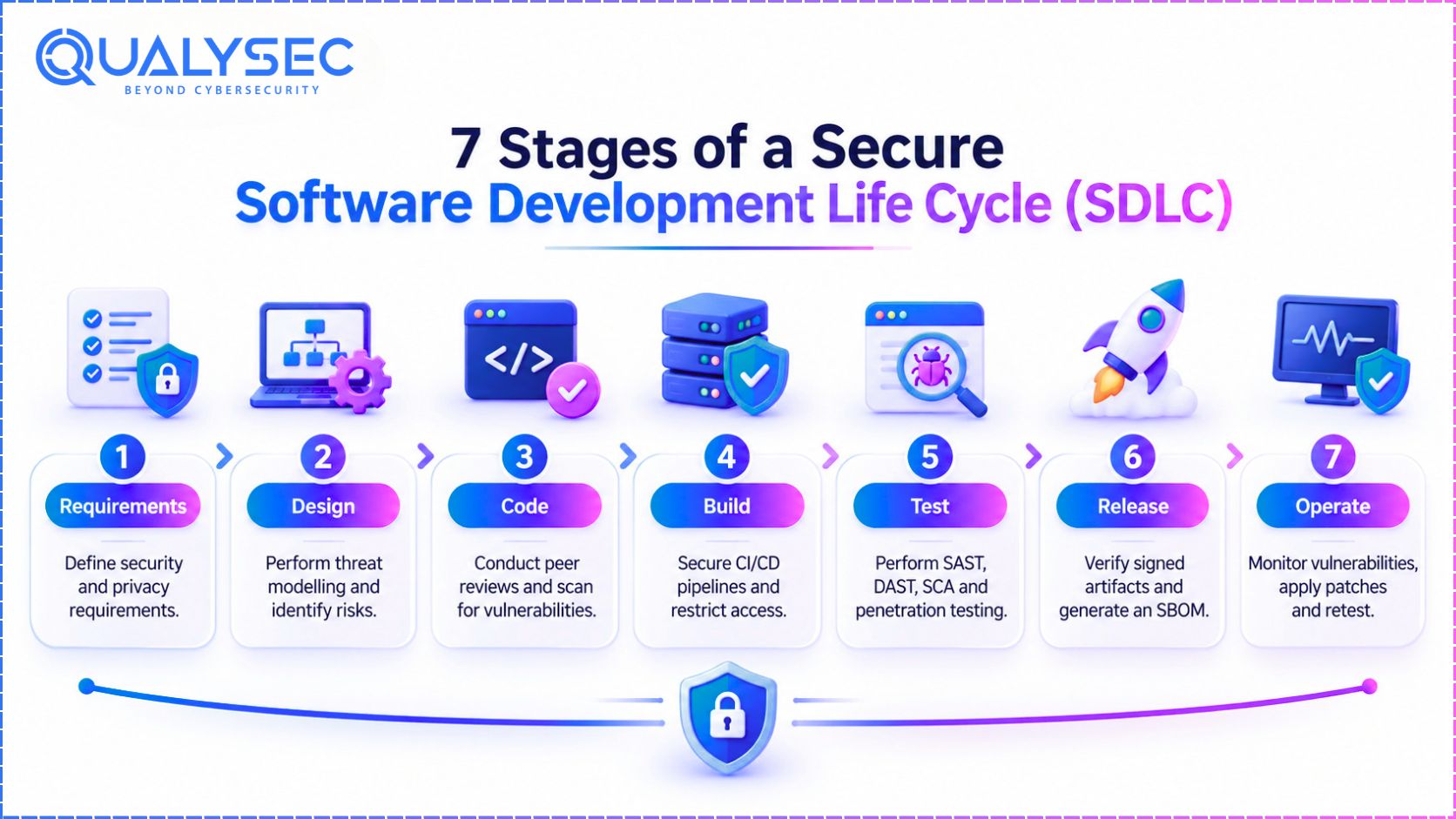
At the outset, introduce a security control and an owner for each stage. This helps in integrating security early into the software development lifecycle. And integrating security early into the software development lifecycle works when it’s a rule, not a suggestion. Security problems arise in the SDLC when there is no one responsible for a stage. Without a gate, there is no security at a stage.
A first pass that is feasible:
- Requirements: write security requirements next to functional ones. Identify the data and the people who can access it.
- Design: conduct a threat model on any feature that involves authentication, payments, or personal data. Keep only a short list of threats and what controls you will implement for each threat.
- Code: all changes must go through peer review. Block merges that add secrets or known vulnerable packages.
- Build: lock down the build system. Control access to pipeline files and publishing a release.
- Test: automate scanners on each commit and plan for more intensive testing before major releases.
- Release: check that what is being released is what is constructed. Set up signing and document the build log.
- Operate: take vulnerability reports, monitor for fix dates, retest following fixes.
Want an external team to test a release before shipping? Discuss the matter with the experts from Qualysec!
What are the most important SDLC Security Best Practices for each stage?
The most important practices are those that are linked to a gate and a piece of evidence. Avoid advice that is so generic it can’t be substantiated. Great SDLC cyber security programs will have a short list, and the proof will be easy to identify. Each stage has a practice, a check before work progresses, and proof to be kept.
Table 2 displays the practice, gate and evidence required at each stage.
| Stage | Practice | Gate before proceeding | Evidence to keep |
| Requirements | Security & privacy requirements written per feature | Inspected by a named owner | Signed-off requirement list |
| Design | A threat model is developed for sensitive features. | Open threats have a control or an accepted risk | Threat model document |
| Code | Secrets and dependency checks are also included in peer review. | No merging with unresolved critical findings. | Scan records and reports. |
| Build | Publishing rights are limited, and the pipeline is protected by access rights. | Only authorised IDs can publish | Pipeline access list and build logs. |
| Test | Auto-scan and manual testing of high-risk changes | All critical and high findings corrected or accepted | Test reports and retest results |
| Release | Signed artifacts, SBOM generated | Original build and SBOM verified. | Signed record and SBOM file. |
| Operate | Intake of vulnerability reports; patch process. | Meet deadlines by severity. | Ticket history, advisories |
There are two habits that distinguish teams that maintain momentum from those that don’t. First, they have limited the list of items to be followed to a manageable size. Second, they do not silently skip a gate, but record an exception with an owner and an expiry date.
What Security Testing in SDLC should we run and when?
Use lightweight automated tests on all changes, and more rigorous manual testing before critical releases. SDLC security testing isn’t one tool. Different types of problems are covered by each test type and not by others.
What each test sees and doesn’t see is summarised in Table 3.
| Test | Typical stage | What it finds | What it misses |
| Static analysis (SAST) | Code | General source code security problems. | Errors that depend on how the app runs |
| Software Composition Analysis (SCA) | Code, build | Known-vulnerable open source packages | New defects and malicious code with no advisory yet. |
| Secrets scanning | Code | Keys and passwords stored in the repository. | Secrets that are not stored in the repository. |
| Dynamic analysis (DAST) | Test | Problems that are apparent in the running app | The logic behind complex workflows. |
| Penetration testing | Pre-release, post-release | Chained flaws, broken access control, logic errors | Items not in scope. |
Automated security scans can quickly identify many known vulnerability patterns and insecure configurations, but they cannot reliably evaluate every business logic flaw or application-specific security requirement.
This is why most programmes run scanning in the pipeline and add manual testing prior to major releases as well as after major architectural changes.
What did the XZ Utils Backdoor Teach about Build Security?
It demonstrated that a trusted maintainer account and build script could be used to implement an attack that code review can’t detect. CISA released its alert on 29 March 2024, advising users to move to XZ Utils version 5.4.6 Stable due to malicious code found in versions 5.6.0 and 5.6.1.
As The Hacker News reported the facts:
- This vulnerability was assigned CVE-2024-3094 and given a CVSS score of 10.0.
- Versions 5.6.0 (February 24, 2024) and 5.6.1 (March 9, 2024) were affected.
- It was discovered by Microsoft engineer Andres Freund.
- The attack was made by a user named “Jia Tan.”
- This attack exploited the build process and was hidden in a masked test file.
- It was directed against sshd via systemd.
Three lessons follow:
- Trust is a control. Check who can commit to the projects you rely on and watch for sudden changes.
- The build is an integral piece of the product. Tarballs and test files may be different from the source tree. Compare what was reviewed with what shipped.
- Verify releases. Upgrade important packages only after you have looked at the changes, pinned versions and checked the signatures.
There’s no need for a new tool for this. It must cover your dependencies as well as your code and be implemented using the practices you found in Table 1.
How to tell if your SDLC is secure?
Count and trend outcomes. If you do not have any numbers for a program, you can’t demonstrate improvement. These SDLC security best practices metrics apply to most teams:
- Time to fix by severity. How long are critical and high findings open?
- Pipeline pass rate. How many builds pass security checks without being overridden?
- Escaped findings. How many issues did the earlier gates fail to find in production?
- Dependency age. How far behind is your library with the highest exposure?
- Exception count. How many accepted risks are past their expiry date?
Check the numbers monthly. Weak gates produce more escaped findings. If the override count is increasing, the gate is too slow.
What is the role of Qualysec in SDLC Security Testing?
Qualysec provides complete penetration testing services for web, API, mobile, cloud, and network applications. Teams use it as the manual testing layer in their SDLC security testing plan before or following a big release or change.
Severity ratings, reproduction steps, and remediation are included with each engagement report. Once the team has addressed any problems, Qualysec retests to ensure the fixes hold.
Penetration testing complements pipeline scanning. It does not replace it. Scanners cover known patterns at speed, and human testers find the chained and logic flaws that scanners miss.
How should a team begin?
Choose the stage that’s leaking the most right now, and install a gate on it. This is the real-life application of including security in the software development lifecycle. Next, assign each gate to one of the four groups of the SSDF, write down the evidence, and then follow the five numbers above. Programmes created in this manner remain credible when the SDLC Cyber Security questions come pouring in from the buyer. SDLC security best practices aren’t worth a darn until someone has demonstrated them.
The federal change in 2026 removed the paper. It didn’t alter the engineering. Buyers still ask how software developers construct it, and a team with gates, evidence, and clean test results can answer in an afternoon.
Want to test a release before your customers do? Meet with Qualysec’s security professionals.

Conclusion
Even with OMB Memo M-26-05 removing mandatory federal attestation forms in 2026, U.S. buyers and agencies still expect proof that your software is built securely. Integrating SDLC security best practices based on NIST SP 800-218 (SSDF) remains the clearest blueprint for delivering it.
You do not need to overhaul how your team builds software; just assign clear owners, enforce simple security gates, and keep basic evidence at every stage. Start by locking down your riskiest release step, pairing automated scans with manual penetration testing, and tracking your fix times.
Ready to find and fix the gaps in your release process? Schedule a complimentary consultation with Qualysec’s security experts today.
Frequently Asked Questions
1. What are the best practices in security for SDLC?
SDLC security best practices are the controls put in place by the team at every stage in software delivery. They include written security requirements, threat modelling, peer review, dependency and secrets scanning, a protected build pipeline, signed releases and a patch process. Each should have an owner, a gate and evidence that the team ran it.
2. What is NIST SSDF?
The SSDF is NIST Special Publication 800-218, a collection of high-level practices that can be integrated into any software development model. Version 1.1 was released on February 3, 2022. It categorises practices into four categories: Prepare the Organisation, Protect the Software, Produce Well-Secured Software and Respond to Vulnerabilities. It is a framework rather than a rule, and teams use it to structure their tasks and respond to buyer queries.
3. Should federal software vendors continue to follow SP 800-218 in 2026?
OMB memo M-26-05, dated January 23, 2026, rescinded M-22-18 and M-23-16. The new memo allows agencies to refer to SP 800-218, but does not require it, and the attestation form is not mandatory. NIST SDLC security guidance remains the standard. Each agency establishes its own terms and conditions depending on its risk assessment, so suppliers need to review each contract.
4. When should security testing begin?
It should begin before code exists, in the requirements and design phases. Design threats identified now won’t be caught by any scanner later. The team runs automated checks on every commit, and testers perform manual testing like penetration testing on high-risk features prior to release. If security starts at the testing stage, all defects are found late and are more expensive to fix.
5. What’s the difference between SAST, DAST, and pen testing?
SAST reads source code for insecure patterns without running the code. DAST is a probe that is used on a running application from the outside. Penetration testing introduces a human tester who follows the results of one test through to the next and checks the business logic, including whether one user can access another user’s information. Typically the first two are run automatically, and the third precedes significant releases.
6. What is a Software Bill of Materials (SBOM) and who would want one?
An SBOM is a document that provides a listing of the components that make up a piece of software. Agencies may adopt contractual terms that require a producer to deliver a current SBOM on request, according to OMB’s M-26-05. They are also requested by enterprise buyers. Create one at release time, as the build ships; keep it with the build record.