






India’s mobile banking ecosystem has become a critical part of everyday financial transactions. However, expanding digital payment services, interconnected APIs, and evolving cyber threats are increasing security challenges for banks.
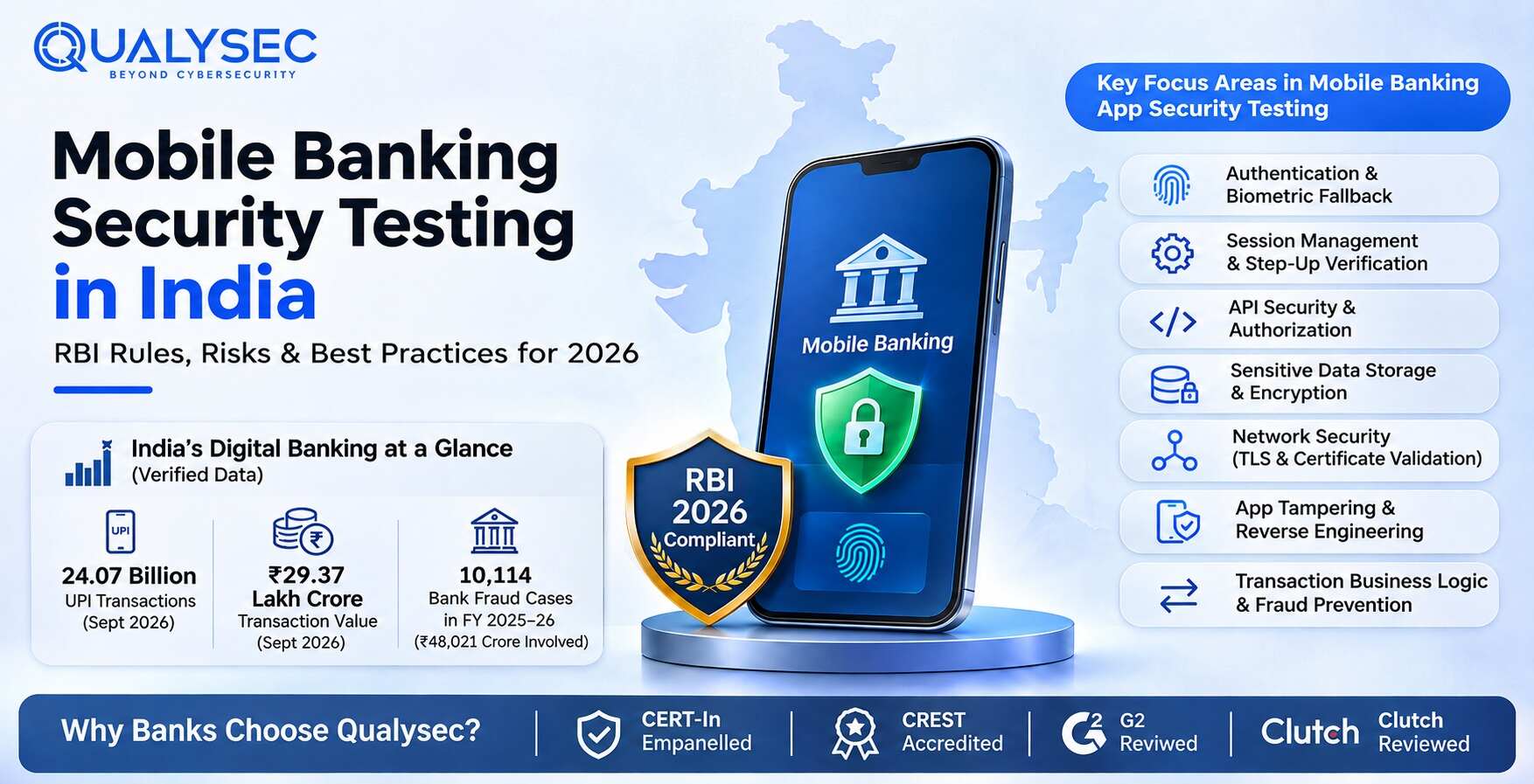
According to the National Payments Corporation of India (NPCI), UPI processed 24.07 billion transactions worth ₹29.37 lakh crore in September 2026, with 756 banks live on the platform.
Meanwhile, RBI’s Annual Report 2025–26 recorded 10,114 bank fraud cases involving ₹48,021 crore. These figures cover reported frauds of ₹1 lakh and above across banking operations, not exclusively mobile banking incidents.
For banking CISOs, securing customer transactions requires more than implementing passwords, OTPs, or biometric authentication.
Mobile banking security testing in India helps financial institutions identify exploitable vulnerabilities across mobile applications, APIs, authentication workflows, and payment infrastructure.
This guide examines RBI’s latest requirements, critical vulnerabilities, emerging threats, and the testing practices banks should prioritize in 2026.
What Is Mobile Banking Security Testing?
Mobile banking security testing evaluates whether banking applications securely authenticate users, protect financial information, and prevent unauthorized transactions.
A comprehensive Mobile Banking App Security Assessment examines Android and iOS applications alongside connected APIs, backend services, and payment workflows.
Unlike basic vulnerability scanning, penetration testing attempts to validate exploitable security weaknesses under controlled conditions.
Testing commonly covers authentication, session management, API authorization, sensitive data storage, encryption, device integrity, and transaction business logic.
The objective is to identify vulnerabilities before attackers exploit them and provide actionable evidence for remediation.
Why Is Mobile Banking App Security Testing Critical in India?
India’s digital banking infrastructure processes enormous transaction volumes, making application security essential for customer protection and operational resilience.
Latest Indian Banking and UPI Statistics
| Indicator | Verified data |
| UPI transactions, September 2026 | 24.07 billion |
| UPI transaction value, September 2026 | ₹29.37 lakh crore |
| Banks live on UPI, September 2026 | 756 |
| Bank fraud cases, FY 2025–26 | 10,114 |
| Amount involved in reported bank frauds, FY 2025–26 | ₹48,021 crore |
| Card/internet/digital payment fraud cases, FY 2025–26 | 293 |
Sources: NPCI UPI Statistics and RBI Annual Report 2025–26.
RBI’s fraud figures include cases reported during the financial year, potentially involving earlier incidents. The amount involved is not equivalent to realized losses.
Although these statistics do not directly measure mobile application vulnerabilities, they demonstrate the scale of financial activity dependent on secure digital infrastructure.
For banks, weaknesses in application authorization, authentication, or transaction validation can expose customers to financial and privacy risks.
Five Major Mobile Banking Security Challenges for Indian Banks
1. Securing Frequent Banking App Releases
Digital banking teams regularly introduce UPI integrations, digital onboarding, biometric authentication, and payment features.
The challenge: Security reviews may struggle to keep pace with rapid application releases.
Banks need risk-based testing integrated into development and release processes, particularly after changes affecting authentication or transactions.
2. Protecting Banking APIs
Mobile banking applications depend on APIs for account information, beneficiary management, and payment processing.
Broken object-level authorization can expose another customer’s financial information if backend systems trust identifiers supplied by a mobile application.
Testing must verify server-side authorization across every sensitive transaction.
3. Preventing Account Takeover
Credential theft, malicious applications, phishing, and insecure recovery workflows can increase account takeover risks.
A successful login does not establish that account recovery, session expiration, and device registration are secure.
4. Managing Third-Party Integration Risks
Banking applications integrate payment providers, identity verification services, and software development kits.
These components create additional security dependencies that require assessment throughout the application lifecycle.
5. Providing Evidence for Regulatory Reviews
Banking security leaders need more than vulnerability reports.
They must maintain documented risk ratings, remediation ownership, vulnerability resolution evidence, and retesting results to support security governance and applicable regulatory requirements.
RBI Mobile Banking Security Testing Requirements in 2026
The Reserve Bank of India issued updated Commercial Banks – Digital Payment Security Controls Directions, 2026, dated July 31, 2026, with updates consolidated on October 1, 2026.
These directions establish requirements for digital payment application security, authentication, fraud prevention, and security assessments.
RBI Security Testing Requirements
| Activity | Requirement |
| Vulnerability assessment | At least half-yearly |
| Penetration testing | At least annually |
| New applications or major changes | Additional VA/PT |
| Source code review/certification | Required, with annual continuation when changes or upgrades occur |
| Threat modelling | Incorporated into application lifecycle management |
| Vulnerability remediation | Time-bound corrective action |
| Application security standards | Relevant OWASP standards, including MASVS and ASVS |
RBI also requires covered banks to monitor unauthorized or malicious applications impersonating genuine banking applications.
These directions apply to the specified commercial banking category. Other regulated entities must consult their applicable RBI directions.
Key takeaway: Annual penetration testing is a regulatory baseline, not a substitute for additional testing following significant application changes.
Mobile Banking Attack Surfaces: What Should Banks Test?
A mobile banking application operates across interconnected security layers.
| Attack surface | Testing priorities |
| Mobile device | Local storage, malware exposure, overlays, device integrity |
| Application | Authentication, biometrics, session management |
| Network | TLS, certificate validation, secure communication |
| Backend APIs | Authorization, request validation, access controls |
| Payment workflows | Transaction integrity, beneficiary verification, replay prevention |
A weakness in one layer can expose another.
For example, a compromised session token may become more dangerous when backend APIs fail to enforce account ownership or transaction-level authorization.
Therefore, mobile banking app security testing must assess the complete customer journey, not only the application interface.
Eight Critical Mobile Banking Security Vulnerabilities
1. Broken Authentication and Biometric Fallback
Biometric authentication improves usability, but poorly implemented fallback mechanisms can weaken account security.
Testing should examine biometric enrolment, failed attempts, password recovery, device changes, and fallback authentication.
2. Weak Session Management
Insecure session handling can allow unauthorized access even after a user logs out.
Testers should verify token expiration, logout invalidation, concurrent sessions, and step-up authentication before sensitive operations.
3. Broken API Authorization
Banking APIs must independently validate whether users are authorized to access specific accounts and initiate transactions.
Testing should identify broken object-level authorization, privilege escalation, and unauthorized access to customer information.
4. Insecure Sensitive Data Storage
Applications can expose information through local databases, cached files, debug logs, or hardcoded credentials.
Security assessments should inspect storage mechanisms and verify that sensitive financial information receives appropriate protection.
5. Weak TLS and Certificate Validation
Improper hostname verification or certificate validation can undermine secure communication.
Testing should assess TLS configurations, invalid certificate handling, and certificate pinning where implemented.
6. Application Overlay and Screen-Capture Risks
Malicious applications may attempt to overlay banking screens, capture sensitive information, or manipulate user interactions.
Assessments should evaluate protections against relevant overlay attacks, screen capture, and device-level interference.
7. Reverse Engineering and Application Tampering
Attackers may analyze mobile application binaries to understand internal logic or manipulate client-side controls.
Testing should evaluate obfuscation, anti-debugging, hooking detection, and runtime integrity mechanisms.
These defenses complement rather than replace secure backend authorization.
8. Transaction Business Logic Vulnerabilities
A banking application may enforce strong authentication but still contain payment workflow weaknesses.
Testing should examine beneficiary modification, unauthorized transaction changes, duplicate processing, payment limits, and replay resistance.
Latest Mobile Banking Cybersecurity Trends in India: 2026
Mobile Malware and Remote-Access Threats
Malicious applications, fraudulent downloads, and remote-access abuse remain significant concerns for mobile banking users.
Banks should assess device-integrity controls and their response to high-risk conditions, while recognizing that device detection cannot eliminate every form of malware-related fraud.
AI-Assisted Fraud and Impersonation
AI-generated phishing messages, synthetic voices, and increasingly convincing impersonation attempts create additional challenges for financial institutions.
Application testing should be combined with transaction monitoring, risk-based authentication, and fraud prevention controls.
Fake Banking Applications
Attackers can distribute fraudulent applications impersonating legitimate banking services.
RBI’s 2026 directions require banks to monitor for unauthorized and malicious applications resembling their genuine offerings.
Greater Focus on Payment Business Logic
Security teams increasingly need to consider how attackers might abuse legitimate transaction functionality rather than relying solely on traditional software vulnerability checks.
Release-Based Security Testing
An application that passed testing earlier may develop vulnerabilities after changes to APIs, libraries, authentication, or payment workflows.
Regression testing and retesting help banks identify recurring vulnerabilities across releases.
Code Review vs Automated Scanning vs Penetration Testing
Each assessment method serves a different purpose.
| Method | Primary purpose |
| Source code review | Identify insecure coding patterns, exposed secrets, and implementation weaknesses |
| Automated scanning | Detect known vulnerability patterns and insecure configurations |
| Manual penetration testing | Validate exploitable weaknesses, authorization failures, and business logic issues |
| Retesting | Verify fixes and identify unresolved security weaknesses |
A comprehensive Mobile Banking App Security Assessment combines these activities according to the application’s risk profile.
Automated results require validation because identifying a potential weakness does not establish exploitability.
How Does Mobile Banking Penetration Testing Work?
Step 1: Define the assessment scope
Identify Android and iOS applications, backend APIs, authentication mechanisms, and critical transaction workflows.
Step 2: Perform threat modelling
Evaluate potential attack paths affecting customer accounts, sensitive information, and financial transactions.
Step 3: Conduct static and dynamic analysis
Inspect mobile binaries, local storage, network communication, and runtime security controls.
Step 4: Test authentication and APIs
Assess account recovery, biometric fallback, sessions, authorization, and device binding.
Step 5: Validate transaction security
Test payment authorization, beneficiary management, transaction integrity, and replay protections.
Step 6: Report vulnerabilities
Document severity, affected functionality, reproducible evidence, business impact, and remediation recommendations.
Step 7: Retest security fixes
Validate remediation across affected builds and APIs before closing findings.
What Should Banks Prepare Before a Security Assessment?
Before starting mobile banking app security testing, banks should prepare:
- Android APK/AAB and iOS builds suitable for authorized testing
- Test accounts with relevant roles and permissions
- API documentation and available architecture diagrams
- Authentication, recovery, and transaction workflows
- A controlled staging environment and test payment data
- Previous security reports and known remediation status
Providing these resources helps security testers assess realistic workflows without disrupting production transactions.
How to Choose a Mobile Banking Security Testing Provider in India
Banks should evaluate providers based on technical capability, independent credentials, methodology, and remediation support.
Key considerations include experience testing Android and iOS applications, expertise in API and payment workflow security, OWASP-aligned methodologies, detailed reporting, and independent retesting.
Providers should also demonstrate how they protect confidential banking information throughout an engagement.
How Qualysec Helps Banks Strengthen Mobile Application Security
Qualysec is a CERT-In Empanelled and CREST-Accredited penetration testing company providing security assessments for mobile applications, APIs, web applications, and supporting banking infrastructure.
For Indian banks and financial institutions, Qualysec combines manual penetration testing, OWASP-aligned methodologies, and remediation-focused reporting to help identify exploitable vulnerabilities and support regulatory readiness.
Qualysec’s capabilities include:
- Mobile Banking App Security Assessment: Android and iOS application penetration testing.
- Banking API Security Testing: Authentication, authorization, and payment workflow validation.
- RBI-Aligned Security Assessments: Testing and reporting to support applicable regulatory security requirements.
- Manual Penetration Testing: Identification of business logic flaws and vulnerabilities that automated scanners may miss.
- Remediation and Retesting: Actionable findings and verification of security fixes.
Organizations evaluating Qualysec can independently review its credentials and customer feedback through:
- CREST – Qualysec Accreditation
- G2 – Qualysec Customer Reviews
- Clutch – Qualysec Technologies Reviews

Frequently Asked Questions
Is mobile banking penetration testing mandatory in India?
RBI’s 2026 directions require covered commercial banks to conduct penetration testing of digital payment applications at least annually, with additional testing following major changes or new implementations.
How often should banks assess mobile application security?
Covered commercial banks must conduct vulnerability assessments at least half-yearly and penetration testing at least annually under the applicable RBI directions.
How long does mobile banking security testing take?
Assessment duration depends on the number of applications, APIs, user roles, authentication methods, transaction workflows, and the complexity of the testing environment.
What is included in a Mobile Banking App Security Assessment?
It can include Android and iOS testing, authentication validation, API security assessments, business logic testing, data protection verification, vulnerability reporting, and retesting.
Which framework is used for mobile banking application testing?
OWASP MASVS is a recognized mobile application security framework. OWASP ASVS and relevant API security guidance support testing of connected backend systems.
Can penetration testing guarantee RBI compliance?
No. It provides application security evidence, while complete compliance also involves governance, policies, operational controls, documentation, and other requirements.
Conclusion
Mobile banking security testing in India is essential for protecting financial transactions as digital banking platforms grow more interconnected.
Banks must assess authentication, APIs, application integrity, sensitive data handling, and payment business logic—not merely rely on automated vulnerability scans.
By combining mobile banking app security testing, secure development practices, RBI-aligned assessments, and timely remediation, financial institutions can strengthen application security and improve regulatory readiness.
Qualysec helps organizations identify exploitable vulnerabilities, understand their business impact, and verify security improvements through structured penetration testing.