

One weak software dependency can disrupt hospital operations and compromise patient information within a day. Developing healthcare software in an insecure manner results in late-stage patches, audit failures, and delayed product release. This is why the NIST Secure Software Development Framework (SSDF) is essential for the healthtech community.
Integrating the NIST 800- 218 practices allows medical software developers to address vulnerabilities early. It also helps to comply with FDA requirements without delaying the launch of the product. Instead, you turn security into an automated process that is integrated into your daily builds.
This article explains the NIST Secure Software Development Framework (SSDF) for healthcare tech companies. We are going to explain 4 practice groups, FDA 510(k) compliance, CI/CD pipeline integration, and post-market vulnerability management for healthcare systems.
Key Takeaways
- NIST SSDF implements the concept of shifting left to prevent supply chain attacks during the SDLC process.
- Four major components (PO, PS, PW, and RV) determine policy, code protection, and vulnerability response.
- Executive Order 14028 requires that CISA attest to all software sold to federal government agencies in the United States.
- Compliant with FDA 510(k) pre-market requirements for medical device cybersecurity and SPDF compliance.
- Automates CI/CD pipelines with SAST, DAST, SCA, and credential scanning.
- Implements software provenance with SBOMs in machine-readable format (CycloneDX/SPDX).
- Signs software binaries and containers cryptographically (Cosign/Sigstore).
- SP 800-218A extends controls to AI models against prompt injection and data poisoning.
What is the NIST Secure Software Development Framework (SSDF)?
The NIST Secure Software Development Framework (SSDF) is a collection of essential practices. It can be integrated into each phase of the software development lifecycle to ensure that security. SSDF approach is shift-left. It means moving security up the development process to minimize delays, expensive fixes, or even forgo security testing altogether.
Security controls are embedded early and continuously, from initial design through coding, build automation, and post-release support. Provides developers, security teams, and auditors with common ground to ensure software is more resilient against supply chain attacks.
These all apply to any type of software, including custom internal applications, commercial off-the-shelf (COTS) software, SaaS platforms, and open-source software projects.
Who Needs NIST SSDF Compliance?
The framework is used differently by different organisations for different strategic and operational purposes:
- Commercial Software Creators: SaaS platforms, mobile application developers, and enterprise software vendors use the framework to meet enterprise vendor risk management (VRM) requirements.
- Government Contractors: Any vendor delivering digital services, bespoke code, or SaaS to public sector entities must demonstrate NIST SSDF alignment.
- Medical Device Manufacturers: Medical hardware and software companies use NIST 800- 218 to comply with the FDA cybersecurity pre-market requirements.
- Internal Enterprise Engineering: SSDF security principles are applied to secure internal systems to remove security silos and secure internal databases.
Why is this Framework needed?
Building modern healthcare software without a secure foundation creates major operational, financial, and regulatory risks:
- Third-Party Supply Chain Risks: Over 80% of application code relies on open-source libraries. A single unvetted dependency can expose PHI, disrupt clinical networks, or risk patient safety.
- FDA Premarket Mandates (Section 524B): The FDA requires medical software to prove cyber resilience under FD&C Act Section 524B. Following NIST 800- 218 satisfies FDA SPDF expectations for 510(k) clearances.
- Lower Remediation Costs: Fixing security flaws during design is far cheaper than in production. SSDF security prevents expensive post-release hotfixes and launch delays.
What are the 4 Core Practices of NIST SSDF?
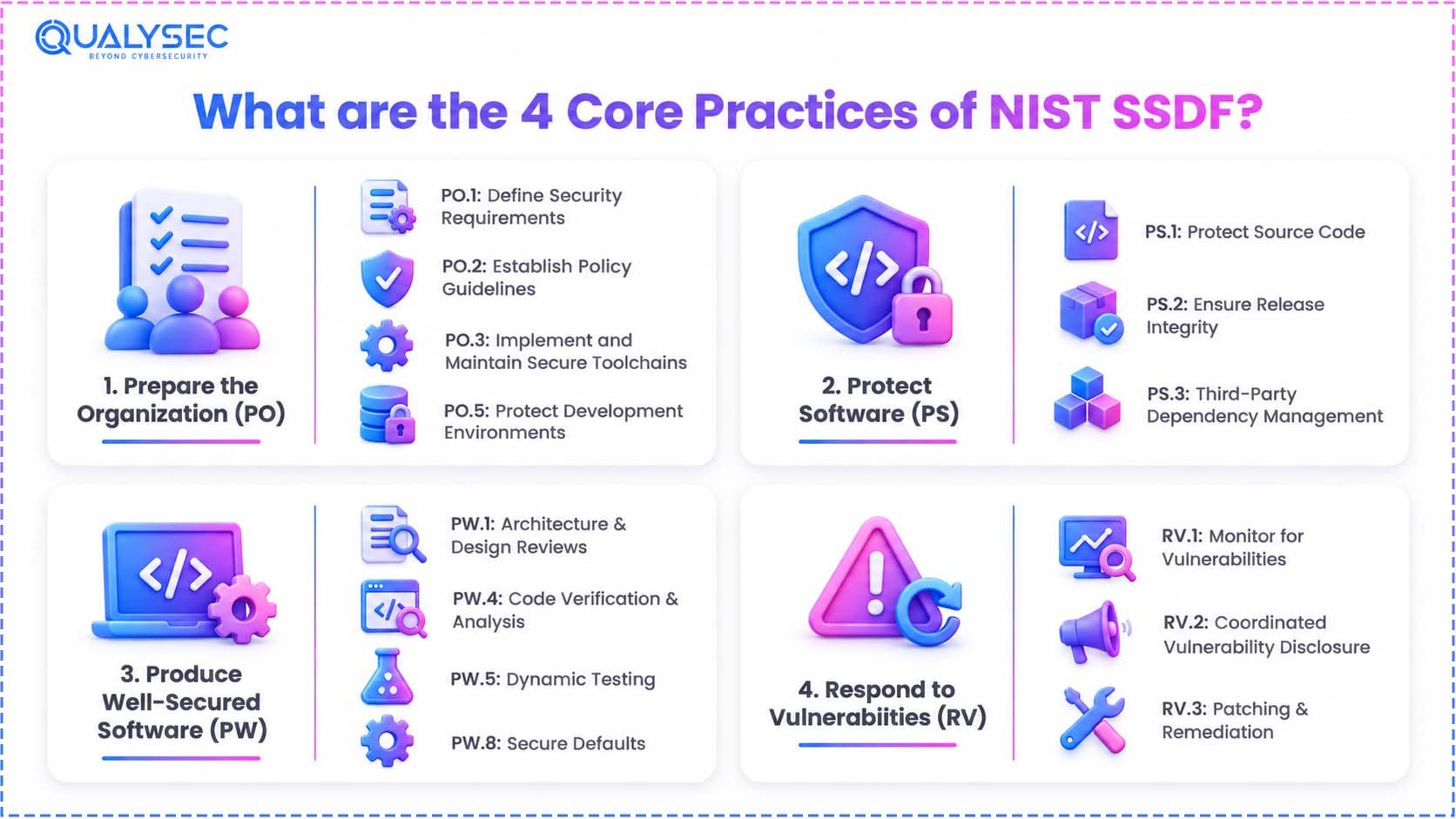
There are four major practice groups in the NIST SSDF where the security guidelines have been divided to address every phase of the software development process. Each practice group has a defined objective, starting from creating a secure development environment, protecting the source code, developing secure software, and vulnerability response.
1. Prepare the Organization (PO):
The Prepare the Organization (PO) practice group identifies the personnel, policies, processes, and secure development platform required before software development. This ensures that the personnel have the security requirements, development tools, and controlled development environment necessary for building the software safely.
- PO.1 (Define Security Requirements): Delegate security responsibilities for the software to the project managers, architects, developers, and other concerned personnel.
- PO.2 (Establish Policy Guidelines): Set guidelines concerning the secure coding, risk management, and security requirements of the organization.
- PO.3 (Implement and Maintain Secure Toolchains): Equip the developers with secure build platforms, secure compilers, code repositories, and security tools.
- PO.5 (Protect Development Environments): Make the development environment secure using access control, network isolation, and Multi-Factor Authentication (MFA).
2. Protect Software (PS):
The PS practice group protects the source code, component dependencies, build scripts, and output artifacts of a release from tampering or theft.
- PS.1 (Protect Source Code): Ensure security of source code by deploying role-based access controls, branch protection, mandatory code review, and signed commits to safeguard against any unauthorized changes.
- PS.2 (Ensure Release Integrity): Ensure software releases have not been altered by creating signed binaries, build provenance (like SLSA attestations), and checksums for cryptographic signature purposes.
- PS.3 (Third-Party Dependency Management): Maintain a machine-readable Software Bill of Materials (SBOM) in either SPDX or CycloneDX format to track down open-source and third-party components.
3. Produce Well-Secured Software (PW):
Produce Well-Secured Software (PW) practice community emphasizes designing software that is built in a secure way and is subjected to extensive testing before deployment. Design review, vulnerability assessment of source code, application testing, and secure default configurations encourage security in the development process.
- PW.1 (Architecture & Design Reviews): Design review and Threat Modeling (STRIDE) are performed in order to spot any security threats present in the software design stage.
- PW.4 (Code Verification & Analysis): Security teams utilize Static Application Security Testing (SAST) tools to scan the source code for any coding errors, vulnerabilities, exposed secrets, etc.
- PW.5 (Dynamic Testing): The application is tested using Dynamic Application Security Testing (DAST) and penetration testing to find vulnerabilities at runtime.
- PW.8 (Secure Defaults): Application developers configure applications to have secure defaults with secure communication and least privilege access controls.
4. Responding to Vulnerabilities (RV):
The RV practice group provides an environment for defining and handling security issues that arise in production environments.
- RV.1 (Monitor for Vulnerabilities): Ensure that CVE feeds, advisory databases, and upstream dependency alerts are monitored continuously.
- RV.2 (Coordinated Vulnerability Disclosure): Have an open, published vulnerability disclosure policy (VDP) for security researchers to report bugs safely.
- RV.3 (Patching & Remediation): Rapidly develop, test, and distribute security patches and hotfixes without disrupting clinical or business workflows.
Who Needs NIST SSDF Compliance and What are the Legal Requirements?
Organizations that create, procure, or deliver software for governmental organizations and regulated sectors often have to conform to the NIST Secure Software Development Framework (NIST SSDF). Regulatory agencies and vendors have turned NIST SP 800-218 into a requirement rather than a recommendation.
I. How Does NIST SSDF Meet the FDA Medical Device Regulations?
Manufacturers are required to have strong cybersecurity when submitting medical devices or health software for a pre-market review (such as a 510(k) clearance). The FDA recognizes implementation of NIST SSDF as an effective method to satisfy its Secure Product Development Framework (SPDF) expectations.
II. What Do Executive Order 14028 and OMB Policy Directives Require?
In response to major software supply chain breaches, Executive Order 14028 instructed NIST to publish SP 800-218. In turn, OMB Memoranda M-22-18 and M-23-16 mandated that U.S. federal agencies only employ software from producers that have formally, independently, and publicly confirmed their compliance with NIST SSDF practices.
III. What is the CISA Self-Attestation Form and how does the RSAA Portal work?
The Cybersecurity and Infrastructure Security Agency (CISA) has published the Secure Software Development Attestation Form to ensure compliance is uniform. This attestation must be completed by software producers who will be selling to federal entities and upload supporting documentation directly to CISA’s online Repository for Software Attestations and Artifacts (RSAA).
How to Use NIST SSDF in Software Development?
Implementing NIST SSDF in software development processes requires embedding security considerations at each phase of software development. By automating security testing in CI/CD workflows, organizations are able to identify vulnerabilities at an early stage, produce SBOMs, and develop secure software.
Where to Integrate Security Tools Stage-by-Stage into Your CI/CD Pipeline?
To automate NIST SSDF practices, security teams map automated scanning engines directly to source control and CI/CD stages:
- Commit Phase (Task PS.1.1): Hardcoded API keys or credentials should not be allowed into code until it’s committed with pre-commit hooks.
- Pull-Request Phase (Task PW.4.1): Automatically analyze changed lines of code using SAST scanners (e.g., SonarQube, Semgrep).
- Build Phase (Task PS.3.1): Use Software Composition Analysis (SCA) tools (such as Trivy, Grype) to scan software and generate an SBOM.
- Packaging Phase (Task PS.2.1): Sign container images and compiled binary files with cryptography using signing tools such as Sigstore/Cosign.
How to Automate SBOM Creation and Binary Signing in Code?
The following YAML configuration illustrates a production-ready GitHub Actions workflow. It automates Task PS.3.1 (SBOM generation using Syft) and Task PS.2.1 (Cryptographic signing using Cosign via OIDC keyless signing):
YAML name: NIST SSDF Automated Pipeline

on:
  push:
    branches: [ "main" ]

jobs:
  build-and-secure:
    runs-on: ubuntu-latest
    permissions:
      contents: read
      packages: write
      id-token: write # Enables OIDC keyless signing with Sigstore/Cosign

    steps:
      - name: Checkout Source Code
        uses: actions/checkout@v4

      - name: Set up Docker Buildx
        uses: docker/setup-buildx-action@v3

      - name: Build Container Image
        run: |
          docker build -t ghcr.io/${{ github.repository }}:v1.0.0 .

      # NIST SSDF Task PS.3.1: Produce Machine-Readable SBOM (CycloneDX Format)
      - name: Generate Software Bill of Materials (SBOM)
        uses: anchore/sbom-action@v0
        with:
          image: ghcr.io/${{ github.repository }}:v1.0.0
          format: cyclonedx-json
          output-file: sbom.cyclonedx.json

      # NIST SSDF Task PS.2.1: Cryptographically Sign Image with Cosign
      - name: Install Cosign
        uses: sigstore/cosign-installer@v3.5.0

      - name: Sign Container Image
        run: |
          cosign sign --yes ghcr.io/${{ github.repository }}:v1.0.0
How Does NIST SSDF Work for FDA Medical Device Compliance?
Medical device manufacturers can use the NIST Secure Software Development Framework (SSDF) to meet FDA expectations for pre-market cybersecurity.
The FDA has a specific mandate for manufacturers to use an SPDF.
The NIST SSDF is widely accepted as an excellent model for meeting SPDF requirements.
Key FDA Regulatory Touchpoints:
- Mapping to SPDF Requirements: FDA expects cybersecurity management throughout the product lifecycle. The core practices of NIST SP 800-218 are exactly what FDA SPDF expects in pre-market submissions, including 510(k) clearances.
- Software Bill of Materials (SBOM): FDA requires pre-market submissions to include a full machine-readable Software Bill of Materials. Maintaining an SBOM is a vital part of the practices at SSDF and is used to identify vulnerabilities in third-party healthcare components.
- Threat Modeling & Risk Analysis: FDA focuses on Safety Risk Management. SSDF architectural review tasks require teams to conduct threat modeling to evaluate how software vulnerabilities could impact patient safety or device functionality.
- Post-Market Vulnerability Handling: Medical devices are used in hospital settings for several years after deployment. The SSDF’s vulnerability response practices enable device manufacturers to maintain consistent vulnerability disclosure processes and provide post-market security patches without impacting clinical workflows.
How to Achieve SSDF Compliance – Step-by-Step Roadmap

Achieving organization-wide SSDF alignment requires a structured, multi-phase operational strategy to avoid disrupting developer velocity.
Step 1: Evaluate Security Practices
Evaluate your software development cycle based on the 42 tasks from the NIST Secure Software Development Framework (SSDF). Locate security weaknesses, set security requirements, and assign security roles and policies.
Step 2: Implement Security Automation
Include SAST, SCA, secrets scanning, SBOM creation, and artifact signing in your CI/CD pipeline to continuously ensure secure development practices.
Step 3: Collect Proof of Compliance
Gather evidence in the form of audit logs, SBOMs, security documentation, and build evidence. Use this information to undergo customer audits and government self-attestation when necessary.
How Should You Handle Legacy Systems and Third-Party Commercial Software?
There are special compliance strategies for applying the SSDF requirements to legacy code bases and commercial off-the-shelf (COTS) software.
Plan of Action and Milestones (POA&M): Federal guidelines allow organizations to also submit a written plan of action and milestones to document missing practices for legacy software that cannot be fully controlled by the SSDF today but will be controlled in the future.
Third-Party COTS Software: Organizations acquiring COTS software must require vendors to supply an attestation form and machine-readable SBOMs to verify build integrity before deployment.
NIST SP 800-218 Implementation: Common Pitfalls & Solutions
While implementing NIST SP 800-218, organizations can face various kinds of problems, especially while adopting secure software development practices for the first time. Understanding these common pitfalls helps to build an effective implementation strategy.
Handling Compliance as a One-Time Checklist:
- Pitfall: Filling out CISA attestation documentation while not modifying the development process each day.
- Solution: Implement automated security solutions in the CI/CD pipeline that generate continuous evidence of compliance.
False Positive Security Findings:
- Pitfall: Execution of untuned SAST rules at maximum severity results in false positives and developers’ reluctance.
- Solution: Be realistic. Do not block pull requests for false critical findings, but record them into the remediation backlog. Block High and Medium findings.
Improper Handling of Legacy Applications:
- Pitfall: New federal compliance requirements such as those in OMB directives might apply to legacy systems as if they were brand new, which stops delivery.
- Solution: Have a consistent POA&M and enforce strong SSDF controls for all the new feature builds.
Unprotected Build Runner:
- Pitfall: Lack of protection of CI/CD runner opens the door to command injections and supply chain attacks.
- Solution: Run ephemeral, isolated build runners without extra network access.
How Qualysec Aligns Development Lifecycles With NIST SSDF Requirements
Qualysec helps customers from various industries to operationalize SSDF principles throughout the whole development process. In order to meet NIST SP 800-218 requirements through existing workflows, it is necessary to combine automation and manual processes to validate the requirements.
Automated tools can be used for scanning processes in CI/CD pipelines, but more sophisticated tasks like complex logic validation, build environment security, and strict audit requirements require cybersecurity assessment services.
- Static and Secure Source Code Review: In addition to automated source code review using SAST, our certified security engineers conduct manual and hybrid code reviews that allow identifying hidden business logic flaws, sensitive data exposure, and injection issues.
- Dynamic and API Penetration Testing: Robust dynamic application testing (DAST) allows validating whether applications will withstand potential attack vectors during runtime on the web, mobile, desktop, and API platforms.
- FDA Premarket Cybersecurity & Medical Device Security: We provide comprehensive vulnerability assessment, risk analysis, and threat modeling for hardware and software medical device developers following FDA 510(k) requirements and expectations from SPDF and NIST SSDF.
- Proof of Compliance: Providing actionable, severity-classified reports and dashboards for easy third-party compliance proofing, client vendor risk assessments, and regulatory attestations.
By performing security assessments and working with the dev team, we help organizations to prove their SSDF compliance, meet the requirements of governments and procurement enterprises, and maintain good supply chain security without hindering release velocity.
Conclusion
The NIST SSDF transforms security from being the last step before release into becoming an automated component of the everyday development process. Through automated processes that produce SBOMs, sign build outputs, and secure CI/CD pipelines, engineering teams can efficiently protect software from supply chain attacks at the earliest possible point before they become an issue in a production environment.
Ensuring compliance with NIST SP 800-218 regulations, FDA requirements for medical devices, or enterprise sales agreements need not hinder development teams. By automating continuous collection of evidence and configuring scanners to scan only for serious vulnerabilities, you can develop software that is resilient, completely compliant, and ready for further distribution by default.

FAQs
1. Is NIST SSDF compliance a mandatory legal requirement for all software companies?
Compliance is not a mandatory legal requirement for each company. It is only mandatory when selling software directly or indirectly to the government agencies of the United States of America under Executive Order 14028.
2. What is the difference between NIST SSDF and standard NIST SP 800-53 controls?
While the NIST SP 800-53 controls focus on security controls in operation, the NIST SSDF (SP 800-218) controls focus on the software development process, secure code writing, CI/CD pipeline hardening, and third-party supply chain risk management.
3. What is the CISA Self-Attestation Form and how do software vendors submit it?
It is an official document in which software vendors affirm that their development processes comply with the requirements of the NIST SSDF framework. The document is submitted to CISA through the RSAA portal together with the relevant evidence.
4. How does NIST SP 800-218A deal with securing AI and Large Language Models?
NIST SP 800-218A modifies existing SSDF policies to specifically address artificial intelligence models. These modifications give guidance on securing training data from data poisoning, safeguarding any proprietary model weights, cleansing prompts to prevent any injection attacks, and adding safety guardrails to model outputs.
5. What is an SBOM, and why is it needed according to NIST SSDF?
An SBOM is basically the ingredient list of your software product, in that it includes all open-source components and third-party dependencies used. An SBOM is mandated in NIST SSDF because the team can quickly find which package to fix when a vulnerability comes out. The Syft and Trivy tools can generate SBOMs in your build process.