

The updated FDA cybersecurity requirements are based on Section 524B of the FD&C Act and a recently updated premarket guidance. In early 2026, the guidance was updated to reflect the new Quality Management System Regulation. All “cyber device” submissions will require a postmarket vulnerability plan, evidence of secure design, and a software bill of materials.
Key Takeaways
- Section 524B introduces cybersecurity as a mandatory requirement for market authorisation – not a recommendation.
- The three pillars of the FDA cybersecurity requirements are a vulnerability plan, secure processes, and an SBOM.
- In early 2026, the FDA reissued its guidance for premarket submissions to conform with the QMSR and ISO 13485:2016.
- This is up from 46% a year ago, as 56% of healthcare buyers have now rejected a device due to security concerns.
- The FDA may reject submissions that are not accompanied by the proper cybersecurity documentation.
Introduction: A Bad Quarter for Assuming Devices Are Safe
A cyber attack in March 2026 targeted global operations of medical device manufacturer Stryker, one of the world’s largest (RunSafe Security, 2026 Index). The incident thrust an industry already on edge into its current conundrum. During the same survey period, 24% of the healthcare organisations said they suffered an attack or an exploited vulnerability involving a medical device. When these attacks occurred, 80% of the organisations said that the attacks had a moderate or significant impact on patient care.
The answer from hospital buyers has been the most straightforward one. RunSafe’s April 2026 survey included 551 purchasing decision-makers. In it, 56% had declined a device due to security concerns, rising from 46% a year ago. 35% would not consider a device without an S-BOM. Security has become a procurement gate, and the gate is continually getting tighter.
This is the market that the new FDA cybersecurity requirements were designed for. As of March 2023, FDA cybersecurity regulations have made security a legal requirement to be in the U.S. market. Since then, the rules have been continuously tightened. This document provides an explanation of the current requirements and what has changed more recently. It also demonstrates how manufacturers in any part of the world can make a submission that passes the review.
First Question: Is Your Product a “Cyber Device”?
The FDA cybersecurity regulations of Section 524B are for a specific category – cyber devices. There are three aspects to the definition, and it’s more expansive than many teams think. A cyber device is software or software that provides software functionality. It can be internet-connected and has properties that might be susceptible to attack.
Can is doing a lot of work. The FDA’s focus is on what is possible, not what is planned. A device that has a wireless module but is not activated, or a device that does not use a debug port, can qualify (Censinet, FDA Guidance). Typically, infusion pumps, patient monitors, imaging systems, implantable cardiac devices, and software as a medical device are all included in the definition. The DA encourages manufacturers to seek permission before submitting a medical device cybersecurity plan if it falls on the edge of the parameters.
There’s one more scoping point to consider for global manufacturers. The requirements are applicable to all premarket submission pathways such as 510(k), PMA, De Novo, PDP and HDE, and are applicable after March 29, 2023. If a company alters a previously authorized cyber device in a way that requires a new submission, it must also update the plan for that new submission; the medical device cybersecurity regulations are fully applicable.
The Three Pillars of Section 524B
Remove all of the guidance documents, and the statute only requests three things. All three must be shown in each cyber device submission. The following is a direct representation of the core FDA cybersecurity requirements, and each is associated with specific documentation.
| Statutory Requirement | What It Means | What the FDA Expects to See |
| 524B(b)(1): Vulnerability plan | A plan to monitor, identify, and address postmarket vulnerabilities in a reasonable time | Coordinated vulnerability disclosure process, monitoring procedures, and update timelines |
| 524B(b)(2): Secure by design | Processes providing reasonable assurance that the device and related systems are cybersecure | Threat modelling, security architecture, risk assessment, testing evidence, and patch delivery |
| 524B(b)(3): SBOM | A software bill of materials covering commercial, open-source, and off-the-shelf components | Machine-readable component inventory with versions, suppliers, and vulnerability tracking |
Pay attention to the unspoken request of the 2nd pillar. A cybersecurity policy statement is not “reasonable assurance. Reasonable assurance is not a policy statement. It is evidence. The FDA expects manufacturers to incorporate security into the design and test it through a variety of methods, such as vulnerability scanning and penetration testing. However, industry players have completely ignored the third pillar, the Software Bill of Materials (SBOM), in the compliance file. It’s now in demand straight from the buyer’s mouths, as 35% of buyers are giving up on devices without it.
What Changed Most Recently: The 2025-2026 Updates
Teams that produced their submissions in response to the 2023 guidance should be aware of what has moved. Two updates represent the state of FDA cybersecurity standards, both of which are recent.
June 2025: The Final Guidance and Section VII
The October 2023 version of the guidance (FDA Cybersecurity) was replaced by the final version on June 27, 2025. This was primarily because of the new Section VII, dedicated to Cyber devices. The FDA uses that section to clarify who must comply with Section 524B, which devices the policy covers, and what documents manufacturers need for each submission type. It also provided clarifications on changes to previously approved devices.
February 2026: QMSR Alignment
The larger change came with the Quality Management System Regulation, which will take effect on February 2, 2026. It was to be a replacement for most of 21 CFR Part 820, introducing ISO 13485:2016 (February 2026, DLA Piper). Then, the FDA released a new version of its premarket cybersecurity guidance that corresponds to the QMSR, replacing the June 2025 version. Manufacturers now integrate cybersecurity risk management into design controls, validation, and CAPA, embedding it directly within an ISO 13485-based quality system instead of containing it in a separate binder.
It is a sweet bit of news for global manufacturers. The majority already have ISO 13485 quality systems for other markets. Now, the updated FDA cybersecurity regulations are in that same language. The guidance is based on the principles that are aligned with IMDRF. This simplifies the reusability of a single security file in the US, EU MDR, and other systems.
What a Compliant Submission Package Looks Like
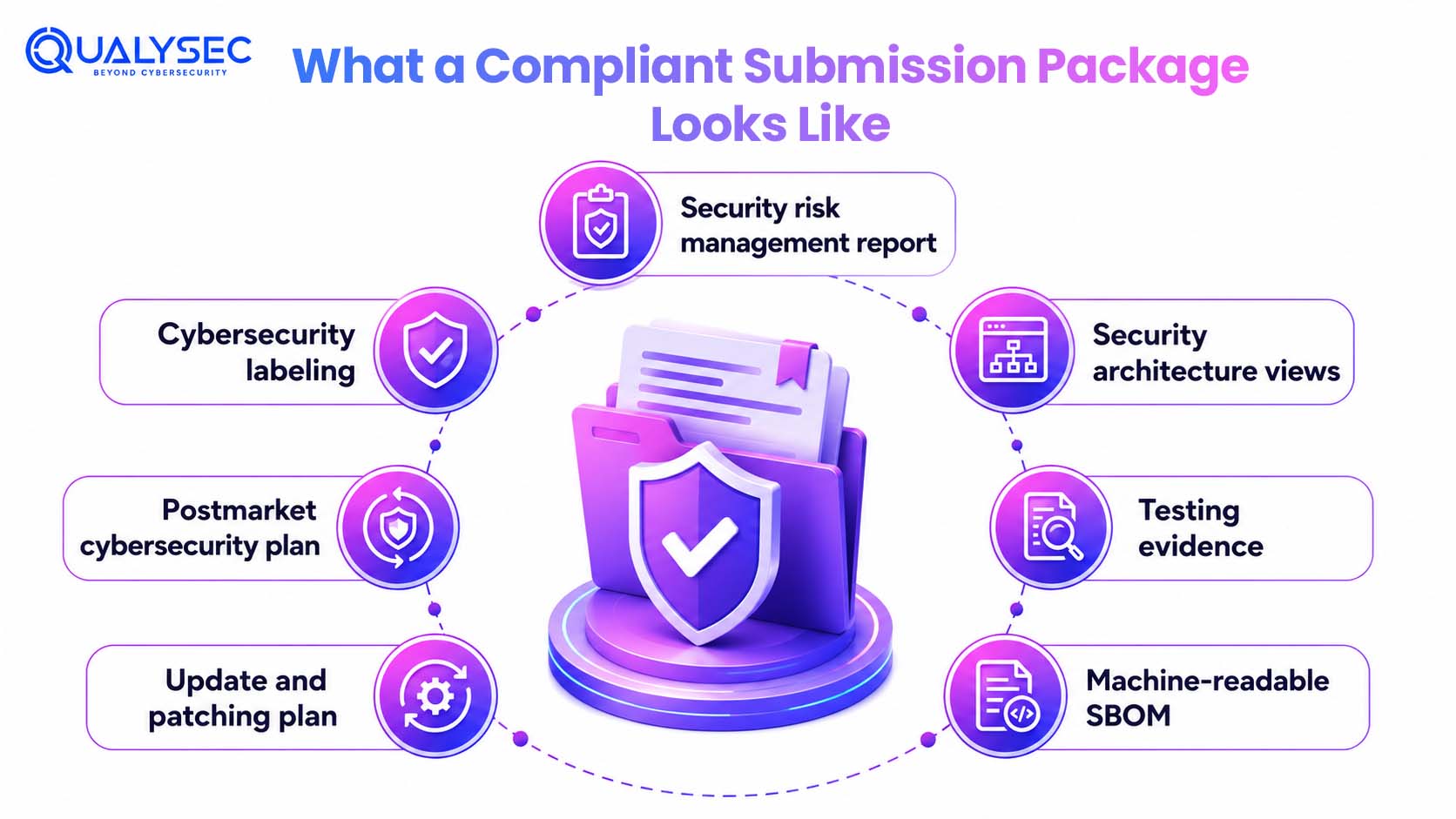
Reviewers are not interested in reading a set of documents that are not part of a coherent security story. The best papers are clear and logical in scope from threat to control, to test, to label. The FDA cybersecurity standards are implemented in the following basic documents.
- Security risk management report. Threat modelling, Misuse cases, Risk controls, and Rationale for residual risk.
- Security architecture views. Annotated data-flow diagrams, trust boundaries, asset inventories, and defensive layers.
- Testing evidence. The analysis of static and dynamic code, fuzzing, vulnerability scans, and penetration test results.
- Machine-readable SBOM. All components that have versions and suppliers, and your methodology for tracking disclosed vulnerabilities.
- Update and patching plan. Signed & authenticated update delivery, with rollback protection and staged deployment.
- Postmarket cybersecurity plan. Customer notification, vulnerability monitoring and coordinated disclosure procedures.
- Cybersecurity labeling. Remove security data from the user, such as connectivity and expectations of updates.
The implications of not having this package aren’t hypothetical. The FDA has been able to reject submissions since October 1, 2023, that do not contain cybersecurity details. If a student refuses to accept it, the review clock does not start. In the case of a company running out of launch runway, an RTA letter costs quarters lost, not days lost.
Last but not least, tracing and crafting – reviews go to them. Each threat identified should relate to a control, each control to a test, and each test to a result. Facilitating that thread, reviewers ask fewer questions. Reviewers who are unable to respond in writing with a deadline will ask all of them.
Why Manufacturers Outside the US Should Care Just as Much
The temptation for a Bangalore, Berlin, or Tel Aviv manufacturer is to label this as a “US problem. The market disagrees. The U.S. is still the world’s largest medical device market. Section 524B is applicable to any submission, regardless of the country of origin for the device. The medical device cybersecurity regulations are based on submission, not factory.
The push from regulation is also becoming globalised. The RunSafe 2026 Medical Device Cybersecurity Index revealed that almost 79% of organisations have been influenced by FDA guidance and EU MDR requirements in their procurement processes. In the meantime, 84% now include cybersecurity requirements in their vendor RFPs. The manufacturer that is compliant with the FDA cybersecurity requirements has essentially answered most of the world’s most difficult procurement questionnaires.
The threat data describes why the rules are important. In April 2026, ORDR found that 99% of hospitals have at least one connected device containing a known exploited vulnerability. The average cost of a healthcare breach in the United States has increased by 9.2% over the last year, to $10.22 million. According to its 2025 report, the FBI ranks healthcare as the top target after recording 460 known ransomware attacks against the sector. In that context, the medical device cybersecurity regulations came across as more of a “triage” machine than a bureaucracy.
Making a 510(k) or PMA for a connected device? Qualysec’s penetration testing delivers the security testing evidence that FDA reviewers are looking for, backed by a well-documented methodology, severity-rated findings, and retesting following patching. Talk to Qualysec about premarket security testing.
How to Prepare: Five Moves That Clear Review
If the review passes without any hitches, there’s a pattern to the manufacturers. They do not treat FDA cybersecurity requirements as an afterthought; they build them directly into design inputs. It takes five moves to make the difference.
Start threat modeling at architecture, not at submission. Retrofit security is readily visible to reviewers and costly to implement. Model threats when data flows are still on the whiteboard. Each subsequent document gets easier to write.
Build the SBOM into your build pipeline. Handmade SBOM dries out before use. Automatically generate it with each build, in a machine-readable format. The papers that MITRE published in April 2026 about SBOM data normalisation contain the answers to where the problems lie in terms of quality.
Test like an attacker before FDA reads like a reviewer. Penetration testing is now an industry standard practice. MDIC released a white paper on the validation of a device’s cybersecurity using penetration testing in June 2026. It’s linked on the FDA’s cybersecurity page. Testing evidence is where one stands a chance of making claims of security stand up against showing it.
Write the postmarket plan you can actually run. The reviewers are able to distinguish between an aspirational and an operational plan. The names, channels, and timelines that you will actually meet under the coordinated vulnerability disclosure process are the name of the game. Customer notification expectations have been elevated to about 30 days after a vulnerability is discovered.
Align your quality system now, not at renewal. The QMSR will be in effect since February 2026, in which case cybersecurity evidence should come from your ISO 13485 processes. Your risk files, design controls and CAPAs already communicate security, and your submission mostly writes itself.
Where Submissions Actually Stumble
The same failure patterns are all too common for reviewers. To know them is the very best preparation. The most typical pitfall is to consider the FDA cybersecurity regulations as a paper overlay following design freeze. Reviewers dig into retrofitted security documentation — and they find it just as it is.
The second pattern is an aspirational SBOM. A component list is prepared by hand by teams before they file. It removes transitive dependencies and deviates from the shipped build. The current FDA cybersecurity guidance requires a machine-readable SBOM that is true to reality. It should be backed by a live process that tracks newly disclosed component vulnerabilities.
The third is thin testing evidence. Vulnerability scans are not a reasonable assurance. As with the medical device cybersecurity regulations framework, testing is expected to be proportional to risk, and for connected devices, adversarial testing. The submission that combines a scan with documented penetration testing covers this question in a clear manner. FDA cybersecurity submissions do not have to be accompanied by deficiency letters in order to receive them.
The Bottom Line
The story of 2026 is that the market had a comeuppance with the regulator. In 2023, the FDA made cybersecurity a legal requirement. But it was a commercial gate that hospital purchasers quickly made, and in fact, they are increasingly rejecting insecure devices. The FDA cybersecurity requirements are a burden for a manufacturer; that’s yesterday’s question answered. The question now is, “Does your security evidence seal the deal?
The requirements are unchanging and predictable. Three statutory pillars: Vulnerability plan, Secure-by-Design processes, and SBOM. The FDA has converged its current standards for cybersecurity on the QMSR and ISO 13485 in early 2026. There is one deadline that never changes: The submission deadline. Construct security early, test separately, and fully document the story. It is the way in which connected devices are getting onto and remaining in the market.
Need submission-ready security evidence? Qualysec assesses medical device software, APIs, cloud backends, and connected ecosystems, validating them in a realistic manner against actual attack methods. The report delivers findings in the ‘audit-ready’ format that premarket reviewers expect. Contact Qualysec to request a medical device security assessment today.
Frequently Asked Questions
Q. What are the FDA cybersecurity requirements for premarket submissions?
Section 524B requires that all cyber device submissions contain three components. The plan to track and respond to postmarket vulnerabilities, including coordinated disclosures. Second, evidence of processes that give reasonable assurance the device is cyber secure, and updates and patches are available. Third, a software bill of materials of commercial, open-source, and off-the-shelf parts.
Q. Which devices count as “cyber devices” under the FDA cybersecurity regulations?
In FDA cybersecurity regulations, a cyber device is defined as software that can connect to the internet, can be vulnerable to threats, and is software. Dormant wireless modules and unused ports count towards capability, which the FDA reads as connectivity. Some of the common examples encompass infusion pumps, patient monitors, imaging systems, implants, and software as medical devices.
Q. What changed in the latest FDA cybersecurity standards?
There are two updates to the FDA cybersecurity standards that are most important. The final guidance for June 2025 also included Section VII, which explains specifically how to document compliance with Section 524B. Following the effective date of the QMSR (2nd February 2026), the FDA has updated the guidance to match ISO 13485:2016 quality systems and cybersecurity. The updated edition replaces the 2025 version.
Q. Can the FDA reject a submission over cybersecurity alone?
Yes. Starting October 1, 2023, the FDA will not accept submissions that fail to provide the necessary cybersecurity information, thereby putting a halt to the review clock. Lack of security information may also cause a submission to fail to achieve market authorisation. The approval process treats cybersecurity not as a subset of general safety, but as an independent requirement.
Q. Do the medical device cybersecurity regulations require penetration testing?
Regulators do not explicitly cite penetration testing in medical device cybersecurity laws. The guidance requires evidence of security testing, but the typical method for doing this is independent testing. MDIC released penetration testing best practices for medical devices in June 2026, which are available on the FDA’s cybersecurity page. In reality, submissions without any credible evidence of testing are difficult to achieve the necessary reasonable assurance.