Choosing one penetration testing provider can be harder when almost every vendor claims that they are offering expert testing and strong security. You should look for a CREST-accredited penetration testing company that can offer a complete penetration testing service. This shows the importance of choosing top CREST-accredited penetration testing companies for 2026 buyers.
CREST accreditation proves that the organization has been independently assessed and has the right expertise and qualified security professionals. Verizon’s 2026 Data Breach Report found that 31% of breaches involved vulnerability exploitation. This demonstrates the importance of choosing a CREST-accredited penetration testing company for penetration testing.
In this guide, we will discuss top CREST-accredited penetration testing companies and why CREST accreditation is important. We will also cover what common mistakes you can avoid before choosing the company.
How Have We Ranked These CREST-Accredited Penetration Testing Companies?
This list ranks the top CREST-accredited penetration testing companies by focusing on their technical capabilities. All details are verified through the official CREST marketplace prior to listing.
We have checked for:
- CREST Directory Official Verification: We verified each provider’s current corporate certification, legally registered company, and service types approved by CREST. Such as infrastructure, application, or threat-led penetration testing using CREST official directory information.
- Manual Exploitation Depth & Methodology: We checked for providers who dedicate most of their testing hours to human-led activities. This includes exploit chaining, business-logic testing, and complex vulnerability research, rather than relying mainly on automated scanners.
- Service Delivery and Remediation Support: This includes the evaluation of the final report for the quality of the process. Such as the proof-of-concept process steps, severity rating process using CVSS or OWASP methodology, the remediation plan, and retest window.
- Enterprise & Regulated Sector Fit: We assess which types of organizations each provider is best equipped to serve. This includes large enterprise consultancies supporting frameworks as well as agile PTaaS providers designed for organisations with high-velocity software development and continuous testing requirements.
What Should You Expect From CREST-Accredited Providers as a Buyer?
You should expect a CREST-accredited penetration testing company to demonstrate elements like accreditation, certified penetration testers, expertise in testing, reporting, and appropriate scope. As a buyer, you need to know that the provider is genuinely accredited. So they can deliver the right type of assessment for your organization.
Here is what you should look for:
- Qualified penetration testers: The testing should be done by qualified testers. You can verify that the particular testers are qualified via certifications.
- Scope of accreditation: You need to know exactly what the provider’s accreditation covers.
- Advanced testing capabilities: Some organizations require more than just a penetration test. Confirm if you want a red team test or threat-led test that follows frameworks such as STAR, CBEST, or TIBER-EU.
- Actionable security report: You should get reports explaining each security weakness, its impact, evidence to support it, and corrective actions to be taken.
- Documentation for procurement and auditing: You could require accreditation documents and other proof to help you approve suppliers, conduct audits, and comply with regulations.
- Cost understanding: You should know what influences the price of security tests. Such as the scope of the work, the size of the environment, technical complexity, testing approach, and engagement needs.

Which Are the Top CREST-Accredited Penetration Testing Providers in 2026?
Choosing a CREST-accredited penetration testing provider can be challenging when each company offers different expertise, services, and industry experience. This list highlights leading providers in 2026 and compares what they offer and what makes them different from others.
-
CyberCX

CyberCX is an Australian cybersecurity company with around 1,000- 4,999 security professionals. The organization works internationally through Australia, New Zealand, Europe, and the United States, with nine security operations centers.
Key Services:
- Penetration testing
- Vulnerability assessment
- Incident response
- Cloud security
- Managed security
- Identity and access management
- Cybersecurity consulting
Technical Expertise: They have expertise in networks and infrastructure, cloud environments, applications, and enterprise security assessments.
Industries Served: They work for Government, finance, health care, critical infrastructure, and enterprises.
What Sets Them Apart from Other Companies: You can choose CyberCx if you are an organization that needs penetration testing as well as other cybersecurity services.
-
Qualysec
Qualysec is one of the top penetration testing companies based in India. We focus on human-led, AI penetration testing services rather than only focusing on automated scanning. We have completed more than 2,500+ assessments with organizations across sectors including BFSI, healthcare, SaaS, e-commerce, and critical infrastructure.
Key Services:
- Website penetration testing
- Mobile application penetration testing
- API penetration testing
- Network infrastructure testing
- Cloud application testing
- Vulnerability assessment
Technical Expertise: Human-led security testing using standard frameworks such as OWASP, NIST, PTES, and OSSTMM.
Industries Served: We have worked for BFSI, healthcare, SaaS, e-commerce, critical infrastructure, and tech firms.
What Sets Them Apart from Other Companies: You can choose us if you want comprehensive penetration testing with detailed reporting. We also provide compliance support and overall security for your organization.
-
Cyberintelsys
Cyberintelsys is a Singapore-based cybersecurity company operating around India, USA, Australia, Canada, Africa, and the Middle East. According to its CREST profile, Cyberintelsys has between 10 and 49 employees and more than 200 clients globally.
Key Services:
- Web application penetration testing
- Mobile application penetration testing
- API penetration testing
- Cloud penetration testing
- OT/IoT testing
- Red teaming
- Source code review
- Security assessments
- Compliance consulting
Technical Expertise: They primarily offer application security, cloud security, network infrastructure, IoT/OT environments, and product security.
Industries Served: They have been working with industries like tech companies, health care providers, financial institutions, and enterprises with connected products.
What Sets Them Apart from Other Companies: Enterprises requiring penetration testing and vulnerability assessment on applications, infrastructure, cloud, and connected environments can choose them.
-
Wizlynx Group
Wizlynx Group is a global cybersecurity services provider located in Switzerland. They offer offensive security measures such as penetration testing, red teaming, and adversary simulation. They have been offering cybersecurity services for the last 35 years and have already served 1300+ clients till now.
Key Services:
- Penetration testing
- Red teaming
- Adversary simulation
- Social engineering
- Security assessments
Technical Expertise: Networks and infrastructure, web application/APIs, mobile applications, wireless networks, cloud, identity and access management (IAM), and IoT devices.
Industries Served: Financial services, government/public sector, healthcare, IT, and energy.
What Sets Them Apart from Other Companies: Organizations requiring specialized offensive security testing can choose this provider.
-
ST Engineering Info-Security
ST Engineering Info-Security is a Singapore-based cybersecurity company offering services with more than 25 years of expertise in cybersecurity. Their CREST profile lists 500–999 employees and identifies penetration testing as a core professional service.
Key Services:
- Managed Detection and Response (MDR)
- Supply chain monitoring
- Cloud security monitoring
- AI-enabled threat elimination and response
- Vulnerability assessment and penetration testing (VAPT)
Technical Expertise: Enterprise network environments, industrial environments, SCADA systems, and critical information infrastructure.
Industries Served: They have been working with government agencies, critical infrastructure providers, industrial organizations, and commercial enterprises.
What Sets Them Apart from Other Companies: You can choose them for Complex IT/OT environments, especially suited for government entities and critical infrastructure.
-
NCC Group

NCC Group is a UK-based cybersecurity service provider with over 30 years of experience in cybersecurity and security testing. They have been listed with 1,000 – 4,999 employees in the CREST marketplace. Providing a wide range of offensive security and cyber defence services.
Key Services:
- Penetration testing
- Cryptography and encryption
- Blockchain security
- Cloud security services
- Attack surface management
- Vulnerability scanning and management
Technical Expertise: Its testing includes network, application, infrastructure, cloud, and adversary simulations.
Industries Served: NCC Group serves organizations from sectors like finance, government, tech, healthcare, and others.
What Sets Them Apart from Other Companies: It is ideal for larger and highly regulated organizations that require both offensive security testing and cyber defense services.
-
Orange Cyberdefense

Orange Cyberdefense is an international cybersecurity company that helps organizations detect and resolve any security issues within their infrastructure. Their CREST profile states that the company has between 100 and 499 employees. They provide services related to penetration testing, vulnerability assessment, and incident response.
Key Services:
- Threat-led penetration testing
- Incident response and endpoint security
- OT, network, and Application security
- Identity & Access Management (IAM)
- Cloud and workspace security
Technical Expertise: Their penetration testing includes testing of cloud infrastructure, internet-connected devices, applications, hardware, mobile, and operational technology.
Industries Served: They cater to enterprises, government, financial services, retail, and critical infrastructure organizations.
What Sets Them Apart from Other Companies: The company is best fit for organizations that require security testing of both traditional IT environments and cloud, mobile, IoT, and OT technologies.
-
Dionach
Dionach is a UK-based organization offering cybersecurity services such as penetration testing, security assurance, compliance, and incident response. The company currently offers cloud security, social engineering, red teaming, threat-led penetration testing, and AI security governance, among others.
Key Services
- Threat-led penetration testing (TLPT)
- Red team security assessments
- Assumed breach assessments
- Purple teaming
- Identity assurance purple teaming
- Cloud security assessments
- Social engineering
- OT/ICS/SCADA testing
- AI application penetration testing
- Ransomware readiness assessments
Technical Expertise: The company takes a manual approach along with automated tools to exploit vulnerabilities and verify the attack path. They provide risk-based recommendations for mitigation.
Industry served: It serves industries such as healthcare, finance, government, critical national infrastructure, and others.
What Sets Them Apart from Other Companies: Dionach is ideal for organizations requiring penetration testing with security assurance and compliance, as well as threat-led testing.
-
Claranet Cyber Security

Claranet Cyber Security offers penetration testing, continuous security testing, application security, red teaming, and managed security services. They operate with an international team of more than 500 employees across the whole group.
Key Services:
- Web application penetration testing
- Infrastructure penetration testing
- Mobile application penetration testing
- Continuous security testing
- Cloud security testing
- Red teaming
- Purple teaming
- Social engineering
- AI/ML/LLM security testing
- Application security
- Threat modelling
Services Offered: High-level penetration testing (infrastructure, web, mobile, and APIs), red teaming, cloud security assessments, ISO 27001 and PCI DSS compliance, and security managed services.
Technical Expertise: Offers a combination of deep knowledge of multi-cloud infrastructure with offensive security testing that allows securing both applications and their hosting environment without any effort.
What Sets Them Apart from other Companies: Offers a full-featured, accredited technical security audit service supported by a multi-cloud provider’s experience.
-
LRQA
It is a top global company in assurance, inspection, and cybersecurity services, with its headquarters located in London, United Kingdom. They provide risk management and technical security solutions to companies from all around the world.
Key Services:
- Web application, Mobile application, and Cloud penetration testing
- Red teaming
- Purple teaming
- Threat intelligence
- Incident response
- Regulatory compliance testing
- Threat modelling
Technical Expertise: LRQA performs testing of web and mobile applications, infrastructure, cloud, physical security, and social engineering situations.
Industries Served: The cybersecurity services offered by LRQA have a significant emphasis on the financial services industry, critical infrastructure, and transport, among others.
What Sets Them Apart from Other Companies: LRQA would be a good fit for organizations requiring penetration testing in conjunction with regulatory assurance and compliance.
-
NetSPI

NetSPI is a US-based cybersecurity company that specializes in penetration testing, attack surface management, and breach and attack simulation for businesses. NetSPI’s methodology combines the use of a technological platform and human security experts to help organizations detect vulnerabilities continually.
Key Services:
- Penetration Testing as a Service (PTaaS)
- Application penetration testing
- AI/ML, Cloud, and Network penetration testing
- Hardware and IoT security testing
- Red team operations
- Attack Surface Management (ASM)
- Breach and Attack Simulation (BAS)
- Secure code review
- Threat modelling
- Blockchain security testing
Technical Expertise: NetSPI utilizes testing methods that include both human-led testing by security experts and the use of special technology and AI.
Industry Served: Financial services, healthcare, technology, cloud services, and other large businesses. NetSPI emphasizes working with US banks, healthcare firms, cloud services, and technology organizations.
What Sets Them Apart from Other Companies: Offers state-of-the-art tech-enabled penetration testing solution platforms that suit mature enterprises with an ongoing visibility requirement of threat exposure.
-
Bishop Fox

Bishop Fox specializes in offensive security, providing organizations with the ability to find their weaknesses via penetration testing, red teaming, and continuous attack surface testing. The firm’s approach is a blend of security professionals working together with the Cosmos technology platform.
Key Services:
- AI/LLM security assessments
- AI-powered penetration testing
- Mobile application assessments
- Hardware penetration testing
- Network penetration testing
- Attack surface discovery and testing
- Ransomware readiness
- Continuous Threat Exposure Management (CTEM)
Technical Expertise: It combines highly skilled manual hacker-led penetration testing services with contemporary automated asset discovery services that help detect security exposures for businesses dynamically.
Industries Served: Financial services, healthcare, energy and utilities, manufacturing, media and entertainment, technology, and other large enterprises.
What Sets Them Apart from Other Companies: They offer highly skilled offensive security consulting services with continuous platform testing capabilities.
-
Stingrai
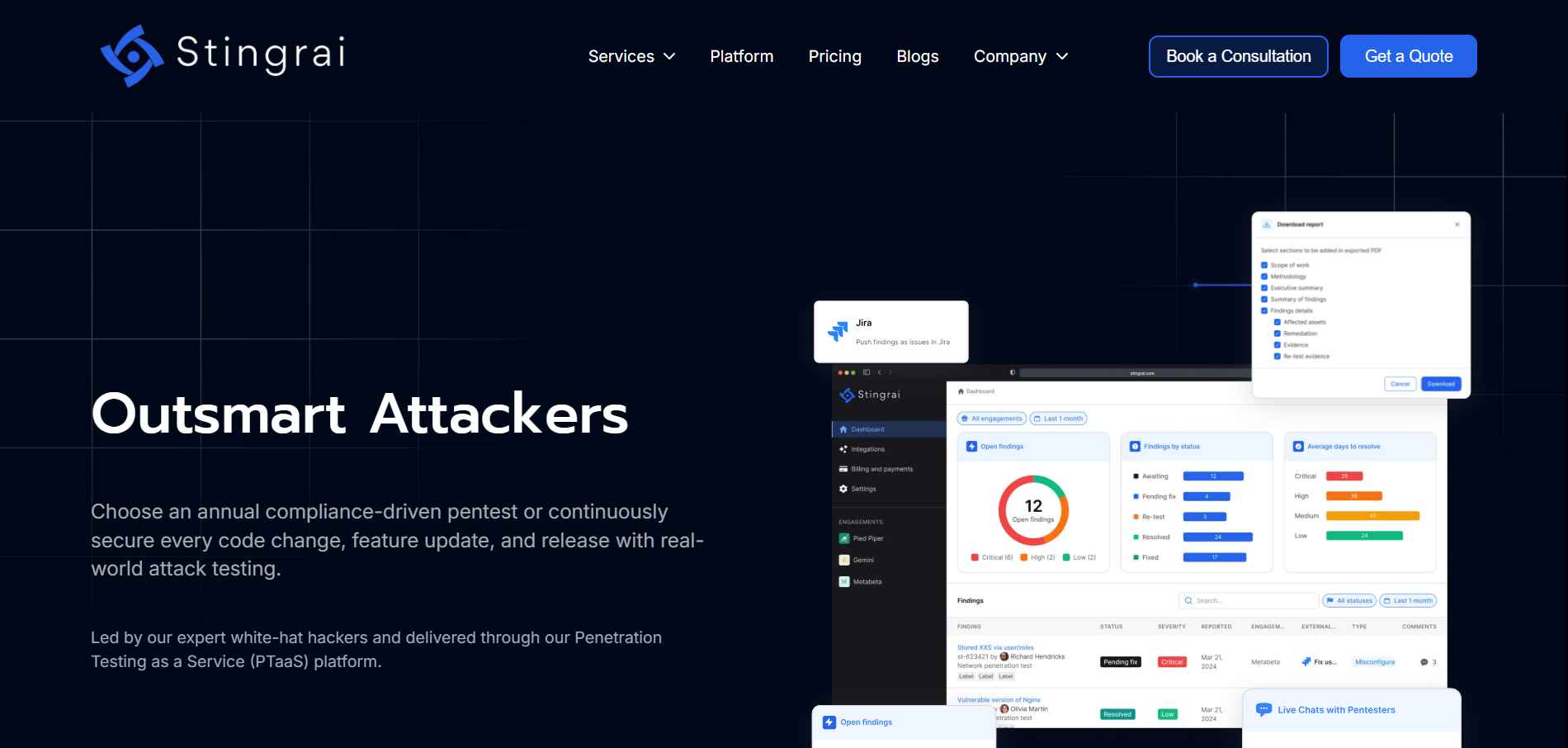
Stingrai is a security vendor that provides penetration testing and security vulnerability assessments before they get exploited by any attacker. The combination of hands-on experience in security research and automation helps it to find security flaws in modern applications and infrastructure. The organization has incorporated the experience of security researchers with ongoing tests using the PTaaS platform and the Snipe AI agent.
Key Services:
- Web application penetration testing
- Mobile application penetration testing
- API penetration testing
- AI and LLM penetration testing
- Internal and external network penetration testing
- Active Directory security assessments
- Cloud penetration testing
- Red teaming
- Purple teaming
- Penetration Testing as a Service (PTaaS)
Technical Expertise: Stingrai employs security researchers with proven experience in the area and has previously reported vulnerabilities to Fortune 500 companies.
Industries Served: Technology, financial services, healthcare, and other organisations with security-sensitive applications and infrastructure.
What Sets Them Apart from Other Companies: Its security testing is aimed at tech companies, digital businesses, financial companies, healthcare companies, and security-sensitive applications and infrastructure.
-
Mandiant (Part of Google Cloud)
Mandiant is a cybersecurity company providing threat intelligence and incident response services around the world. It became part of Google Cloud in 2022 and was established way back in 2004. It has gained popularity due to years of researching the biggest cyber threats and monitoring some of the most advanced threat actors.
Key Services:
- Penetration testing
- Web and mobile application testing
- Cloud penetration testing
- Internal and external penetration testing
- Social engineering assessments
- Embedded device and IoT penetration testing
- ICS/SCADA penetration testing
- Red team assessments
- Threat intelligence
- Digital forensics and incident response (DFIR)
Technical Expertise: Mandiant integrates penetration testing, adversary simulation, and threat intelligence to conduct tests on applications, networks, cloud, IoT, and industrial environments.
Industries Served: Banking, healthcare, technology, government, critical infrastructure, retail, and many more.
What Sets Them Apart from Other Companies: It offers the gold standard of frontline threat intelligence and breach resolution service providers in the world. It is a great choice for sophisticated cyberattack patching.
-
Synack
It is an enterprise crowdsourced cybersecurity and penetration testing service provider established in 2013 by two former NSA security professionals. They employ a methodology that integrates crowdsourced security testing by connecting companies with verified security experts via their testing platform. This model blends human intelligence with technology to enable companies to continually detect security vulnerabilities.
Key Services:
- Penetration Testing as a Service (PTaaS)
- Web application penetration testing
- API penetration testing
- Cloud penetration testing
- Mobile application testing
- AI and LLM penetration testing
- Attack surface management
- Compliance penetration testing
Technical Expertise: Synack uses its PTaaS platform, AI, and verified security professionals to conduct tests that leverage technology for vulnerability discovery and validation.
Industries Served: Financial services, public sector, retail and e-commerce, technology, and other large enterprises.
What Sets Them Apart from Other Companies: Provides a unique hybrid solution of hacker ingenuity and platform automation.
Which Provider Fits Your Specific Testing Scope?
| Cybersecurity Service | Best-Fit Provider | Unique Directive |
| Broad Enterprise & Regional Infrastructure | CyberCX | Executes large-scale regional operations, merging baseline penetration testing with incident response and IAM. |
| Web Application and API Pentesting | Qualysec | Combines deep human-led vulnerability exploration with high-speed coverage across thousands of completed assessments. |
| Continuous PTaaS & Vulnerability Management | NetSPI | Replaces static PDF assessment reports with a proprietary platform built for ongoing, real-time tracking and analytics. |
| Crowdsourced Testing & Attack Surface Management | Synack | Pairs a globally vetted community of ethical hackers with continuous platform-driven automation. |
| Adversary Simulation & Red Teaming | Mandiant | Powered by frontline telemetry tracking real-world advanced persistent threats (APTs) and zero-day vulnerabilities. |
| Industrial Control Systems (ICS/SCADA) | ST Engineering Info-Security | Brings specialized operational technology (OT) engineering expertise tailored explicitly for critical infrastructure. |
| Multi-Cloud & Compliance-Driven Auditing | Claranet Cyber Security | Blends extensive multi-cloud architecture knowledge with formal ISO and PCI regulatory compliance audits. |
| Financial Sector & Regulatory Assurance | LRQA | Focuses heavily on stringent financial regulations, enterprise risk frameworks, and high-assurance sectors. |
| Continuous Attack Surface & Red Teaming | Bishop Fox | Integrates their proprietary “Cosmos” security platform directly with elite hacker-led offensive testing. |
| Large-Enterprise Cyber Defense Integration | NCC Group | Leverages over three decades of experience delivering end-to-end offensive assessments and defensive intelligence. |
| Hybrid IT, Cloud, IoT, and OT Testing | Orange Cyberdefense | Maintains a broad international footprint capable of simultaneously securing legacy IT and modern connected environments. |
| Risk-Based Security Assurance & AI Governance | Dionach | Bridges manual exploit checks with modern threat modeling and emerging AI security governance frameworks. |
| Specialized Offensive Security & Wireless Testing | Wizlynx Group | Offers decades of deep technical specialization in wireless networks, physical security, and adversary simulations. |
| Global Application, Cloud, and IoT Security | Cyberintelsys | Delivers multi-region testing capabilities with a core emphasis on cloud layers and connected smart products. |
| Research-Driven AppSec & Tech Startups | Stingrai | Employs top-tier independent security researchers specializing in advanced vulnerability discovery for tech firms. |
How Much Does Penetration Testing Actually Cost in 2026?
The price of penetration testing is not consistent and can vary depending on several factors. The price will vary based on:
- Number of assets
- Application complexity
- Number of APIs
- Number of user roles
- Testing depth
- Manual effort
- Infrastructure scope
- Cloud environment
- Source code review
- Compliance requirements
- Testing timeline
- Retesting requirements
- Reporting needs
But to make it more convenient, the standard industry benchmarks are broken down into three primary pricing tiers:
| Testing Scope | Approximate Value | Primary Cost Drivers |
| Small Web Application | $5,000 – $12,000 | Limited endpoints, standard auth model, single-tenant scope |
| Complex SaaS / Modern APIs | $12,000 – $30,000 | Multi-tenancy, extensive API endpoints, complex RBAC logic |
| Internal Enterprise Network | $15,000 – $45,000 | Active Directory size, internal IP hosts, network segmentation depth |
| Global Red Team Operations | $40,000 – $80,000+ | Multi-vector simulation (phishing, physical, digital), custom tooling |
How To Select a CREST-Accredited Penetration Testing Company in 2026?
Before selecting any service provider for penetration testing, the procurement department should independently confirm the CREST status of the organization. You shouldn’t simply depend upon the claims made by the service provider.
This can be achieved by checking the legal identity, accredited service, region, and accredited practitioners from the official CREST database. You have to keep in mind that CREST ANZ is not the same as CREST International accreditation.
CREST Vendor Evaluation & Checklist
| What To Verify | Why It Matters | What Specific Details to Check |
| Provider’s CREST Listing | Confirms that the organization has an official CREST presence. | Search the CREST Marketplace and confirm that the provider has an active profile. |
| Contracting Entity | The name shown on a website may differ from the company’s registered legal name. | Check that the legal entity named in the contract matches the organisation listed by CREST. |
| Accredited Service | CREST accreditation applies to defined service categories rather than covering every service a company provides. | Confirm that CREST Penetration Testing is specifically included within the provider’s accredited scope. |
| Geographical Coverage | The accreditation or membership status may not apply to every office or international branch. | Verify that the office or legal entity performing the assessment falls within the relevant accreditation scope. |
| Accreditation Evidence | Procurement and compliance teams may need formal evidence for their records. | Request current membership or accreditation documentation and confirmation of the applicable scope from the provider. |
| Testers Qualification | An organisation’s accreditation does not mean that every employee holds an individual CREST qualification. | Ask for the names of the proposed testers and verify their individual IDs and certifications. |
| Scope and Methodology | The contracted engagement should reflect the appropriate CREST methodology and agreed testing requirements. | Review the Statement of Work (SOW), including the testing methodology, scope, deliverables, and sign-off requirements. |
| Threat-Led Requirements | Threat-led assessments require a different approach from a conventional vulnerability assessment or penetration test. | Establish whether requirements such as CBEST, TIBER-EU, or STAR apply to the engagement. |
| Verification Records | Evidence of due diligence can be important during future procurement reviews or audits. | Keep copies of CREST directory checks, screenshots, accreditation documents, vendor statements, and relevant proposal records. |
| Final Status | Accreditation details can change between supplier selection and contract signing. | Carry out one final CREST Marketplace check immediately before signing to confirm that the provider’s status and scope are still current. |
Conclusion
Choosing the correct top CREST-accredited penetration testing companies for 2026 Buyers is an essential step. It prevents your company from suffering from compliance issues, wasted money, and unforeseen security gaps. Choosing a certified company, giving importance to manual testing, and checking hidden costs before the assessment are important steps. These help your organization choose the correct provider.
FAQs
What is CREST accreditation for a penetration testing company?
Being CREST accredited means that the organization must pass strict third-party audits. These include technical methodology, data protection measures, governance, and background checks of its personnel.
How do I verify whether a cybersecurity provider is actually accredited by CREST?
Visit the official CREST marketplace. Use the corporate name of the vendor and check that their corporate membership is active and valid. You can also check how many years they have been actively CREST-accredited.
Why is it necessary for compliance audits to include CREST-certified penetration testing?
Compliance audits frequently require CREST-certified penetration testing because the security assessment needs to be done by trained and certified testers. The test results obtained in such cases are reliable and repeatable.
What is the difference between PTaaS and traditional penetration testing?
Traditional penetration testing provides a static PDF report. Penetration Testing as a Service (PTaaS) allows for ongoing tracking of vulnerabilities using an interactive portal.
How long does a standard enterprise penetration test take to complete?
An average penetration test takes about two to four weeks, depending greatly on the scope of the testing. It depends on how complex the application is and how many different attack surfaces are being tested.
How do black-box, white-box, and grey-box penetration testing differ from each other?
Black-box testing entails pretending to be an outsider who knows nothing about the system; white-box testing entails giving testers complete access to system architecture diagrams and the source code; and grey-box testing entails giving partial credentials of an insider or third party.