






Introduction
Preparing for a SOC 2 audit can be challenging, especially for companies that do not have a dedicated compliance team. Many SaaS companies already use security tools, restrict employee access, monitor their systems, and perform regular backups. However, they often struggle to prove that these activities are properly documented.
For example, your company may use multi-factor authentication (MFA), but can you show who has access to production systems? Do you have records of employee access reviews? Can you demonstrate that security vulnerabilities are identified and fixed?
These are the types of questions that make SOC 2 documentation important.
SOC 2 compliance documentation helps companies demonstrate how they protect customer data, manage security risks, and maintain their systems. This guide explains which documents you need, how to prepare them, what evidence to collect, and how to avoid common documentation mistakes.
What Is SOC 2 Compliance Documentation?
SOC 2 compliance documentation includes the policies, procedures, records, and evidence that demonstrate how an organization manages information security.
It is based on the AICPA Trust Services Criteria:
- Security: Protecting systems against unauthorized access.
- Availability: Keeping systems and services available.
- Processing Integrity: Ensuring systems process information accurately and reliably.
- Confidentiality: Protecting sensitive business information.
- Privacy: Managing personal information appropriately.
Security is required for every SOC 2 examination. The other criteria depend on the services provided and the organization’s requirements.
Documentation helps auditors understand what security controls exist, how they work, and whether the organization follows them.
What Documents Are Required for SOC 2 Compliance?
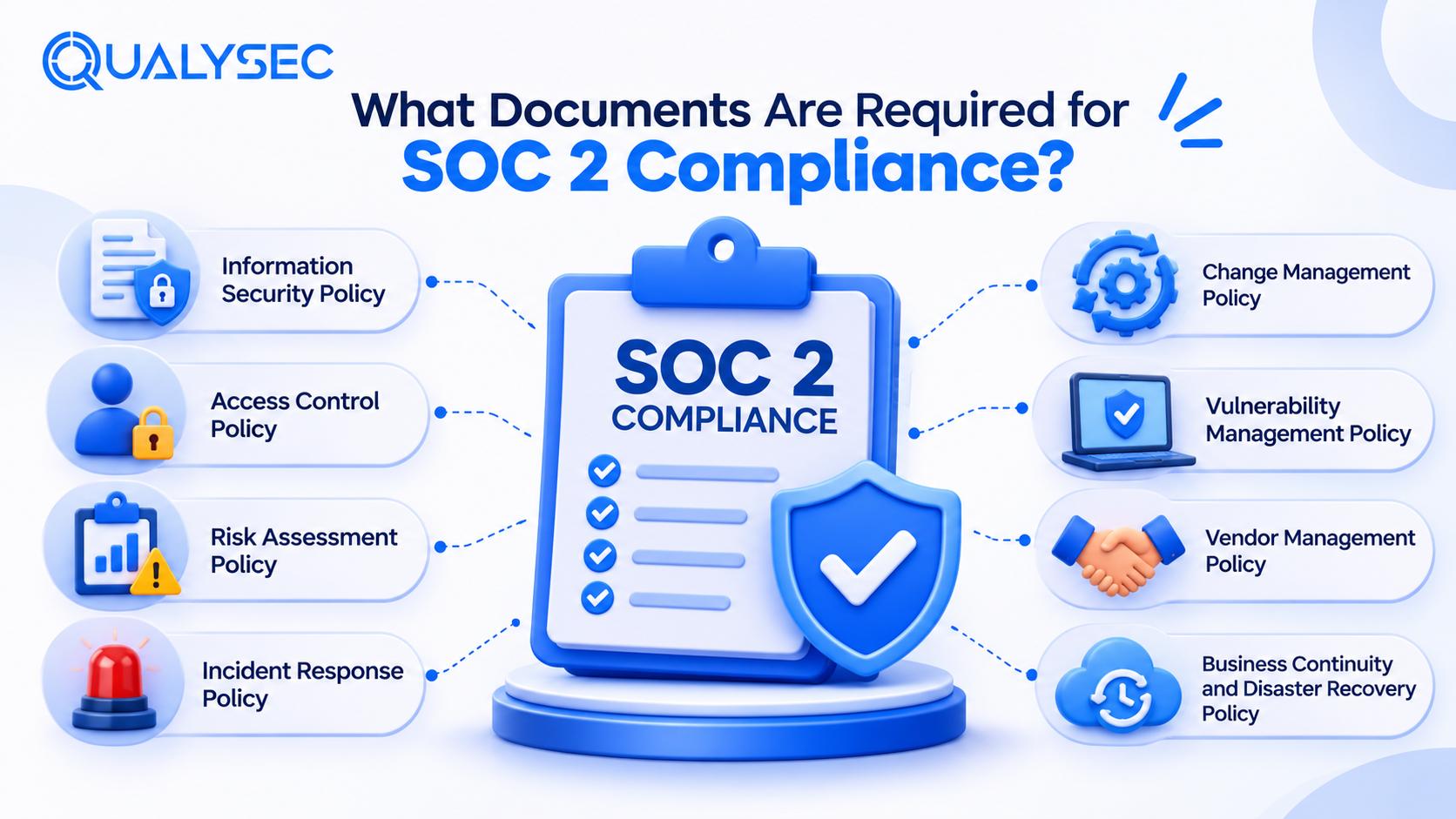
There is no single mandatory document list for every company. Requirements depend on the audit scope, services, risks, and applicable Trust Services Criteria. However, most SaaS companies should prepare the following documents.
1. Information Security Policy
This document explains how the company protects its information and systems.
Include:
- Security responsibilities.
- Employee security requirements.
- Data protection rules.
- Security risk management.
- Policy approval and review procedures.
2. Access Control Policy
This explains who can access company systems and how permissions are managed.
Include:
- User access approvals.
- Password and MFA requirements.
- Administrator access restrictions.
- Employee onboarding and offboarding.
- Periodic access reviews.
3. Risk Assessment Policy
This explains how the company identifies and manages security risks.
Include:
- Potential threats.
- Vulnerabilities and business impact.
- Risk classification.
- Existing security controls.
- Risk treatment plans.
Maintain a risk register showing identified risks, responsible owners, and remediation status.
4. Incident Response Policy
This explains what employees should do when a security incident occurs.
Include:
- Incident identification.
- Reporting procedures.
- Investigation responsibilities.
- Containment and recovery.
- Internal and external communication.
- Post-incident reviews.
Also maintain an incident register, including records of investigation and resolution.
5. Change Management Policy
This document explains how software and infrastructure changes are reviewed and approved.
Include:
- Change requests.
- Code review requirements.
- Testing procedures.
- Approval records.
- Deployment logs.
- Emergency change procedures.
6. Vulnerability Management Policy
This explains how the company identifies, prioritizes, and fixes security vulnerabilities.
Include:
- Vulnerability scanning procedures.
- Security testing requirements.
- Severity classification.
- Remediation timelines.
- Retesting procedures.
- Risk acceptance records.
7. Vendor Management Policy
If your company uses AWS, Google Cloud, payment gateways, or other third-party services, you should document how vendors are evaluated.
Include:
- Vendor inventory.
- Security assessments.
- Relevant vendor SOC reports.
- Data protection agreements.
- Periodic vendor reviews.
8. Business Continuity and Disaster Recovery Policy
This explains how the company maintains or restores services during disruptions.
Include:
- Backup procedures.
- Recovery responsibilities.
- Recovery Time Objectives (RTO).
- Recovery Point Objectives (RPO).
- Disaster recovery testing.
Other supporting documents may include employee security policies, encryption policies, data retention policies, and acceptable use policies.
What Evidence Do Auditors Expect?
Preparing a policy is not enough. Companies must also provide evidence that their security controls are actually working.
Consider this example:
Your access control policy states that employee permissions are reviewed every quarter.
An auditor may ask:
- When was the last access review completed?
- Who performed the review?
- Which accounts were checked?
- Were unnecessary permissions removed?
- Where is the approval record?
You should maintain actual access review records rather than simply showing the written policy.
Here are some examples of evidence:
| Security control | Evidence to maintain |
| Access management | User lists, access approvals, MFA configurations |
| Change management | Pull requests, code reviews, deployment records |
| Vulnerability management | Scan reports, penetration testing reports, remediation tickets |
| Incident response | Incident records, investigation reports, exercise results |
| Employee security | Training records, policy acknowledgments |
| Backup management | Backup logs, restoration test results |
| Vendor management | Vendor assessments, relevant SOC reports |
| Risk management | Risk register, assessment records, treatment plans |
Evidence should have dates, responsible owners, and enough information to demonstrate the activity performed.
How to Collect SOC 2 Evidence from Your Existing Tools
Most technology companies already use tools that generate useful audit evidence. The challenge is knowing what to collect and where to find it.
Here are some practical examples.
- AWS: Collect IAM configurations, access records, security monitoring logs, backup records, and relevant infrastructure configurations.
- GitHub: Maintain pull requests, code review approvals, repository permissions, and deployment histories.
- Jira: Use change requests, security remediation tickets, incident records, and task approvals.
- Google Workspace: Maintain user access records, MFA settings, account management records, and relevant administrative logs.
- Cloud monitoring platforms: Collect security alerts, monitoring records, and investigation results.
The evidence should support the relevant control. Not every screenshot or system export is sufficient on its own.
For example, a screenshot showing multi-factor authentication (MFA) enabled does not necessarily prove that all relevant user accounts use MFA.
How to Prepare SOC 2 Documentation for the First Time
If your company has never prepared SOC 2 documentation, start with the following steps.
Step 1: Define your audit scope
Identify the services, applications, infrastructure, and customer data included in the examination.
Step 2: Review existing security practices
Check which security controls are already implemented. Identify missing policies, procedures, and evidence.
Step 3: Prepare policies
Write policies based on your actual business processes. Avoid copying templates without customization.
Step 4: Assign document owners
Every important policy and control should have a responsible person.
Step 5: Start collecting evidence
Identify what evidence each control requires and collect it regularly.
Step 6: Review documentation
Check whether policies match actual practices and whether evidence is complete and up to date.
Step 7: Address security gaps
Prioritize missing controls, unresolved vulnerabilities, and incomplete procedures before the examination.
SOC 2 Type I vs. Type II: What Changes in Documentation?
The main difference is how the auditor evaluates your security controls during the SOC 2 compliance certification process.
| Requirement | SOC 2 Type I | SOC 2 Type II |
| Evaluation | Control design and implementation | Control design and operating effectiveness |
| Assessment | Specific date | Defined observation period |
| Documentation | Policies and implementation evidence | Policies and ongoing operational evidence |
| Access reviews | Evidence of implemented processes | Records of reviews throughout the period |
| Change management | Defined approval process | Records of actual changes and approvals |
For Type II, companies must maintain evidence throughout the examination period.
For example, if access reviews are performed quarterly, retain the records for each review during the relevant period.
Do not wait until the audit begins to collect evidence. Some records cannot be recreated accurately after the activity has taken place.
Common SOC 2 Documentation Mistakes
These mistakes can create unnecessary problems during audit preparation.
- Using generic templates: Policies may describe security processes that the company does not actually follow.
- Solution: Customize documents according to your infrastructure and business operations.
- Missing evidence: Security controls may exist, but there are no records proving they operate.
- Solution: Establish an evidence collection process for each applicable control.
- Outdated policies: Documents may not reflect recent changes to applications, cloud infrastructure, or employee responsibilities.
- Solution: Assign owners and schedule regular reviews.
- Incomplete access records: Companies may not maintain records of employee access approvals and removals.
- Solution: Document user provisioning, permission changes, and offboarding.
- Unresolved vulnerabilities: Security issues may be identified but remain without clear ownership or remediation records.
- Solution: Track vulnerabilities through remediation tickets and retesting.
- Poor document organization: Evidence may be scattered across emails, spreadsheets, and cloud drives.
- Solution: Maintain a centralized, access-controlled documentation repository.
How Often Should SOC 2 Documentation Be Updated?
Not every document needs to be updated every month. The review frequency should reflect the document’s purpose and the organization’s policies.
| Document | Suggested review frequency |
| Information security policy | At least annually and after significant changes |
| Access control records | According to the defined access review schedule |
| Risk assessment | At least annually and when significant risks change |
| Vendor assessments | According to vendor risk and review schedules |
| Incident records | Whenever an incident occurs |
| Change management records | For each applicable change |
| Vulnerability records | Whenever vulnerabilities are identified and remediated |
| Disaster recovery plan | Periodically and after significant infrastructure changes |
Always document policy approvals, revisions, and completed reviews.
How to Maintain SOC 2 Documentation After the Audit
SOC 2 documentation should not become inactive after receiving an examination report.
Companies continue to introduce new applications, onboard employees, change infrastructure, and work with additional vendors. These changes can affect existing security controls.
To maintain documentation:
- Review policies according to their defined schedules.
- Collect evidence throughout the year.
- Review employee and administrator access.
- Track vulnerabilities until remediation is verified.
- Update vendor assessments when necessary.
- Record security incidents and corrective actions.
- Test backup and disaster recovery procedures.
- Document significant changes to systems and services.
A continuous process makes future examinations easier and helps maintain consistent security practices.
Conclusion
SOC 2 compliance documentation requires more than preparing security policies. Companies must demonstrate that their security controls are implemented, followed, and supported by reliable evidence.
Start by understanding your audit scope, preparing relevant policies, assigning document owners, and collecting evidence from existing systems.
Pay particular attention to access management, vulnerability remediation, change management, incident response, and vendor security.
The best approach is to document what your company actually does, identify what is missing, and improve those processes before the audit. This makes SOC 2 compliance preparation more manageable and helps build a stronger security program.

Frequently Asked Questions
1. Is SOC 2 documentation mandatory?
Organizations undergoing a SOC 2 examination need sufficient documentation and evidence to demonstrate how their applicable controls are designed and operated. The exact documentation depends on the examination scope.
2. Can a small startup prepare SOC 2 documentation?
Yes. Small companies can prepare documentation using their existing tools and assign responsibilities to employees. They should focus on relevant controls rather than creating unnecessary policies.
3. Do I need a separate policy for every SOC 2 control?
No. One policy can address multiple related controls. The important requirement is that all applicable control activities are adequately documented.
4. What happens if SOC 2 documentation is missing?
Missing documentation can make it difficult to demonstrate that a control was properly implemented or operated. The auditor may identify a control exception or other issue, depending on its significance and the examination circumstances.
5. Can I use automated tools to collect SOC 2 evidence?
Yes. Automation can help collect access records, configuration details, security logs, and other evidence. However, companies still need to review the evidence and ensure it supports the relevant controls.
6. How long should SOC 2 documentation be retained?
Retention periods depend on the type of record, contractual obligations, legal requirements, and internal policies. Organizations should establish documented retention and disposal schedules.
7. Does SOC 2 require penetration testing?
SOC 2 does not prescribe a universal penetration testing frequency for every organization. However, security testing can support risk assessment and vulnerability management by identifying weaknesses and documenting remediation activities.