The NYDFS Cybersecurity Regulation under 23 NYCRR 500 mandates that regulated financial institutions implement security testing programs, including penetration testing and NYDFS vulnerability assessment, to identify and remediate cybersecurity weaknesses. The NYDFS Cybersecurity regulation has emerged as a response to the rapid increase in cyberattacks targeting financial institutions during the early 2010s. Banks, insurers, and financial service providers faced a lot of data breaches, ransomware incidents, and unauthorized access to sensitive customer information.
These incidents exposed weaknesses in traditional security practices and showed the need for strong regulation and cybersecurity measures. To address these growing risks, the New York State Department of Financial Services introduced the NYDFS Cybersecurity Regulation (23 NYCRR 500) in 2017. Under the regulation, financial institutions must conduct annual penetration testing (evaluating both internal and external boundaries) and risk-based automated vulnerability scanning (supported by manual reviews for non-scannable systems). The organisations must also complete VAPT audit documentation to show cybersecurity compliance during regulatory examinations.
This guide provides a comprehensive overview of NYDFS 23 NYCRR 500 penetration testing and NYDFS vulnerability assessment requirements, covering testing frequency and risk-based methodologies under the fully phased-in Second Amendment standards.
What is the NYDFS Cybersecurity Regulation?
The New York Department of Financial Services Cybersecurity Regulation (23 NYCRR 500) is a state-level regulation issued by the New York State Department of Financial Services (NYDFS) that requires financial institutions operating under NYDFS supervision to implement cybersecurity programs.
Before 2017, cyberattacks against banks and financial institutions started rapidly increasing, resulting in the loss of sensitive data and money. The NYDFS introduced a regulation to protect nonpublic financial information, ensure that the organization maintains strong cybersecurity programs, and improve incident reporting of cyberattacks within the system.
Since 2017, the cybersecurity landscape has changed extensively. Part 500 was amended again in 2023 to address evolving cyber threats, incorporate artificial intelligence (AI) security risks, and strengthen cybersecurity requirements across all regulated entities. Making it one of the most comprehensive cybersecurity compliance standards for financial organizations.
Applicability and covered organisations
Jurisdiction: State of New York, applicable organisations located in New York, Organizations operating in New York and licensed by NYDFS, such as:
- Banks and trust companies
- Savings banks
- Foreign banks operating in New York
- State-chartered credit unions supervised by NYDFS.
- Insurance companies
- Insurance agents and brokers
- Reinsurance companies
- Mortgage lenders and mortgage brokers
- Check-cashing businesses
- Money transmitters
- Virtual currency businesses, such as those holding a BitLicense
A company outside New York or even outside the United States must comply if it has a license or authorization from NYDFS.
Important Dates and Regulatory Timetable
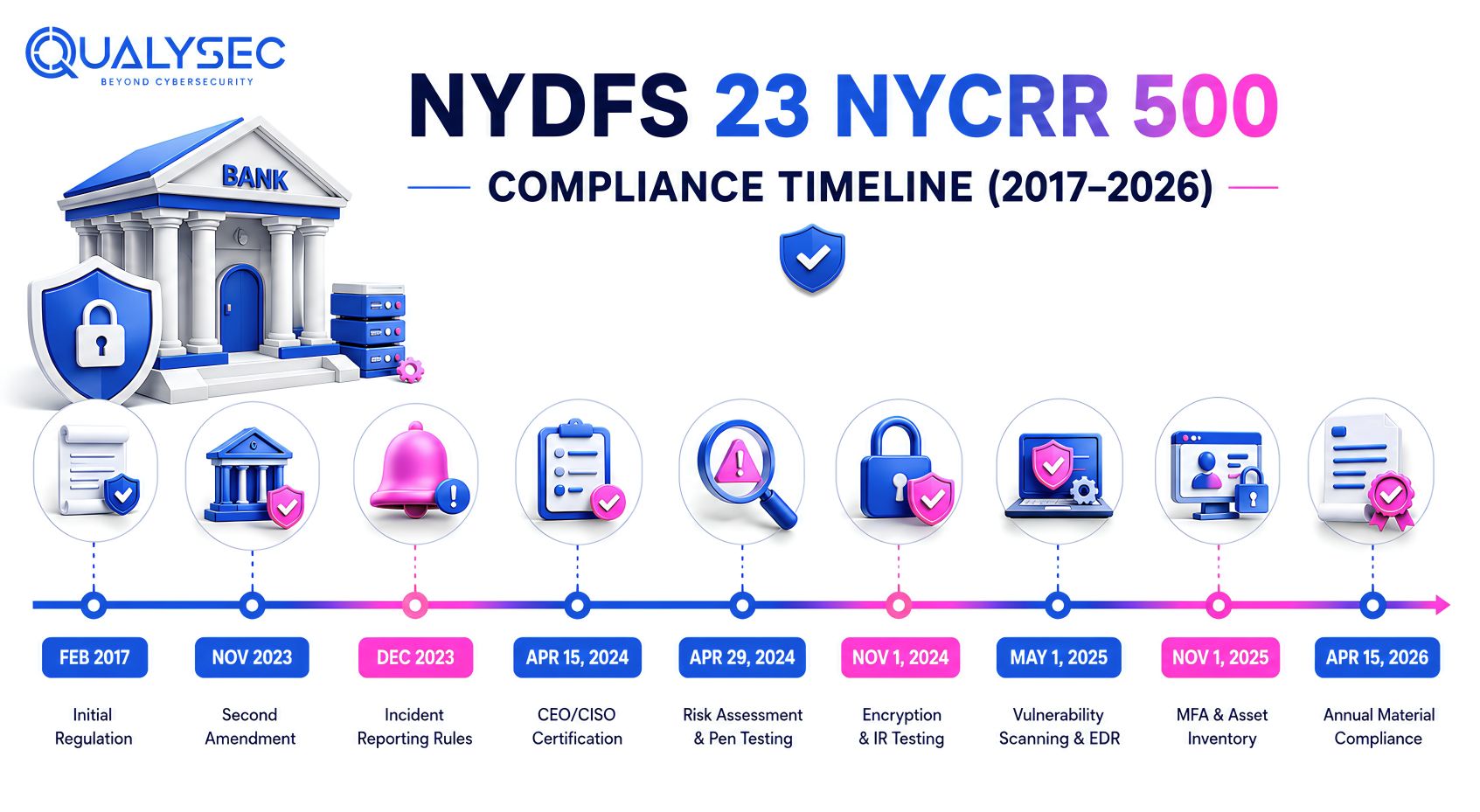
Organizations must monitor important regulatory milestones and amendment phase-in dates to keep complete compliance under 23 NYCRR 500:
- April 15, 2026: Covered entities have to provide their yearly Certification of Material Compliance addressing all revised Second Amendment criteria.
- November 1, 2025: Deadline for completion of work. Fully enforceable across all covered entities are universal multi-factor authentication (MFA) across every information system (§ 500.12) and total asset inventory management (§ 500.13).
- May 1, 2025: Mandatory automated vulnerability scanning (§ 500.5(a)(2)), privileged access reviews (§ 500.7), and Class A technical controls (EDR, centralized logging) take effect.
- November 1, 2024: Mandatory are governance requirements (§ 500.4), encryption rules (§ 500.15), and business continuity/incident response testing (§ 500.16).
- April 29, 2024: Risk assessments (§ 500.9), cybersecurity rules (§ 500.3), penetration testing controls (§ 500.5(a)(1)), and threat intelligence supervision will all have revised standards that go into force.
- April 15, 2024: The yearly compliance submission starts and needs joint certification or knowledge from the CEO and CISO (§ 500.17(b)).
- December 1, 2023: New 72-hour cybersecurity incident notification and 24-hour ransom payment reporting rules become effective (§ 500.17).
- November 1, 2023: The Second Amendment to Part 500 is adopted by NYDFS. This adds more monitoring, changes the standards for penetration testing/scanning, and adds new regulations for Class A Companies.
- February 2017: The NYDFS releases the first 23 NYCRR 500 rule.
Requirements under NYDFS Cybersecurity Regulation
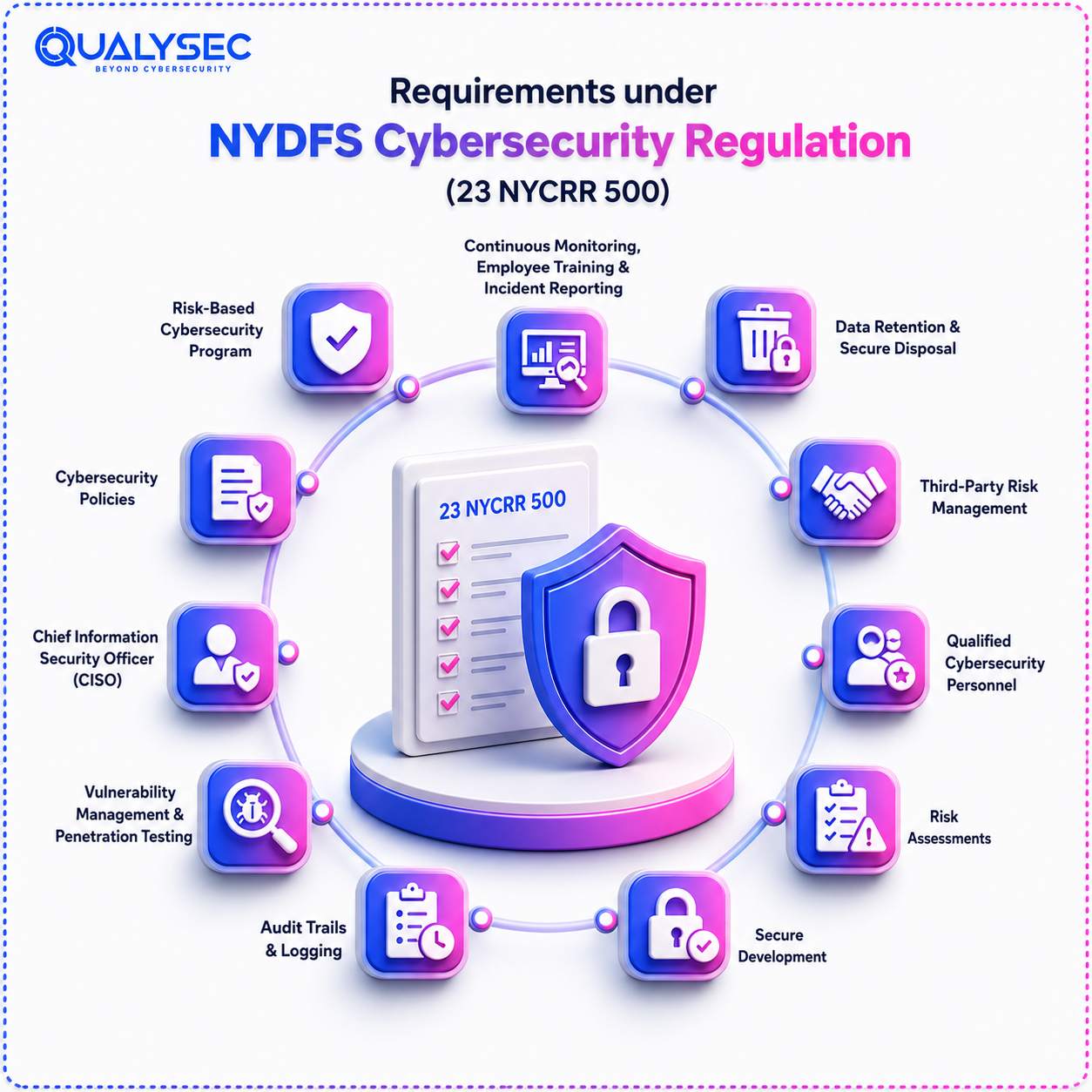
As per Section 500 of the NYDFS, the covered entities must:
- Maintain a risk-based cybersecurity program to identify and assess cyber threats, protect nonpublic information, detect & respond to cyber threats & attacks, and recover from cyberattacks.
- Implement written cybersecurity policies approved by senior management or the board. The written cybersecurity policies must cover information security, access control, asset management, incident response, vendor management, and network/application security.
- Appoint a CISO (Chief Information Security Officer) responsible for managing the cybersecurity program and reporting cybersecurity risks to senior management on an annual basis.
- Under § 500.5, create vulnerability management policies that include manual evaluations, automatic vulnerability scanning, and penetration testing to spot and address flaws.
- Maintain audit trails and logging systems to track financial transactions and detect cybersecurity incidents and events for investigation.
- Enforce least-privilege access controls, conduct periodic access reviews, and remove system access when employees leave the organisation.
- Implement secure development practices and application security testing for internal development and third-party applications.
- Conduct periodic cybersecurity risk assessments to identify threats to information systems, customer data, and business operations.
- Employ qualified cybersecurity professionals or external experts to manage security operations.
- Implement a third-party cybersecurity policy, including vendor risk assessments and contractual security requirements.
- Implement policies limiting the retention of nonpublic information and securely disposing of data when it is no longer needed.
- Implement continuous security monitoring or risk-based testing, and conduct regular phishing or cybersecurity training for employees.
- Report cybersecurity incidents within 72 hours, ransomware payments within 24 hours, and submit annual compliance certifications.
NYDFS VAPT Requirements under Section 500.5
Section 500.5 states that covered entities are to include monitoring and testing within their cybersecurity programs to evaluate how effective their security controls are. These monitoring and testing activities shall include continuous monitoring or periodic Penetration Testing and vulnerability assessments.
Under the amended regulation (§ 500.5), an organization must have effective continuous monitoring systems that can detect vulnerabilities or changes in information systems on an ongoing basis. The regulation requires annual penetration testing unless the organization has implemented effective continuous monitoring.
Annual Penetration Testing
The covered entities must conduct penetration testing at least once every year. These tests simulate real cyberattack scenarios and evaluate whether security controls can prevent unauthorized access.
Under Section 500.5(a)(1), a qualified internal or outside party must conduct penetration testing looking at attack vectors from within and beyond the boundaries of the information system. Penetration testing should examine:
- External attack surfaces
- Internal network security
- Web and mobile applications
- Authentication and authorization systems
- Data protection controls
The results are documented in audit-ready pentest reports, which include detailed evidence of exploitation attempts, findings, and remediation recommendations.
Bi-Annual Vulnerability Assessments (§ 500.5(a)(2))
Under Section 500.5 of the NYDFS Cybersecurity Regulation, Covered Entities must conduct vulnerability assessments at least twice each year unless they have effective continuous monitoring in place. The regulation specifies that these bi‑annual assessments must include systematic scans or reviews of information systems designed to identify publicly known cybersecurity vulnerabilities based on the results of the organization’s formal risk assessment.
Activities in the Vulnerability Assessment
A bi‑annual vulnerability assessment under NYDFS generally includes:
- Automated scanning to detect missing security patches, insecure or open network services, outdated software components, and weak encryption configurations.
- Manual Review- proprietary systems, specialized appliances, or segmented environments cannot be scanned automatically. The organization may conduct manual reviews to identify vulnerabilities that scanners may miss.
- Threat Alerts (§ 500.5(b))- Covered entities have to keep a system to get timely information on fresh flaws from threat intelligence sources and assess them against their risk profile.
- Risk-based security analysis: determines how often each system must be tested on the basis of its severity and potential impact.
Risk-Based Analysis
Risk-based cybersecurity programs are a core requirement under NYDFS 23 NYCRR 500. It mandates that organizations prioritize security testing based on risk, rather than testing every system with the same level of effort.
Meaning of “risk.”
Risk in the context of NYDFS means the potential for a cybersecurity threat to exploit a vulnerability in an organization’s information systems and cause harm to the organization, its operations, or its customers. Risk considers several factors, such as:
- Sensitivity of the data – financial records, customer information, or authentication credentials
- Business impact – financial losses, operational disruptions, legal consequences, or reputational damage
- Exposure of the system – the system is exposed to potential attackers from internet-facing or accessible from external networks.
Systems that process sensitive financial data, support critical business functions, or are exposed to external networks have a high risk. Therefore, require stronger security controls and more security testing.
What is VAPT in Cybersecurity?
Vulnerability Assessment and Penetration Testing (VAPT) is a cybersecurity testing methodology used to identify, validate, and exploit potential weaknesses in digital systems.
Although the terms are often used together, they perform different functions in a security testing program.
| Testing Type | Purpose | Result |
| Vulnerability Assessment | Identifies security weaknesses using automated and manual techniques | List of vulnerabilities with severity ratings |
| Penetration Testing | Simulates real-world attacks to determine exploitability | Demonstrates how attackers can compromise systems |
For covered entities, vulnerability assessments and penetration testing are not only technical security activities but also important compliance mechanisms that demonstrate the effectiveness of the cybersecurity program.
These testing activities help produce penetration testing compliance reports, vulnerability assessment reports, and VAPT audit documentation that help regulators to review and make appropriate implementations during cybersecurity audits.
Role of testing in compliance and regulatory examinations
NYDFS regularly conducts cybersecurity-focused examinations to evaluate the effectiveness of the organization. During these examinations, regulators review penetration testing reports, vulnerability scan results, remediation records, and risk assessment documentation to assess whether the organisation is actively addressing cybersecurity risks in line with regulatory requirements.
How can Qualysec help
Qualysec is a CREST-accredited cybersecurity services provider that helps financial institutions and fintech organizations strengthen their security posture and meet regulatory obligations. The company specializes in security testing services such as penetration testing, vulnerability assessments, and security audits across web, mobile, cloud, API, and network environments.
By identifying vulnerabilities before attackers exploit them, Qualysec helps organizations implement structured security testing programs that support NYDFS cybersecurity compliance and meet regulatory expectations under Section 500.5.
Key Security Testing & Compliance Services
- Penetration Testing: Cybersecurity experts conduct NYDFS 23 NYCRR 500 penetration testing by simulating real-world cyberattacks on financial systems, applications, APIs, and internal networks. These tests evaluate whether security controls can prevent unauthorized access to sensitive financial data and critical infrastructure.
- Vulnerability Assessments: Qualysec performs NYDFS vulnerability assessment activities to identify weaknesses across networks, cloud platforms, applications, and APIs. These assessments help financial institutions detect missing patches, insecure configurations, outdated software, and exposed services that could lead to cybersecurity incidents.
- Financial Services Pentesting: Qualysec offers specialized financial services pentesting designed for banks, fintech platforms, insurance companies, and payment systems. These tests focus on critical systems such as online banking portals, payment gateways, financial APIs, and cloud infrastructure used in financial operations.
- Compliance Support: Qualysec helps organizations align their cybersecurity programs with regulatory expectations by reviewing risk assessments, security policies, access controls, and testing practices required for NYDFS cybersecurity compliance. This ensures that the organization’s cybersecurity framework meets regulatory requirements under 23 NYCRR 500.
- Continuous Security Monitoring: Qualysec helps organizations implement ongoing monitoring practices that support risk-based security testing under the NYDFS regulation. Continuous monitoring helps detect vulnerabilities, configuration changes, and potential security incidents across systems and networks.
- Audit Preparation: Qualysec provides structured documentation and audit-ready pentest reports that demonstrate regulatory compliance. These reports include penetration testing results, vulnerability assessment findings, risk ratings, and remediation evidence that support regulatory examinations and cybersecurity audits.
Conclusion
Achieving NYDFS cybersecurity compliance requires financial institutions to regularly check and improve their cybersecurity controls. Organisations need to make sure their systems, networks, and applications are protected from cyber threats and unauthorised access. One important requirement is performing NYDFS 23 NYCRR 500 penetration testing. These tests help organizations simulate real-world cyberattacks and understand whether their security controls can prevent attackers from compromising their systems.
Furthermore, conducting a regular NYDFS vulnerability assessment helps identify security issues such as missing patches, weak configurations, and outdated software. Finding these weaknesses early allows organizations to fix them before they can be exploited by attackers. For regulated organizations, financial services pentesting also helps demonstrate that proper security testing is being performed as part of their cybersecurity program. Maintaining clear reports, remediation records, and testing documentation helps organizations show regulators that they are actively managing cybersecurity risks.

Frequently Asked Questions (FAQs)
1. Does NYDFS mandate penetration testing?
Yes. Section 500.5 requires financial institutions, including finntechs, to perform annual penetration testing to evaluate system security and identify exploitable vulnerabilities unless effective continuous monitoring is implemented.
2. Is a vulnerability assessment required under NYDFS?
Yes, financial institutions, including finntechs, must perform bi‑annual vulnerability assessments to detect known weaknesses, misconfigurations, missing patches, or outdated software, ensuring proactive identification and management of cybersecurity risks.
3. What is the required frequency for NYDFS VAPT?
Penetration testing is required annually, and vulnerability assessments must be conducted at least twice per year, with additional testing after significant system changes or risk-based prioritization.
4. What audit evidence is required for NYDFS compliance?
Entities must maintain reports that show test scope, methodology, findings, remediation actions, risk assessment linkage, policies, and approval by the CISO (chief information security officer) to demonstrate ongoing cybersecurity program effectiveness.
5. What should penetration testing compliance reporting include?
Reports should include scope, objectives, methodology, detailed findings with risk ratings, remediation guidance, proof-of-concept evidence, remediation tracking, and alignment with the organization’s risk assessment and policies.