




Every day, millions of people in Brazil keep sharing their personal data with businesses. Be it for online shopping, banking, finances, medical bills, appointments, restaurants, and more. Intentionally or unintentionally, data sharing is one of the main things we do on a regular basis. Technically, this personal data is highly valuable for businesses, and that’s where hackers try to steal or exploit it.
Gone are the days when data breaches in Brazil or any other nation used to be a rare event. The increasing number of cyberattacks and data exploitation cases is raising concerns among regulatory authorities. That’s where the LGPD compliance checklist becomes important to ensure serious enforcement actions. In simple words, if your business is collecting, storing, processing, or using personal data of the people of Brazil, it needs to be in alignment with the LGPD – Brazil’s General Data Protection Law.
For ventures dealing with the Brazilian people’s personal data, non-compliance with LGPD can be quite expensive. The ANPD (Autoridade Nacional de Proteção de Dados) is actively investigating companies against the checklist. The companies that remain in misalignment with the compliance checklist are getting fines, penalties, and suspensions as well.
In this guide, we’ll cover the essential aspects related to the LGPD data protection law in Brazil in 2026. Get a deeper insight into what the law needs, the process to achieve compliance, and how to run proper cybersecurity audits.
What Is LGPD Compliance?
LGPD stands for Lei Geral de Proteção de Dados and is the General Data Protection Law of Brazil. The law was enacted in August 2018 and came into full force on September 18, 2020, with the sanctions and penalties provisions becoming enforceable from August 1, 2021.
LGPD compliance means that your organization needs to follow the regulations set by the authorities. These laws are created for companies that collect, process, store, or share personal data of individuals in Brazil. The personal data can be of Brazilian citizens or anyone physically located in Brazil at the time of the data collection.
As per the statistics, Brazil’s cybersecurity market was valued at approximately US$3.7 billion in 2025 and is projected to grow at a CAGR of around 10% through 2029. This figure clearly highlights the need for organizations to ensure security against potential hacking or exploitation cases.
While inspired in part by the EU’s GDPR, the LGPD is Brazil’s own independent data protection framework, applicable to both public and private organizations, with its own distinct requirements and enforcement body (ANPD).
In simple terms, LGPD security requirements require data collection only for a valid legal reason and storing personal data securely. Further, this involves being transparent with Brazilian individuals about the data usage, or giving them the ability to access or delete the data. Additionally, this includes reporting data breaches to both ANPD and affected individuals.
Understanding Key LGPD Compliance Requirements
| Requirement | What It Means | Key Deadline |
| Lawful basis for processing | 10 legal bases apply to general personal data (Article 7); 8 apply to sensitive personal data (Article 11). | Before any data collection begins |
| DPO appointment | Designate and publicly disclose a responsible person | Immediately |
| Data breach notification | Report to ANPD and affected individuals | 3 calendar days for the preliminary report |
| Data subject rights | Immediately, or within a maximum of 15 days from the request date (Article 19). | Within 15 days |
| Record of Processing (RoPA) | Document all data flows and activities | Ongoing |
| Technical security controls | Encryption, access control, vulnerability testing | Ongoing |
| International transfer SCCs | International transfers must use an ANPD-approved mechanism, such as SCCs, adequacy decisions, or binding corporate rules. | Mandatory since August 23, 2025 |
| Breach records | Maintain records of all incidents | Minimum 5 years |
How to Achieve LGPD Compliance In 2026?
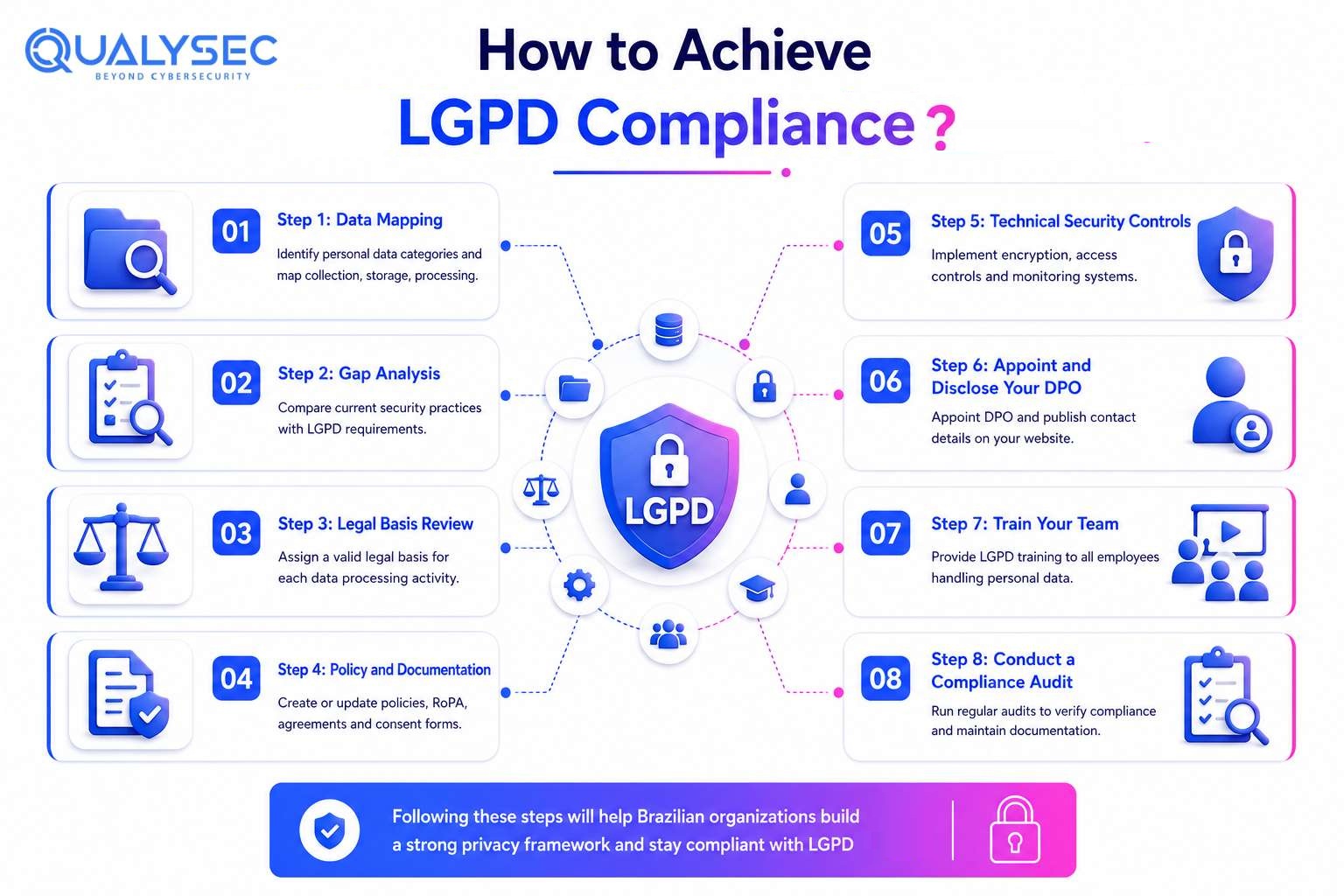
Step 1: Data Mapping
First, Brazilian organizations need to identify the categories of personal data. The data for storage, collection, and processing can be stored internally or held by third-party vendors as well.
Step 2: Gap Analysis
Next, you need to compare the current security practices against LGPD compliance requirements. It also identifies what is missing and needs to be focused on.
Step 3: Legal Basis Review
For every data processing activity, the organization needs to assign a valid legal basis or reasoning.
Step 4: Policy and Documentation
Further, you need to draft or update the privacy policy, internal data protection policy, Record of Processing Activities (RoPA), data processing agreements with vendors, and consent forms.
Step 5: Technical Security Controls
Next, the company collecting personal data of Brazilian individuals needs to implement encryption, access controls, monitoring systems, and cybersecurity testing.
Step 6: Appoint and Disclose Your DPO
Further, you need to appoint the Data Protection Officer and publish their contact details on your website and in your privacy documentation.
Step 7: Train Your Team
All employees who handle personal data must receive LGPD training. This includes understanding their obligations, how to handle data subject requests, and what to do if a breach occurs.
Step 8: Conduct a Compliance Audit
Run a formal LGPD compliance audit to verify all requirements are met and documented. Repeat this at least once a year, or any time your data processing activities change significantly.
LGPD Compliance Checklist 2026 For Brazilian Businesses to Follow
To understand the LGPD compliance checklist better, here are some of the key things to check if your organization is ready for the regulatory bodies.
| Compliance Requirement | Key Action Items for Brazilian Companies |
| Data Mapping | Complete the inventory of all data processing activities. |
| Lawful Basis | Assign a specific legal basis to every processing activity. |
| Privacy Policy | Update and ensure the policy is publicly available. |
| Consent | Review mechanisms to ensure they are LGPD-compliant. |
| DPO Appointment | Appoint a Data Protection Officer and disclose contact info. |
| Subject Rights | Establish a process with a 15-day response SLA. |
| Breach Response | Create a breach response plan with a 3-calendar-day preliminary notification rule to ANPD, followed by a full report within 20 business days |
| RoPA | Maintain an up-to-date Record of Processing Activities. |
| Record Keeping | Keep all data breach records for at least 5 years. |
| Vendor Contracts | Review third-party contracts for compliance clauses. |
| Data Transfers | Implement SCCs for all international data transfers. |
| Security | Implement encryption and strict access control measures. |
| VAPT | Conduct vulnerability and penetration testing regularly. |
| Staff Training | Complete LGPD training for all relevant employees. |
| Compliance Audit | Document a formal LGPD audit of your systems. |
How Does Qualysec Help With LGPD Compliance In Brazil?
Till now, one thing has been quite clear: companies in Brazil need to follow complex standards and would need LGPD compliance services from a reliable partner. Qualysec, one of the reputed and trusted cybersecurity companies, brings the same to all businesses in Brazil dealing with people’s personal data.
The Qualysec team brings human-led AI penetration testing to maintain compliance with the technical security requirements. Our team makes a real difference in following the ANPD regulations during serious enforcement actions. We have already helped numerous businesses across Brazil with hands-on, audit-ready reports to maintain LGPD compliance. Rather than just identifying the loopholes, we help you document the issues and possible solutions.
LGPD Compliance Audit
At Qualysec, we perform end-to-end cybersecurity audits that include data mapping, legal verification, privacy policy, DPO assessment, vendor contract evaluation, and more. Our audit reports will give a clear picture of your current capabilities, vulnerabilities, and compliance gaps.
VAPT (Vulnerability Assessment & Penetration Testing)
LGPD compliance expects organizations to implement essential security protocols to safeguard personal data. Qualysec’s VAPT services evaluate your personal applications, APIs, mobile applications, and networks to find real vulnerabilities. It gives you enough time and visibility to fix these issues before a data breach becomes a serious issue for your business compliance.
Security Requirements Assessment
Our team checks your technical and organizational controls according to the LGPD’s security obligations. On a high-level view, these include encryption protocols, access control, incident response readiness, and third-party platform security.
Ongoing Compliance Support
LGPD compliance standards need to be a continuous process instead of a one-time project. The ANPD
regulations keep changing from time to time and involve new regulations related to AI, DPIA, biometrics, and data. The Qualysec team offers continuous monitoring, re-testing, and advisory support to build a strong posture of compliance.
Talk with our experts for an LGPD compliance audit and related assistance.
Conclusion
Hence, LGPD compliance in 2026 is more than just about ticking a checklist, but about legal requirements. This includes serious financial and reputational damages in case the organization is found to be in non-compliance with regulations. Since Brazil is experiencing an increase in data breaches and cyber threat cases, ANPD is actively assessing companies and issuing penalties. In some cases, the fines can be huge and lead to an overall ban as well.
No matter if you’re just thinking about how to achieve LGPD compliance or need an audit to validate everything is in alignment, having the right partner will definitely assist. Qualysec combines human-led AI penetration testing with updated LGPD knowledge to assist with compliance. Overall, this helps your business remain secure and in compliance with data protection guidelines.
Frequently Asked Questions
1. What is LGPD compliance?
LGPD compliance is all about following the requirements set by Brazil’s Lei Geral de Proteção de Dados (LGPD) for organizations. This involves data collection on a legal basis to safeguard it from any sort of exploitation. Organizations must submit a preliminary breach notification to ANPD within 3 calendar days of becoming aware of an incident, followed by a full report within 20 business days.
2. Who needs to comply with LGPD?
Whether your company is in Brazil or another nation, if there is involvement of personal data of individuals in Brazil, it needs to comply with the LGPD compliance audit. This covers businesses of all sizes, from micro-enterprises and startups to large corporations.
3. What are the key requirements for LGPD compliance?
Some of the major requirements of LGPD security requirements include DPO appointment, data processing activities, data breach reporting within 3 calendar days for the preliminary report, honoring data subject rights, maintaining a Record of Processing Activities, implementing technical security measures, and more.
4. What are the penalties for non-compliance with LGPD?
ANPD can impose fines of up to 2% of the company’s gross revenue in Brazil in its prior fiscal year, capped at R$50 million per violation, in addition to other sanctions such as public warnings, data processing suspension, or deletion of the relevant personal data.
5. How can a company become LGPD compliant?
Any Brazil-based organization needs to follow a structured process underpinned by the LGPD data protection law in Brazil. This includes data mapping, gap analysis, legal basis review, policy and documentation, technical security controls, DPO appointment, staff training, and formal compliance audit. LGPD compliance is an ongoing obligation. A formal audit should be conducted at a minimum annually, and also triggered by significant changes to data processing activities, new vendor relationships, or following any breach.
6. Is VAPT required for LGPD compliance?
LGPD compliance doesn’t mention VAPT specifically, but organizations need to implement operational technical security measures. VAPT is one of the most effective ways to verify if those measures actually work.
7. How long does it take to achieve LGPD compliance?
Usually, the LGPD compliance process takes a couple of months, as per the company’s size and complexity. Further, the timeline also depends on the data volume, current security measures, and governance maturity.
8. What is an LGPD compliance audit?
The LGPD compliance checklist includes a proper review of the organization’s data protection against the requirements. This includes covering legal, operational, and technical security obligations to highlight gaps and the security roadmap.
9. Do small businesses need LGPD compliance?
Yes, any organization needs to comply with the LGPD regulations irrespective of the size or scale. As per ANPD, there can be fines or penalties for any organization that remains non-compliant with the guidelines.