






A financial advisor must comply with regulations, protect the personal data of clients, and ensure that the accounting records are correct. Financial advisors compliance solutions assist organizations in dealing with such issues and also meet the requirements set by the SEC.
According to the SEC, in 2026 the total regulatory assets managed by registered investment advisors were about $166 trillion. This shows how big the industry is and the need for proper compliance measures. A breach in compliance measures can lead to serious consequences for companies.
The blog provides information about major compliance rules, common issues with compliance, and the use of compliance software. It also provides information on preparation for the SEC exam, cybersecurity measures, and how compliance can be improved.
Key Takeaways
- Financial advisors’ compliance helps keep records accurate and minimize risks to regulators.
- Investment Advisors Act, Rule 206(4)-7, Marketing Rule, Regulation S-P, and Regulation S-ID are some of the key regulations.
- Regulatory changes, documentation, cyber risk exposure, and vendor risks are common.
- Compliance Software can track deadlines, archive communications, monitor, and keep records.
- RIAs should select solutions that have regulatory coverage, security, audit trails, and system integration.
- Organized records and evidence of good compliance controls are essential for SEC examination preparation.
- Sensitive data is safeguarded by penetration testing and vulnerability assessments.
Understanding Financial Advisor Compliance and its Importance
Financial advisors compliance refers to meeting the regulations on the management of clients’ investments, providing financial advice, and keeping client information confidential. RIAs should comply with the Investment Advisors Act of 1940. It is vital to make prudent decisions while managing investments in the interests of one’s clients. Investment advisor compliance software helps firms manage regulatory responsibilities, maintain records, and monitor compliance activities.
The importance of these responsibilities becomes clearer as the industry grows. According to the 2026 Investment Advisor Industry Snapshot, SEC-registered advisors managed $176.8 trillion in assets for 73.7 million clients during 2025. Assets under management increased by 22.3% compared with 2024.
What Are the Core Compliance Solutions for Financial Advisors?
There are various options that financial advisors may consider for the purpose of performing compliance management. The common solutions include:
- Compliance Management Software: Helps firms track regulatory deadlines, maintain records, and monitor employee activities.
- Outsourced CCO and Consulting Services: Provide support for annual compliance reviews, SEC examination preparation, and policy development.
- Third-Party and Vendor Risk Management: Helps firms assess external service providers, review their security practices, and monitor potential risks.
- Broker-Dealer and Enterprise Solutions: Support larger advisory firms through supervisory reviews, trade monitoring, and regulatory guidance.
Key Regulations Under Financial Advisor Compliance
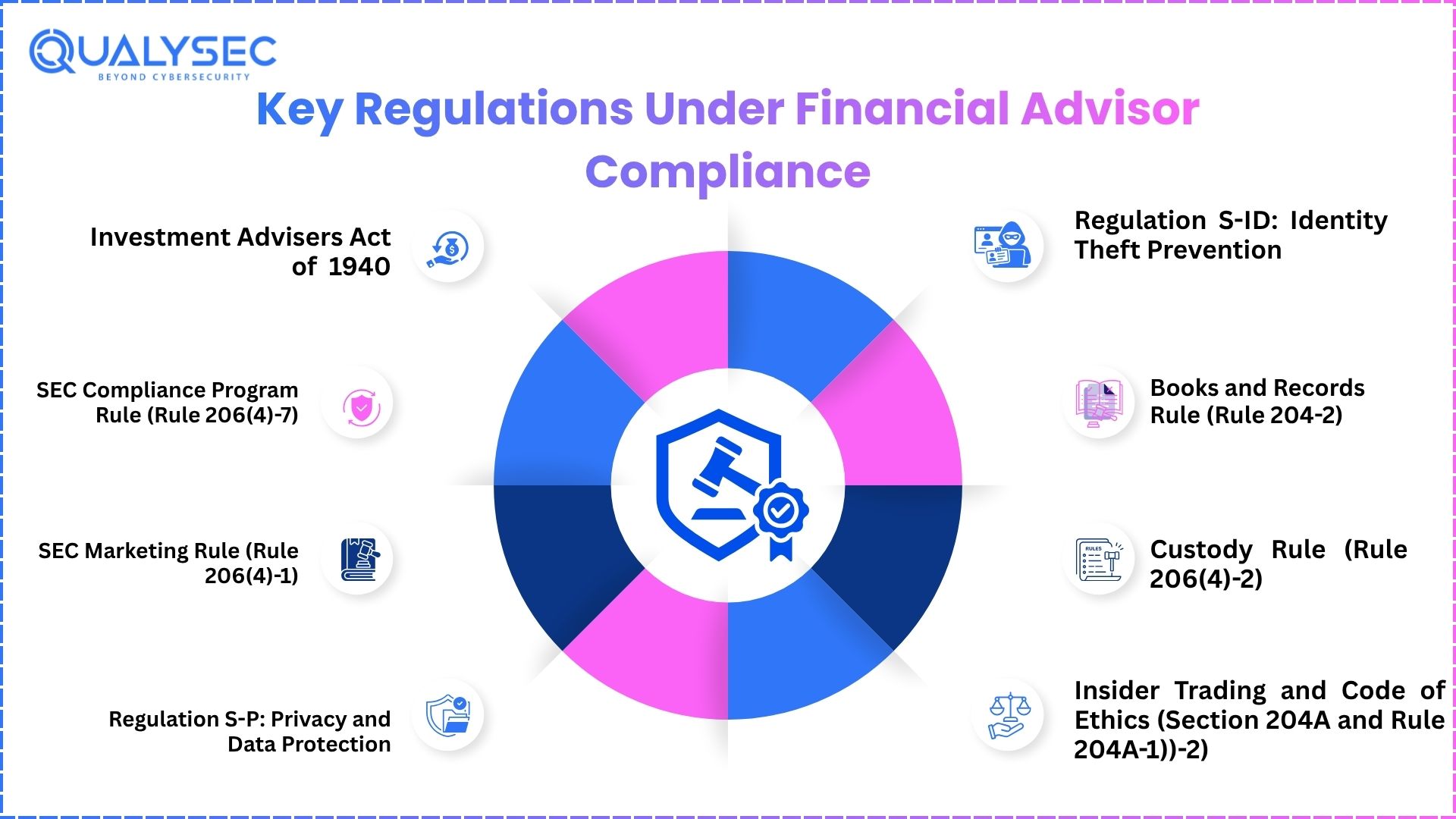
Investment advisory firms in the US are required to comply with regulations regarding investment management, client service, and business operations. The Securities and Exchange Commission (SEC) regulates those firms registered with it and enforces the relevant regulations.
These include dealing in clients’ best interests, sharing accurate information, maintaining business records, and protecting client data. Compliance with these regulations can help investment firms comply with their duties, protect their clients, and remain in good standing with regulators.
Key regulations include:
I. Investment Advisors Act of 1940
The most significant legislation regarding investment advisors in the U.S. is the Investment Advisors Act of 1940. The act defines who is considered an investment advisor and specifies rules related to registration and disclosure.
Most SEC-registered investment advisors must file Form ADV with the SEC. This form explains what services the firm offers, how much it charges, and how it manages its business. It also discloses any conflicts of interest and certain disciplinary records. This information helps clients understand the firm before trusting it with their investments.
II. SEC Compliance Program Rule (Rule 206(4)-7)
Rule 206(4)-7 requires SEC-registered investment advisors to prepare written policies and procedures on securities laws. These policies should address risks related to the firm’s daily activities and help prevent compliance violations.
Under this rule, firms must:
- Appoint a Chief Compliance Officer (CCO) to manage the compliance program.
- Review their compliance policies at least once a year to check whether they are working effectively.
- Update these policies when regulations, business activities, or risks change.
This rule helps firms make compliance part of their daily operations instead of treating policies as documents that are created and forgotten.
III. SEC Marketing Rule (Rule 206(4)-1)
The SEC Marketing Rule regulates how investment advisors advertise their services and communicate investment performance to prospective and existing clients. It applies to advertisements, testimonials, endorsements, and certain third-party ratings.
Key requirements include:
- Prohibiting false, misleading, or unsubstantiated statements about investment performance, services, and qualifications.
- Presenting gross and net performance together with appropriate prominence and disclosures when performance is advertised.
- Disclosing relevant information about testimonials, endorsements, compensation, and conflicts of interest.
- Maintaining supporting records for advertisements and applicable performance claims.
IV. Regulation S-P: Privacy and Data Protection
Regulation S-P mandates financial institutions to ensure the protection of their customers’ private financial information. These organizations include specific types of investment advisors and cover various types of private information such as financial records and account information.
Incident response and management for service providers were some of the additions introduced in the 2024 amendment to this regulation.
Key requirements include:
- Keeping written policies in place that safeguard customer data.
- Developing processes that will alert them about security issues.
- Overseeing third-party service providers dealing with customer data.
- Giving notification about the security breach to affected individuals within 30 days of its discovery.
The amended requirements became applicable to larger institutions on December 3, 2025, and smaller institutions on June 3, 2026. Both deadlines have passed.
V. Regulation S-ID: Identity Theft Prevention
Regulation S-ID requires certain financial institutions and creditors to establish written Identity Theft Prevention Programs. It applies to covered entities that offer or maintain qualifying accounts, including certain investment advisory firms.
The regulation requires applicable firms to:
- Recognize signs of identity theft, referred to as red flags.
- Watch covered accounts for any suspicious behavior.
- Develop a response plan for identity theft.
- Review and update their programs as new identity theft risks emerge.
This will allow organizations to recognize suspicious behavior in accounts before any losses occur.
VI. Books and Records Rule (Rule 204-2)
Rule 204-2 demands that investment advisors registered with the SEC keep accurate records regarding their financial transactions, relationships with clients, and business communications. Such records are necessary for the firms to prove their compliance with SEC regulations.
Required records include:
- Account books, bank statements, and transaction documents.
- Written communications with respect to investment advice and recommendations.
- Investment advisory agreements and the Form ADV filing.
- Applicable personal trading records and compliance documentation.
Electronic records must also be properly indexed, protected against loss or alteration, and available for regulatory inspection.
VII. Custody Rule (Rule 206(4)-2)
The Custody Rule safeguards the funds and securities of clients if there is custody of the client’s assets or some other type of control over the client’s assets by the investment advisor.
Other regulations like FFIEC compliance also support financial institutions in maintaining appropriate controls and protect sensitive financial information.
The rule generally requires applicable advisors to:
- Maintain client funds and securities with qualified custodians, such as eligible banks or broker-dealers.
- Have a reasonable basis to believe qualified custodians send account statements directly to clients at least quarterly.
- Arrange annual surprise examinations by independent public accountants when required, subject to applicable exceptions.
Certain arrangements, including qualifying pooled investment fund audits, can provide alternatives to the surprise examination requirement.
VIII. Insider Trading and Code of Ethics (Section 204A and Rule 204A-1)
Rule 204A mandates that the investment advisor set up policies and procedures to prevent any abuse of material non-public information. Material non-public information refers to sensitive information regarding firms, securities, or proposed transactions.
Rule 204A-1 further requires registered investment advisors to establish and enforce written codes of ethics. These codes define expected employee conduct and help prevent personal trading conflicts.
Key requirements include:
- Establishing procedures to prevent insider trading and misuse of confidential information.
- Setting ethical standards for employees and supervised persons.
- Requiring access persons to report applicable personal securities holdings and transactions.
- Reviewing employee trading activities to identify potential conflicts with client interests.
Best Practices for Financial Advisors to Overcome Compliance Challenges
As financial advisors, you will be required to take care of regulatory compliance, documentation, confidentiality, and other matters concerning the smooth functioning of the business. This becomes difficult for small firms that do not have enough manpower and technology.
- Keeping Up with Regulatory Changes: Regulatory requirements and SEC examination priorities evolve. Smaller firms may struggle to interpret new guidance, assess its impact, and update internal policies before compliance gaps emerge.
- Managing Records and Client Communications: Advisors use email, text messages, messaging apps, and video calls to communicate with clients. Capturing and preserving required business communications across these channels can be difficult. The SEC continues to take enforcement action against firms that fail to retain required electronic communications. These records are also important during a financial compliance audit.
- Protecting Client Information: Financial advisory firms hold sensitive client data, including account details, tax records, and personal information. Phishing, ransomware, business email compromise, and credential theft can expose this information or disrupt business operations.
- Managing Conflicts of Interest: Conflicts can arise from advisory fees, referral arrangements, affiliated products, or investment allocations. Firms must identify these conflicts, disclose relevant information, and manage them in clients’ best interests.
- Overseeing Third-Party Vendors: Advisors rely on custodians, cloud providers, CRM systems, and portfolio-management platforms. Outsourcing these services does not remove the need to assess vendor risks and monitor their security and operational controls.
- Managing Limited Resources and Human Error: Smaller firms may have limited budgets and compliance staff to manage software, training, audits, and cybersecurity. Mistakes such as phishing clicks, improper communications, or inaccurate disclosures can create additional compliance risks.
How Does Investment Advisor Compliance Software Support Compliance?
Investment advisors require compliance to record, monitor employees, make regulatory filings, and communicate with clients. The SEC compliance software streamlines all of these activities. It helps firms track deadlines, assign responsibilities, and maintain records. It also helps the Chief Compliance Officer (CCO) manage the compliance program more efficiently.
Essential Features of Compliance Software
- Communications Archiving: Stores business emails and supported messages to help firms maintain required records.
- Personal Trading Monitoring: Tracks employee investments and collects required holdings and transaction reports under Rule 204A-1.
- Form ADV and Form CRS Management: Organises filing information, tracks deadlines, and reminds staff about required updates.
- Employee Activity Tracking: Records employee training, policy acknowledgements, outside business activities, and required disclosures.
- Marketing Review: Helps review advertisements, check promotional claims, and maintain supporting records.
- Vendor Oversight: Stores vendor assessments and security documents to help firms monitor third-party risks.
The software assigns tasks, sends deadline reminders, and displays pending activities on a central dashboard. This reduces manual work and makes records easier to find during SEC examinations.
What Should RIAs Look for in RIA Compliance Solutions?
Registered Investment Advisor refers to an individual or entity that gives investment advice for compensation and is registered with the SEC or a state securities regulator. RIAs must follow applicable regulatory requirements, including rules covering client disclosures, recordkeeping, fiduciary duties, and compliance programs.
RIA compliance solutions refer to software applications and services that assist RIA companies in fulfilling their compliance obligations. Choosing the right financial advisors compliance solution helps firms manage regulatory tasks, monitor employee activities, and maintain accurate records.
When selecting RIA software solutions, firms should consider the following factors:
Regulatory Coverage and Compliance Features
- Check whether the platform supports applicable SEC and state compliance requirements.
- Look for tools to track personal trading, gifts, political contributions, and employee disclosures.
- Ensure it captures required business communications across email, text messages, and other channels.
- Check whether it tracks Form ADV deadlines, client brochure delivery, and annual compliance reviews.
Security and Data Protection
- Look for multi-factor authentication (MFA) and role-based access to prevent unauthorised access.
- Ensure client information is protected during transfer and while stored.
- Review independent security reports, such as SOC 2 Type II, where available.
- Check whether the platform records user activity, file access, and important system changes.
Scalability and Software Integration
- Choose software that connects with existing CRM systems, custodians, and portfolio management platforms.
- Ensure it can support more employees, clients, and business locations as the firm expands.
- Consider cloud-based platforms that provide regular updates, maintenance, and reliable access without requiring local servers.
What Happens During an SEC Examination, and How Can Advisors Prepare?
An SEC examination evaluates the activities of an investment advisor, including its compliance practices, policies, and recordkeeping. It could involve an assessment of any client fee structures, conflict of interest issues, investment suggestions, advertising practices, and privacy protections.
In 2026, the SEC published a new examination handbook on October 1. It also announced its FY2027 examination priorities on October 23. These priorities highlight fiduciary duties, compliance programs, cybersecurity, and customer data protection.
Advisors should organize compliance policies, annual review records, Form ADV filings, client disclosures, and business communications. Maintaining organized records and reviewing compliance policies regularly helps firms prepare for SEC compliance for financial advisors.
Why Do Financial Advisors Need Cybersecurity Solutions to Support Compliance?
Financial advisors manage confidential client information using digital communication channels and business applications. Cybersecurity solutions are essential for safeguarding client information, detecting weaknesses in security, and fulfilling regulatory duties.
- Penetration Testing for Client Portals and Applications: Penetration testing simulates cyberattacks to identify weaknesses in client portals, websites, and mobile applications before attackers exploit them.
- Vulnerability Assessments and Cloud Security Reviews: These assessments identify security weaknesses in networks, servers, and cloud systems that could expose sensitive client information.
- Third-Party and Vendor Security Assessments: These assessments review vendors’ security practices, access controls, and data protection measures to identify risks from external service providers.
- Security Reports and Vulnerability Retesting: Security reports document identified weaknesses and recommended fixes. Retesting verifies whether those vulnerabilities have been properly resolved.
- Incident Response and Recovery Planning: An incident response plan guides firms through detecting, containing, and recovering from security incidents.
Real-World Example of How Compliance Failures Led to SEC Action Against United Planners
United Planners’ Financial Services of America was fined by the SEC in October 2026 due to its failure to adequately supervise its investment advice. The advisor kept holding leveraged and inverse ETFs in the portfolios of its clients for prolonged periods, even though the assets are intended for short-term trading only. As a result, 54 clients, many of them elderly or retired, suffered significant losses.
What Action Did the SEC Take?
- Ordered the firm to stop violating the relevant investment advisor regulations.
- Issued a formal censure against the firm.
- Imposed a $600,000 penalty.
This case proves that the existence of compliance policies alone is not sufficient. It is necessary for financial advisory companies to review the investments periodically and make appropriate investment decisions.
How Penetration Testing Helped Strengthen Financial Application Security: A Qualysec Case Study
A financial services application required protection from any unauthorised access to its sensitive financial data. This was the case where the client required a security assessment.
What we did:
- Performed black-box and white-box penetration testing.
- Reviewed the security of the login process, access control, APIs, and sessions.
- Reviewed input validation and settings.
- Cooperated with the development team in order to fix identified problems.
- Performed several cycles of retesting.
Outcome:
- Delivered a detailed report with security findings and recommendations.
- Helped the development team address identified vulnerabilities.
- Verified fixes through repeated testing.
Applications and APIs are also used by financial consultants to handle clients’ confidential data. If there are any issues with access control or the API, this information may be exposed. Penetration testing is one way of finding these weaknesses.
Read the complete case study to learn how penetration testing protects client data.
Quick Checklist for Financial Advisors to Comply With for Financial Advisor Compliance?
Financial advisor compliance requires more than meeting regulatory deadlines. Organizations need consistent policies, employee training, accurate records, and strong security controls.
The following practices help RIAs manage compliance responsibilities and protect client information.
- Review and Update Compliance Policies: Review written policies at least once a year and update them when there is any shift in regulatory requirements, business operations, or risk profiles.
- Strengthen Access Controls and MFA: Use MFA and role-based access controls to safeguard client records and restrict employee access.
- Educate Employees on Compliance and Cybersecurity: Provide employees with education regarding phishing, password hygiene, data privacy, and appropriate communication channels.
- Safeguard Client Records and Communication Channels: Store client records in secure systems, communicate through proper channels, and encrypt sensitive data.
- Develop an Incident Response Plan: Describe how employees can identify, report, contain, and recover from security incidents. Test the plan frequently.
- Perform Security Assessment: Perform vulnerability assessments and penetration tests and document the results. Track the mitigation process and validate vulnerabilities.
How Can Qualysec Help Financial Advisors Maintain Compliance?
Being a cybersecurity company specializing in penetration testing, Qualysec helps financial advisory firms identify and address security weaknesses that could expose sensitive client information. Qualysec’s VAPT services cover web applications, APIs, networks, and cloud environments. These assessments help you strengthen technical security controls and support your broader data protection and compliance efforts under regulations such as Regulation S-P.
- Secure Client Portals and Advisory Platforms: We test web applications, APIs, and client-facing platforms to identify vulnerabilities such as injection flaws, broken access controls, and authentication weaknesses that could expose client information.
- Support Regulation S-P Data Protection: Our security assessments help identify weaknesses that could allow unauthorised access to nonpublic personal information. We provide findings and remediation guidance to help you strengthen data protection measures.
- Support SEC Examination Preparation: We provide detailed security reports outlining identified vulnerabilities, their potential impact, and recommended fixes. These reports can serve as supporting evidence of technical security assessments during compliance reviews and examinations.
- Identify Third-Party Security Risks: We assess cloud environments, API integrations, and external systems to identify security weaknesses that could affect your business through third-party connections.
- Verify Security Fixes Through Retesting: After your team addresses identified vulnerabilities, we can retest the affected systems to verify whether the security issues have been resolved.
- Reduce Data Breach Risks: By identifying exploitable weaknesses before attackers discover them, we help you reduce the risk of unauthorised access, data exposure, and business disruption.

Conclusion
Financial advisors compliance solutions are a continuous process that goes beyond just abiding by regulations and annual compliance reviews. It involves keeping accurate records, handling conflicts of interest, protecting client data, and ensuring compliance with the processes within the firm. Choosing the right compliance solution will make it easier for firms to achieve this.
Cybersecurity assessments help identify any weaknesses before they become major issues. This, when coupled with good compliance and data protection, helps RIAs avoid any regulatory risks and protects their clients’ information.
FAQs
1. What are compliance requirements for financial advisors?
Financial advisors must meet applicable registration, fiduciary, disclosure, recordkeeping, and client data protection requirements. They must also maintain written compliance policies and address conflicts of interest.
2. Which regulations apply to financial advisors in the United States?
Key federal regulations include the Investment Advisors Act of 1940, SEC Rule 206(4)-7, the Marketing Rule, Regulation S-P, Regulation S-ID, and the Books and Records Rule.
3. How can financial advisors maintain SEC compliance?
Advisors can maintain SEC compliance by reviewing policies annually, updating Form ADV, preserving required records, monitoring employee activities, disclosing conflicts, and addressing identified compliance gaps.
4. What cybersecurity requirements apply to financial advisory firms?
Covered firms must follow applicable data protection requirements, including Regulation S-P safeguards and incident-response obligations. Other cybersecurity controls should address access management, vendor risks, and data security.
5. How can financial advisors protect sensitive client financial data?
Advisors can protect client data through encryption, multi-factor authentication, restricted access, secure communication channels, regular vulnerability assessments, and employee cybersecurity training.
6. What should financial advisors look for in a compliance solution?
Look for solutions that support regulatory tracking, communication archiving, personal trading monitoring, filing reminders, employee oversight, secure recordkeeping, and integration with existing business systems.