






Take a small health technology company, based in the UK, that has just won its first pilot contract with the NHS for the home use of a monitoring application. The clinical safety team is requested by the trust, and the founders provide a risk register, a penetration test report, and a privacy notice. One week later, the reply identifies three missing documents: a clinician-approved hazard log, a clinical safety case report, and a plan to define the risk matrix. Nobody in the company knew what the safety pack needed to include, and that’s why the pilot slips a quarter.
The NHS has set a clinical risk management code of best practice for health IT manufacturers in the standard NHS DCB0129, under section 250 of the Health and Social Care Act 2012. Version 4.2 introduces a Clinical Safety Officer, a risk management plan, a hazard log and a safety case report, all of which must be kept throughout the product lifecycle. Trusts check this evidence before go-live via DTAC, as well as their responsibilities under DCB0160, which is the companion standard for the deployment of organisations.
To achieve DCB0129 compliance, it is necessary to begin with a registered clinician and a functioning process, rather than with a purchased template or a certificate. This guide explores who the standard binds, the changes to the law in 2025 and 2026, and what documents trusts seek, while also examining where security testing sits.
Qualysec can scope penetration testing and convert each of the security issues into a clinical harm statement that your Clinical Safety Officer can add to the hazard log.
What DCB0129 Is, Who Must Comply and Why the Duty Is Tightening
The new DCB0129 covers all organisations creating or providing health IT for use in health and care settings in England, from patient records to patient applications. It is not a certificate that a supplier can purchase but rather a process that the manufacturer performs. It is documented and maintained and is in effect for the life of the product.
Health IT categories in scope, with illustrative hazards (AI and Digital Regulations Service)
| Product category | Illustrative clinical hazard |
| Electronic patient records | Wrong-patient record or missing allergy data |
| E-prescribing systems | Incorrect dose or duplicated medication order |
| Patient-facing applications | Missed deterioration alert or misleading advice |
| Clinical decision support | Inaccurate recommendation accepted without review |
| Integration middleware | Lost, delayed, or misrouted clinical messages |
If the company markets a product as such, but if a software failure can reasonably lead to patient harm, it will be subject to DCB0129, even if the company does not. NHS England’s guidance on applicability frees up cases that fall on the border between the two, and trusts expect suppliers to document the outcome so they are able to supply it when required by the assurance team. The standard is used alongside ISO 14971, UK MDR, DTAC and the DSPT, and the NHS guidance suggests an existing ISO 14971 working process should be mapped before closing gaps.
The legal basis and the 2025 to 2026 changes
| Law | Effect on the standard | In force |
| Health and Social Care Act 2012, s250 | Power to publish information standards, including DCB0129 and DCB0160 | 2012 |
| Health and Care Act 2022, s95 | Changes the duty from “have regard to” to “must comply” | 7 July 2025 |
| Data (Use and Access) Act 2025, s121 | Allows the compliance duty to reach IT providers | 5 February 2026 |
The review page of NHS England, however, continues to say that “bodies must continue to have regard to the standards” until the new ones are developed. Most suppliers get the standard today via NHS contracts or DTAC, so counsel should check the position of each product before NHS England updates the standard.
DCB0129 and DCB0160: Two Standards, One Safety Chain
DCB0129 manages the clinical safety argument, the manufacturer’s half, whereas DCB0160 manages the clinical safety argument, the deploying organisation’s half, where the supplier provides the evidence. A trust can’t sign its own safety case until it has read the supplier’s submission, so the quality of the pack determines how quickly it deploys.
How the duties divide between the two standards
| Aspect | DCB0129 (manufacturer) | DCB0160 (deploying organisation) |
| Applies to | Company building or supplying the system | NHS or care body deploying it |
| Current version | 4.2 (2018) | 3.2 (2018) |
| Core outputs | Plan, hazard log, safety case report | Local plan, hazard log, safety case report |
| Approved by | Manufacturer’s Clinical Safety Officer | Deploying organisation’s Clinical Safety Officer |
| Hand-over | Safety case report and hazard log (3.3.3, 3.5.3) | Local configuration and workflow hazards |
The difference between DCB0129 and the DCB0160 division is about authorship: it’s safe as built according to the supplier’s perspective, and the trust makes it safe locally. Most friction arises when transferred hazards are present, since clause 6.3.1 requires another organisation to implement controls.
A trust assessing both DCB0160 and DCB0129 at the same time is asking the question that the supplier’s officer asked: “Can the trustee’s officer complete the argument that the supplier’s officer started?” Some of the most frequent explanations given for rejected packs are vague transfers, so this column is worth much attention and effort initially.
DCB0129 Clinical Risk Management: Roles and the Process Clause by Clause
There are two main principles that apply in the standard: a named clinician who has clinical risk and a process from design through to decommissioning. Even the most exhaustive of risk assessments done prior to launch cannot meet DCB0129 clinical risk management.
Roles and approval duties under the standard
| Role | Clause | Responsibility |
| Top Management | 2.2.1 | Provides resources, assigns competent staff and nominates the CSO |
| Clinical Safety Officer | 2.3.1 | A “suitably qualified and experienced clinician” |
| Clinical Safety Officer | 3.2.2, 3.3.2, 3.5.2 | Approves the plan, every hazard log version, and every safety case report |
The officer should also register with a professional body, for example, the GMC or NMC, and have suitable clinical safety training; NHS England continues. A lot of micro-suppliers sign an outside officer successfully but choose an officer shortly before the submission, and he or she will be very unfamiliar with the log, which will negatively impact the security argument. Top management must fulfill their duties under clause 2.2.1, and the clinical safety officer cannot make decisions on residual risk solely.
The risk management process by stage (DCB0129 v4.2)
| Stage | Clauses | Core activity | Output |
| Analysis | 4.1 to 4.4 | Define scope, identify hazards, and estimate risk “using the criteria” in the plan | Scored hazards |
| Evaluation | 5.1 | Judge each initial risk against the acceptability criteria. | Accept or control decision. |
| Control | 6.1 to 6.4 | Reduce risk, check for new hazards, verify each control (6.3.2, 6.3.3) | Verified controls and residual risk |
| Delivery and monitoring | 7.1 to 7.3 | Release with the safety case, review safety concerns, and repeat for change. | Updated log and incident record |
Clause 4.4.1 does not specify a risk matrix but instructs the manufacturer to estimate the risk according to the criteria established in the manufacturer’s plan. Many suppliers in the UK use a 5 by 5 grid, and one case report on safety published the acceptability bands in Table 6.
Acceptability bands in one published safety case report (Vitacam)
| Risk rating | Classification |
| 1 and 2 | Acceptable |
| 3 | Undesirable |
| 4 and 5 | Requires elimination or further control |
The most commonly overlooked clause is 7.2, which calls for a process to “collect and review reported safety concerns” and a Safety Incident Management Log. If the situation is not the case, support tickets and complaints should be added to the hazard log; otherwise, effective DCB0129 clinical risk management ends on the day of the product launch.
DCB0129 Documentation: What Goes in the Safety Pack
The trust will request three key documents: the Clinical Risk Management Plan, the Hazard Log and the Clinical Safety Case Report, all approved by the CSO. All three need to be the same version of software as the trust plans to deploy; otherwise, the reviewer can’t trust them.
Core safety pack documents and their approval route
| Document | Clause | Required content | Approval |
| Clinical Risk Management Plan | 3.2 | Risk acceptability criteria (3.2.1) and timing of safety case reports | CSO (3.2.2) |
| Hazard Log | 3.3 | Hazard, cause, harm, controls, initial and residual risk, owner and status, kept for the product’s life (3.3.1) | CSO, every version (3.3.2) |
| Clinical Safety Case Report | 3.5 | Argument of acceptable safety at each lifecycle phase (3.5.1), supplied to the receiving organisation (3.5.3) | CSO (3.5.2) |
| Safety Incident Management Log | 3.6 | Safety incidents and their resolution (7.2.5) | Maintained by the manufacturer |
Reviewers never read these documents in isolation; they cross-check them, and DCB0129 documentation most often fails on consistency rather than on missing content. Table 8 lists the inconsistencies that consultants and trust reviewers report most frequently, together with the correction each one requires before resubmission.
Common consistency failures in safety packs
| Inconsistency | Where the reviewer sees it | Correction |
| Hazard rated 4 in the log but called acceptable | Safety case report summary | Align the report with the log and the plan’s bands |
| Plan without a defined matrix | Clinical Risk Management Plan | Define every label and band (4.4.1) |
| No link to a software release | All documents | Version documents as release artefacts (7.3.4) |
The audit trail requirement in clause 7.3.4 is also met by treating the DCB0129 documentation as release artefacts, which are treated in the same manner as the software, with version numbers that move alongside the software. These documents should be generated using templates published by NHS England, and suppliers should fill in the template with the product information rather than with generic placeholder information.
DCB0129 Requirements Meet Security Testing: Cyber Hazards as Clinical Hazards
Any potential for change, delay or disclosure of clinical data is a patient safety risk and should be noted in the hazard log. Like any clinical hazard caused by a design or configuration fault, these hazards require a severity, likelihood, and documented controls.
NHS England’s review states that the cybersecurity requirements should be “better integrated with clinical risk management standards”, and NHS DTAC already does this as part of clinical safety and cybersecurity. There is no mention of penetration testing in the DCB0129 requirements; however, clauses 6.3.2 and 6.3.3 still require evidence of the existence and operation of each control.
Writing security findings as clinical hazards (synthetic examples)
| Security finding | Clinical harm | Control | Verification evidence |
| Object-level authorisation flaw in the readings API | Treatment decision based on another patient’s observations | Authorisation check on every request | Penetration test and retest reference |
| Message queue drops deterioration alerts under load | Delayed escalation for several patients | Durable queue with alarms | Load test report |
Where security test evidence supports the standard
| Test evidence | Clause: it can support |
| Penetration test report | Likelihood estimate for security hazards (4.4) |
| Retest confirming the fix. | Verification that the control works (6.3.2, 6.3.3) |
| Letter of attestation | Supporting evidence for the safety case report (3.5) |
It becomes much easier to meet DCB0129 requirements for verification and post-deployment monitoring when all security findings are presented as clinical harms.
Code example: checking a hazard log against the plan’s matrix
Someone sanity-checks a safety case with a hazard log before reading it, and a Python script performs five equivalent checks. Each check corresponds to a clause, and the script executes for two versions of a synthetic hazard log for a remote monitoring application.
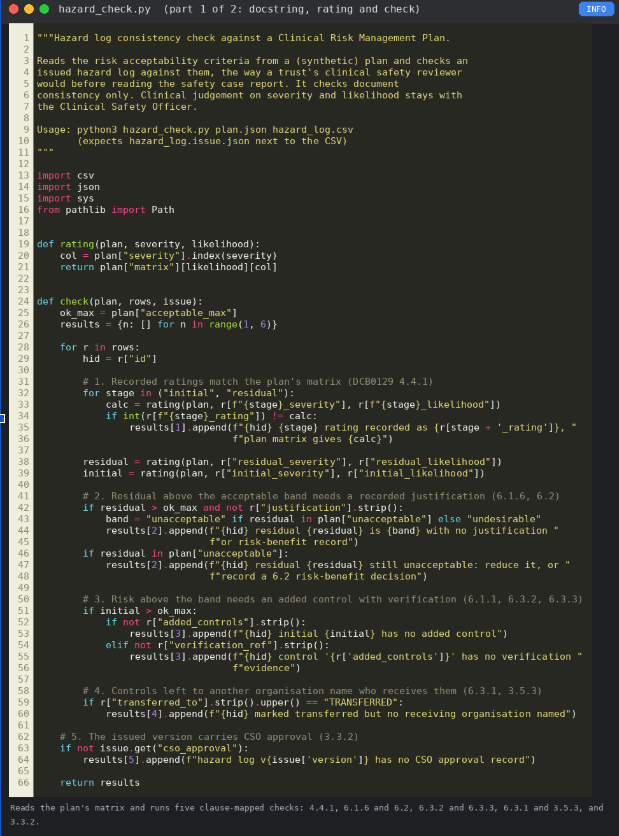
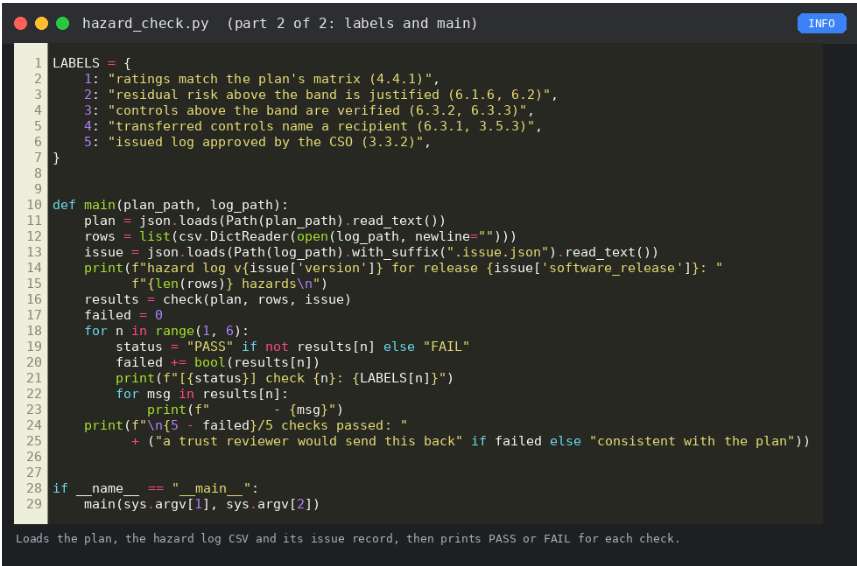
hazard_check.py
The synthetic plan, with its own matrix and bands (clause 4.4.1):
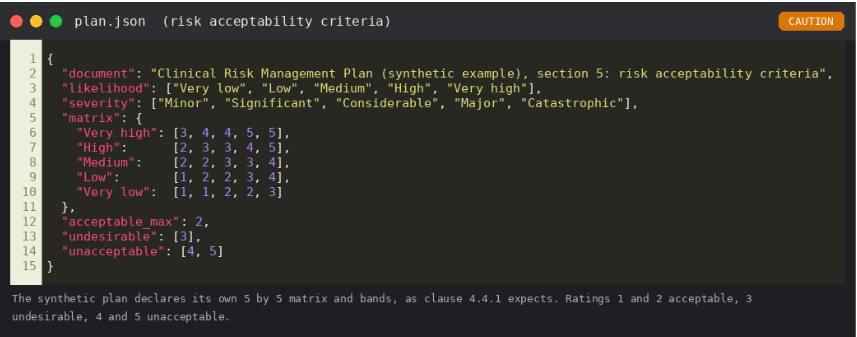
plan.json
Real output, unedited:
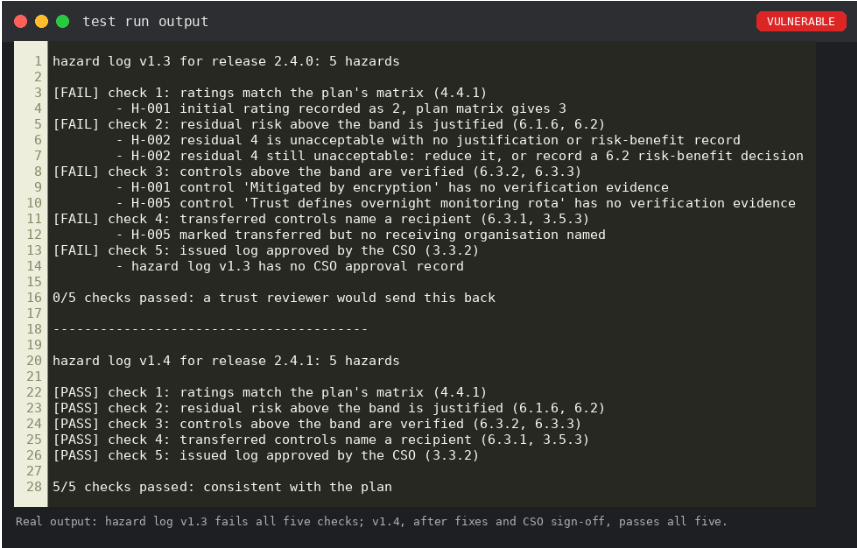
Test run output
Version 1.3 contains a mis-scored hazard, an unjustified unacceptable risk, an unverified encryption control, a transfer without a recipient and no CSO approval. The data and matrices are synthetic, and only the officer checks document consistency, leaving it to their clinical judgement on each rating.
A 10-Step Plan for Product Teams
There is more to sequencing than paperwork, as teams that hire an officer late waste months trying to determine which pieces of evidence were missing from their record when they were developing. Table 11 provides a practical order of work and the output that each should leave in the file.
A 10-step order of work
| Step | Action | Clause | Output |
| 1 | Run the applicability check. | NHS guidance | Recorded scope decision |
| 2 | Appoint a registered CSO and an accountable executive. | 2.2, 2.3 | Appointment record |
| 3 | Approve the plan with its matrix and criteria. | 3.2.1, 3.2.2 | Approved plan |
| 4 | Define scope, integrations and third-party parts | 4.2 | Scope statement |
| 5 | Run hazard workshops that include security findings. | 4.3 | Draft hazard log |
| 6 | Score, evaluate, control, and verify each hazard. | 4.4 to 6.4 | Verified controls |
| 7 | Write the safety case report for the release. | 3.5.1, 3.3.3 | Issued report and log |
| 8 | Hand both to the deploying organisation | 3.5.3 | Hand-over record |
| 9 | Monitor safety concerns after go-live. | 7.2 | Incident log entries |
| 10 | Repeat the process for every change. | 7.3 | Updated log version |
In my testing work, the hazard logs I review most often contain security rows that stop at “mitigated by encryption” and provide no supporting evidence. A single retest reference in the control column resolves that weakness, and it gives the officer something concrete to sign against.
How Qualysec Supports Health-Tech Suppliers on Clinical Safety Evidence
Qualysec is a specialised penetration testing company, and the security rows in a supplier’s hazard log provide evidence of the standard. The team reviews patient applications, clinician portals, APIs, integrations, and medical device software, and documents each patient application with a clinical harm statement for the officer. The supplier’s officer always holds the clinical sign-off, and retesting and a letter of attestation provide the verification evidence that clause 6.3 is looking for.
In my testing work, I often see the most common security rows in hazard logs that only state “mitigated by encryption” without any supporting evidence. That is a weakness that one retest reference in the control column overcomes and provides the officer with something to sign off on.
Case study: medical device and app testing for vTitan
The vTitan engagement (Clutch; Qualysec)
| Field | Detail |
| Client | vTitan, a healthcare IoT company |
| Product | Accuflow Uro device and companion mobile application |
| Scope | Android and iOS applications, device-to-cloud communication |
| Framework | FDA guidelines, NIST-aligned method |
| Period | December 2024 to February 2025 |
| Outcome | Letter of attestation; supported a major hospital partnership |
The US FDA engagement was not an NHS engagement, but an officer would need to have a similar set of evidence for a similar product in the UK.

Next Steps
It is not a process of documents with a process added to it after creating it to please a reviewer; it is a process with documents attached. Count all the security rows in the hazard log that contain a verification reference this week, as reviewers will be searching for it.
Priority actions before submission
| Timeframe | Action |
| This week | Count security rows with a verification reference |
| This month | Brief the CSO and define the plan’s matrix |
| Before submission | Retest security controls and update the safety case |
Before the next trust submission, talk to our team about penetration testing written as clinical harm statements, with retests and attestation for your file.
To see how Qualysec presents findings, review a sample penetration testing report showing severity ratings, reproduction steps and retest results for each issue.
Frequently Asked Questions
1. Is DCB0129 mandatory for software suppliers to the NHS?
In practice, NHS buyers require it, as it falls under section 250 of the 2012 Act and is included in procurement and DTAC. The 2022 and 2025 Acts strengthen the duty, but NHS England advises bodies to “have regard to” the existing versions, so check with counsel.
2. Who can be a clinical safety officer?
A suitably qualified and experienced clinician who has current professional registration, e.g from the GMC or NMC, and recognised clinical safety training will suffice. The person in charge could be in-house staff or a contractor and needs to approve the plan, each version of the hazard log, and each safety case report.
3. What documents does an NHS trust ask for?
Trusts are requested to provide all approved, matched, and requested clinical documents: Clinical Risk Management Plan, Hazard Log, and Clinical Safety Case Report. When reviewers raise questions about safety issues after go-live, they want to know how they communicate them to the supplier and how any safety issues return to the hazard log.
4. Does a penetration test count toward DCB0129?
A penetration test is not sufficient as a stand-alone method but it provides likelihood evidence for security hazards and verification evidence for the controls. Both the hazard log and safety case report should include these, and the writer should write them in a clinical rather than a technical manner to enable the officer to sign without hesitation.