

CREST VAPT services in the Philippines help organisations determine whether their security controls can withstand real-world cyberattacks. Many businesses still rely on automated vulnerability scans that identify known weaknesses without showing how attackers could exploit or chain them.
According to Fortinet’s 2026 Global Cybersecurity Skills Gap Report, 93% of organisations surveyed in the Philippines reported experiencing at least one breach. 52% said these incidents resulted in losses exceeding $1 million, while 70% took over a month to fully recover from an attack. CREST-accredited VAPT can help address this gap through structured testing, qualified professionals, and controlled exploitation.
In this blog, we will discuss CREST- accredited VAPT Services in the Philippines. We will also cover what VAPT assessments cover, which Philippine regulatory requirements they can support, what a VAPT report should include, and how to select a suitable provider.
Key Takeaways
- CREST VAPT offers security testing that is independent and well-structured.
- This includes networks, web, mobile, cloud, APIs, and wireless systems.
- Manual testing can identify attack paths and any business logic weaknesses.
- VAPT fulfills the Philippines’ privacy and financial security needs.
- It could assist with ISO 27001, PCI DSS, and OWASP guidance.
- VAPT reports contain risk rating, evidence, remediation, and retesting details.
- Choose providers based on CREST accreditation, expertise, scope, and reporting quality.
What Is CREST-Accredited VAPT Services?
A CREST VAPT service is a vulnerability assessment and penetration testing service offered by a cybersecurity company. These cybersecurity companies undergo evaluation by CREST to fulfill the set requirements of their organization and services. It helps buyers to have faith in the procedures used by the company in security testing and risk, data, and test quality management.
Key elements of CREST penetration testing and vulnerability assessment include:
- Independent assessment: CREST accreditation requires an independent assessment of the provider against the relevant organizational and penetration testing criteria instead of relying solely on claims by the provider.
- Structured testing practices: CREST criteria cover areas like testing methodologies, risk management, engagement management, communication, supervision, and quality assurance.
- Skilled Professionals: CREST provides credentials such as CPSA, CRT, CCT INF, and CCT APP. Not all testers need to undergo individual certification, since CREST also considers relevant skills, knowledge, and experience.
- Continual advancement of standards: CREST constantly evaluates the requirements of its accreditation program to adapt to technological advancements.
For organizations in the Philippines, it is essential to understand the difference between provider accreditation and professional certification. You should ensure that the provider has the latest CREST accreditation and evaluate the credentials of the professionals assigned to the assignment.
Why Do Businesses Need CREST VAPT Services in the Philippines?
Customer data, applications, cloud, and internal networks are becoming more vulnerable to cyber threats in the Philippines. In 2026, more than 19.2 million credentials were compromised across 255 data-breach incidents. This exposed around 335 million records and 2.6 terabytes of data. This makes proactive security testing ever more critical.
CREST VAPT Services in the Philippines combines structured methodologies, skilled professionals, controlled exploitation, and independently assessed provider processes. It helps organizations to detect vulnerabilities, test security measures, and provide genuine evidence to security and compliance teams.
Protection of Customer and Business Data
Your organization might be handling sensitive personal, financial, and business information. These are attractive targets for cyber criminals.
- Growing threats: Viettel Cyber Security’s H1 2026 recorded 16,619 phishing attempts and 21 ransomware incidents in the Philippines.
- Beyond automated scans: Manual testing can uncover business-logic flaws, vulnerability chains, and attack paths that automated tools may overlook.
- Independent assurance: CREST accreditation provides additional assurance that the provider has been assessed against defined organisational and testing requirements.
- Proactive protection: VAPT identifies exploitable weaknesses before attackers can use them to access sensitive information.
Philippine Data Privacy and Security Expectations
According to the Data Privacy Act 2012, organizations are required to implement reasonable and appropriate security measures. NPC Circular No. 2023-06 further addresses controls such as access management, authentication, logging, and data protection.
- Validate controls: VAPT tests whether authentication, access controls, segmentation, encryption, and vulnerability management work effectively.
- Support privacy governance: Findings can help Data Protection Officers identify weaknesses that could expose personal information.
- 72-hour requirement: Qualifying personal data breaches generally require notification to the NPC and affected individuals within 72 hours.
- CREST is not mandatory: Philippine law does not specifically require CREST accreditation, but independent accreditation can strengthen assurance around testing quality.
Risks Across Different Environments
There are several interconnected attack surfaces that modern businesses need to test specifically.
- Web: Injection flaws, authentication issues, access control vulnerabilities, and business logic issues.
- Cloud: Excessive IAM permissions, exposed cloud services, misconfigurations, and exposed cloud storage.
- Mobile: Insecure storage, cryptography problems, and application/backend issues.
- APIs: Broken object-level authorization, excessive data exposure, and authentication problems.
- Internal infrastructure: Segmentation flaws, Active Directory security problems, and lateral movement possibilities.
The scope of the assessment should be aligned with your organization’s technology stack and risk profile.
Business, Regulatory, and Reputational Impact
The financial impact of breaches continues to increase. IBM’s report found that the average breach cost across ASEAN organisations reached US$4.12 million, compared with US$3.67 million in 2025.
- Financial risk: Proactive testing can identify weaknesses before they contribute to costly incidents.
- Regulatory exposure: VAPT provides evidence that security controls are actively assessed.
- Customer confidence: Independent testing can support security assurance for customers, partners, and auditors.
- Better remediation: Evidence-based findings and severity ratings help teams prioritise corrective actions.
You can rely on CREST-accredited VAPT to bring together technical testing, processes, qualified expertise, and independent provider assurance. These will help evaluate security controls and find out how they react to realistic attacks.
What Systems Does a CREST-Accredited VAPT Assessment Cover in the Philippines?
The CREST VAPT Services in the Philippines can cover your organization’s external and internal networks, web and mobile applications. Also cloud infrastructure, APIs, microservices, and wireless environments. The exact scope depends on your organization’s technology stack, attack surface, and security objectives.
Assessors typically evaluate:
- External and Internal Networks: Perimeter firewalls, routers, switches, internal workstations, Active Directory domains, and segment boundaries.
- Web Applications and Portals: This includes customer-facing portals, e-commerce checkout, enterprise resource planning (ERP), etc., and content management systems.
- Mobile Applications: Android and iOS application binaries, backend API communication layers, and local storage caches.
- Cloud Environments: Infrastructure-as-a-Service (IaaS) deployments across AWS, Azure, and Google Cloud, covering serverless functions and containerized Kubernetes clusters.
- APIs and Microservices: RESTful and GraphQL endpoints for data access between mobile clients, web frontends, and third-party vendor integrations.
- Wireless Networks: Corporate Wi-Fi guest networks, rogue access point detection and segmentation controls.
How Do CREST-Accredited Providers Conduct VAPT Assessments?
The CREST-accredited provider follows an organized, reproducible approach based on international standards and tight control limits. The process lifecycle generally follows the core five stages:
- Scoping & Rules of Engagement: Establishing specific testing boundaries, IP ranges, target applications, testing windows, and emergency communication channels to mitigate business disruption risks.
- Information Gathering & Reconnaissance: Conducting active and passive enumeration to identify available targets, open ports, service banners, and subdomains.
- Vulnerability Analysis & Exploitation: Applying automated analysis and manual investigation to locate weaknesses and exploit them to prove actual risk.
- Post-Exploitation & Lateral Movement: Showing the damage that a breach can cause by pivoting through internal networks or applications’ privilege escalation.
- Reporting & Debriefing: Preparing comprehensive technical findings with assigned CVSS risk levels and possible remediation options for executives and engineers.
Which Philippine Regulations and Standards Can VAPT Support?
CREST-accredited VAPT can help your organization meet the security requirements of privacy laws, financial regulations, and international security standards. It will assist you in identifying weaknesses, validating the effectiveness of security controls, and keeping evidence of security testing.
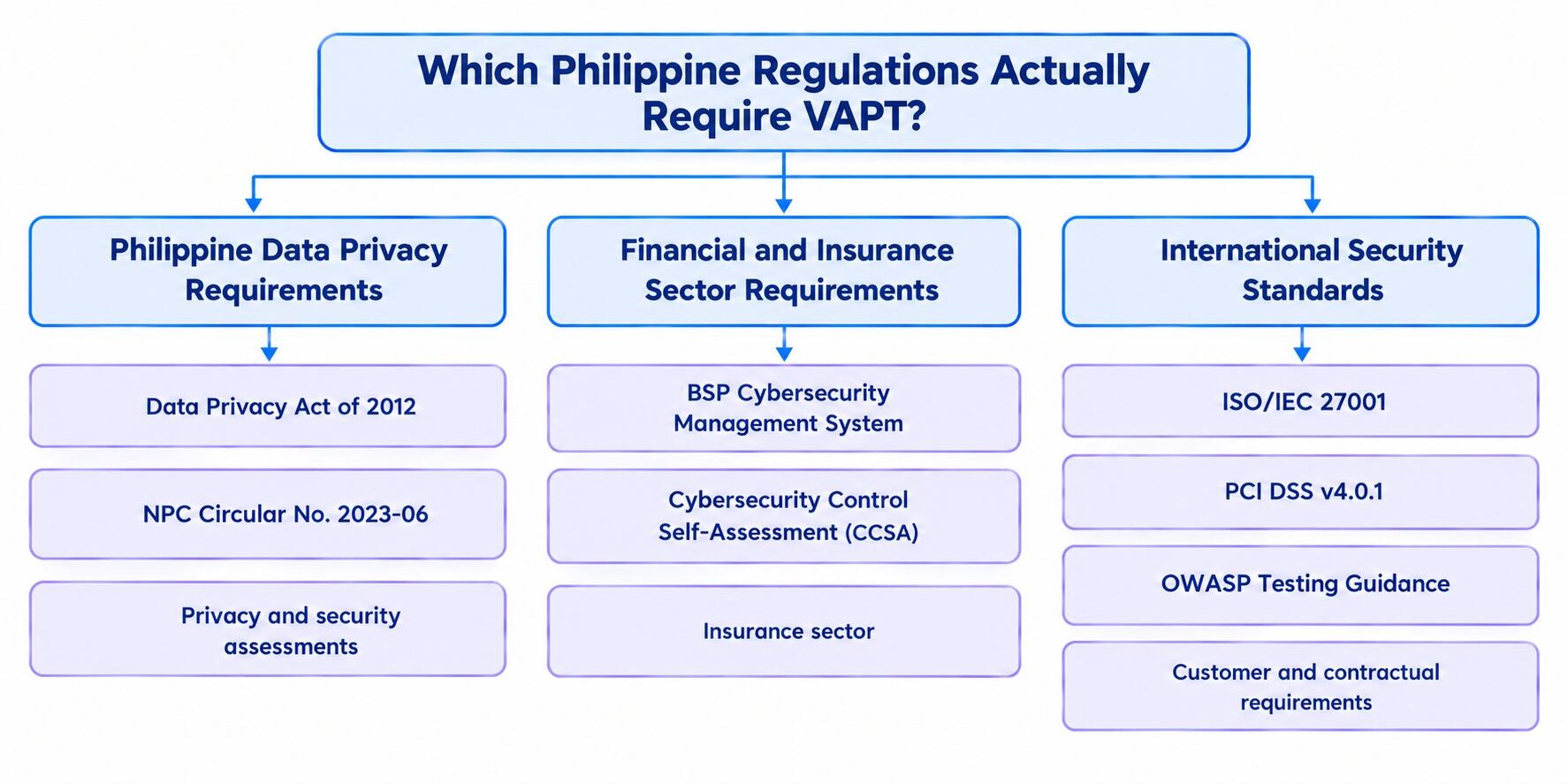
Philippine Data Privacy Requirements
The Data Privacy Act of 2012 requires organizations to implement reasonable and appropriate security measures for personal information processing. VAPT can help in validating whether the technical security measures used by an organization are actually effective against the threats.
- Data Privacy Act of 2012: VAPT can identify vulnerabilities that allow unauthorized access to personal information.
- NPC Circular No. 2023-06: Testing can be used for evaluating controls such as authentication, access management, logging, and protection of personal data.
- Privacy and security assessments: A VAPT report should provide documented identification of weaknesses, remediation priorities, and security improvements.
Financial and Insurance Sector Requirements
All financial institutions supervised by the Bangko Sentral ng Pilipinas (BSP) are required to implement cybersecurity and technology risk controls. VAPT can be a part of their security assessment and control validation process.
- BSP Cybersecurity Management System: VAPT will test the effectiveness of security controls in applications, networks, and infrastructure.
- Cybersecurity Control Self-Assessment (CCSA): VAPT findings can serve as the technical basis for assessment of cybersecurity controls and gap identification.
- Insurance sector: VAPT can help in performing security and technology risk assessments in insurers if testing is required by regulatory or internal security requirements.
International Security Standards
Philippine organisations may also need to meet international standards when handling payment data, serving global customers, or maintaining an information security management system.
- ISO/IEC 27001: VAPT will help in validating relevant information security controls and identifying weaknesses in the organization’s ISMS.
- PCI DSS v4.0.1: All organizations that possess cardholder data environments are required to conduct penetration testing annually and after any major changes.
- OWASP Testing Guidance: Technical guidance to assess web applications and APIs for common and complex security weaknesses.
- Customer and contractual requirements: Independent VAPT reports will be the evidence of security testing performed during customer, supplier, or third-party security assessments.
What Should a CREST-Accredited VAPT Report Include?
A CREST-accredited VAPT report should contain a description of testing scope, identified vulnerabilities, evidence, risk levels, and remediation actions. The report should provide enough detail for business leaders to understand the risk and technical teams to reproduce, fix, and validate each vulnerability.
Executive Summary and Risk Overview
The executive summary provides the results of the assessment in business-friendly language.
- Risk summary: Count of findings by Critical, High, Medium, and Low severity.
- Business impact: Possible operational, financial, regulatory, or data security impact.
- Key weaknesses: Most important vulnerabilities and attack vectors found.
Technical Findings and Evidence
Technical findings give technical teams the evidence that will help them to understand and reproduce each vulnerability.
- Vulnerability details: Description, affected asset, and CVSS severity.
- Proof of impact: Screenshot, requests, responses, or proof-of-concept evidence.
- Root cause: Explanation of how and why the vulnerability was found.
Remediation Recommendations and Retesting
The report should also explain how to remediate identified vulnerabilities and validate the remediation.
- Remediation guidance: Specific fix for code, configuration, or architecture.
- Prioritization: Recommended actions based on risk and business impact.
- Retesting: Validation of vulnerabilities that were reported.
How Can You Select a CREST-Accredited VAPT Service Provider in the Philippines?
Selecting the right partner requires careful verification to avoid common marketing ambiguities. You should utilize the following checklist:
- Verify organizational accreditation: Check the official CREST register to make sure that the company has valid and active company-level accreditation.
- Check tester certifications: Make sure that assigned testers have active individual certifications.
- Evaluating government compliance: If bidding for public sector contracts or Government-Owned and Controlled Corporations (GOCCs), confirm whether the provider holds local DICT Trusted Assessment Providers (DTAP) accreditation.
- Requesting sample deliverables: Ask the provider to provide sample anonymized reports to evaluate technical depth, remediation clarity, and quality of executive summary.
- Examination of operational policies: Make sure that the provider maintains professional indemnity insurance and follows secure data handling practices for sensitive client data.
How Does Qualysec Help in Fulfilling VAPT Requirements in the Philippines?
Qualysec is a CREST-accredited cyber security company specialized in human-led comprehensive offensive security and VAPT assessments. Qualysec’s testing methodology is designed to help enterprises navigate complex threat environments. Instead of using automated outputs only, their engagements are focused on the simulation of multi-vector attacks on modern digital architectures.
As a specialized CREST penetration testing company, they offer:
- Structured compliance mapping: We align assessment deliverables to regional regulatory requirements. This includes National Privacy Commission (NPC) circulars and Bangko Sentral ng Pilipinas (BSP) IT risk management guidelines, providing audit-ready artifacts.
- Multi-environment coverage: Assessments include web applications, mobile binaries, complex API endpoints, cloud configurations (AWS, Azure, GCP), and internal/external network perimeters.
- Controlled adversary simulation: Using black-box, gray-box, and white-box testing methodologies, our testers systematically chain low-risk flaws to complex attack vectors to evaluate actual business exposure.
- Actionable remediation support: Deliverables include CVSS-scored vulnerability classification, root cause breakdown, proof-of-concept evidence, and practical remediation guidelines for developers.
- Verification and retesting: Structured retesting protocol ensures that security gaps are properly patched and verified before reporting sign-off.
Conclusion
CREST VAPT Services in the Philippines help organisations move beyond basic vulnerability scanning to identify and validate exploitable security weaknesses. By testing networks, applications, APIs, cloud environments, and other critical assets, VAPT provides actionable findings that security teams can remediate and retest. For organisations handling sensitive data or meeting regulatory and customer security requirements, working with a CREST-accredited provider can strengthen assurance, improve security visibility, and support a more proactive approach to cyber risk management.
FAQs
1. Is CREST accreditation mandatory for VAPT providers in the Philippines?
It is not normally mandatory for organizations offering VAPT in the Philippines to be CREST accredited. Choosing a CREST-accredited organization means that there has been an independent assessment of the organization. It can give you confidence that the vendor will follow the strict requirements to protect the sensitivity of your organization.
2. How often should organisations in the Philippines conduct VAPT assessments?
Organizations in the Philippines should conduct VAPT assessments at least once a year. The requirement also depends on applicable regulations, contractual obligations, and the organisation’s risk profile.
3. Which systems and applications should be included in a VAPT assessment?
VAPT could include external and internal networks, web and mobile applications, API, cloud computing, wireless networks, and many other areas. The scope needs to depend on the technical landscape of the organisation.
4. Can VAPT help organizations meet Philippine Data Privacy Act requirements?
VAPT can help organizations validate technical security measures used to protect personal information under the Data Privacy Act of 2012. It can identify vulnerabilities that may lead to unauthorised access, data exposure, or other security weaknesses.
5. What is included in a typical VAPT report?
A VAPT report typically includes an executive risk summary, technical findings, severity ratings, evidence of exploitation, business impact, and remediation recommendations.