






As per the report of Gartner, by the end of 2026, almost 80% of enterprises will integrate large language models (LLMs) into their workflows. If you are testing your AI systems by using the same pentesting tools that you use for web-based apps, you are leaving a wide door open for loopholes. Traditional cybersecurity and software testing practices were not designed to evaluate AI-specific risks such as adversarial manipulation, prompt injection, model extraction, or data poisoning. To address this challenge, the Open Web Application Security Project (OWASP) introduced the OWASP AI Testing Guide for auditing the trustworthiness of AI. OWASP AI Testing Guide is the first open, universally recognized standard that outlines a repeatable, useful, and technology-neutral procedure for evaluating the overall dependability, security, robustness, and fairness of AI systems.
In this blog, we explore what the OWASP AI Testing Guide is, why it is becoming essential for AI security audits, and how organizations can use it to evaluate vulnerabilities across AI applications, models, infrastructure, and data pipelines.
What is the OWASP AI Testing Guide?
The Open Web Application Security Project OWASP AI Testing Guide (AITG) is a publicly available framework released by the Open Web Application Security Project (OWASP) that provides methodologies, test cases, and best practices for assessing AI systems and models. OWASP AI Testing Guide targets the “black box” risks unique to machine learning: adversarial attacks, data poisoning, and model theft
It is designed to go beyond traditional cybersecurity testing by addressing risks specific to AI, including dynamic failures, data risks, bias, and prompt injection testing.
Why is the OWASP AI Testing Guide important?
Fintech, healthcare, education, and technology. These systems handle tons of data on a daily basis, and the organizations require structured, repeatable testing methodologies that go beyond traditional software validation practices. The OWASP AI framework:
- Meets AI-related security threats: The guide integrates OWASP AI security and handles those risks that are unique to AI-based systems, such as model exploitation, adversarial manipulation, or system exploitation. It includes prompt injection testing, model extraction testing, and abuse case evaluation specific to generative AI abuse case testing environments.
- AI vulnerability assessment practices: Traditional penetration testing does not record AI-specific weaknesses. OWASP guide standardizes AI vulnerability assessment methods that assess training data integrity, inference risks and sensitive information exposure.
- Focuses on data-centric risks: AI systems are highly dependent on data. The OWASP guide provides testing strategies for data poisoning, corruption, leakage, inadvertent memorization, as well as integrity failure, which may compromise model security or performance.
- Train model behaviour: AI models may hallucinate, generate biased outputs, or behave unpredictably when exposed to adversarial or non-standard inputs. OWASP guide includes systematic behavioural testing to determine reliability, fairness and robustness.
- Supports AI risk management: The OWASP is consistent with more general AI risk management framework practices in that it presents repeatable controls that align testing activities of technical testing to governance and compliance needs.
- OWASP methodologies: The guide is built upon ideas already explored in the OWASP Web Security Testing Guide, modifying the available precepts on application security testing to AI-based systems.
- Aligns with LLM-specific testing efforts: The guide works alongside the OWASP LLM testing guide, which specifically focuses on large language model threats and misuse cases.
What does the OWASP AI Testing Guide cover?
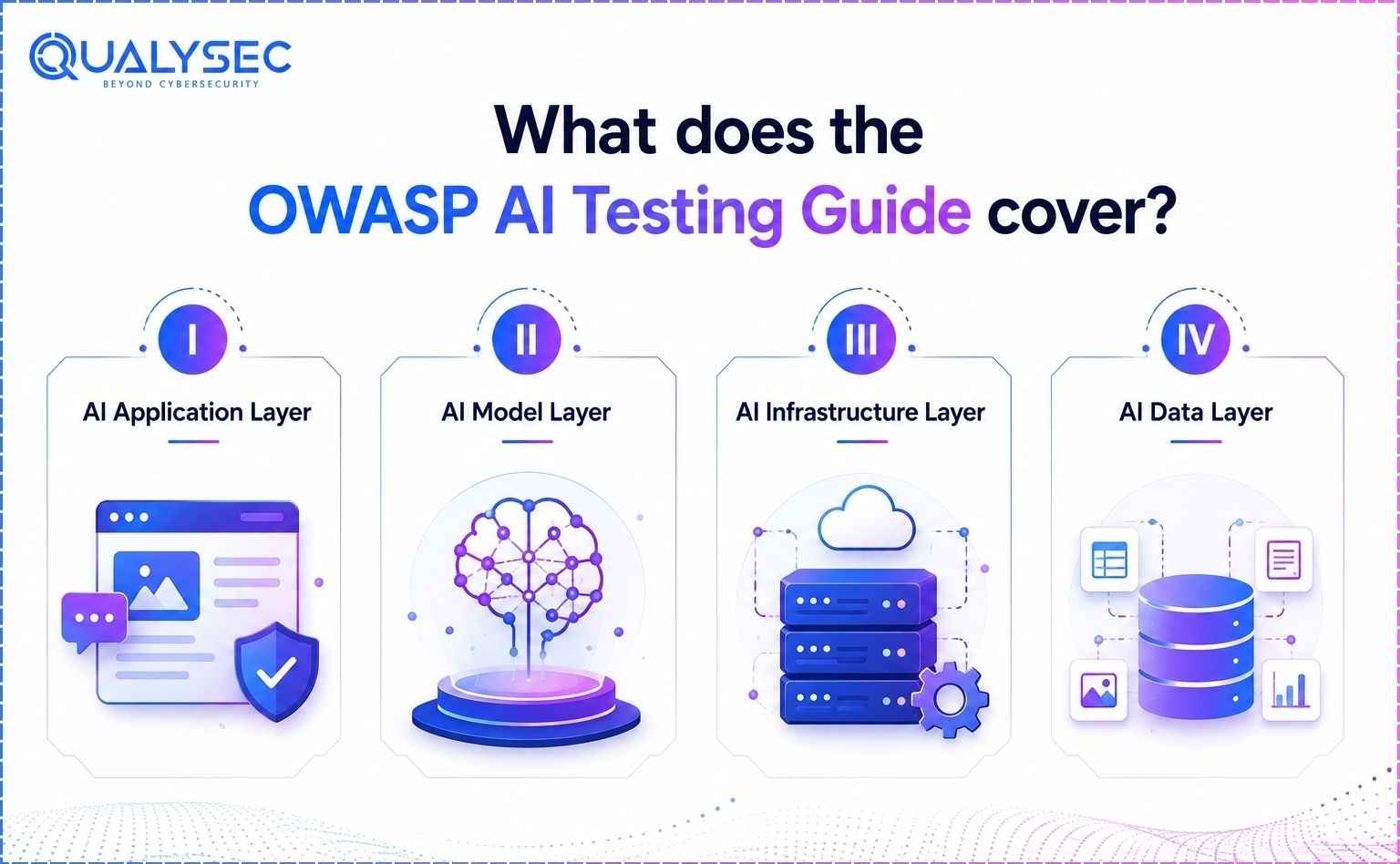
OWASP AI Testing Guide (AITG) covers the entire AI development lifecycle, starting from data ingestion to deployment. It has a critical layer, and each layer has specific test cases designed to uncover vulnerabilities and trust issues that wouldn’t normally be revealed through conventional security tests:
I. AI Application Layer
This layer focuses on the external interface and behaviour of AI systems. It includes testing for prompt injection (direct and indirect), output manipulation, insecure output handling, and agentic AI (e.g., goal hijacking, tool/plugin misuse. It evaluates how the system handles malicious inputs, misuse cases, and interaction patterns that could trigger incorrect or unsafe outputs. These tests help validate whether OWASP AI security principles are enforced at the user and API level.
II. AI Model Layer
Here, the focus is on the model’s core logic, including robustness, bias, privacy properties, and alignment. It evaluates for adversarial robustness (evasion attacks), model extraction (intellectual property theft), inversion attacks, and hallucinations. Note that the tests in this category operate directly on model behaviour to assess how outputs change under stress conditions and adversarial examples.
III. AI Infrastructure Layer
It evaluates the environment in which the AI operates, including the data pipeline, computing infrastructure, third-party services, container security, model-drift monitoring, and cloud dependencies.
IV. AI Data Layer
AI systems are only as trustworthy as the data they were trained on. It validates data integrity, identifies poisoning attacks, and checks for infrastructure issues that can compromise the entire system and lead to the leakage of sensitive information.
Secure Your AI Pipelines Before the Next Retrain. Schedule Your AI Security Vulnerability Assessment Now.
How is the OWASP AI Testing Guide used in AI audits?
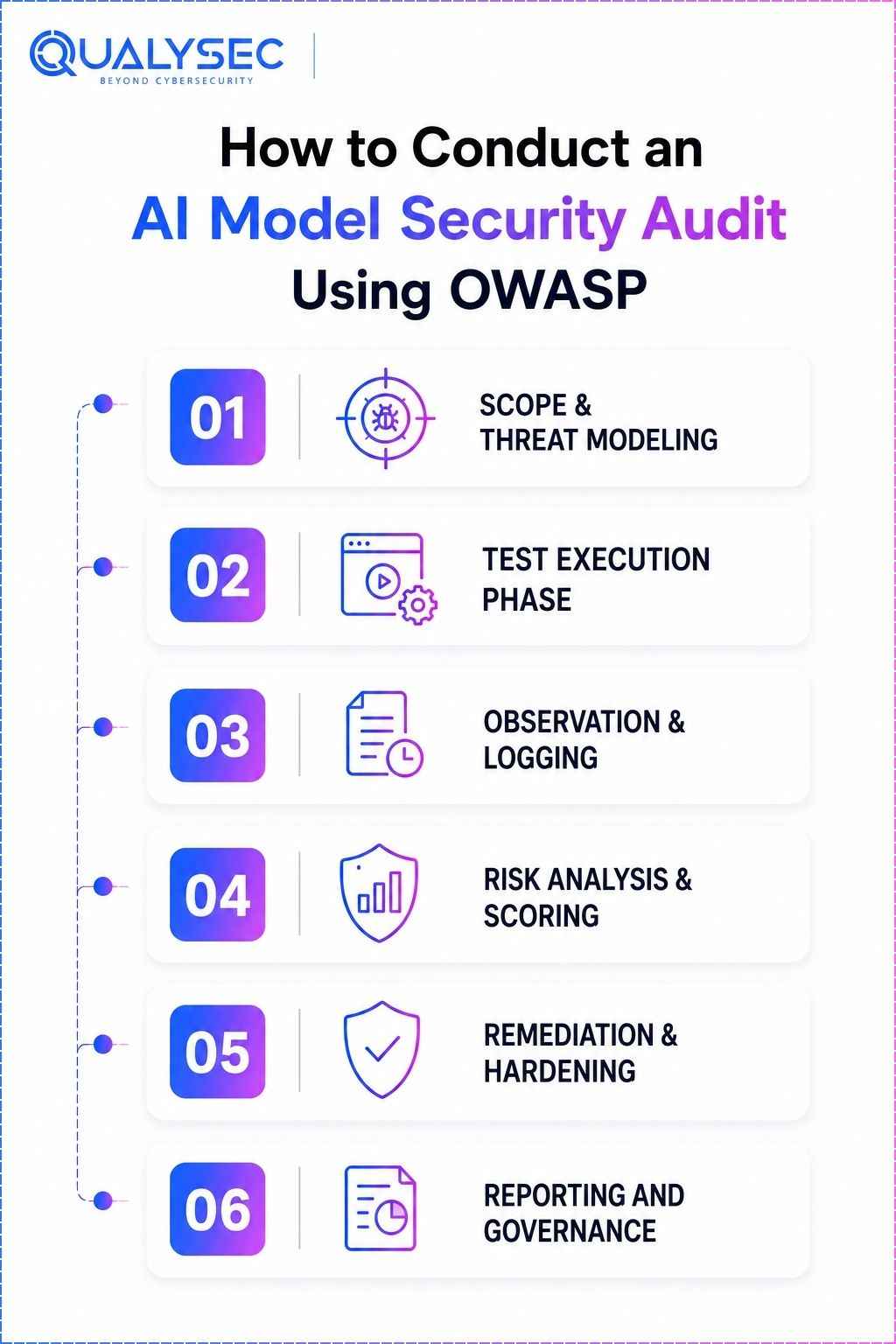
An AI model security audit using the OWASP guide follows a structured process:
1. Scope definition
The auditors outline the boundaries, components, data flows, and risk profile of the AI system. They decide on the relevance of which layers, interfaces and test cases will be used depending upon the system architecture, deployment and documented threat model.
2. Test Running
The auditors will run the specified defined test suites over the model and associated infrastructure. Such tests can contain adversarial inputs to determine vulnerability to timely injection, robustness testing to determine resilience to malformed or adversarial inputs, bias and fairness testing based on controlled data variance and black-box and white-box testing based on access privileges to the system.
3. Observation and Logging
Auditors do this by taking note of model outputs, anomalous behaviours, patterns of error, policy violations and deviations of expected performance during testing. In current AI audits, automated testing tools, logging pipelines, and custom scripts are often used to provide wider coverage.
4. Risk analysis and scoring
The audit results are summarized and contrasted with the preset risks. They use structured scoring systems or combine with systems such as OWASP AI Maturity Assessment to measure the impact and urgency.
5. Remediation Planning
Based on the mitigation recommendations provided in the guide, auditors offer remedies like retraining of models using curated datasets, enhancing control over input validation and output filtering, refining system prompts and guardrails, revising governance policies or hardening infrastructure and access controls.
6. Reporting and Governance
A final report summarises the scope, methodology, findings, risk rating, and recommended remediation to the internal governance review and compliance validation.
Who should follow the OWASP AI Testing Guide?
The guide is important for all professionals involved in AI systems, including, but not limited to:
- AI/ML Engineers responsible for model development and deployment.
- Cybersecurity teams are validating resilience against AI-specific attacks.
- Risk and compliance officers ensure adherence to internal and external governance.
- Security auditors conducting third-party assessments or internal reviews
- DevOps and DevSecOps practitioners are integrating AI controls in the CI/CD pipeline
- Product managers and decision makers evaluating AI risk before launch
How often should AI models be tested using OWASP guidelines?
AI systems are dynamic by nature. Models change over time due to adaptations like retraining, data updates, and shifts in usage patterns. As such, testing should not be a one-time event.
- AI models should be tested continuously through automated validation to detect drift, staleness, and new vulnerabilities over time.
- Conduct full AI security testing before deployment to catch security and trustworthiness risks early.
- Integrate continuous validation in CI/CD and MLOps pipelines so models are regularly tested as they evolve.
- Re-run relevant test suites whenever the model is retrained, or its data, architecture, or features change.
- Regular periodic audits (e.g., scheduled cycles aligned with governance policies) help ensure ongoing compliance and risk management.
- Automated tests should run frequently enough to detect behavioural changes or adversarial issues before they affect production.
How does the OWASP AI Testing Guide relate to ISO/IEC 42001?
The relationship between the OWASP AI Testing Guide (AITG) and ISO/IEC 42001 is best understood as the difference between a technical toolkit and a management blueprint.
1. Governance vs. Execution
- ISO/IEC 42001 – The “What”: This is a process and policy standard. It informs an organization on how to install an AI management system, risk management, and accountability. It poses the following question: Do you have a process to secure AI?
- OWASP AITG – The “How”: It is a technical validation standard. It gives the details of the test cases (e.g., how to give a timely injection or monitor model inversion). It is responding to the question: “Here is the way you know whether that process is working..
The ISO/IEC 42001 provides the management processes and organizational structure necessary to regulate the AI systems responsibly throughout their lifecycle, policies, roles, risk management processes, monitoring, and ongoing improvements. Nevertheless, it does not dictate specific technical measures to be used in proving the security or any feasibility of AI models. The OWASP AI Testing Guide supplements the standard in this regard. It comprises organized test cases of vulnerability identification, e.g., timely injection, adversarial manipulation, data poisoning, model extraction, prejudice, and sensitive data leaks.
2. Integration of Risk Management
The ISO 42001 asks companies to perform AI-specific risk assessment. The OWASP AITG is directly correlated to these requirements, in that the technical vulnerabilities (such as those available in the OWASP Top 10 to LLMs) that may undermine the goals established by the ISO standard are identified.
The ISO/IEC 42001 standard demands that organizations to conduct AI risk assessment, monitoring and performance evaluation on the lifecycle of AI systems. The testing processes outlined in the OWASP guide offer considerable mechanisms of conducting these tests through the testing of model behavioural and security by provoking real-world attacks. OWASP guide supports various lifecycle phases that ISO/IEC 42001 highlights, such as development, validation, deployment, and post-deployment monitoring.
What is the outcome of applying the OWASP AI Testing Guide?
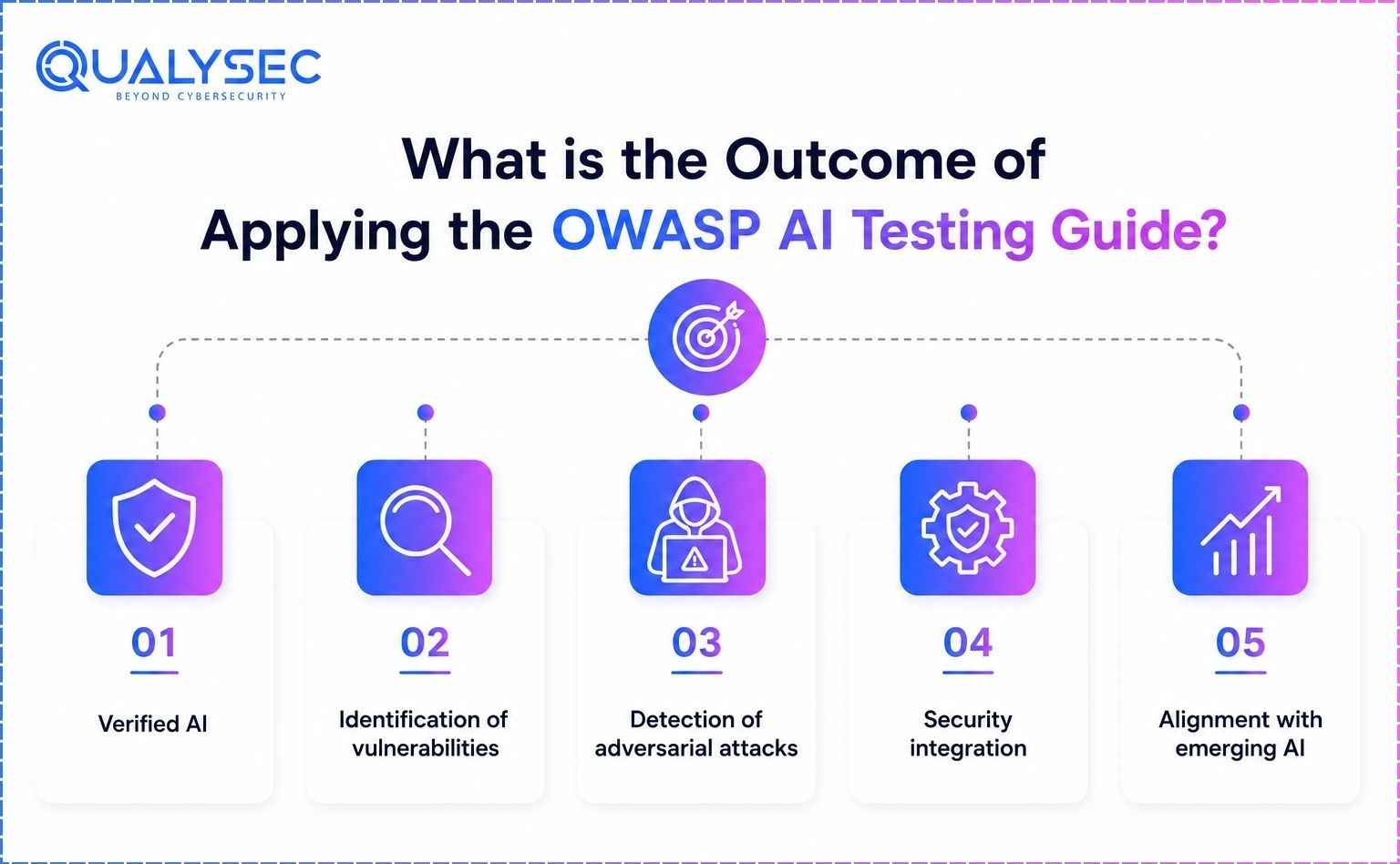
The OWASP AI Testing Guide shows:
1. Verified AI: This is the most important outcome that shows the trustworthiness of AI systems. The guide provides a standardized methodology for testing AI systems that helps organizations to verify:
- secure against attacks
- reliable in decision-making
- aligned with intended policies
- safe for real-world deployment
2. Identification of vulnerabilities: Applying the guide helps in finding the AI-specific vulnerabilities that traditional and manual software testing may miss.
3. Detection of adversarial attacks: Applying the OWASP AI Testing Guide helps in detecting adversarial attacks and manipulation through prompt injection, jailbreak attacks, adversarial examples, and model evasion attacks.
4. Security integration: The OWASP AI Testing Guide helps organizations integrate testing throughout the entire AI lifecycle, not just after deployment. It promotes security model design, continuous testing during training and deployment, and monitoring for model drift and degradation.
5. Alignment with emerging AI: The OWASP guide aligns with global standards and frameworks such as AI risk taxonomies and governance models. It helps organizations to follow responsible AI practices, which help in making documented risk management processes and improved compliance readiness.
How can Qualysec help?
Implementing the OWASP AI Testing Guide requires technical expertise, testing methodologies, and continuous security monitoring across the AI lifecycle. Qualysec, a cybersecurity testing and consulting company, helps organizations operationalize AI security through advanced testing services aligned with the OWASP framework and modern risk management practices. It provides:
- AI security testing and vulnerability discovery: Finds risks by assessing AI vulnerabilities in models, data pipelines, and applications by detecting threats such as adversarial manipulation, data poisoning, and model exploitation according to OWASP AI security practices.
- Prompt injection and LLM security testing: Incorporates both Prompt injection testing and adversarial input testing of the generative AI system, and relies on the OWASP LLM testing guide methodology to detect jailbreaks, misuse cases, and unsafe model outputs.
- AI penetration testing: Applicable strategies are based on the OWASP AI framework and the OWASP Web Security Testing Guide to test AI applications, API, and infrastructure to identify traditional vulnerabilities, as well as AI-related security threats.
- AI security maturity and risk assessment: Measures AI security posture based on OWASP AI Maturity Assessment and finds gaps in governance, testing processes, and technical controls.
- AI risk management and compliance support: Help in the implementation of controls that are in line with AI risk management framework to enhance governance, monitoring and compliance of emerging AI security standards.
- Continuous security testing of AI systems: Employs continuous testing of AI systems to identify vulnerabilities, model drift, and adversarial risks as AI systems progress, and is consistent with OWASP AI security testing practices.
Don’t wait for a data breach or a model hallucination to compromise your enterprise. Partner with Qualysec today for comprehensive OWASP AI Testing Guide compliance.
Conclusion
The OWASP AI Testing Guide is a turning point in the manner in which organizations audit, secure and validate AI systems. As generative AI and autonomous models emerge, new data pipelines and sophisticated data pipelines cannot be tested using traditional security tests. The guide is a step-by-step, systematic, repeatable, and expansive approach to evaluating AI reliability, ranging from immediate injection testing through information integrity, infrastructure stamina, and prejudice discovery. The introduction of the AI Testing Guide is a starting point to responsible and safe AI implementation for any organization that implements AI on a large scale.
Need to secure your LLMs? Don’t rely on web pentesting tools for AI risks. Talk to a Qualysec AI Security Specialist Today.

Frequently Asked Questions (FAQs)?
1. What is the OWASP AI Testing Guide?
The OWASP AI Testing Guide is a security framework that helps organizations test the security of their AI systems and verify that they are reliable and resistant to attacks. It offers the means of detecting weaknesses in the AI models, data, and infrastructure.
2. Why is AI security testing important?
The AI systems can handle a lot of sensitive data and are susceptible to attacks like prompt injection or adversarial inputs. Adequate AI vulnerability testing aids in the identification of such risks in advance and avoids unsafe or biased AI conduct.
3. What kinds of risks can the OWASP AI Testing Guide detect?
The guide helps in detecting risks like prompt injection attacks, data poisoning, model extraction, adversarial manipulation, biased outputs, and sensitive data leakage. Such weaknesses may affect the reliability and security of AI systems.
4. How is AI security testing different from traditional penetration testing?
Traditional penetration testing includes applications, networks, and vulnerabilities within the code. AI testing identifies other risks associated with model behaviour, integrity of training data, adversarial inputs, and AI decision-making, which standard security tests do not represent.
5. Who should use the OWASP AI Testing Guide?
AI software developers, cybersecurity professionals, security auditors, DevSecOps teams, and compliance officers who need to evaluate the safety, security, and reliability of the AI systems prior to deployment.