






NIST SP 800-53 provides a list of administrative, technical and physical controls to help organisations manage risks to their systems, data and processes,
NIST SP 800-53 Rev 4 was withdrawn by NIST on 23rd September 2021 and replaced with NIST SP 800-53 Rev 5. Since its publication in 2020, Rev 5 has had a number of point releases, with the most recent being Release 5.2.0 in August 2025.
While Rev 4 was primarily developed for federal information systems and organisations, non-federal organisations could also voluntarily implement its controls. Rev 5 builds on this by making the framework more adaptable to different organisational needs and technology environments.
In this blog, we will compare NIST SP 800 53 Rev 4 vs Rev 5, look at the major changes to control families, baselines and prioritisation, and explain what organisations need to consider when moving to Rev 5.
Key Takeaways:
- Applicable to a Wider Range of Organisations: The title has removed the word ‘Federal’, and the controls use more flexible language to support different technology environments, including cloud, SaaS, IoT, and OT.
- 20 Control Families: The privacy controls have been moved from Appendix J. Additionally, 2 new families have been added – PT (PII Processing and Transparency) and SR (Supply Chain Risk Management).
- 3 Publications: The baseline control selection has been moved into NIST SP 800-53B. Assessment procedures are covered in NIST SP 800-53A.
- Risk-Driven Approach: P1-P3 Priority Codes have been removed. Control prioritisation is now driven by organisational risk.
NIST SP 800-53 Rev 4 vs Rev 5: Side-by-Side Comparison
Let’s begin by taking a look at the summary of key differences between NIST SP 800-53 Rev 4 and NIST SP 800-53 Rev 5 within the NIST SP 800-53 framework.
| Comparison Point | NIST SP 800-53 Rev 4 | NIST SP 800-53 Rev 5 |
| Target Audience/Scope | Primarily focused on federal information systems. Non-federal organisations could voluntarily implement the controls. | Designed for federal and non-federal organisations across different sectors and technology environments. |
| Status | Published April 2013. Updated January 2015. Withdrawn 23rd September 2021. | Published September 2020 (Updated December 2020). Continuously updated with point releases. Most recent point release – 5.2.0 (August 2025). |
| Number of Control Families | 17 control families in the main catalogue, with Program Management (PM) in Appendix G and privacy controls in Appendix J. | 20 integrated security and privacy control families. |
| Structure | Privacy controls in Appendix J. Baseline selections in Appendix D. | Integration of the Program Management family (previously in Appendix G), 2 new control families (PT & SR), and integration of privacy controls into the main catalogue. |
| Control Language | Many controls begin with ‘The organization’ or ‘The Information System’. | Outcome-focused language, with less reference to specific systems or organisations. |
| Baseline Controls | Within Appendix D. | Within a dedicated document (NIST SP 800-53B). |
| Priority Codes | P1/P2/P3 priority tags to give an indication of implementation order. | Fixed priority codes have been removed. Prioritisation based on risk. |
| Control Numbers | Baseline controls and enhancements. | Existing control numbers have been retained where controls were carried forward. |
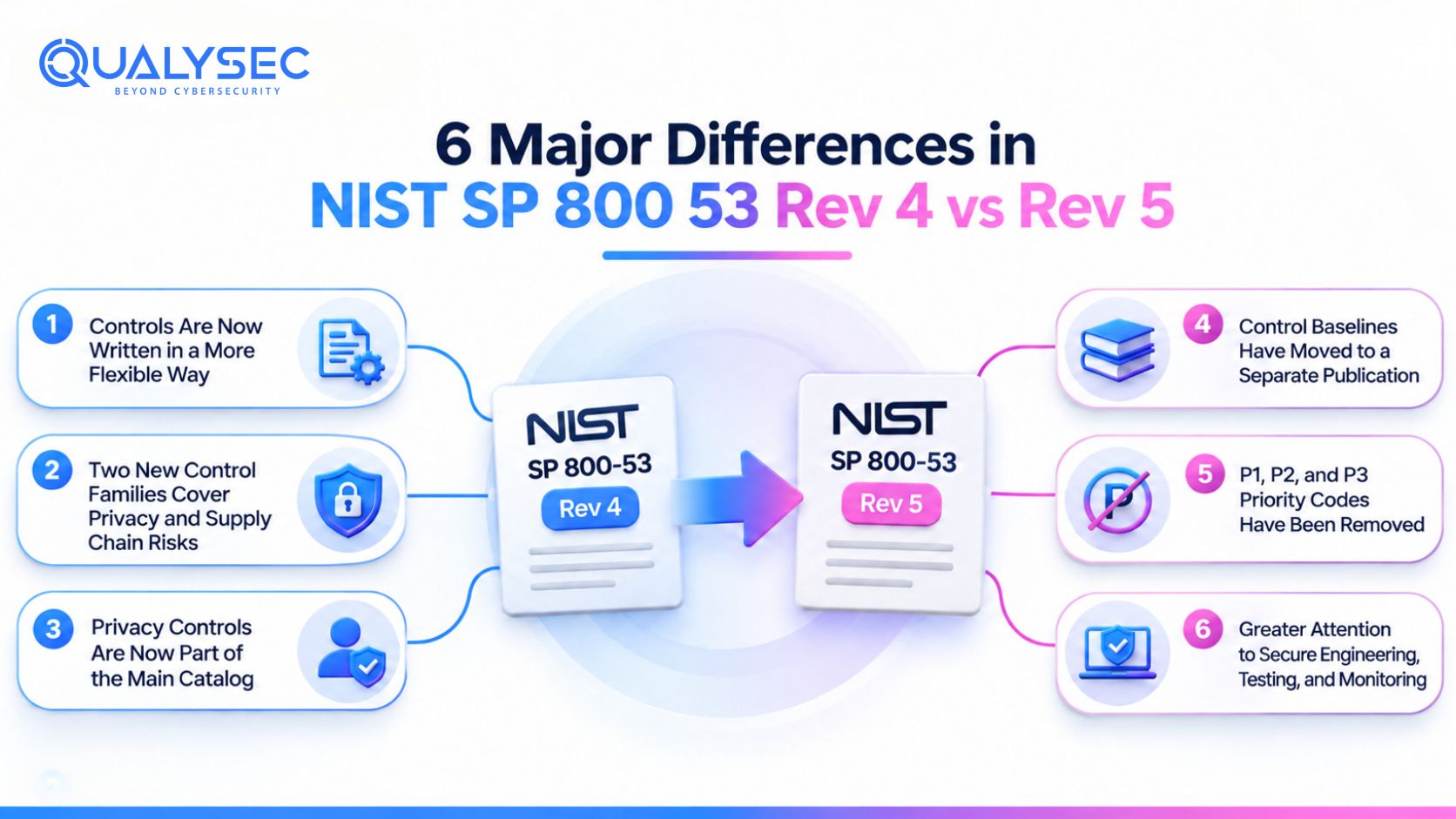
6 Major Differences in NIST SP 800 53 Rev 4 vs Rev 5
Understanding these changes can help your teams avoid common issues when implementing Rev 5.
1. Controls Are Now Written in a More Flexible Way
Many controls in Rev 4 start with ‘The organization’ or ‘The Information System’. This was suitable for traditional on-premises environments, but difficult to apply to cloud services, SaaS applications and Industrial Control Systems. In Rev 5, the control language is less tied to specific systems or organisations, with a greater focus on the outcome required.
Why this matters: Controls can more easily be applied to cloud infrastructure, APIs, IoT systems and hybrid environments. Teams still need to define how each control applies to their environment, but the language is less tied to traditional IT systems.
Common issue: As the controls are written in a more outcome-focused way, it may not always be clear how implementation responsibilities should be divided within your System Security Plan. This can lead to unnecessary issues being raised during audits. To avoid this, make sure the responsibilities for implementing controls are clearly defined in your updated SSP. For example, for Access Control (AC-3), in a cloud environment you may have: “AWS IAM provides identity and access management capabilities, while the cloud team configures roles and permissions at the infrastructure layer. The internal application security team manages tenant-level RBAC policies within the production SaaS platform.”
2. Two New Control Families Cover Privacy and Supply Chain Risks
Rev 5 now has 20 control families. 2 new families have been added:
- PT – PII Processing and Transparency. 8 base controls to ensure appropriate authorisation for processing PII, limit collection of data and allow clear privacy notices.
- SR – Supply Chain Risk Management. 12 base controls and 15 enhancements. Covers risks in relation to third-party suppliers, software, hardware and service providers.
Pro Tip: The SR family builds on some requirements covered in Rev 4, including SA-12. However, new controls have been added to cover different areas within supply chains. These are SR-2 (Supply Chain Risk Management Plan), SR-4 (Provenance), SR-11 (Component Authenticity) and SR-12 (Component Disposal). If you currently perform vendor governance using an annual security questionnaire, examining the SR family will help identify where you should perform more in-depth checks.
3. Privacy Controls Are Now Part of the Main Catalog
In Rev 4, privacy controls were in a separate Appendix (Appendix J). In some organisations, this separation contributed to privacy and security teams working in silos. Both teams would often assess the same controls around access, logging and encryption. In Rev 5, privacy requirements have been integrated into the main control catalogue.
The PT control family covers PII-specific requirements, while other control families, such as Access Control (AC) and Audit and Accountability (AU), also contain privacy considerations. When scoping controls for systems handling Personal Data, privacy leads should be consulted at an early stage. Consider if the Privacy baseline (included in NIST SP 800-53B) is suitable for your environment.
4. Control Baselines Have Moved to a Separate Publication
In Rev 4, the low, moderate and high baselines were included in Appendix D. In Rev 5, all federal security and privacy control baselines (including tailoring/overlay guidance) have been moved to NIST SP 800-53B.
Having the baseline controls in a separate publication allows us to update baseline selections independently of the main 800-53 controls. It also means that private sector teams can easily use them as a reference when aligning with other standards (ISO/IEC 27001:2022 / SOC 2 / NIST CSF 2.0). Note that the controls included in SP 800-53B are specific to the Federal Government. While non-federal organisations may use them as a reference, applicability will depend on contractual, regulatory and risk requirements.
5. P1, P2, and P3 Priority Codes Have Been Removed
If you are familiar with Rev 4, you will be familiar with sorting controls within spreadsheets by P1/P2/P3 priority to determine which controls to implement first. In Rev 5, these priority tags have been removed completely.
Controls no longer have a set priority. Instead, the priority of implementation depends on the security risk, business requirement, threat assessment, and resources available. For example, a fintech SaaS provider, hospital network, and manufacturing company will have very different threats.
6. Greater Attention to Secure Engineering, Testing, and Monitoring
Several controls have been updated in Rev 5 to reflect improved Secure Engineering, vulnerability management, and assurance practices. This work has continued within point releases. To understand what changes have been made, it is useful to separate the changes made in the latest point release from the changes included in the original Rev 5.
Additions in Release 5.2.0 (August 2025)
As outlined in the NIST change summary, 3 new additions have been made in Release 5.2.0. These cover logging syntax, cyber resilience and root cause analysis. They are SA-15(13) (Development Process, Standards, and Tools | Logging Syntax), SA-24 (Design for Cyber Resilience) and SI-02(07) (Flaw Remediation | Root Cause Analysis). SA-15(13) and SI-02(07) are control enhancements, while SA-24 is a new control. There has also been a revision to SI-07(12) and some discussion text within various controls. Note that no changes have been made to federal SP 800-53B baselines in Release 5.2.0. This means that the new additions are not included in the federal baselines in NIST SP 800-53B. Organisations can consider adding them through tailoring based on their security and risk requirements.
Key Existing Controls Retained or Updated in Rev 5
- SA-8 (Security and Privacy Engineering Principles). Previously titled ‘Security Engineering Principles’, this control has been updated to include privacy requirements. The control includes both security principles (least privilege and defence in depth) and privacy considerations.
- AC-4 (Information Flow Enforcement). This control applies to controlling and monitoring information flow between APIs, microservices and network boundaries.
- RA-5 (Vulnerability Monitoring and Scanning). Previously titled ‘Vulnerability Scanning’. This control covers scanning for vulnerabilities, monitoring for new vulnerabilities and ensuring scanning meets organisation-defined requirements.
- CA-8 (Penetration Testing). This control was included in Rev 4. It requires penetration testing to be carried out at organisation-defined frequencies and on organisation-defined systems/components. This remains a requirement in Rev 5 to support the testing and monitoring approach.
How to Move from NIST SP 800-53 Rev 4 to Rev 5
Whether or not you need to migrate immediately will depend on your contractual obligations, regulatory requirements, and security framework. For federal organisations, follow the relevant NIST and RMF requirements for your organisation. For private organisations, check whether customers, contractual requirements or industry-specific regulations require a certain version. Even if migration is optional, reviewing the changes in Rev 5 can help to improve security and privacy controls.
As much of the control numbering has remained consistent, there are 6 simple steps to follow to migrate:
- Compare Your Existing Controls: Use NIST’s supplemental comparison workbook to understand how your existing controls map to controls in Rev 5. Identify which controls have not changed, which have updated requirements and which have been withdrawn.
- Check Baseline Control Changes: Open NIST SP 800-53B and check if there are new enhancements/considerations to add to your Low/Moderate/High/Privacy baseline. Do not assume that your Moderate baseline from Rev 4 maps directly to the Moderate baseline in Rev 5.
- Review the New PT and SR Requirements: Review your privacy notices, PII processing, vendor due diligence and software supply chain controls to determine which PT and SR controls apply to your environment.
- Update Control Ownership and Parameters: Update implementation statements in your SSP to define clear control ownership, based on outcome-focused language. Ensure that the team clearly defines all Organization-Defined Parameters (ODPs) (scan frequency, log retention period, session timeout, etc.)
- Test Security Controls: Perform technical testing, vulnerability scanning and penetration testing, where appropriate, across your in-scope environment to identify any misconfigurations or exploitable weaknesses in advance of an external audit.
- Update Security Documentation: Update your SSPs, POA&Ms and evidence. Also review NIST SP 800-53A to ensure internal testing processes align with the assessment procedures for Rev 5.
Validate Your NIST 800-53 Rev 5 Controls with Qualysec
While updating policy documents and System Security Plans is important during a Rev 5 transition, there are many different controls to implement across 20 families, including management controls, people controls, physical controls and privacy controls. Within technical controls, penetration testing can be used to meet requirements such as CA-8. Penetration testing can be a useful way to validate technical controls, in addition to vulnerability scanning (RA-5) and security and privacy engineering practices (SA-8).
For organisations comparing NIST 800 53 Rev 4 vs Rev 5, Qualysec can help security and compliance teams validate technical controls. They use a hybrid method of automated vulnerability scanning and manual penetration testing in Web, Mobile, API, Cloud and AI/LLM environments. This allows us to identify potential vulnerabilities in your systems that automated testing may not have picked up. They provide clear remediation actions and reports to help you meet your technical security requirements under NIST SP 800-53 Rev 5.

Conclusion
NIST SP 800-53 Rev 5 is now the active standard, replacing the withdrawn Rev 4 with a more flexible, risk-driven framework for both federal and private organizations. Key updates include two new control families for privacy (PT) and supply chain risks (SR), privacy requirements woven directly into the main catalog, and control baselines moved to a separate publication (SP 800-53B). With outcome-focused language replacing rigid system rules and fixed priority codes removed, moving to Rev 5 gives teams a more practical way to secure modern cloud environments, manage third-party risks, and validate their defenses.
Ready to validate your technical controls? Get in touch with our security team to discuss scoping a penetration test for your environment.
Frequently Asked Questions
1. Is NIST 800-53 Rev 4 still valid?
NIST SP 800-53 Rev 4 was officially withdrawn on 23rd September 2021 and has been replaced with Rev 5. Federal agencies implement controls from Rev 5 as part of their Risk Management Framework (RMF). However, FedRAMP has its own specific baselines and transition requirements for cloud service providers. Despite this, you may still find references to Rev 4 in legacy contracts. For example, security requirements in NIST SP 800-171 Rev 2 were based on selected controls from the moderate baseline of Rev 4. Therefore, you should check which standard and version is referenced in your contracts.
2. What are the new control families in NIST SP 800-53 Rev 5?
- PT (PII Processing and Transparency): Contains 8 base controls relating to privacy management and notices for personal data.
- SR (Supply Chain Risk Management): Contains 12 base controls and 15 enhancements relating to managing risks within third-party suppliers, hardware and software.
3. Did NIST SP 800-53 Rev 5 change the existing control numbers?
No. Many control and enhancement numbers have been retained to make crosswalking easier. The document identifies controls that have been withdrawn with a note indicating their status. The team has also added new controls and enhancements within the relevant control families.
4. Why did NIST move control baselines into SP 800-53B?
By moving baseline controls to SP 800-53B, control selection rules are separated from control definitions. Therefore, baseline controls can be changed independently of the main control catalogue. Additionally, private organisations can implement controls from SP 800-53 alongside other standards (such as ISO/IEC 27001 or NIST CSF 2.0) without automatically adopting the baselines defined for federal agencies.
5. Does NIST SP 800-53 Rev 5 apply to private organizations?
Yes. While not mandatory for all private organisations, a customer contract or regulation within a specific sector may require the controls. ‘Federal’ was removed from the title of Rev 5 to reflect its applicability beyond federal information systems. Private businesses (including SaaS providers, cloud service providers and critical infrastructure operators) can implement this control framework to develop their security and privacy controls. While private companies do not generally face legal requirements to conform to NIST SP 800-53 Rev 5, many use it to meet security requirements set by enterprise customers and align with other standards.