

HITRUST assessments can be challenging if the proof of adequate security measures is spread among many individuals, systems, and software. HITRUST documentation collects all this information together, including policy statements, access audits, and security vulnerability assessments.
If documentation is not complete or is gathered last minute, then you will waste time tracking down the records. It will also take time to fix gaps in your documentation. Having well-organized and updated records right from the start will help prevent any delay in assessments.
This guide explains the steps needed to create an audit-ready evidence repository. We’ll also discuss the three HITRUST assessment levels and the 10 core evidence categories. We’ll discuss how the v11 PRISMA scoring model assesses your portfolio, and a step-by-step HITRUST documentation checklist.
Key Takeaways
- Evidence is required for documented policies and implementation under HITRUST.
- ePHI needs to be mapped for collection, processing, storage, and disposal.
- RBAC, MFA, access reviews, and logs help IAM evidence.
- Penetration testing, vulnerability scanning, and retesting evidence security controls.
- Business impact assessment, RTO, RPO, and DR testing evidence preparedness.
- Continuous evidence collection ensures audit-readiness of the organization.
What Is HITRUST CSF Certification?
Achieving HITRUST certification proves that your organization maintains an elite cybersecurity and data protection program. The CSF framework was developed by the HITRUST Alliance to integrate interdependent standards. These include HIPAA, NIST SP 800-53, ISO 27001, PCI-DSS, and GDPR.
Organizations choose from three different tiers of assessment depending on their risk profile and partner needs:
- HITRUST e1 (Essential 1-year): Sticks to the basics of cybersecurity hygiene for 43 baseline security controls. It provides initial security for a start up who is in a lower-risk category.
- HITRUST i1 (Implemented 1-year): Provides moderate threat-adaptive protection for 182 static controls. It responds to fast-changing cyber threats on an annual basis.
- HITRUST r2 (Risk-based 2-year): This is the highest level of comprehensive security. It includes very specific, risk-assessed controls between 200 and more than 500 requirement statements. It can be checked over a two-year cycle.
It is essential to have all the facts about the total HITRUST certification cost before you start an engagement. Direct assessment fees, assessor rates, and internal resource allocation typically range from $35,000 for an e1 assessment to well over $100,000 for an r2 audit.
Why Does HITRUST Documentation and Evidence Matter?
Documented evidence acts as the primary factor during every HITRUST audit. The assessors cannot award passing grades in MyCSF if there is no complete, structured HITRUST compliance documentation.
A disciplined HITRUST documentation repository immediately provides three benefits:
- Assessor Defensibility: Each of your team’s scores must be accompanied by accepted technical artifacts that will meet rigorous HITRUST Alliance Quality Assurance (QA) review.
- Continuous Operation Proof: Historical audit logs are proof that your controls are effective all day.
- Operational Repeatability: Written SOP’s ensure that security operations are carried out in a repeatable manner regardless of staff changes.
What Documents Are Required for HITRUST CSF Certification?
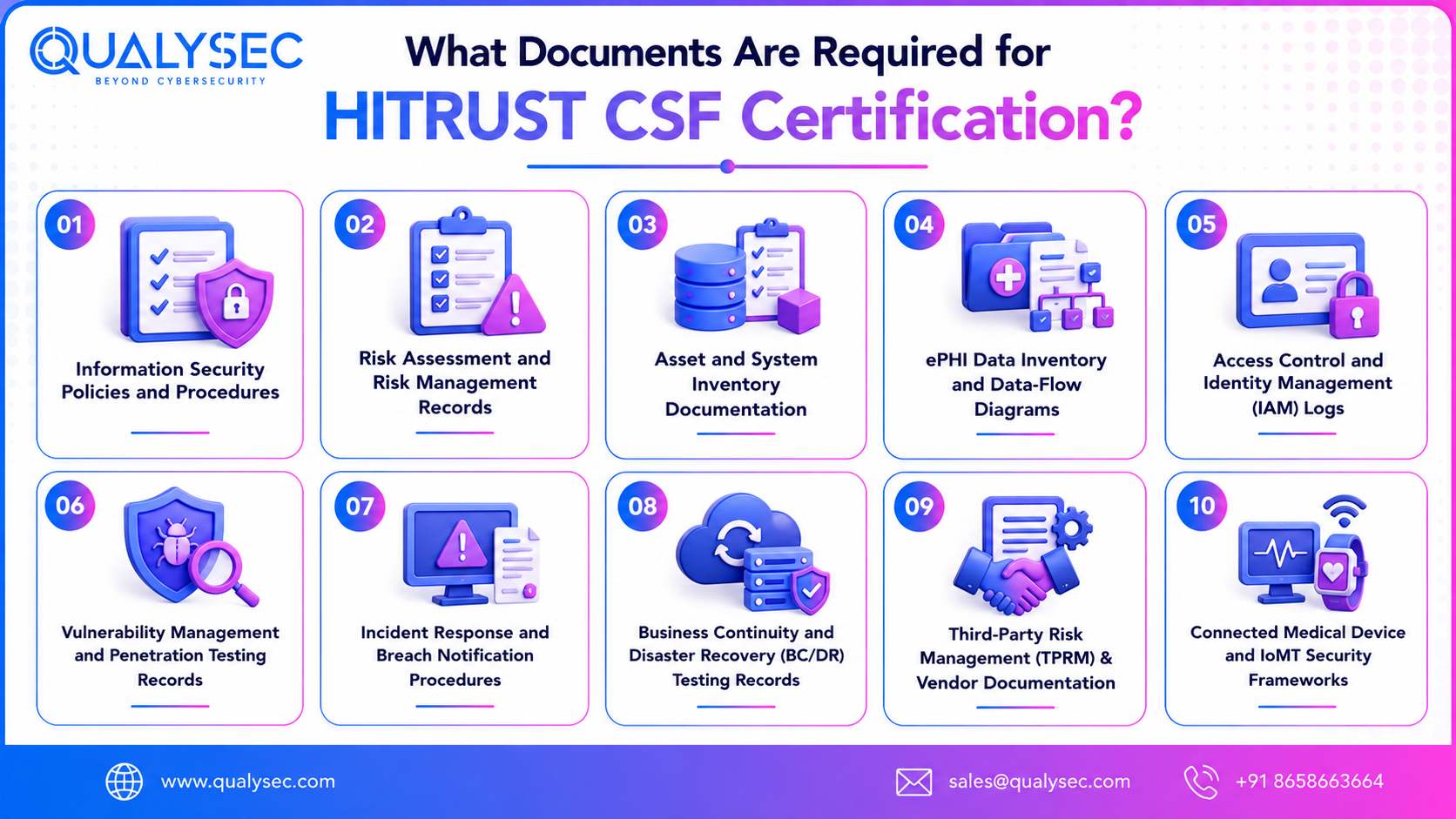
Your organization is required to have a set of organized, cross-referenced evidence in 10 different operational pillars to meet core HITRUST compliance requirements. Here is the technical breakdown of what assessors expect to see in your evidence binder.
1. Information Security Policies and Procedures
Policies establish rules that must be followed, and procedures provide step-by-step technical action. Assessors confirm both to make sure that your security rules are documented and executed. All documents should include formal executive approval, version control, and an annual review date or timestamps.
2. Risk Assessment and Risk Management Records
You need to demonstrate that risk management is a regular and ongoing cycle of activities within the business. Assessor checks for formal risk assessment reports, extensive risk registers and risk treatment plans. They also check evidence of threat tracking and steps being taken to reduce risk.
3. Asset and System Inventory Documentation
You cannot secure systems you do not track. Assessors inspect complete hardware, software, virtual machine, container, and database inventories. Owners of the asset, environment (production, staging, dev), and physical or cloud host need to be clearly named in each entry.
4. ePHI Data Inventory and Data-Flow Diagrams
Healthcare organizations must map protected health information (ePHI). Inventories, sensitivity classification matrices, and data flow diagrams are examined by assessors to trace PHI from the point of collection and processing to its eventual storage and disposal. The external APIs and cloud infrastructure listed in third-party data maps are also crucial.
5. Access Control and Identity Management (IAM) Logs
Identity controls guarantee that users have access only to those areas which are needed. Access approval documentation, RBAC matrix, and screenshots proving that multifactor authentication is in place are important parts of HITRUST documentation. Quarterly access review sign-offs and access termination logs also must be part of HITRUST audit documentation.
6. Vulnerability Management and Penetration Testing Records
Proactive security testing shows that technical measures are able to resist attacks in actual practice. Monthly internal or external vulnerability scan results have to be delivered. Annual manual penetration testing reports for web applications and cloud infrastructure, and closed remediation tickets, demonstrate that the team fixed bugs.
7. Incident Response and Breach Notification Procedures
Assessors check your preparedness to handle live security incidents. The required documentation should consist of your formal Incident Response Plan (IRP), annual tabletop drill meeting artifacts, and attendance logs. It should also contain post-drill action plans and centralized Security Operations Center (SOC) incident logs.
8. Business Continuity and Disaster Recovery (BC/DR) Testing Records
You must have to prove systems recover swiftly from outages, hardware failures, or ransomware attacks. Assessors validate Business Impact Analyses (BIA) with Recovery Time Objectives (RTO) and Recovery Point Objectives (RPO). They also check written DR playbooks, database Recovery logs, and Cloud failover validation exports.
9. Third-Party Risk Management (TPRM) & Vendor Documentation
Vendor risk management is an ongoing process. Your evidence library needs to hold signed Business Associate Agreements (BAAs) and completed vendor due diligence questionnaires. You should also have annual risk ratings and the current status of third-party partners’ SOC 2 Type II or HITRUST CSF reports.
10. Connected Medical Device and IoMT Security Frameworks
When clinical hardware works with your network, specialized documentation is required. Assessors review inventory schedules for Internet of Medical Things (IoMT), including firmware versions and locations. They also check detailed device patching procedures and architectural drawings, including network segregation from corporate subnets.
How Does HITRUST v11 Score Your Documentation?
HITRUST evaluates every control statement across five distinct PRISMA maturity attributes:
| Maturity Level | Weight | Description |
| Policy | 15% | Approved, written security rules and corporate standards. |
| Procedure | 20% | Operational step-by-step guides defining execution steps. |
| Implemented | 40% | The heaviest weight. Direct technical proof in production. |
| Measured | 10% | Automated testing, KPIs, and metric tracking outputs. |
| Managed | 15% | Corrective action tracking and management oversight. |
How Should Organizations Prepare and Organize Their HITRUST Evidence?
Putting together your HITRUST documentation needs to follow a disciplined process well before any on-site assessment begins.
First of all, you have to follow the incubation guidelines:
- The 60-Day Policy Rule: Written policies and procedures need to be approved and active for at least 60 days before any auditing occurs.
- The 90-Day Implementation Rule: Any technical evidence such as logs, scans, and access reviews needs to show 90 consecutive days of implementation.
Organize your technical evidence in a single location, which restricts access to HITRUST domains. Name your files using a standardized naming convention that includes timestamps.
What Should HITRUST Documentation & Evidence Checklist Include?
HITRUST documentation checklist needs to include both policy and proof of implementation of such policies. This is a list of some of the documents and technical evidence that are needed in preparation for a HITRUST assessment.
Phase 1: Written Policies & Procedures
These documents prove you have established a formal governance framework that meets the rules before an audit begins. Without them, auditors cannot verify that the organization’s security policies are formally approved and established.
- Information Security Master Policy: Lays down the overall security framework, executive accountability, roles & responsibilities, and the organizational scope.
- Access Control & Identity Management Policy: Ensures least-privilege policy, stringent password criteria, mandatory use of MFA, and the timeframe for account deprovisioning.
- Data Classification & Management Policy: Classifies sensitivity of ePHI data, mandatory encryption requirements at rest and in transit, and media destruction procedures.
- Vulnerability & Patch Management Policy: States the frequency of vulnerability scans, the criticality of vulnerabilities, and mandatory patching timeframes under SLAs.
- Incident Response Plan (IRP): Details the triage process, levels of severity, containment strategy, breach reporting regulations, and communications procedures.
- Third-Party Vendor Management Policy: Requires security assessments before contract, execution of BAAs and continuous third-party risk management.
- Business Continuity and Disaster Recovery (BC/DR) Plan: Details operational recovery processes, emergency response teams, and failover procedures.
Phase 2: Technical Implementation Evidence
This evidence proves that your team is actively following the written policies and applying the security controls when required. Maintaining continuous logs, scan reports, and other technical records helps during the HITRUST assessment.
- Formal Penetration Test Reports: The yearly deliverables from offensive security testing on the web application, mobile application, our healthcare API, and cloud perimeter.
- Remediation and Patch Verification Documentation: The team closed the tickets and re-tested the documentation, confirming that the vulnerabilities have been mitigated and patched according to SLA requirements.
- Network and Data Flow Diagrams: Diagram showing our network boundary, placement of firewalls, subnets, and flow of protected health information (ePHI) through our environment.
- System-Generated Access Log Exports: Identity provider (IdP) audit logs, Active Directory audit logs, Cloud console audit logs, and database server access logs.
- Active Configuration Screen Captures: Screen capture demonstrating current configuration of the active security policies, endpoint detection and response (EDR). Also provides multi-factor authentication for cloud portal accounts.
- Vulnerability Scans Data: Monthly reports of internal and external vulnerability scans conducted over 90 days.
- Employee Training Record: Learning management system (LMS) exports confirming completion of security awareness and HIPAA training modules by employees at hire and annually.
- BC/DR Tabletop Exercise Documentation: Minutes of our annual tabletop exercises, attendance log, debrief of scenarios, and remediation items.
How Qualysec Helps in HITRUST Evidence Collection
Qualysec helps organizations create technical documentation for their HITRUST compliance. The documentation includes assessment results, remediation documentation, and retest results. These can be maintained as part of the organization’s HITRUST evidence repository.
- Human-Led AI-Powered Penetration Testing: We perform a comprehensive assessment of web applications, health care APIs, mobile applications, and cloud infrastructure.
- Compliance with HITRUST: The outcome of tests can be mapped to HITRUST controls. It helps auditors align the security test process with the necessary controls.
- Remediation evidence: Once the vulnerabilities have been remediated, we retest the systems. Record that the vulnerabilities have been successfully remediated to provide evidence of remediation.
- Re-testing documentation: Our validation report and re-tests provide evidence of the initial finding, action taken to address the issue, and re-test result.
Qualysec ensures your system’s safety through professional penetration testing and proper verification.
Conclusion
The process of attaining compliance need not be difficult, but one must adopt a systematic and proactive process for collecting evidence. The success of your audit depends on the process of collecting comprehensive HITRUST documentation before any auditor reviews your system.
This requires strict adherence to the policy of keeping the 60-day rule and having 90 days’ worth of continuous technical evidence. It will help avoid any kind of last-minute panic during the audit process, as well as any engineering bottlenecks.

Frequently Asked Questions
1. What is a HITRUST certificate?
HITRUST Certification represents an official recognition that shows that the company complies with the highest standards of information protection for the health sector. It integrates several security standards such as HIPAA, NIST, and ISO 27001 into one certification.
2. How do you prepare for a HITRUST audit?
Be prepared by grouping all the security documentation into one central repository that is mapped directly to HITRUST. Ensure that your documented policies are up-to-date and are live for at least 60 days, along with 90 days’ worth of system logs.
3. What documentation is required for HITRUST certification?
Required documentation includes the organization’s security policies in written form, asset inventory, ePHI data flow diagram, and risk assessments. You will need to prove your technical compliance by providing access reviews, vulnerability scan results, vendor agreements, and disaster recovery testing.
4. Does HITRUST require penetration testing documentation?
Yes, HITRUST requires penetration test reports on a manual basis for web applications, cloud-based systems, and APIs. Moreover, you will be required to present closed ticketing and re-testing certifications for all security weaknesses identified during the penetration test.
5. How often should HITRUST documentation be updated?
Formal review and approval of written policies, standard operating procedures, and the risk register need to take place annually. Technical logs, such as vulnerability assessments, access assessments, and configuration assessments, should be collected continuously or on a quarterly basis.
6. What is included in a HITRUST documentation checklist?
A documentation checklist is divided into rules and proof. Phase 1 lists all written governing policies like access control and incident response plans. Phase 2 lists live technical artifacts like audit logs, penetration test reports, and training records.