

HITRUST certification is a powerful way for healthcare organizations to provide evidence of their security controls. Before starting the certification journey, organizations also need to understand what the process will require from their budget. The costs may differ from one organization to another. Knowing the HITRUST compliance cost before certification can help choose the correct assessment that is easy and predictable.
The total cost depends on many things, such as the type of assessment, quantity of controls, organization size, security maturity, and pre-assessment work. Knowing about these aspects can help healthcare organizations avoid unnecessary costs when getting ready for certification.
In this blog, we will discuss HITRUST compliance costs in 2026, the cost of different HITRUST assessments, and other costs related to HITRUST compliance. We will aso discus about the key factors affecting the budget and effective ways of managing compliance costs.
Key Takeaways
- HITRUST costs differ depending on the type of assessment, the organization’s size, scope, and security maturity.
- e1, i1, and r2 have different costs and requirements, with r2 being the most detailed and expensive.
- Several factors determine the cost of HITRUST compliance. Such as HITRUST fee, assessor’s fee, gap analysis, penetration testing, and security vulnerabilities.
- The number of systems used, scope of work, and complexity of the company’s IT infrastructure can increase the cost of the process.
- Pre-assessment identification of security gaps will allow you to minimize additional costs.
- Existing security policy documents can reduce the cost of the preparation process.
What Is The Cost Of Different HITRUST Assessments in 2026?
Different HITRUST assessments come with different levels of testing, control requirements, and evidence, which affects the cost directly. The number of assessments and their depth determine the cost of HITRUST certification.
The higher the number of control mechanisms needed and the degree of testing, the higher the cost of assessment becomes. The size of your organization, the number of systems you have, and risk factors may also determine the final cost.
-
e1 Assessment
The e1 assessment is aimed at identifying basic cybersecurity controls and consists of 44 controls that are constant and do not change. It verifies whether the controls are implemented and operational in your organization. The e1 assessment does not demand much documentation or difficult testing.
As a result of lower testing requirements, the assessment requires fewer auditors and becomes cheaper for you. The price of an assessment normally varies between $30,000 and $55,000.
-
i1 Assessment
The i1 assessment involves testing 182 fixed controls and concentrates on cybersecurity processes already in place. It evaluates if such controls are applied uniformly throughout your organization. The i1 assessment needs more testing, data gathering, and vulnerability analysis compared to the e1 assessment.
Therefore, the i1 assessment is more comprehensive and costly than the e1 assessment.
On average, its cost is between $65,000 and $110,000.
-
r2 Assessment
The R2 assessment is the most extensive HITRUST assessment. Controls are selected based on parameters such as risk profile, volume of data, and complexity of systems. Integrations with third parties and other business aspects might impact the selection of controls as well.
The assessment covers five areas of maturity:
- Policy
- Procedure
- Implemented
- Measured
- Managed
This means that the assessment will need more evidence, testing, documentation, and auditing activities. This has a budget of approximately $100,000 to $250,000 and above, depending on organizational needs. This has 250 to 1,000+ controls and is good for organizations with more complex security requirements.
The budgets above are estimated for the first year and are not HITRUST CSF fee prices. They could cover the full costs, including the assessment fees, audit fees, HITRUST portal, technical remediations, and HITRUST security testing. It also includes the internal effort required to prepare documentation and evidence.
What Expenses Are Involved in HITRUST Certification?
The major expenses included in the cost of HITRUST Certification include HITRUST and MYCSF fees and external assessor fees. It also includes gap assessment, penetration testing, remediation, and retesting.
Note: The cost listed below is an approximate value based on the prices that have been charged by different service providers. These are not HITRUST fixed prices, and they may vary depending on the size of your organization and other factors.
HITRUST and MyCSF Portal Fees
HITRUST Alliance demands mandatory fees for using their assessment system (MyCSF) and processing the report. The fees include:
- MyCSF Access: Enterprises can get an annual subscription to MyCSF starting at approximately $15,000 to $25,000. The cost can increase depending on the size of the company. Also, you can go for MyCSF assessment access for 90 days, which costs approximately $3,000 to $6,000.
- Processing Fees: Fees that need to be paid to HITRUST for review and issuance of the report. The expected price is around $6,000 for e1, $7,000 for i1, and $8,000 to $9,000+ for r2 assessments.
External Assessor Fees
You must have to hire a HITRUST Certified External Assessor to carry out the validated assessment process. Their fees can contribute to one of the most important parts of your budget.
- e1 Assessments: Can cost approximately $20,000 – $40,000
- i1 Assessments: Can cost approximately $40,000 – $80,000
- r2 Assessments: Can cost approximately $60,000 – $150,000
The cost of an r2 assessment can also increase depending on the total control count.
Readiness and Gap Assessment
Gap assessment generally ranges between $15,000 and $60,000 based on whether you choose an external auditor, consultant, or internal team. It helps in identifying gaps in policy, control, and operations. If identified earlier, this will help save time and costs later in the process of assessment.
Technical Security Testing and Penetration Testing
HITRUST requires proper evidence of how well your technical controls work. Testing network, infrastructure, and application penetration testing is usually priced between $10,000 and $30,000. The price will depend on the extent, number of systems to be tested, and the depth of the tests.
Remediation and Retesting
In case any vulnerabilities or gaps are found during scanning and assessment processes, their repair will add to the overall HITRUST compliance cost. Updates to software and access to the cloud could lead to extra expenditures. Additional third-party testing could also result in increased costs due to unresolved findings. The total cost of remediation may vary between $10,000 and $40,000; sometimes it can also increase.
If you are in confusion about how much HITRUST certification costs, understanding the above details gives you a brief idea.
What Structural Factors Can Rapidly Increase Your HITRUST Costs?
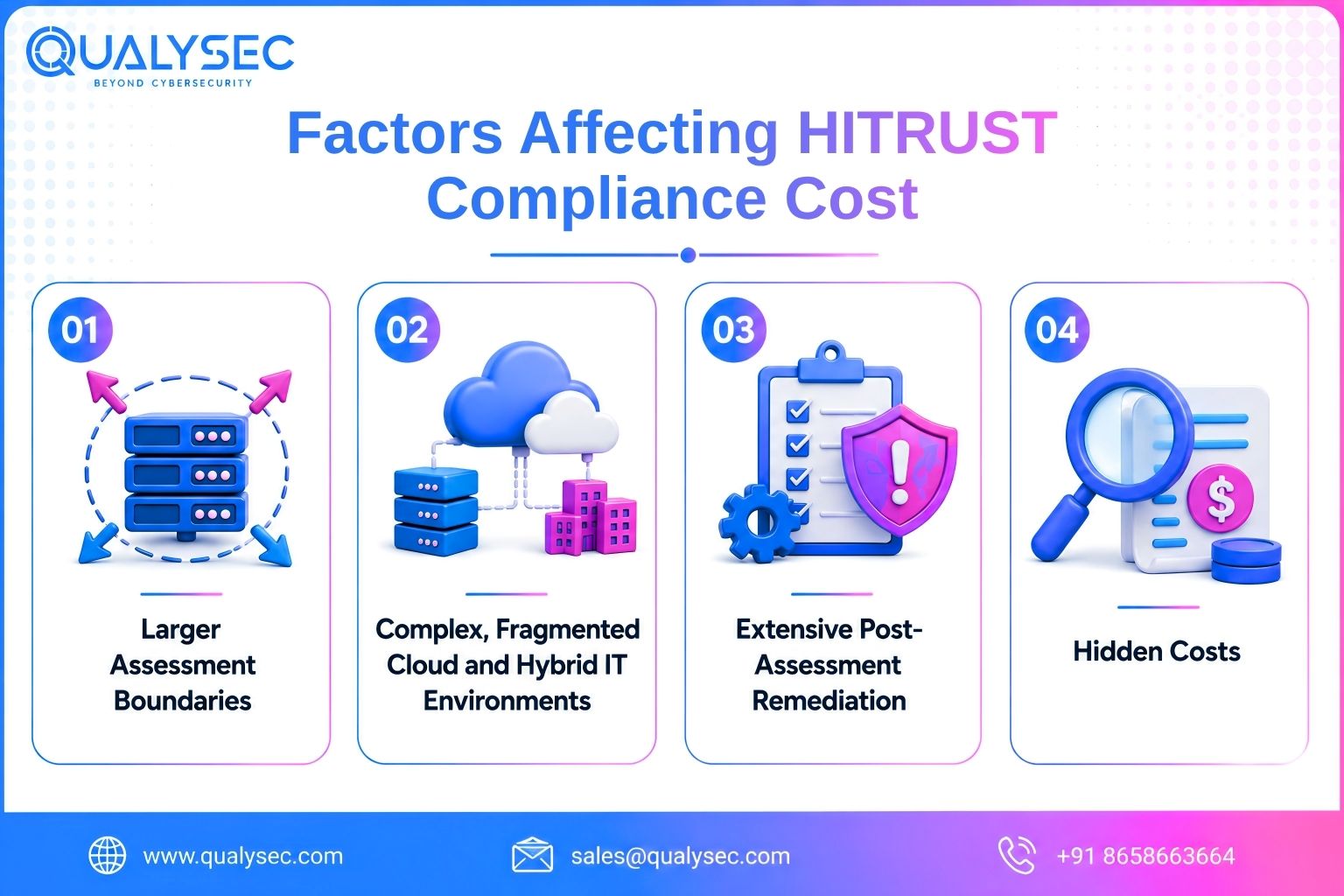
There are structural factors that may impact the overall cost of compliance with HITRUST.
There could be two firms attempting to get the same r2 certification, yet their overall assessment costs will differ. These structural factors, such as firm size, system complexity, scope, and reliance on other parties, may make the overall cost higher.
1. Larger Assessment Boundaries
When the scope of the audit is wide, more facilities, business units, databases, and people become subject to audit. More sample populations have to be reviewed, such as onboarding documents and access requests, increasing the billable hours for external auditors.
2. Complex, Fragmented Cloud and Hybrid IT Environments
Keeping data on legacy on-premises servers, AWS, Azure, and multiple SaaS platforms complicates matters. The auditor will need to check technical settings on each individual platform, which creates more testing rounds and penetration tests.
3. Extensive Post-Assessment Remediation
Discovering significant security weaknesses during the assessment process can raise your HITRUST compliance cost rapidly. In case the assessor uncovers any failed controls, your company will have to address those issues before continuing with the assessment.
There may also be additional expenses associated with re-testing of the improved controls by the assessor.
4. Hidden Costs
- Control Count Scaling: r2 evaluation might involve a greater number of controls compared to the baseline. Excessive control counts could lead to higher fees for the portal and assessor, which could be approximately $50 per additional control.
- Internal Workload: The preparation of evidence might require 250 to 600+ hours of work for the internal team. Such workload might distract employees from their regular tasks.
- Interim Review Cost: r2 evaluations require an interim review after 12 months. Such a review involves an auditor fee that is approximately 25%–35% of the original evaluation fee.

How Can You Reduce Your HITRUST Compliance Costs?
Maintaining reasonable HITRUST certification costs means proper planning prior to auditors working on an hourly basis.
I. Conducting a rigorous technical gap analysis early
Do an internal assessment 3-6 months before your audit. It’s cheaper to find out where you have holes in your policies and unsecured data storage internally than externally.
II. Reusing existing security controls and cross-mapping evidence (SOC 2, ISO 27001)
If you have already been preparing a SOC 2 Type II audit or ISO 27001 certification report, don’t do everything all over again. HITRUST facilitates evidence cross-mapping. Leveraging policies, access logs, and risk assessments saves internal preparation time. Using cloud inheritance can meet many requirements automatically.
III. Partnering with an efficient, manual-led penetration testing provider that includes free patch retesting
Penetration Testing is an integral part of the HITRUST security evaluation process of HITRUST. Automated scanning tools fail to detect business logic vulnerabilities, creating problems during audits. Engaging a penetration testing firm that provides free patch retesting after a manual-driven assessment will allow you to fix issues without extra testing fees.
What Is the Difference Between Compliance Setup Cost vs. Final Certification Cost?
i) The price of building a secure infrastructure vs. the price of paying an auditor to verify it
- Cost of Compliance Setup: The expense of creating a compliant security environment. This includes investing in endpoint detection and response (EDR) software, security information and event management (SIEM) logging, security awareness training platforms, and hiring compliance consultants.
- Final Certification Cost: The cost incurred in paying the auditor (External Assessor) and the HITRUST Alliance (for MyCSF and report fees).
ii) Ongoing annual maintenance and interim review costs to maintain active certified status
Maintaining a certification is an ongoing process; there is no one-time cost for HITRUST certification.
- Year 1 (r2): Full assessment takes around $100,000–$250,000+.
- Year 2 (r2): Interim review is done, and it costs about $25,000–$50,000.
- Year 3 (r2): Full assessment is done once again in order to renew the certificate.
- After Year 3: The same process applies for maintaining an active HITRUST certification.
How Qualysec Minimizes Your Financial Risk and Guarantees Audit Success
At Qualysec, we make sure that the technical testing process in your HITRUST certification becomes faster and more cost-effective. It should help you complete your audit on time. We offer:
- Cost-predictable Pentesting: Get transparent and fixed pricing from the start, with no extra charges and no surprises in advance for the particular HITRUST assessment you require (e1, i1, or r2).
- Technical Challenges Elimination Before Auditors: Our specialized team finds even complicated business logic vulnerabilities before your audit. It ensures you will not be surprised by them.
- Detailed Technical Report With Evidence: We offer a comprehensive and documented report with concrete examples of how you can fix issues in accordance with HITRUST controls.
- One-to-One Guidance From Experts: Your developers collaborate directly with our HITRUST-certified experts to get instant help fixing technical gaps.
- Proof of Security for Assessors Right Away: When you become fully secure, we provide you with an official Letter of Attestation and certificate that you can show immediately.
Conclusion
It is definitely worth considering the HITRUST certification if you own any healthcare business and want to protect patient information. There is no fixed HITRUST compliance cost associated with the certification. It depends on several factors such as the selected assessment level, complexity of the IT infrastructure, and size of the firm. Using a good strategy will help keep the costs under control.
Conducting a gap analysis at an early stage reuses the evidence that you already have about the security of the system. You can also fix technical problems before the start of the assessment, which will definitely reduce the cost of the audit.

Frequently Asked Questions
1. How much does a typical HITRUST r2 assessment cost?
The HITRUST r2 Assessment usually costs about $100,000 to $250,000+ in the first year. The exact cost varies based on the number of controls, organization size, IT complexity, assessor fees, and the need for remediation.
2. Is penetration testing included in the external assessor’s fee?
Penetration tests are often conducted independently of the external assessor’s assessment charges. Penetration test charges are independent of each other for networks, infrastructure, and applications, depending on the needs of individual organisations.
3. How can we lower the cost of our HITRUST penetration testing requirement?
Start testing early, use a manual-led approach, and choose a provider that includes patch retesting. Identifying and fixing vulnerabilities before the HITRUST assessment can help avoid additional testing and remediation costs.
4. What are the factors that influence the cost of HITRUST certification?
The major factors include the nature of the assessment, number of controls, size of the organization, and IT environment. Remediation, penetration testing, and preparation can also contribute to the total cost.
5. Can existing compliance certifications reduce HITRUST costs?
Yes, existing SOC 2 or ISO 27001 evidence can often be reused or cross-mapped to HITRUST requirements. This can reduce duplicate documentation and the internal effort needed for assessment preparation.