2 out of every 3 federal agencies failed their own government’s security audit. It is neither a hypothetical nor a worst-case scenario dreamed up by a vendor trying to sell you something.
The U.S. Government Accountability Office looked at 23 major civilian federal agencies and found that 15 of them, about two-thirds, had ‘ineffective’ information security programs under FISMA in fiscal year 2022. Zoom out further, and the picture gets worse. Between FY2017 and FY2022, no more than 8 of those 23 agencies ever received an ‘effective’ rating in any single year.
These are the same agencies whose job includes enforcing this law on everyone else. If you’re working through a FISMA compliance checklist right now, that number should change how you read every line on it.
Key takeaways
- FISMA applies to contractors the moment they operate or support a federal information system. It isn’t optional based on company size.
- There’s no single FISMA certificate. The actual outcome is an Authority to Operate (ATO).
- Six core activities run the program: inventory, categorize, select and implement controls, assess, authorize, monitor.
- NIST 800-53 governs federal systems directly. NIST 800-171 governs Controlled Unclassified Information sitting on contractor systems.
- GAO’s own audits show compliance on paper doesn’t reliably predict whether a system can actually withstand an attack.
Who Actually Has to Comply with FISMA Compliance Checklist Requirements?
Most contractors assume FISMA compliance is something that happens to federal agencies, and their own role in it is a downstream formality. That assumption misses how the law is actually written.
The Federal Information Security Modernization Act of 2014 gives the Department of Homeland Security authority to administer information security policy across non-national-security federal Executive Branch systems, with the Office of Management and Budget holding oversight of the whole program.
The law’s reach doesn’t stop at agency walls, though. Contractors, vendors, and other non-federal entities fall squarely inside FISMA’s scope the moment they:
- Operate an information system on behalf of a federal agency.
- Support or manage such a system.
- Handle data tied to federal operations.
There’s no size threshold, no small-business exemption, and no grace period for newer vendors.
Two separate FISMA reform efforts, introduced in 2021 and again in 2023, would have tightened contractor incident notification requirements. Neither passed in full, so that specific obligation isn’t law yet. But lawmakers proposing the same fix twice in two years tell you where enforcement is likely headed and why a solid FISMA compliance checklist matters more than ever for contractors.
NIST 800-53 vs NIST 800-171: Critical Differences in Your FISMA Compliance Checklist
Two NIST publications are often confused, and that confusion costs contractors time and money.
- NIST Special Publication 800-53 governs federal information systems directly, the ones agencies themselves own and operate.
- NIST Special Publication 800-171 governs a narrower category: Controlled Unclassified Information (CUI) living on contractor-owned systems.
- CMMC is a Department of Defense program built specifically to protect Federal Contract Information and CUI within the Defense Industrial Base. It’s narrower than full FISMA. With CMMC 2.0 requirements actively rolled into Defense contracts, contractors holding CUI must undergo formal third-party assessment (C3PAO) or self-assessments mapped directly to NIST 800-171 controls.
Comparison Table for FISMA Compliance Checklist:
| Aspect | NIST 800-53 | NIST 800-171 | CMMC |
| Scope | Federal agency systems | Contractor systems with CUI | DoD contractors (CUI/FCI) |
| Applies to | Agencies directly | Non-federal contractors | Defense Industrial Base |
| Controls | Full catalog | Tailored subset | Maturity levels + 800-171 |
| Common Mix-up | Over-applied by contractors | Under-applied on federal contracts | Confused with full FISMA |
A defense subcontractor storing CUI on its own servers needs to comply with 800-171, not the full 800-53 control set. Getting that distinction wrong means either overbuilding a program that costs more than it should or underbuilding one that leaves gaps exposed during an audit and fails your compliance checklist review.
The Complete FISMA Compliance Checklist
A compliance checklist only works if you understand what each line is actually asking for, and where contractors typically get it wrong in practice.
| Requirement | What It Actually Means | Where Contractors Fail |
| System inventory | Every information system and its interconnections get logged | Shadow IT and forgotten assets never make it into the System Security Plan |
| FIPS 199 categorization | Systems are categorized by potential impact under FIPS Publication 199 | Categorized once at kickoff, never re-assessed as the system’s function or data changes |
| NIST 800-53 controls | A tailored set of security and privacy controls gets applied from the 800-53 catalog | Controls get implemented as paperwork, never actually tested for real resistance |
| System Security Plan (SSP) | Documents which controls are in place and what risk remains | Describes an architecture that no longer matches what’s running in production |
| Risk assessment | An ongoing evaluation of threats and their potential impact | Treated as a one-time box to check before the audit, not a living process |
| Independent assessment | A third party validates whether controls actually work | Validates the documentation, not whether the system resists a real attacker. This is the exact gap GAO keeps flagging |
| Authority to Operate (ATO) | A senior agency official formally accepts the system’s risk | Contractors assume “compliant” and “authorized” are the same event. They’re not |
| Continuous monitoring | Systems are monitored continuously, with reporting to OMB and Congress annually | Monitoring is built to survive the annual audit window, not to run all year |
Together, they describe a program that has to stay current every day of the year, which is the foundation of any effective FISMA compliance checklist.
Why There’s No Official FISMA Compliance Checklist Certificate
Search “FISMA certification,” and you’ll find plenty of vendors happy to sell you one. The problem is that no such certification exists.
The actual output of the FISMA process is an Authority to Operate (ATO), a risk-acceptance decision made by a designated authorizing official at the agency. It’s a judgment call, tied to a specific system, at a specific point in time, not a credential you earn once and keep on a shelf.
Some vendors still market something called “FISMA Certification and Accreditation,” or C&A. That model is largely historical. It’s been replaced by the Risk Management Framework (RMF) and associated Security Assessment and Authorization processes that agencies and their contractors actually operate under today. A vendor pitching a “FISMA certificate” is usually working from outdated language or doesn’t fully understand what the process produces.
The modern process follows the Risk Management Framework (RMF) from NIST SP 800-37:
- Categorize
- Select Controls
- Implement
- Assess
- Authorize (ATO)
- Continuous Monitoring
Where the Paperwork Passes and the System Still Fails: Lessons from Real FISMA Compliance Checklist Audits
Passing doesn’t mean you’re secure. Passing means you cleared a specific bar on a specific day, and that bar measures whether documentation exists, not whether your system can survive contact with a real attacker.
- AmeriCorps’ FY2025 FISMA audit showed progress by closing 10 of 15 open recommendations carried over from prior years, yet still rated the overall information security program as ineffective, with key Cybersecurity Framework functions at only the ‘Defined’ maturity level (oversight.gov, February 2026).
- The Millennium Challenge Corporation’s FY2024 audit found the agency ‘generally implemented an effective information security program’ while noting unresolved weaknesses like event-logging gaps in the same report (oversight.gov, January 2026). Both had documented gaps sitting right next to their ratings.
This isn’t two unlucky agencies. GAO itself found that OMB’s ‘effective’ and ‘not effective’ rating scale produces imprecise results that don’t clearly show how well controls actually work in practice. The rating tells you less than it sounds like it does.
This is exactly why OMB’s FY2022 guidance (M-22-05) specifically calls out manual and automated penetration testing and red team exercises as ways to validate security empirically, beyond metrics-based reporting. Compliance tells you a control exists. Testing tells you whether it holds, which is the difference that matters on a FISMA compliance checklist.
Recent FISMA Updates Contractors Should Know (2025 to 2026)
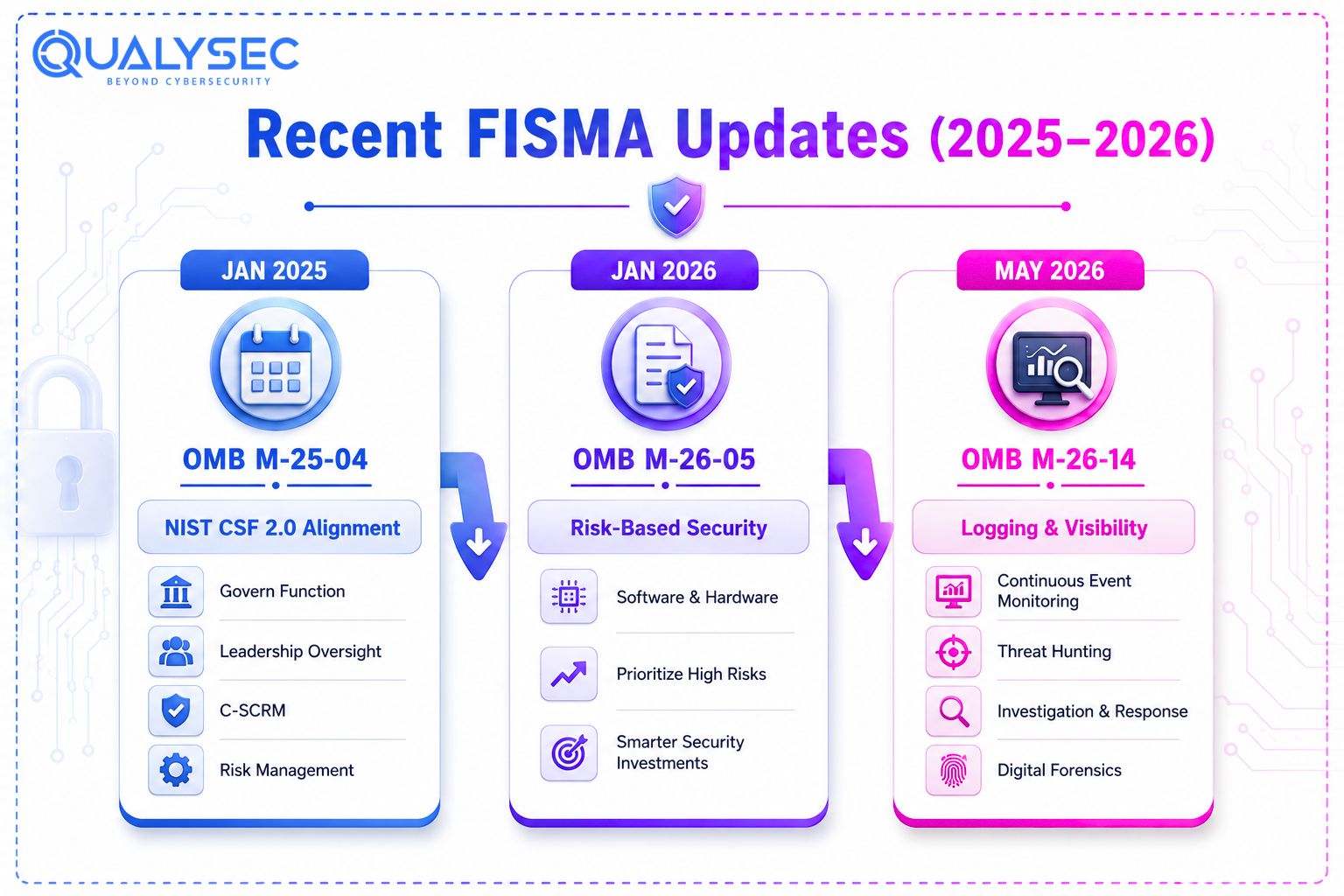
FISMA compliance isn’t a fixed target. Three recent updates change what “compliant” actually requires right now.
- OMB M-25-04, issued in January 2025, shifted IG FISMA metrics to align with the NIST Cybersecurity Framework 2.0, adding an entirely new function called “Govern.” Agency oversight now formally evaluates how security decisions get made and by whom, not just which controls exist. For contractors, this means audits now examine leadership oversight, risk management, and Cybersecurity Supply Chain Risk Management (C-SCRM) alongside technical security controls.
- OMB M-26-05, “Adopting a Risk-based Approach to Software and Hardware Security,” followed in January 2026. It pushes agencies (and by extension, their contractors) toward prioritizing security investment based on actual risk rather than uniform baseline requirements.
- OMB M-26-14, issued in May 2026, focuses on ensuring effective and efficient agency logging and network visibility to defend against evolving cyber threats. It directly responds to the same logging gaps that keep appearing in audits. This emphasizes operational Continuous Event Monitoring (CEM) and robust Threat Hunting, Investigation, Response, and Forensics (THIRF) capabilities over static log retention.
If your FISMA compliance checklist hasn’t been updated since before 2025, it’s already missing at least one of these.
How QualySec Helps You Master the FISMA Compliance Checklist
The gap in the section above isn’t unique to federal agencies. It shows up anywhere compliance gets treated as a paperwork exercise rather than a live test of whether controls actually hold under pressure.
Security frameworks use a multi-layered assessment model, as shown by techniques like Qualysec’s Three-Layered Defence System (human-led AI penetration testing) to help close the gap between compliance paperwork and operational resilience:
- Layer 1: Automated Scanning: Runs automated tools that scan for known vulnerabilities at speed and scale, catching in hours what a manual review would take days to find.
- Layer 2: AI-Powered Analysis: Looks for patterns across a system that a single scan might miss on its own.
- Layer 3: Human-Led Validation: Experienced testers manually attempt to break what the first two layers flagged as secure, the same adversarial pressure GAO and OMB point to when they distinguish real testing from documentation review.
This is why Qualsec a crest accredited cybersecurity company, operates Human-Led, AI-Powered: speed and pattern-matching get you coverage fast, but neither replaces a human deciding whether a system actually resists a determined attacker. Real-time dashboard visibility into testing progress ties directly to the continuous monitoring requirement most checklists treat as an afterthought. Nothing slips through, because nothing gets marked resolved until a human confirms it actually is.
What Happens If You Fail FISMA Compliance Checklist Requirements
FISMA itself doesn’t come with a built-in fine schedule. What actually happens runs through the contract:
- funding gets reduced or withheld,
- contract eligibility gets pulled,
- performance ratings suffer, and
- congressional or Inspector General oversight ramps up.
The real cost often shows up downstream in breach response. After the 2015 OPM breach exposed records belonging to 21.5 million individuals, the federal government awarded a $340 million identity-protection contract, then a second contract worth up to $416 million (GAO-17-614). That’s a documented figure tied to one breach and one agency. It is a reminder of how quickly compliance gaps turn into expensive remediation.
Conclusion
A checklist organizes your compliance program. It tells you what to build, in what order, and what to document along the way. It doesn’t tell you whether any of it survives contact with a real adversary.
That distinction, the one GAO’s own audits keep surfacing year after year, is the difference between passing an audit and actually being secure. Contractors who treat the checklist as the finish line tend to discover the gap at the worst possible time, during an incident, not during a review. The ones who treat it as a starting point usually don’t.
For contractors, the message is clear. Staying current with your compliance checklist isn’t just about passing the audit. It’s about protecting the business.

FAQs
Q. What is the FISMA compliance checklist?
It’s the set of core activities agencies and contractors work through under the Federal Information Security Modernization Act: inventorying systems, categorizing them by risk under FIPS 199, selecting and implementing NIST 800-53 controls, documenting them in a System Security Plan, assessing effectiveness, securing an Authority to Operate, and monitoring continuously afterward. It’s a living process, not a single document filled out once.
Q. Is FISMA compliance mandatory for contractors?
Yes, and there’s no size exemption. The moment a contractor operates, supports, or manages an information system on behalf of a federal agency, FISMA’s requirements apply.
Q. How long does FISMA authorization take?
There’s no fixed timeline in the law, and it varies heavily by system complexity and agency backlog. What matters more is proper sequencing and making the assessment adversarial (not just documentation review) so the resulting ATO rests on solid ground.
Q. What’s the difference between FISMA and FedRAMP?
FISMA is the underlying law that applies to federal information systems generally. FedRAMP is a standardized program built on top of FISMA’s framework, focused on cloud service providers. Contractors selling cloud services to multiple agencies often deal with both.
Q. Who enforces FISMA compliance?
OMB holds overall oversight, DHS administers information security policy for non-national-security systems, agency Inspectors General perform annual independent assessments, and GAO reviews effectiveness government-wide.
Q. What happens if a contractor fails to comply with FISMA?
There’s no statutory fine built into FISMA itself. The real consequences run through the contract: reduced funding, loss of eligibility, increased oversight, and remediation costs, especially if a gap leads to a breach.