






Since July 31, 2024, delivering penetration testing or incident response services to Dubai government, semi-government, or critical information infrastructure entities has required Cyber Force certification, a joint accreditation programme run by the Dubai Electronic Security Center and CREST. Get this decision wrong, and the consequence isn’t just a weaker security report. A provider without current certification legally can’t sell those two services into that segment at all, regardless of how experienced their team sounds on a call. That’s where the role of DESC penetration testing companies in UAE comes into play.
That’s precisely why generic VAPT providers often aren’t enough here. Plenty of firms across the UAE run competent, general-purpose security assessments. Still, DESC Cyber Force sits behind a narrower, government-recognized bar: a UAE trade licence covering cybersecurity activities, current crest penetration testing uae company accreditation, and individual consultants who hold Dubai Police security clearance. Miss any one of those three and a provider simply isn’t eligible for Cyber Force-scoped work, no matter how polished their proposal looks.
Before signing with any DESC penetration testing company, organizations should evaluate DESC-specific expertise, the strength of CREST accreditation behind the actual testing team, the breadth of technical capability on offer, and how clearly the provider documents its process for audit purposes. This guide walks through what to look for, the questions worth asking before you sign, and what a fair engagement should realistically cost.
Talk to Qualysec about DESC Cyber Force penetration testing for your organization!
What Should You Look for in a DESC Cyber Force Penetration Testing Company?
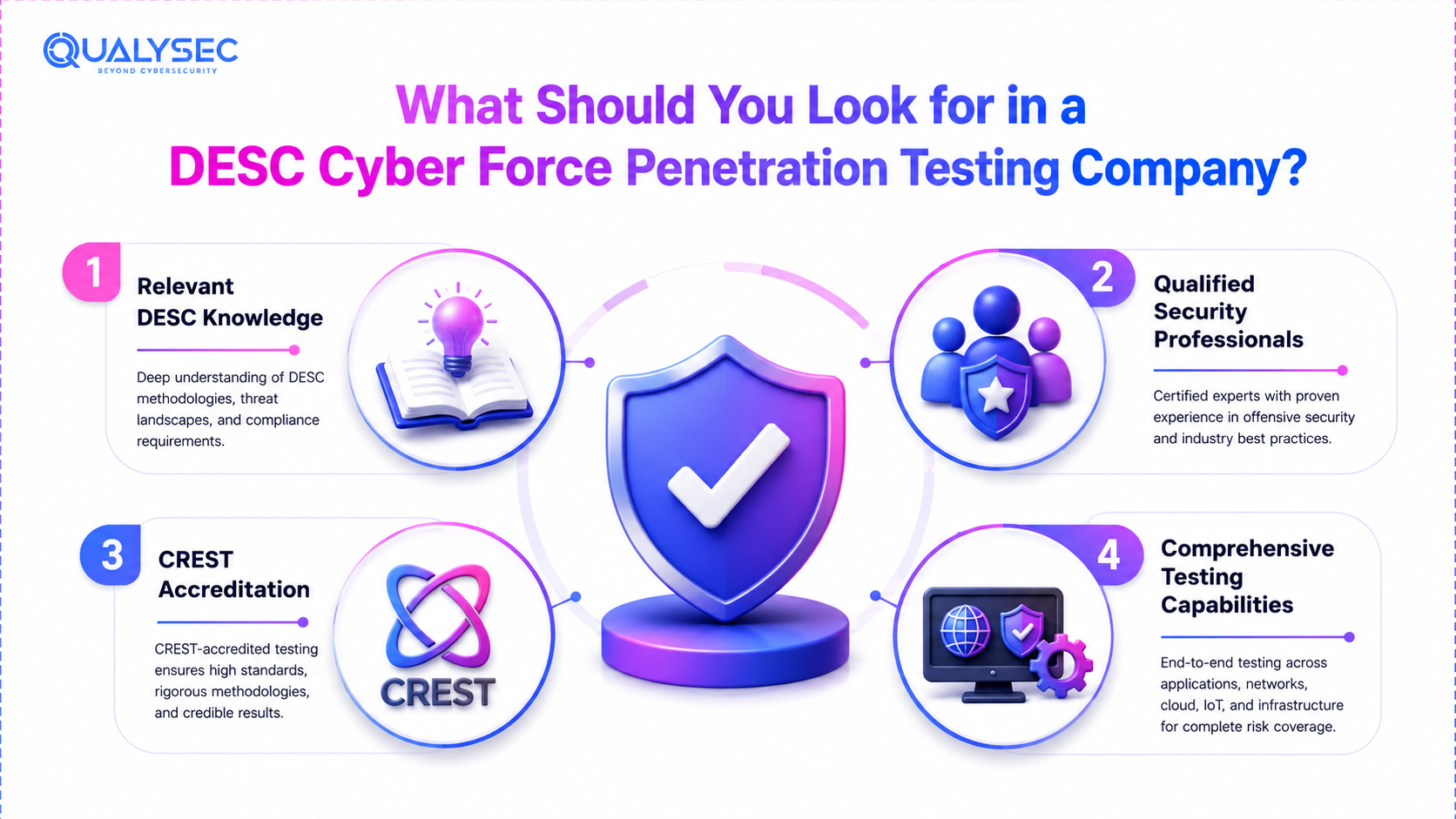
Relevant DESC Knowledge
Understanding DESC penetration testing requirements in Dubai in the abstract isn’t the same as knowing how they apply to your specific entity. DESC’s Information Security Regulation ties testing frequency to how critical a system is: external-facing services generally need penetration testing at least once a year, vulnerability assessments are expected on a quarterly basis, and systems classified as critical infrastructure are tested even more often, on a shortened cycle scaled to their risk level. A provider worth hiring should be able to place your organization within that structure immediately, not run a generic test and stamp DESC’s name on the cover page afterward. This approach helps organizations maintain DESC compliance while addressing security risks according to their actual business and system requirements.
Qualified Security Professionals
Ask who’s actually performing the work, not just who’s signing the proposal. Testers on Cyber Force-scoped engagements need Dubai Police security clearance, a requirement specific to this programme that doesn’t automatically transfer from other certifications. Beyond that baseline, look for individual credentials like OSCP or CREST’s own tester-level certifications, since a firm’s organizational accreditation says nothing about whether every tester on staff meets the same bar.
CREST Accreditation
This isn’t optional context. It’s built directly into the eligibility requirement itself. DESC partnered with CREST specifically to run the Cyber Force programme, making current CREST company accreditation one of three non-negotiable criteria alongside the trade licence and cleared consultants. A firm describing itself as “CREST accreditation pathway, phase two” or “targeting Q4 certification” is not currently eligible for Cyber Force work, however close they may be to getting there.
Comprehensive Testing Capabilities
Cyber Force covers penetration testing and incident response specifically, but the technical scope underneath spans web applications, APIs, cloud environments, internal and external networks, and mobile platforms. A provider limited to one or two of these areas will subcontract the rest, which introduces coordination risk and can weaken consistency across your final report. It’s worth checking too whether the provider’s reporting maps to other UAE frameworks you might also need to satisfy, such as NESA, ADHICS, or CBUAE requirements.
Questions to Ask Before Hiring a DESC Penetration Testing Company
Among the many DESC penetration testing Dubai marketing similar services, a short, direct conversation tends to reveal more than any capability deck.
- What methodology do you follow? A credible answer names a specific framework, PTES or OWASP, for instance, rather than gesturing at “industry best practices.”
- Who will perform the testing? Get names, or at minimum specific role descriptions. Vague answers here usually mean whoever’s available gets assigned, not whoever’s right for the job.
- What systems will be tested? Scope needs precise definition. “Your infrastructure” as a scope statement tends to create disputes later about what was actually covered.
- What certifications do your testers hold? This should explicitly include Dubai Police clearance status for Cyber Force work, not just general technical credentials.
- Do you provide remediation guidance? A list of findings without practical fix guidance just shifts the interpretation burden onto your internal team.
- Do you provide retesting? Confirming a fix actually closed the gap matters as much as finding the vulnerability in the first place.
- How is sensitive testing data protected? Ask specifically about storage location, handling procedures, and retention policy for credentials and findings.
- What does the final report include? A complete report has an executive summary, severity-rated technical findings, reproduction steps, and remediation guidance, not a raw scanner export.
- Can you support compliance documentation? Beyond the technical report, confirm the provider can produce documentation structured for DESC’s own audit format.
- What experience do you have in the UAE? Regional experience matters because DESC, and the wider UAE regulatory landscape around it, has expectations that differ meaningfully from generic international standards.
DESC Penetration Testing Company Evaluation Checklist
| Evaluation Criteria | What to Check |
| DESC expertise | Direct experience testing against DESC’s ISR requirements specifically, not just general UAE experience |
| CREST credentials | Current, confirmed organizational CREST accreditation, not accreditation still in progress |
| Testing scope | Coverage across web, API, cloud, network, and mobile without needing to subcontract |
| Methodology | A named, documented testing framework applied consistently across engagements |
| Reporting | Executive summary, severity-rated findings, and clear reproduction steps included |
| Remediation | Practical, prioritized guidance the internal team can act on without extra translation |
| Retesting | Included as standard or clearly scoped upfront, not treated as an unplanned extra |
| Data protection | Documented handling, storage, and retention policy for sensitive testing data |
| UAE experience | A track record specific to UAE’s regulatory environment, not international projects alone |
Manual vs Automated Penetration Testing
Automated scanning alone tends to miss exactly the vulnerabilities that matter most: business logic flaws, chained exploitation paths, and access control gaps that only surface when a human tester actually tries to break something the way a real attacker would. A common industry benchmark treats a healthy engagement as roughly 30 to 40% automated discovery combined with 60 to 70% expert manual validation and controlled exploitation.
When evaluating a DESC Cyber Force penetration testing company UAE organizations should ask directly what that ratio looks like in the provider’s actual engagements, not just in their marketing copy. A firm leaning almost entirely on automated tooling, then repackaging scanner output as a full penetration test, isn’t delivering the depth DESC’s requirements are built around. The combination is what makes the work credible: automated tools cover breadth efficiently, while manual testers bring the judgment needed to confirm real exploitability rather than filling a report with theoretical findings that don’t reflect actual risk.
How Much Does a DESC Penetration Testing Company Charge in UAE?
Pricing varies with scope and system complexity. Current 2026 UAE market data puts a single, narrowly-scoped web application test at roughly AED 25,000 to 55,000, rising with the number of assets and layers in scope.
| Test Type | Typical Cost Range (AED) |
| Single web application, one user role | 25,000 to 55,000 |
| Combined web + API + cloud engagement | 75,000 to 180,000 |
| Full-stack enterprise engagement | 250,000 to 600,000 |
These figures shift depending on the number of assets in scope, the complexity of the environment, and how deep the testing genuinely needs to go. Engagements with a certified DESC Cyber Force penetration testing company UAE regulators recognize tend to sit toward the higher end of this range, since cleared consultants, CREST-accredited processes, and DESC-specific reporting all carry real compliance overhead. A quote meaningfully below the AED 25,000 floor for Cyber Force-scoped work is worth treating with some skepticism, since a genuinely eligible provider simply can’t absorb that overhead at a discount rate.
DESC Cyber Force Penetration Testing Process
Scoping → Testing → Validation → Reporting → Remediation → Retesting
- Scoping defines what’s being tested and against which standard.
- Testing combines automated and manual techniques within that defined scope.
- Validation confirms findings are genuinely exploitable rather than theoretical.
- Reporting documents everything in a format suitable for both technical teams and DESC audit review.
- Remediation guidance gives the internal team a clear path to fixing what was found.
- Retesting confirms those fixes actually closed the gap.
How Qualysec Supports DESC Cyber Force Compliance
Qualysec brings CREST-accredited penetration testing to organizations working through DESC Cyber Force requirements, pairing automated discovery with expert manual validation across web applications, APIs, cloud environments, networks, and mobile platforms. Every engagement is structured to produce reporting suitable for DESC audit and compliance purposes from the outset, not adapted afterward.
CREST-Accredited Testing, Built for DESC Requirements
Qualysec pairs CREST-accredited automated discovery with expert manual validation across web applications, APIs, cloud environments, networks, and mobile platforms. Every engagement is scoped from the outset to produce reporting suitable for DESC audit and compliance review, rather than being adapted afterward.
What Sets the Engagement Apart
- Retesting included as standard, so organizations can prove vulnerabilities were genuinely closed, not just documented.
- Cross-framework reporting, structured to support NESA, CBUAE, or ADHICS obligations alongside DESC without requiring a separate engagement for each.
- Cleared, qualified testers working within Cyber Force’s specific eligibility requirements from day one.
- Manual validation on every finding, avoiding reports built solely from raw scanner output.
Why It Matters for Audit Season
For organizations juggling DESC Cyber Force penetration testing services Dubai regulators expect alongside other UAE compliance obligations, a single coordinated provider can save significant time during audit season. It replaces multiple disconnected reports with one consistent evidence trail.
Schedule a DESC Cyber Force penetration testing consultation with Qualysec!

Conclusion
Choosing a DESC Cyber Force penetration testing company UAE organizations can genuinely rely on isn’t the same decision as picking a general VAPT provider. The eligibility bar, CREST accreditation, cleared consultants, and DESC-specific expertise exist precisely because Dubai’s government and critical infrastructure entities need verified competence, not just a vendor willing to run a scan and call it compliance. Asking the right questions before signing, checking credentials against the actual Cyber Force requirements rather than general marketing language, and being realistic about what genuine expertise costs will save an organization from discovering a provider’s limitations only after a regulator points them out.
Contact Qualysec to strengthen your DESC Cyber Force compliance with accredited penetration testing!
Frequently Asked Questions
How do I choose a DESC penetration testing company?
Confirm the provider holds current CREST organizational accreditation and that individual testers carry Dubai Police security clearance, both non-negotiable for Cyber Force-scoped work. From there, compare testing scope, methodology, reporting quality, and UAE-specific regulatory experience before weighing price.
What certifications should a penetration tester have?
For Cyber Force-scoped work specifically, testers need Dubai Police security clearance. Beyond that programme-specific requirement, recognized technical certifications like OSCP or CREST’s individual-level credentials demonstrate hands-on exploitation skill rather than theoretical knowledge alone.
Is CREST accreditation important?
Yes, and for DESC Cyber Force work it’s not optional. DESC built the programme directly with CREST, making current CREST company accreditation one of three core eligibility requirements alongside a UAE cybersecurity trade licence and cleared consultants. Without current accreditation, a provider isn’t eligible to deliver Cyber Force-certified services at all.
How much does penetration testing cost in UAE?
Current 2026 UAE market pricing runs roughly from AED 25,000 for a single, narrowly-scoped web application test up to AED 600,000+ for a full-stack enterprise engagement, depending on scope and complexity. DESC Cyber Force engagements tend toward the higher end of the range for comparable scope, given the additional eligibility and compliance work genuinely qualified providers carry.
How long does penetration testing take?
Timelines depend on scope, but most engagements run one to several weeks for the testing phase itself, followed by validation, reporting, and a remediation and retesting cycle. Larger environments or critical infrastructure assessments requiring more comprehensive coverage typically extend that timeline further.
What should a penetration testing report include?
A complete report includes an executive summary for non-technical stakeholders, detailed findings with severity ratings, clear reproduction steps for each vulnerability, and practical remediation guidance. For DESC-related engagements specifically, the report should also be structured in a format suitable for compliance documentation and audit review.