






Key Takeaways
- DESC Cyber Force is a certification for providers, not a special type of test.
- Only Dubai government, semi-government and CII entities must use certified providers.
- The testing itself is just solid professional penetration testing done by approved companies.
- Most organisations still find basic problems like weak passwords, missing patches and poor access control.
- Finding issues in a test is almost always cheaper than dealing with a real breach later.
Introduction
In August 2026, the UAE Cybersecurity Council reported that attackers had gone after the country’s aviation, energy and education systems. Phishing, hacking attempts, multiple angles. They were trying to get in and cause damage. The only reason it didn’t work is that someone was already watching and stopped them
Most organisations don’t have that kind of protection. Attackers could already be probing your systems right now. Penetration testing is how you find the weak spots while you still have time to fix them. Learn more about cyber security penetration testing to see how ethical hacking keeps your systems safe. This blog covers how DESC Cyber Force Penetration Testing works and why UAE businesses need it.
What Is DESC Cyber Force Penetration Testing?
DESC Cyber Force is the Dubai Electronic Security Center’s official certification program for penetration testing providers, run in partnership with CREST. CREST is the certifying body that assesses companies and individual testers. Only accredited companies and testers can deliver these services to Dubai government, semi-government, and critical information infrastructure entities, helping organizations meet their DESC compliance requirements.
It means a professional penetration test done by a certified provider. Security professionals actively try to break into your systems the same way real attackers would, to find weaknesses before criminals do. You can also review a sample pen testing report to see how certified assessments are structured.
Why DESC Cyber Force Penetration Testing is different from other security checks:
- Regular scans rely on automated tools that look for known vulnerabilities.
- Penetration testing uses trained professionals who think like attackers and uncover gaps that tools miss.
- It tests whether your security actually holds up when someone tries to exploit it, not just whether it looks good on paper.
It gives regulators documented evidence that you’re serious about security. It helps your team understand actual risk instead of guessing.
Who Needs DESC Cyber Force Penetration Testing?
It is mandatory for Dubai government entities, semi-government organisations, and Critical Information Infrastructure (CII) operators. These organisations must use only certified providers.
It is also relevant for organisations needing to meet DESC ISR / compliance requirements, or those in sectors where NESA or CBUAE expect regular penetration testing.
For other businesses in the UAE, Cyber Force penetration testing UAE is not legally required, but it is still strongly recommended if you:
- Store customer data or process payments
- Handle sensitive or proprietary information
- Work with government clients or critical sectors
- Want testing that meets the highest local standards recognised by Dubai regulators
If you are exploring local service options, check out the guide on the top 5 penetration testing companies in UAE.
Sectors that benefit most:
- Banks and financial institutions
- Healthcare providers
- Retail companies processing payments
- Government contractors
- Technology companies with proprietary systems
- Any business with customer databases
Small companies often assume penetration testing is only for large enterprises. That is a mistake. Attackers target smaller organisations just as often and frequently find weaker defences. Customers and partners now expect evidence of proper security testing, regardless of company size.
What Does DESC Cyber Force Penetration Testing Cover?
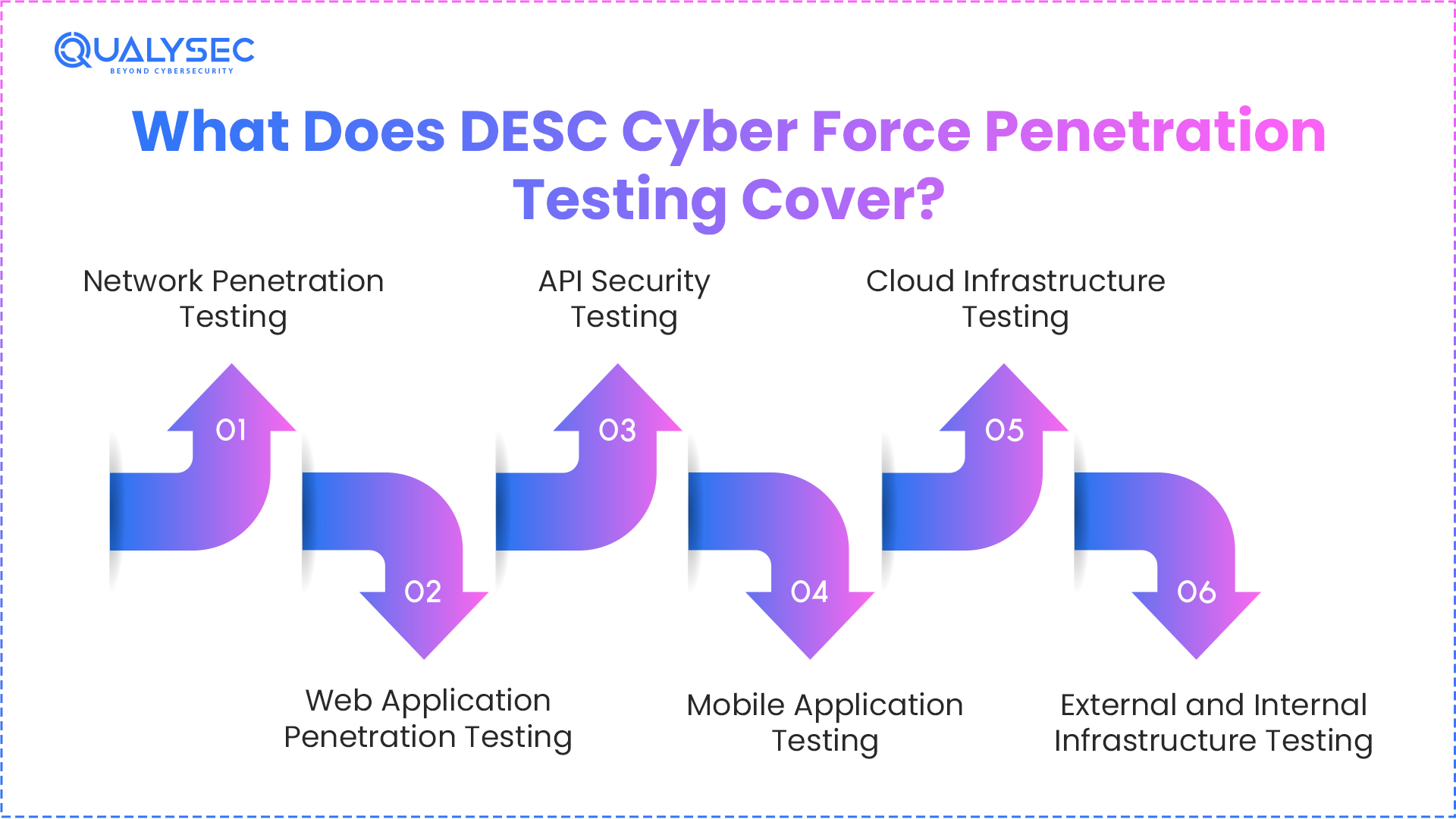
It examines the main ways attackers could gain access to your systems, move around inside them, and cause damage or steal data. For an overview of test categories, read about the different types of pen testing.
1. Network Penetration Testing
This checks whether attackers can break into your network infrastructure from outside or from inside your organisation. It covers routers, firewalls, wireless networks, switches, and other network components.
What testers focus on here:
- Bypassing the firewall to reach internal systems
- Breaking into wireless networks
- Finding systems still using default or weak passwords
- Testing whether network segmentation actually isolates critical systems
- Checking if an attacker can move between network segments after getting initial access
2. Web Application Penetration Testing
This tests your website and web-based applications for security weaknesses that attackers could exploit. This is critical because websites are often the easiest entry point for attackers. Discover more details in the guide to web application penetration testing.
Common problems found:
- Login bypasses that allow unauthorised access
- Injection vulnerabilities that let attackers modify or extract data from databases
- Security misconfigurations that expose sensitive information
- Broken authentication that enables account takeover
- Sensitive data exposure through insecure transmission or storage
3. API Security Testing
This tests the API interfaces your applications use to communicate with each other and external systems. APIs are frequent attack targets because they often have weaker security controls than the main applications. Learn how to protect your interfaces with API security testing or explore specialized API penetration testing services.
What testers look for:
- Weak authentication that allows unauthorised API access
- Missing or weak rate limiting that lets attackers overwhelm systems
- Injection attacks through API parameters
- Exposure of sensitive data in API responses
- Authorisation bypasses that allow access to data or functions the user should not reach
4. Mobile Application Testing
This tests smartphone and tablet applications for security vulnerabilities. Mobile apps often store or handle sensitive information, and attackers increasingly target them.
Typical security issues:
- Insecure local storage that exposes sensitive data
- Weak authentication and session management
- Insecure data transmission over networks
- Code vulnerabilities that allow app manipulation or reverse engineering
- Exposure of API credentials or secrets embedded in the application
5. Cloud Infrastructure Testing
This tests the cloud environments where your applications and data live. Cloud security requires different approaches than traditional on-premises infrastructure.
Cloud-specific problems:
- Misconfigured cloud storage that exposes data publicly
- Weak identity and access management
- Insufficient network segmentation in cloud environments
- Unencrypted data in transit or at rest
- Improper secret management that exposes credentials
6. External and Internal Infrastructure Testing
This tests both internet-facing systems that attackers can see and internal systems that only employees should access. Internal testing matters because many breaches involve compromised employee accounts or insider-level access.
Common findings:
- Systems exposed unnecessarily to the internet
- Default credentials still enabled
- Unpatched systems with known vulnerabilities
- Excessive access permissions for regular staff
- Systems with little or no monitoring or logging
Certified providers like Qualysec use a Three-Layered Defence System (automated tools, AI analysis, and human validation) so nothing slips through. Learn how.
DESC Cyber Force Penetration Testing Process
DESC Cyber Force-certified providers follow a structured professional process that produces thorough testing and clear results. Read the step-by-step guide on web application penetration testing steps to understand standard testing methodologies.
How the DESC Cyber Force Penetration Testing Process works:
| Stage | What Happens |
| Scope and Requirements Review | You and the testing team define what systems get tested, which attacks are allowed, and what success looks like |
| Asset Discovery and Reconnaissance | Testers identify all relevant systems, including servers, applications, network devices, and cloud services |
| Vulnerability Identification | Testers find potential security weaknesses without exploiting them yet |
| Controlled Exploitation | Testers carefully attempt to exploit selected vulnerabilities to prove they are real and exploitable |
| Risk Analysis | Testers assess how serious each issue is and what damage an attacker could cause |
| Reporting | A detailed report is delivered explaining the findings, risks, and recommended fixes |
| Remediation | Your team fixes the issues, with guidance from the testers where needed |
| Retesting | Testers verify that the fixes resolved the problems and did not introduce new ones |
Typical timeline:
- Scoping: 1–2 weeks
- Active testing: 1–4 weeks (depends on scope)
- Reporting: around 1 week
- Remediation and retesting: additional weeks, depending on the number and complexity of issues
Key Vulnerabilities Identified Through Penetration Testing
DESC Cyber Force-certified penetration testing regularly finds the same types of problems in organisations across Dubai and the wider UAE. Learn more about how to identify security vulnerabilities before cybercriminals do. The most common ones include:
- Weak or default passwords on critical systems
- Unpatched systems with known vulnerabilities
- Excessive employee access permissions that are never reviewed
- Sensitive data exposed in unexpected places (backups, development systems, etc.)
- Insecure third-party integrations
- Missing multifactor authentication on important accounts
- Lack of network segmentation, allowing attackers to move freely once inside
- Insufficient logging and monitoring, which can leave breaches undetected for months
- Hardcoded credentials in applications and configuration files
- Insecure APIs with weak or missing authentication
DESC Cyber Force Penetration Testing Report
After testing is complete, you receive a detailed report that explains the findings and recommended fixes. You can review a sample pen testing report to understand how results and risk levels are documented.
What the DESC Cyber Force Penetration Testing Report includes:
- Executive Summary: Findings explained in non-technical language so management can understand the problems and their importance
- Scope and Methodology: What systems were tested, which techniques were used, and any limitations
- Vulnerability Details: Description, location, proof that the issue exists, and potential impact if exploited
- Risk Ratings: Each vulnerability classified as Critical, High, Medium, or Low based on exploitability and potential damage
- Evidence: Screenshots or technical logs showing the vulnerability is real
- Remediation Recommendations: Specific steps to fix each issue and reduce the chance of similar problems
- Retesting Results (if retesting was part of the engagement): Confirmation of which issues were fixed and which still need work
How to use the DESC Cyber Force Penetration Testing Report:
- Share the executive summary with management so they understand the risk.
- Give technical details to your IT team so they know exactly what to fix.
- Use the report for compliance documentation proving you conduct security testing.
- Prioritize fixes based on risk ratings, not effort required.
How Much Does DESC Cyber Force Penetration Testing Cost in UAE?
Pricing varies a lot based on what you’re testing and how complex your environment is. There is no single price that fits every organisation.
Main factors that affect cost:
- Number of systems, applications, and assets in scope
- Complexity of the environment (network, cloud, applications, APIs, mobile, etc.)
- Depth and type of testing required
- Timeline and urgency
- Whether retesting is included
How to get accurate pricing:
- Share your exact requirements with multiple DESC Cyber Force-certified providers and request formal quotes
- A proper provider will assess your environment before giving a realistic figure
- Be cautious of very low fixed-price offers that do not account for your actual complexity. These often cut corners on methodology or depth
- The highest price does not automatically mean the best quality
- Focus on the provider’s experience, methodology, and the clarity of their proposal rather than price alone
Benefits of DESC Cyber Force Penetration Testing
It provides multiple benefits beyond just finding vulnerabilities:
Security benefits:
- Finds weaknesses before attackers do, reducing the chance of expensive breaches
- Shows whether your security controls actually work under real attack conditions
- Gives a clear picture of real risk so you can prioritise security spending effectively
Compliance benefits:
- Provides documented evidence that regulated organisations often need to show during audits
- Helps meet increasing expectations from regulators for regular, professional testing
- Produces reports that demonstrate a serious approach to security
Business benefits:
- Builds customer and partner confidence through proven security testing
- Meets growing requirements from vendors, partners, and cyber insurance providers
- Gives boards and investors the documentation they increasingly expect
Operational benefits:
- Highlights where staff need better security training
- Directs security budgets toward the problems that actually matter
- Confirms which existing measures work and which need improvement
Want comprehensive testing that combines speed with critical human intuition? Qualysec’s Human-Led, AI-Powered approach delivers both. Get started.
How to Prepare for a DESC Cyber Force Penetration Test
Good preparation helps the testing team work efficiently and gives your organisation clearer, more useful results.
Before testing starts:
- Clearly define the scope (which systems, applications, and networks are in scope)
- Notify relevant departments in advance
- Agree with the testing team whether any detection tools need temporary adjustment (most stay enabled)
- Provide the necessary access and credentials in a secure way
- Identify any critical systems or time windows that need special handling
- Appoint an internal coordinator as the main point of contact
- Document any special technical or business constraints
During testing:
- Stay available to resolve access or technical issues quickly
- Provide additional documentation or clarification when the testers request it
- Monitor for any unexpected impact on production systems
- Keep normal business operations running as much as possible
After testing:
- Review the findings with both technical and management teams
- Prioritise remediation based on risk ratings
- Allocate the necessary resources and budget for fixes
- Track remediation progress
- Schedule retesting for critical and high-risk issues once fixes are in place
DESC Cyber Force Penetration Testing vs. Vulnerability Assessment
Penetration testing and vulnerability assessments are different approaches to finding security problems. Understanding the difference between vulnerability assessment and penetration testing will help you choose the right approach.
| Aspect | Penetration Testing | Vulnerability Assessment |
| Approach | Actually tries to exploit vulnerabilities | Scans for known vulnerabilities |
| Cost | Higher, due to manual effort | Lower, mostly automated |
| Time | Takes weeks for comprehensive testing | Takes days for most assessments |
| Depth | Deep analysis of exploitability and impact | Surface-level vulnerability identification |
| Real-world Validation | Proves whether vulnerabilities can actually be exploited | Identifies potential problems without exploitation |
| Best For | Comprehensive security understanding | Baseline scanning and regular monitoring |
Practical guidance:
-
- Use vulnerability assessments for regular baseline checks and ongoing monitoring.
- Use penetration testing when you need thorough validation, especially before major deployments or for regulatory evidence.
- Many organisations get the best results by using both together.

Conclusion
DESC Cyber Force Penetration Testing helps organisations find security weaknesses before attackers do. For Dubai government, semi-government, and Critical Information Infrastructure entities, using a certified provider is mandatory. For other organisations, DESC penetration testing remains one of the most effective ways to understand real risk and strengthen defences.
The cost of finding and fixing issues during a controlled test is almost always lower than dealing with a real breach. Knowing your actual security posture, rather than assuming protection, is the practical starting point for better decisions.
Frequently Asked Questions
1. What is DESC Cyber Force penetration testing?
It is professional penetration testing (often called VAPT UAE) done by a CREST-accredited provider under Dubai’s DESC Cyber Force program. This is commonly called DESC penetration testing UAE. Testers try to break in the way real attackers would.
2. Is DESC Cyber Force penetration testing mandatory?
It is mandatory for Dubai government, semi-government, and Critical Information Infrastructure entities. For others, Cyber Force penetration testing UAE is optional but highly recommended.
3. Who needs DESC Cyber Force penetration testing?
Dubai government, semi-government, and CII organisations must use certified providers. Other organisations can also benefit from DESC Cyber Force Penetration Testing. Size doesn’t matter.
4. How often should penetration testing be performed?
Annual testing is industry standard. Test additionally after major system changes, before regulatory audits, or after suspected security incidents.
5. How long does a DESC penetration test take?
Scoping takes one to two weeks. Active testing takes one to four weeks. Reporting and remediation take additional weeks. Total timeline often ranges from six to twelve weeks.
6. How much does DESC penetration testing cost?
Pricing for DESC penetration testing varies based on scope, complexity, and systems tested. Request quotes from certified providers with your specific requirements.