

Introduction: The Growing Weight of Data Privacy in Qatar
Your systems are encrypted, access is locked down, and the last pen test looked solid. Then the National Cyber Security Agency asks for the Data Protection Impact Assessment on that new payment platform you launched last quarter, and you realise there is no document to hand over.
In Qatar, this is not a minor oversight. Law No. 13 of 2016 and the NCSA’s official DPIA guidelines require you to assess privacy risks before high-risk processing starts. Special category data, new customer systems, biometric tools, or cross-border transfers all sit in that category. Skip the assessment, and you risk a fine of up to QAR 1 million (or higher under other provisions) plus the hard questions from your board.
Most teams only discover this after the system is live. By then, the risks are already built in. The ones that run a proper DPIA early catch the problems while they are still cheap to fix.
This guide shows exactly what Qatar regulators expect, step by step, so you stay ahead of the questions instead of scrambling when they arrive.
Is a DPIA Mandatory in Qatar? Understanding the Triggers
Not every processing activity needs a Data Protection Impact Assessment. The National Cyber Security Agency expects one when the activity may cause serious damage to individuals. That is the real test under Law No. 13 of 2016 and the official DPIA guidelines for a Data protection impact assessment Qatar organisations must follow.
When You Need a DPIA
You need one before you start if any of these apply:
- You process special-nature data (health, children, ethnic origin, religious beliefs, marital status, criminal records, or similar)
- You introduce new technology or make major changes to how data is handled
- You run large-scale collection or profiling that can affect people’s rights or decisions
- You process data of children or other vulnerable groups
- Automated decisions will have significant impact (loan approvals, job screening, service eligibility)
- You move personal data into new cloud systems or share it with new third parties in ways that raise the risk of serious damage
Real-World Situations That Trigger a DPIA
These situations trigger a DPIA in practice:
- A Doha fintech rolls out AI credit scoring. Loan decisions get made automatically. That needs a DPIA before launch.
- A hospital shifts patient records to a new cloud platform. Health data is of a special nature, so the assessment is required.
- A telecom deploys facial recognition for customer verification. The use of biometric technology triggers it.
- An e-commerce platform builds detailed marketing profiles from purchase history at scale. Same requirement.
When You Usually Do Not Need a DPIA
You usually do not need one for:
- Basic contact details with no further analysis
- Processing that is strictly required by law and adds no extra risk
- Small-volume, well-established activities you have already assessed as low risk
- Minor updates that do not change the nature or scale of the processing
Missing a mandatory assessment carries clear costs. The fine can reach QAR 1 million under Article 23. Partners may pause contracts. Insurance can become harder to claim if a breach happens later, and the board will ask why the risk was never documented.
The practical move is to screen every new system or major change against the “serious damage” test. If it looks high risk, run the DPIA early. That keeps you compliant and stops expensive surprises later.
Step-by-Step: How to Conduct a Qatar-Compliant DPIA
A Data Protection Impact Assessment is not one form you fill once and file away. It is a working process that moves through clear stages, each needing proper records and sign-off before you go live. The National Cyber Security Agency expects this level of discipline under the PDPPL. Let’s start with the foundation that everything else rests on.
Step 1: Map and Describe the Data Flow
An auditor asks where the Qatari ID copies are stored and who can open them. If the answer is not immediate, the assessment was never solid. You cannot judge risk until you know what data you hold and where it travels.
- Write down every way data enters the organisation: email typed at signup, card details entered on the payment form, ID scan during KYC, fields pushed by a partner API, or a feed arriving from a data broker.
- List every place the data is stored, including the main production database, cloud object storage, email archives, disaster-recovery replicas, test environments, analytics platforms, and any vendor systems that process it on your behalf.
- Record the actual people or roles that can reach each type of data: developers with production access, support agents, finance staff, contractors running reports, and backup operators. Avoid vague labels such as “staff”.
- Note the retention period for each type: until the customer deletes the account, three years after last activity, seven years for regulatory reasons, or automatic purge after 30 days. “As long as needed” is not enough.
Example data flow for a typical Qatar fintech:
| Data Point | Entry Point | Storage | Who Can Access | Retention |
| Customer email | Website signup | Main database | 2 developers, 1 admin | Until deletion |
| Payment card | Payment form | External processor | 0 internal staff | 30 days |
| Phone number | Mobile app | Cloud database | 3 support, 2 engineers | 2 years |
| Qatari ID copy | KYC process | S3 bucket | 1 compliance officer | 7 years |
| Purchase history | Transaction system | Data warehouse | 5 analysts | 5 years |
The S3 bucket holding ID copies is high-risk personal data (and may involve biometric elements if a photo is stored). It belongs in the assessment with extra attention.
Documentation checklist:
- Full inventory of every personal data type you process
- Clear diagram or list of how data moves between systems
- Named roles that can access each type
- Written retention rules for each type
- Complete list of third parties that touch the data
- Purpose written against each data type so you can later check necessity
A complete and accurate data map makes every later step of the Data Protection Impact Assessment more reliable. Skip the detail and later steps rest on guesswork.
Step 2: Evaluate Necessity and Proportionality
Collecting every new data field ‘just in case’ is a habit the National Cyber Security Agency will question. Under the Data Protection Impact Assessment process, every piece of personal data must be necessary for a clear purpose and proportional to the risk it brings.
Start with necessity. Ask yourself:
- Can the service run without the customer’s phone number, or does email alone work?
- Does a basic account really need a government ID, or will email verification achieve the same result?
- Does eighteen months of behaviour tracking serve the analytics goal, or would three months deliver the same insight?
If a lighter option works, the heavier collection fails the necessity test.
Then look at proportionality. The security and retention around the data should match how sensitive it is. Payment-card data needs tighter controls than a simple email address. Keeping records longer than the business actually needs is hard to justify. Collecting more volume or more types of data than the purpose requires is the same problem.
This is a quick way to walk through the decisions:
| Data Type | Business Purpose | Necessary? | Proportional? | Action |
| Account communication | Yes | Yes | Keep | |
| Phone | SMS notifications | Maybe | No | Remove |
| Government ID | KYC verification | Yes | Yes | Keep |
| Passport copy | Transaction record | No | No | Remove |
| Browsing history | Marketing analytics | Maybe | No | Cut to 30 days |
| Location data | Service delivery | Yes | Yes | Keep |
Write down the answers for every data type. That record is what shows the processing stays inside the limits the PDPPL and NCSA guidelines expect.
Step 3: Conduct a Vulnerability and Risk Assessment
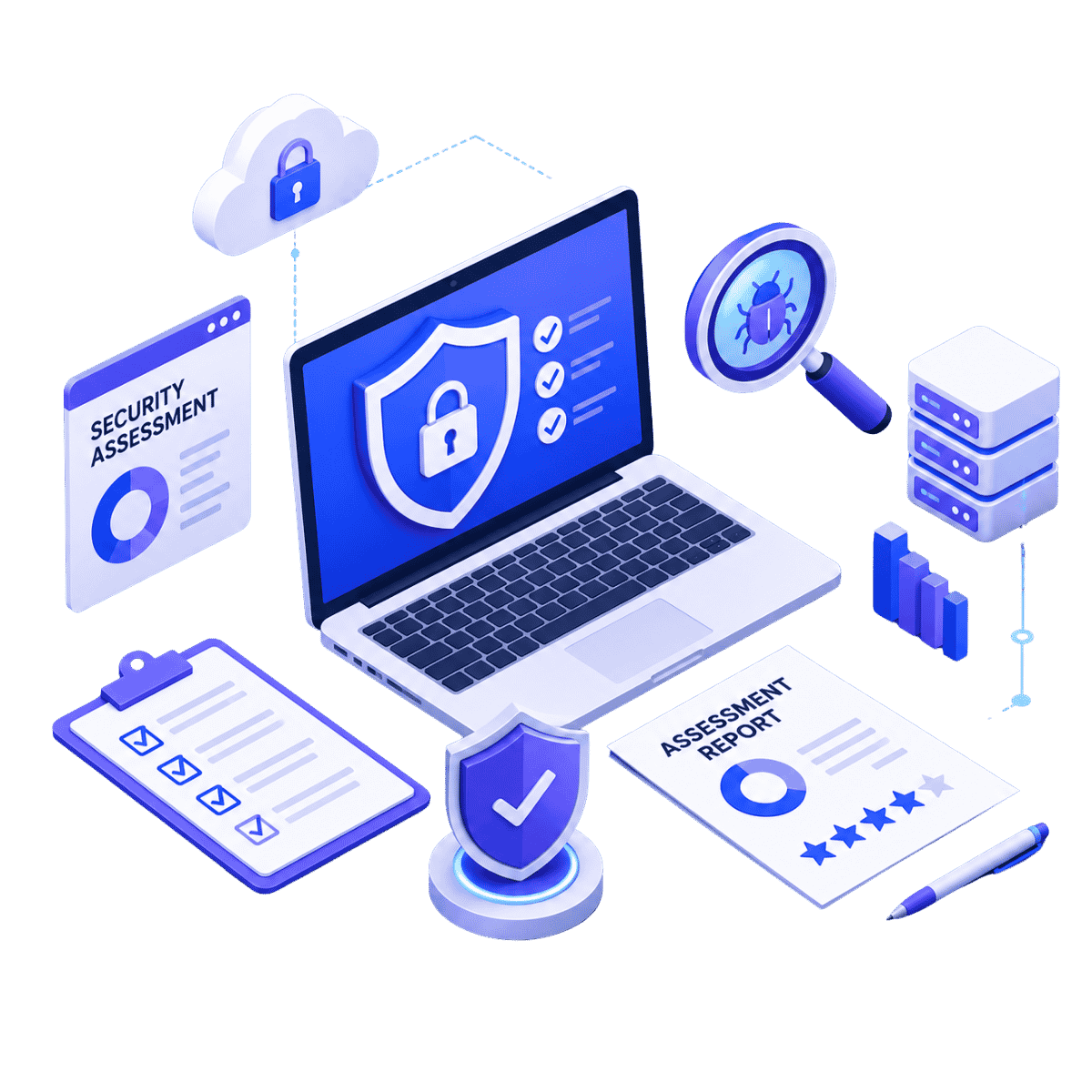
You now know what data you hold and why. The next question is whether the controls you already have actually protect it.
Check the basics first:
- Is the database encrypted at rest? Are the backups encrypted too?
- Does the website force HTTPS and do the APIs encrypt traffic end-to-end?
- Can one customer see another customer’s records? Can a junior staff member reach data outside their role?
- Are weak passwords still allowed? Can multi-factor authentication be bypassed?
- Do you know who opened which records, and can you spot unusual access patterns quickly?
Once those are answered, look at the risk itself. High-value data such as payment cards or health records draws more attention. A data breach can mean financial loss for customers, serious personal harm if health or biometric information is involved, and regulatory exposure for the company. The business also stands to lose through fines, customer churn, partner reviews and reputation damage.
Rate each data set by combining likelihood and impact. A simple matrix helps:
| Data Type | Sensitivity | Likelihood | Impact | Risk Level | Mitigation focus |
| Payment cards | Very high | Very likely | Very severe | Critical | Tokenisation + strong encryption |
| Customer email | Medium | Likely | Moderate | High | Encryption + tight access control |
| Purchase history | Medium | Possible | Moderate | Medium | Encryption + audit logging |
| Marketing preferences | Low | Unlikely | Low | Low | Basic access control |
Automated scanners catch the common issues. Manual penetration testing finds the ones scanners miss. Testers try to pull real data, break access rules, confirm encryption is active, and check whether the logs actually record the activity. Every finding goes into the DPIA record so the National Cyber Security Agency can see you looked at the real risks, not just the paperwork.
Step 4: Deploy Technical and Organizational Mitigation Measures
The risk assessment has shown the weak points. Now the work is to put controls in place that actually bring those risks down to an acceptable level. The National Cyber Security Agency expects both technical fixes and organisational measures.
Technical measures that close the biggest risks
- Encryption for data at rest and in transit
- Multi-factor authentication on systems that hold sensitive records
- Network segmentation that keeps critical data isolated
- Data masking so staff only see what their role requires
- API rate limiting that blocks bulk downloads
- Detailed logging of every access to high-risk data
- Regular patching that removes known weaknesses
- Encrypted and segregated backups
- Disaster recovery tests that prove recovery works under pressure
Organisational measures that keep the controls working
- Written data protection policies that staff actually follow
- Regular training on how to handle personal data
- Background checks for anyone with access to sensitive systems
- Vendor contracts that demand clear security standards
- Quarterly access reviews that remove rights no longer needed
- Documented incident response steps for breaches
- Privacy by design built into new system development
- Automated retention schedules that delete data when the period ends
- Clear breach notification procedures that meet the 72-hour rule
- Insurance that covers data-related incidents
Independent penetration testing confirms whether the controls you deployed actually hold up. Testers attempt to exploit the same weaknesses after the fixes are live. Successful exploitation means the mitigation still needs work. Failed exploitation gives you documented proof that the risk has been reduced. That report becomes useful supporting evidence inside the DPIA file.
Qualysec, a CREST-accredited penetration testing firm that works with organisations across multiple countries including Qatar, specialises in this kind of validation testing. The test results help demonstrate to the National Cyber Security Agency that the technical measures are operating effectively in practice, not just on paper.
Step 5: Document, Review, and Sign-Off
A Data Protection Impact Assessment only counts once it is written down, reviewed by the right people, and formally approved. Without that record, the National Cyber Security Agency has nothing solid to examine if questions arise later.
What the finished DPIA document should include:
- Short summary of the processing and the main risks identified
- Clear picture of how the data moves through systems
- Risk ratings that show likelihood and potential impact
- List of the measures put in place to reduce those risks
- Evidence that the technical controls were tested and held up
- Named sign-off from the person responsible for data protection (or DPO if appointed), legal, IT, and the business owner
- Date the assessment was completed and the date set for the next review
Stakeholder review process:
The DPO checks whether the processing stays within data protection rules. Legal confirms the regulatory angle is covered. IT confirms the technical steps are realistic. The business sponsor confirms the purpose still justifies the data being collected. Feedback goes back into the document until everyone is satisfied.
Sign-off documentation:
Signed by: DPO, Legal Director, IT Director, Business Sponsor, Date
Document storage:
Store the signed version where the relevant teams can reach it. Update it when the processing changes or at least once a year. Archive older versions so you still have the history if an audit looks back.
Red flags if DPIA is inadequate:
- Risks described in generic language with no real detail
- Mitigations written down but never actually put in place
- No testing evidence that the controls work
- Missing signatures from key people
- A template that could apply to any company instead of your specific systems
- Vulnerabilities listed but left unresolved
Complete documentation turns the assessment into proof that you took the risks seriously before the processing started.
How Qualysec De-risks Your DPIA and Accelerates Compliance
Most DPIAs fall short for the same reason: the controls look solid on paper but have never been tested against real attacks.
Typical weak points that surface later
- Encryption covers only part of the data
- Access rights stay wider than documented
- APIs return customer details in clear text
- No independent proof the mitigations work
- Audit questions arrive with evidence missing
How the process fits your timeline
- The DPO or privacy lead documents the processing and planned measures
- Qualysec runs vulnerability assessment and penetration testing in parallel
- Gaps surface early enough for fixes while the rest of the DPIA is still being written
- A retest confirms the residual risk has dropped
- The report goes straight into the DPIA as supporting evidence
Qualysec is a CREST-accredited penetration-testing firm that carries out this validation for organisations operating under Qatar’s PDPPL. The independent results give documented proof that the technical measures actually work, which strengthens the assessment and lowers the chance of later questions from the National Cyber Security Agency.

Conclusion
Skipping a Data Protection Impact Assessment (DPIA) for high-risk processing in Qatar carries a lot of consequences. Fines can reach QAR 1 million, audits become harder, and a later breach leaves you with little to show regulators.
Teams that complete the assessment properly end up with a clear written record of the data flows, the controls tested, and the risks that were reduced. That record is what stands up when questions arrive.
If your systems handle special-nature data, automated decisions, or large-scale profiling, begin the work now and review the assessment at least once a year as the processing changes.
Qatar’s expectations under the PDPPL and NCSA guidelines continue to tighten. Organisations that stay ahead treat the Data Protection Impact Assessment as risk management rather than late-stage paperwork.
Need independent testing to strengthen your next assessment? Speak with Qualysec, a CREST-accredited team already supporting organisations under Qatar’s PDPPL.
Frequently Asked Questions (FAQ)
1. Does our company need a DPIA if our servers are hosted outside Qatar?
Yes. The duty follows the processing of personal data under Qatar rules, not server location. High-risk activity still needs a Data Protection Impact Assessment.
2. Can we use a standard EU GDPR DPIA template for Qatar compliance?
No. Qatar’s framework and NCSA guidelines differ from GDPR. A pure EU template will miss key local requirements and risks rejection.
3. What happens if an organization is unable to perform a DPIA?
If the assessment cannot be completed or residual risks of serious damage cannot be reduced to an acceptable level, the processing should not go ahead until the risks are mitigated or the National Cyber Governance and Assurance Affairs is consulted. Continuing high-risk processing without a proper Data Protection Impact Assessment breaches Qatar rules.