

In 2026, cybercriminals are increasingly targeting PHP applications. Since PHP powers roughly 75% of all websites, it remains a prime target for attackers. The AI tools search billions of sites, looking at them. Attackers can steal information from unsecured PHP applications, demand ransoms, or vandalize the sites. Indian developers are particularly in danger due to the number of old systems operating in fintech and e-commerce. According to trends in 2026, Indian developers are not only facing an increased risk of breach by a legacy codebase by a quarter, but also creating space for PHP security best practices.
Understanding PHP Security
The primary language in 2026 to develop a website is PHP. PHP security ensures that your code, information, and servers are not victimised by cyber attacks. Hackers discover vulnerabilities on a daily basis and attempt to steal information or disable services.
You also consider PHP security measures that prevent individuals who are not supposed to have access to your site. These measures involve checking the input, encryption and safe code writing. PHP 8.4 includes such safety features as enhanced password hashing and type checking. These features are also turned on to make your app stronger.
Common PHP Security Risks
PHP sites continue to be broken every year by attackers. Although fixes have been created, such risks as SQL injection, XSS, CSRF, and others continue to emerge.
SQL Injection Attacks
Bad SQL code is inserted into input fields by attackers. They are able to circumvent the login or obtain all the information in a database. This is easy because queries can be done using simple string joins. As an example, the addition of OR 1=1 to a login box enables the attacker to log in as anybody.
The danger is increased by old code. Error hints can be used to generate advanced attacks by the AI tools. You encounter the sale of database dumps on the dark web every week. Indian banking applications are hard hit. Attackers attack transaction services and lose tens of crores in a single attack.
Cross‑Site Scripting or XSS
Hackers execute JavaScript in the browser of a victim. The hackers are able to steal cookies or redirect users to counterfeit websites. XSS occurs in reflected, stored and in a DOM-based manner. Scripts can be executed freely when the developers do not escape user data that they produce. Entry points are often in the form of comment boxes and search bars. XSS with social engineering is common with attackers who are trying to get higher access by deceiving admins. E-commerce sites are distrusted immediately.
Cross-Site Request Forgery or CSRF
Cross-site request forgery (CSRF) is a form of internet attack that is meant to facilitate the development and operation of hacking code. Attackers fool users who are already logged in into making undesirable moves. Bad sites post the form with your account without any error. When one site does not verify a token, it can send money or modify profiles. CSRF violates the integrity of a session. Picture tags or POST data are used by attackers.
Insecure File Uploads
Users are able to upload executable files that are disguised as pictures. When the site fails to check the file, then the web server can execute it. The uploaded file of PHP has the potential to open if not checked. Attackers change the name of webshells to.jpg. They can then instantly run on the server. Malware loads in lots of traffic sites, crashing them.
Session Management Flaws
Hijacking a session can be done by using a predictable session ID. In case cookies are transmitted using regular HTTP, they can be stolen by an attacker using a man-in-the-middle. Failure to regenerate the IDs upon log-in exposes the users. AI is able to identify trends in older PHP.
Outdated PHP Versions
The PHP 7.x version has numerous unpatched vulnerabilities. New RCE vulnerabilities, such as the recent bugs of PHP Unit, are typical. Many incidents are caused by stalled upgrades. Attackers search for old versions on a regular basis. Several Indian hosts continue to use weak stacks.
PHP Security Best Practices
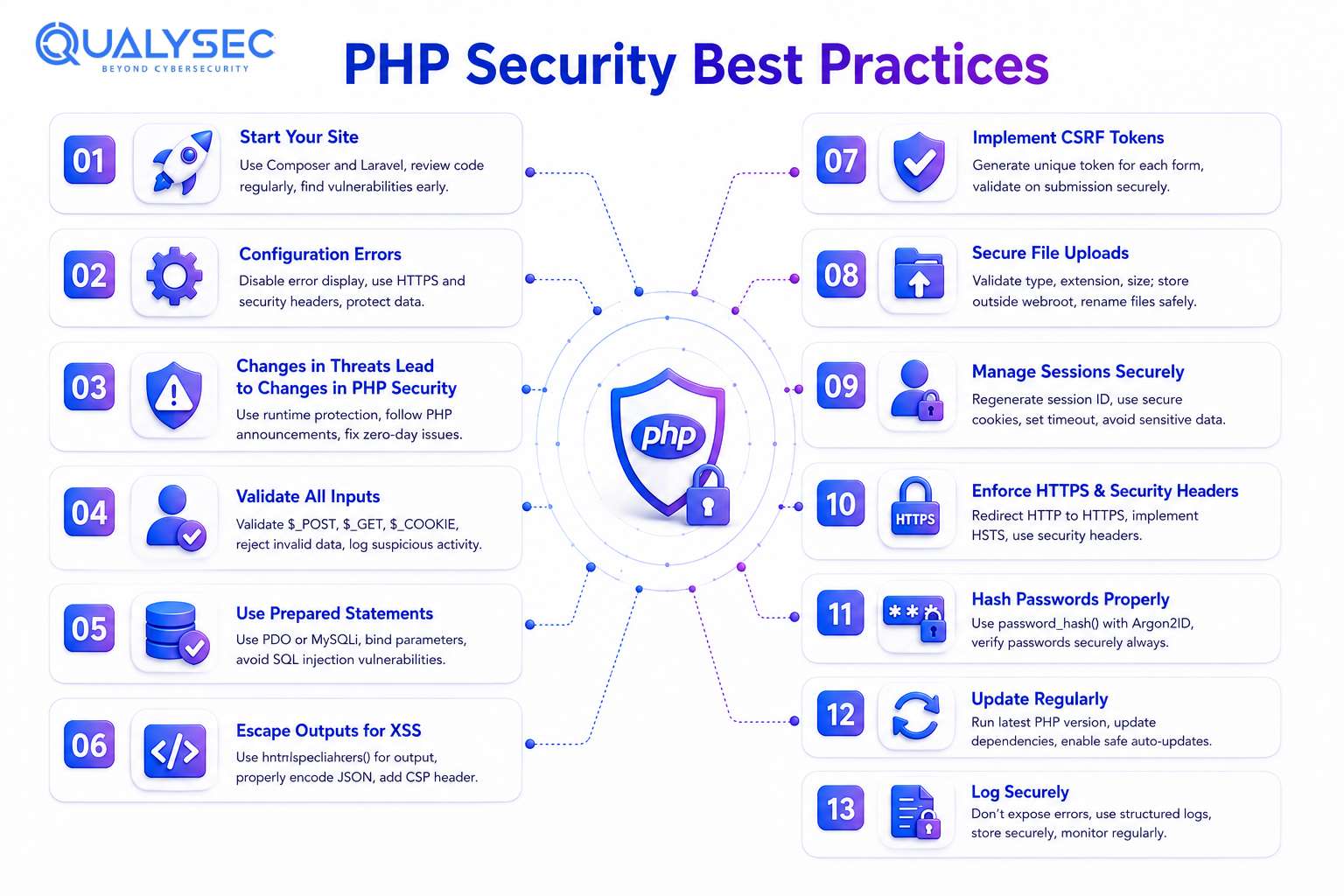
Start Your Site
To accelerate this work, tools such as Composer and the Laravel framework are used. Finding the problems that attackers have concealed is easier when you regularly check your code.
Configuration Errors
Quite a few developers overlook configuration errors. The default settings frequently display error logs and debugging information to the end user. Switch them off immediately in production. Use HTTPS and implement security headers to secure traffic.
Changes in Threats Lead to Changes in PHP Security
AI-based attacks develop unique payloads that can evade the outdated defences. Combat them by use of runtime protection and behavioural analysis. Follow official security announcements of PHP so that you can be able to solve the zero-day issues promptly.
Validate All Inputs
Examine all the $_POST, $_GET and $_COOKIE. Apply filter passlists and white lists of regular expressions. Reject data that looks wrong. An authenticated server prevents 7 out of 10 attacks on the server. Curtail the amount of input that can be transmitted. Record the suspicious information to be investigated.
Use Prepared Statements
Switch to PDO or MySQLi. Bind parameters as opposed to inserting values in SQL. Every attempt at simple string joins always fails.
Escape Outputs for XSS
In case of displaying user data, it is always necessary to use htmlspecialchars(). Enhance the proper encoding of the JSON response. Include a Content Security Policy header.
Implement CSRF Tokens
Make up a token that is random in every form and authenticate it when it is submitted. Use hash_equals() to compare.
Secure File Uploads
Check MIME types, extensions, and sizes. Store files outside webroot. Rename with uniqid().
Manage Sessions Securely
Generate a new session ID upon access change. Use only HttpOnly, Secure, SameSite=Strict cookies.
Physical Enforcement of HTTPS and Security Headers
Redirect HTTP to HTTPS. Include protective headers (HSTS).
Hash Passwords Properly
Adopt password_hash() with Argon2ID. Verify inputs securely.
Update Regularly
Run PHP 8.4+. Check Composer reviews the check every week. Allow automatic updates in case it is safe.
Log Securely
Suppress failure on the part of users. Use Monologue for structured logs. Don’t show them on the screen.
Why PHP Security Best Practices Matter for Indian Developers
India represents one-fifth of the total installations of PHP all over the world. The cost of a breach ranges between 1 and 5 crores. Fintechs are required to practice secure coding by the RBI. You are competing in a saturated market. Secure apps keep customers. E-commerce websites lose 15 per cent of revenue when they are down.
Festivals such as Diwali are attacked by attackers. Peaks of traffic will reveal the vulnerabilities. Adherence to good PHP security practices retains 99.9 per cent of uptime. Global business requires conformity. GDPR and PCI-DSS should be well defended. Indian start-ups thrive better when they appear clean.
These AI attacks are most devastating to the emerging markets. Old code is maintained in small companies. Outsmart competitors with PHP security. The developers obtain certifications such as OSCP by establishing secure projects. Investors take portfolios to the next level when they are displayed with actual protections. Digital India is a government initiative. Secure PHP can be used with UPI. Ignoring it can lead to fines.
Implement PHP security best practices today – Talk to an Expert!
How Qualysec Technologies Can Help You
Advanced PHP Security Services
Qualysec Technologies provides the best PHP security to Indian developers. We observe the PHP security practices. SQLi, XSS, and CSRF are utilized by constantly attacked, and our professionals prevent them in time. Our industry experience secures your apps in 2026, stay safe against the artificial intelligence hackers. We dwell upon input checking, prepared statements, and session security, which are the key elements of the PHP security basics.
Extensive Retail Penetration Testing
Independent of PHP common problems, Qualysec does extensive testing that corresponds to those issues. We attempt SQL injection attacks on your databases and XSS of user interfaces. Forms and unsafe file uploads that potentially result in RCE are found to have CSRF issues. Our testers verify the issues of session problems and PHP 7.x. You receive step-by-step reports on attacks with evidence on how they occur, hence being able to fix them before hackers win. Validation and output escaping are applied to this service, reducing the risk of breaches.
State-of-the-Art Vulnerability Tests
Our scans are an examination of risks listed in PHP security best practices. Unescaped inputs, lack of CSRF tokens, and poor password hashing are the unescaped inputs, missing CSRF tokens, and weak password hashing that are found by automated tools, respectively. Subtle problems, such as misplaced HTTPS headers or session hijacks, are discovered under the manual reviews. We check Composer libraries of known CVEs and suggest that they be upgraded to PHP 8.4+. Qualysec targets high-impact problems, including those that impact Indian e-commerce during the peak periods. You are provided with explicit guidelines on how to correct errors, with code samples of ready-made statements and secure file manipulation.
Customised Compliance and Secure Coding Audits
Qualysec ensures that the PHP apps comply with the rules of RBI and NPCI and the best practices. Checks that are not present in the code that we look at include input checks, secure error logging, and login checks. We also audit HTTPS, CSP headers and Argon2ID hash – Identifying safe session standards and output escape. Indian fintech companies are confident that we will save them crores in breach expenses.
PHP Security Experience that is India-centric
Qualysec is familiar with the Indian developer problems. We manage volume UPI applications and peaks of festival e-commerce. Our professionals work in PHP and will provide a first report as soon as possible. We have the support of ISO 27001 certification. After the audit, the clients attain zero vulnerabilities, and quarterly scans are available.
Smooth Autonomy and Leadership in the Best Practices
Qualysec assists in the sealing of the PHP security holes. We educate your team about filter_var(), htmlspecialchars and PDO. Our reports include ready-to-deploy solutions to every risk. You embrace the best practices of PHP security that help to stop AI attacks.
Conclusion
PHP security best practices protect your applications against the threat ofartificial intelligence in 2026. Developers apply validation, prepared statements, CSRF tokens and frequent updates at present. Indian developers attain a competitive advantage by defensive initiative. Violations destroy brand names in one night – be decisive. Focus on safe working code, use of HTTPS, and dependency auditing in order to reduce risks.
FAQs
1. What do you think are the most frequent PHP security threats in 2026?
SQL injection leads in PHP breaches, then there is XSS, CSRF, unsafe file uploads and session issues. Error logs are assembled into custom payloads by AI agents very quickly. RFI/RCE may be caused by file uploads, and old PHP 7.x contains such holes as CVE-2026-24765. Code that is outdated increases the risks of breaches in 2026, which may only be due to upload activities.
2. What is the reason PHP security best practices are important?
3. What are the PHP security best practices for applying input security?
Check all of the inputs using filter_var() or regex lists. Filter out data that is too large or suspicious. Prepared statements to thwart SQLi by using $stmt->execute [$email]; Output with escape and CSP header. Log odd activity for review.
Example – in case of an invalid email, the email is filtered by filter_var (filter validate email) before it.