

Most ransomware and business email compromise cases investigated in Singapore don’t trace back to some sophisticated zero-day attack. They trace back to unsupported software still running in production, an admin account nobody remembered to lock down, or a backup that turned out not to actually restore when it mattered. The CSA Cyber Essentials Mark exists specifically to close those gaps, and it’s built for exactly the kind of organisation that doesn’t have a dedicated security team to catch them on its own.
The Cyber Essentials Mark Singapore businesses reach for first is exactly this one. If your business is just starting its cybersecurity journey, or you’ve never had an independent party check whether your basic controls actually hold up, this is the certification worth understanding before Cyber Trust, before ISO 27001, before anything more demanding.
What is the CSA Cyber Essentials Mark?
Under the SG Cyber Safe Programme, the Cyber Security Agency of Singapore created the CSA Cyber Essentials Mark for SMEs with limited IT and cybersecurity resources. Where Cyber Trust uses a risk-based model that scales with digital exposure, Cyber Essentials is a fixed baseline: the same essential hygiene controls, assessed the same way, regardless of how large or complex your operation is.
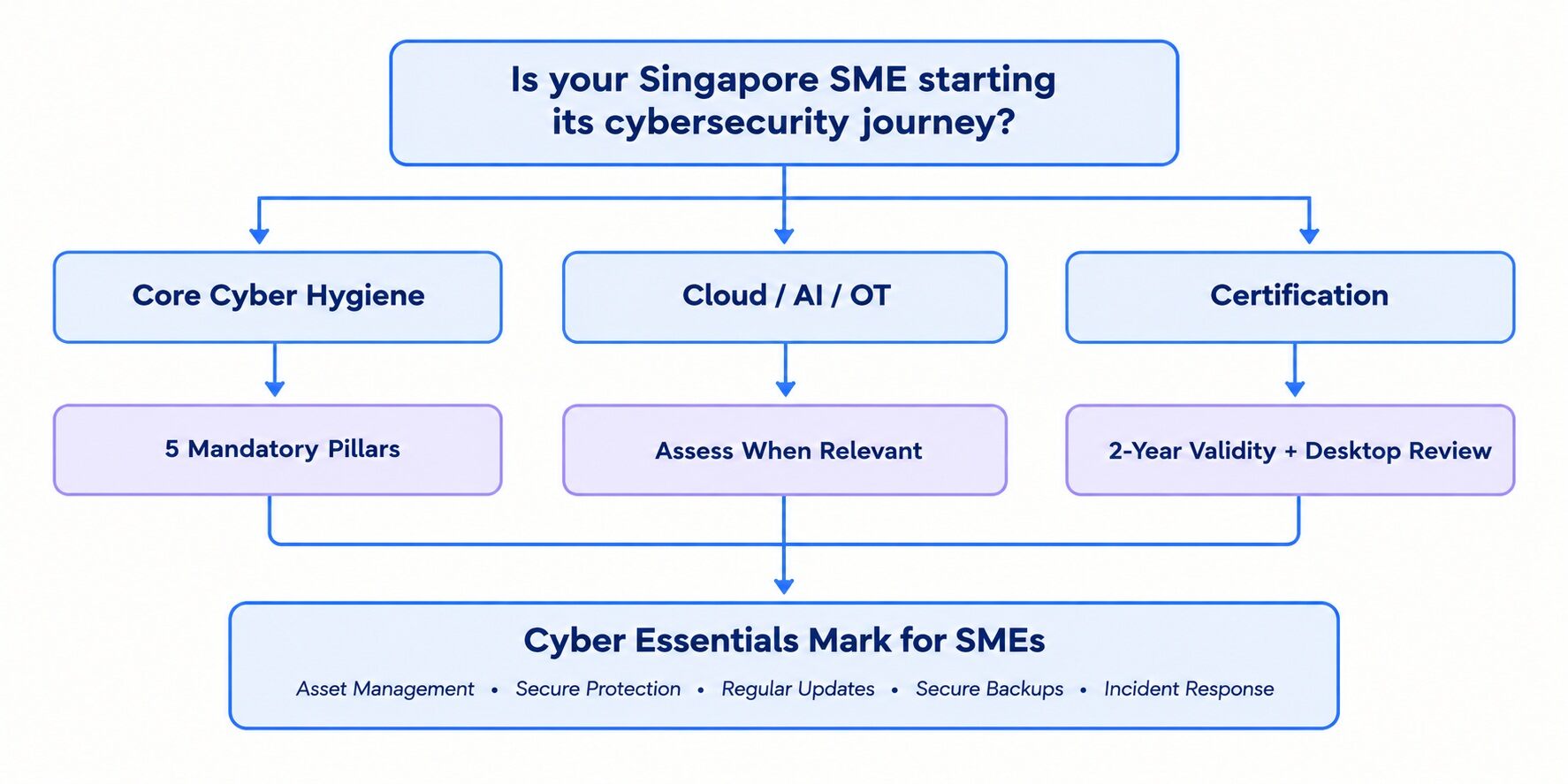
Assessment is a desktop review. You complete a guided self-assessment against CSA’s framework, a certification body verifies your documentation and evidence, and once approved, you’re certified for two years and listed in CSA’s Directory of Certified Organisations. Businesses entering independent cybersecurity verification for the first time should start with Cyber Essentials, even though Cyber Trust does not strictly require it.
There’s a practical overlap worth knowing about too. Singapore’s Personal Data Protection Act requires “reasonable security arrangements” under its Protection Obligation, and the controls Cyber Essentials asks for – asset inventory, access control, patching, backups, incident response – are a credible, documented way to evidence exactly that. Work done for one genuinely serves the other.
The 5 Core Hygiene Pillars Explained
CSA divides the mandatory Classical Cybersecurity pillar into five categories that target how SMEs actually experience data breaches.
Asset Management
You can’t protect what you haven’t listed. This domain expects an accurate, current inventory of hardware, software, cloud services, and business data, with clear ownership assigned to each. Employees routinely adopt unapproved Shadow SaaS tools and create hidden risks for SMEs, but this pillar directly surfaces and addresses those blind spots.
Secure Protection
After mapping your assets, secure them with core controls: deploy anti-malware across every endpoint, enforce secure configurations with no default passwords or unused services, restrict access using least privilege, and mandate multi-factor authentication for critical entry points like email and admin accounts.
Regular Updates
Attackers routinely exploit unpatched software because organizations defer routine updates. This pillar demands systematic, timely patching against known vulnerabilities rather than ad-hoc updates when someone remembers.
Secure Backups
Backups need to actually exist, be stored separately from the systems they protect, and restore correctly when tested. A backup nobody has verified is a backup you don’t actually have, and that gap tends to surface at the worst possible moment, mid-incident.
Incident Response
Detecting, responding to, and recovering from an incident needs a documented plan the team has actually walked through, not something improvised for the first time during a real breach.
Modern Technology Enhancements
In April 2025, CSA expanded both Cyber Essentials and Cyber Trust beyond classical cybersecurity to cover three additional pillars: cloud security, artificial intelligence, and operational technology. Classical Cybersecurity applies to every certified organisation. These three are assessed only where the relevant technology is actually part of how you operate.
Cloud security
Organisations are guided through cloud-specific risk scenarios to assess their own exposure. CSA’s own example: an attacker exploits an insecure API in your cloud service and gains unauthorised access to your data or disrupts service delivery. If your business runs meaningfully on cloud infrastructure, this pillar checks whether you understand your side of the shared responsibility model, not just the provider’s.
Artificial intelligence
This is the pillar most SMEs don’t expect and most need. Under the Assets category specifically, CSA’s guidance now covers visibility into third-party AI tools your employees use without the organisation formally providing them, what CSA calls Bring Your Own AI. If staff are pasting client data into a free AI tool nobody in IT approved, this is exactly the gap this addition is built to catch.
Operational technology
Relevant for businesses running industrial control systems or OT environments alongside standard IT, covering security practices specific to that infrastructure.
Financial Breakdown: Cost, Validity, & Subsidies
Certification is valid for two years, verified through a desktop-based self-assessment review. This saves the annual on-site audits Cyber Trust requires, which keeps ongoing costs lower once you’re certified.
CSA provides funding support toward certification fees. Amounts vary by endpoint count and in-scope pillars like cloud, AI, or OT. This funding is deducted directly from your chosen certification body’s charges.
Organisations that engage a certification body for Cyber Essentials are also eligible for scholarships toward the Google Cybersecurity Certificate. Ask your certification body about this benefit directly, as it is easy to miss.
Certification fees themselves vary between CSA-appointed bodies, so it’s worth comparing before committing. Confirm exact charges and current subsidies directly at csa.gov.sg, as Singapore periodically revises funding schemes for the Cyber Essentials Mark Singapore.
How Qualysec Accelerates Your SME Certification
Cyber Essentials is a self-assessment, but “self” doesn’t mean you should be guessing whether your controls actually hold up. Most of the time spent on certification isn’t filling out the assessment template. It’s closing the gaps the assessment reveals: missing MFA, inconsistent patching, backups nobody’s tested, an incident response plan that only exists in someone’s head.
Qualysec helps Singapore SMEs move through that gap-closing phase faster with advanced penetration testing services:
- Gap assessment against all five core pillars. Plus cloud, AI, or OT scope where relevant, identifying what’s missing before you submit anything to a certification body
- Light technical validation of key controls, including internal network penetration testing, helps confirm backups actually restore. This is how MFA is genuinely enforced rather than just configured. And endpoint protection is active across the fleet you think it’s covering.
- Documentation support turns scattered policies and ad hoc practices into evidence. This is needed for certification bodies’ desktop review.
- A clear path to Cyber Trust later. The asset inventory, access controls, and incident response work done for Cyber Essentials carries forward. This is best if your business grows into needing the higher tier.
The formal desktop review and certification decision sit with bodies such as TÜV SÜD, SGS, or similar appointed providers. Upfront readiness work usually dictates whether the review sails through quickly or bogs down in avoidable gaps.

Illustrative Example: A Typical Cyber Essentials Readiness Engagement
Note: This is a composite scenario based on common patterns across SME engagements and not a specific client.
A 40-person logistics SME in Singapore came to Qualysec believing it was close to Cyber Essentials-ready. Most controls are checked off on paper. The gap assessment told a different story.
Although the team enabled MFA across the email platform, they failed to enforce it on three admin accounts temporarily exempted during a system migration eight months prior. Backups were running nightly, but no one had actually tried restoring from one. When technical validation attempted a test restore, it failed silently due to a misconfigured retention policy. Endpoint protection was active on company-issued laptops but missing entirely from two contractor devices with regular network access.
None of these was dramatic failures. These gaps represent the typical operational drift that occurs when staff manage IT part-time alongside competing responsibilities. This is how the case goes for most SMEs this size.
The cybersecurity team closed the gaps in stages: enforcing MFA fleet-wide, fixing and re-testing the backup restore process, and extending endpoint coverage. The team captured informal workplace habits in writing, transforming them into a concise, actionable incident response plan.
The SME submitted it for its desktop review with a certification body a few weeks later. It passed without a request for additional evidence. This is often the difference between a quick certification and one that stalls for weeks on follow-up questions.
Conclusion
The CSA Cyber Essentials Mark for SMEs isn’t trying to be comprehensive. It’s trying to close the specific, boring gaps that cause most real SME incidents: unpatched systems, weak access control, backups nobody’s checked, and a response plan that doesn’t exist until it’s needed. For a Singapore business without a dedicated security team, that’s exactly the right place to start. And the two-year certification, PDPA overlap, and clear upgrade path to Cyber Trust make it worth doing properly.
Frequently Asked Questions
1. How long does it take for an SME to get certified?
Timelines depend mostly on how many gaps your self-assessment surfaces, not the assessment itself. Businesses with reasonable hygiene in place can often complete asset inventory, access hardening, and backup verification within a few weeks. Organisations starting from a weaker baseline typically need longer to close gaps before submitting for review.
2. Does Cyber Essentials require penetration testing?
No. Cyber Essentials is verified through a desktop-based review of your self-assessment and supporting documentation. Independent technical validation proves your controls work in practice, like testing MFA enforcement or backup restoration, and reduces the risk of failing a review based on paper-only compliance.
3. Can my business upgrade to the Cyber Trust Mark later?
Yes. Cyber Essentials isn’t a formal prerequisite for Cyber Trust, but CSA explicitly recommends organisations with good cyber hygiene progress toward it as their digital operations grow. Upgrading to Cyber Trust preserves your Cyber Essentials groundwork – asset inventories, access controls, and incident response plans carry over directly into the advanced framework.