
AI SAST (Static Application Security Testing) is a type of static application security testing that uses machine learning algorithms to detect vulnerabilities in source code, rather than relying solely on static rules. It identifies security vulnerabilities before executing the code, significantly lowers false positives, and comprehends context that normal scanners may overlook. With the rise of AI-generated code, AI SAST is increasingly essential in business security and identity. However, while AI SAST helps identify code-level issues early, it cannot validate whether vulnerabilities are exploitable in real-world environments. This is where expert-led penetration testing plays a critical role in uncovering business logic flaws, authentication weaknesses, API vulnerabilities, and other security risks that automated tools may miss.
Key Takeaways
- By 2025, analysts estimate the SAST market size to be $554 million and expect it to rise to $1.548 billion by 2030.
- AI SAST reduces false positives by more than 35% when compared to rule-based scanning.
- Vulnerability detection is about 40% more efficient with AI tools than with traditional methods.
- AI-based code generation, multi-language environments, and context are all areas that Traditional SAST struggles with.
- Independent pen testing is the last step after any SAST tool.
Introduction
Organisations lose billions of dollars annually as a result of software vulnerabilities. A bug after deployment is 30x the cost of a bug discovered in development. Early detection of defects before producing code is the primary idea behind static application security testing. But traditional SAST tools have been shown to yield too much noise and less context.
This picture is rapidly changing with the advent of artificial intelligence. The global SAST market was $554 million in 2025 and is projected to grow to $1.548 billion by 2030 with a 22.82% compound annual growth rate (CAGR). The digital transformation that these forces bring especially bolsters AI integration, DevSecOps adoption, and regulatory pressure.
AI SAST is an emerging approach that enhances traditional static application security testing by using machine learning to improve vulnerability detection and reduce false positives. It doesn’t just quicken the old-fashioned. It alters the way of doing it. Machine learning engines process code just like a seasoned security expert would: reading the code in context, flow, and what it would actually be worth exploiting in real-world scenarios. From its inception to the present day, and from today, SAST’s future.
What Is Static Application Security Testing?
Static application security testing (SAST) is the process of examining source code, bytecode, or binary files for security issues. It does this without running the application. Tests occur at the early stages of development, typically within the IDE or CI/CD pipeline. It is quicker and less expensive to find a flaw at this stage than post-deployment.
SAST compares code to a library of known patterns of vulnerability. Common ones are SQL injection, cross-site scripting, path traversal, and insecure cryptography. It correlates findings with standards such as OWASP Top 10 and CWE. The output is a list of security locations, which are identified in code.
There are three well-known limitations of traditional SAST. First, it generates a lot of false positives. Developers learn to suppress alerts, and real problems are lost. Second, it has no context. It marks code that appears hazardous on its own, but not in the other places it is used. Thirdly, it has trouble with contemporary application patterns: APIs, microservices, cloud-native configurations, and code generated with AI.
Here are the key drawbacks to SAST. There are some key drawbacks to SAST, despite the fact that it is gaining a larger share of the application security revenue market as of 2025 (Mordor Intelligence, Application Security Market). 42.5% of SAST deployments are already happening in the CI/CD pipeline. The demand is real. The issue is whether traditional methods can catch up with the pace of today’s development.
The Problems Traditional SAST Could Not Solve
It’s helpful to recognise the gaps that rule-based scanning could not achieve to understand why AI SAST makes a difference. It is from these failures that the investments led to the tools of AI that are available today.
False Positive Overload
The rule-based scanners check for any rule that matches the pattern. They don’t ask if the match is going to be exploited. If you have a large codebase, you might be receiving thousands of alerts per week. Security teams end up spending their time on noise, not on actual problems. When alerts are constantly incorrect, developer confidence in scanning tools quickly wanes.
No Understanding of Data Flow.
In the traditional SAST perspective, code segments are examined individually. It does not have the ability to follow data from input to output between functions, classes or services. It is possible for a SQL query to appear dangerous to a rule-based scanner even if it receives its data from a trusted internal source. The tool is unable to assess for exploitability unless it is able to identify the origin of the data and the usage of this data.
Limited Multi-Language and Framework Support
In modern applications, there are many languages and frameworks used. It is possible to have Java back-end, JavaScript front-end, Python for data pipelines, and Go for microservices in a single product. Typical SAST systems support one or two languages very well. Lack of coverage leaves gaps or blind spots.
Inability to Handle AI-Generated Code
These days, 30-40% of enterprise code is being created by AI coding tools. According to the 2025 research from Veracode, they found AI-generated code to be 2.74 times more vulnerable than human code. Developers designed traditional scanners for patterns written by humans. They do not account for the weaknesses in structures and buildings caused by using AI models. New ways of scanning are needed.
Poor Developer Experience
When security tools impede development, they’re not going to be adopted. Typical SAST was usually the last step in the pipeline. By then, there was no context, no remediation, and no developer was happy. Maintaining integration in the IDE was slow and impractical with rule-based engines.

What Makes AI SAST Different?
AI SAST is based on machine learning and semantic code analysis, either in addition to or in place of fixed rules. It gains knowledge from millions of actual vulnerability instances. It has an awareness of the intentions of code, data flow, and architectural patterns. Can differentiate between a truly menacing route and a rather suspicious route.
One of the major technical differences is contextual reasoning. A traditional scanner observes a function call and determines if it is in a suspected dangerous pattern. An AI SAST engine can trace the source of the inputs to that function, how they are tested, and what they can impact. It makes a decision that is more in line with an experienced security reviewer.
This distinction has tangible results. AI SAST tools are able to reduce false positive rates by more than 35% from legacy scanning. The overall accuracy of AI-powered vulnerability detection is about 40% higher. This is not a set of marginal changes. They are a shift in the “actionability” of what security teams can do with the tool’s output. They are a reflection of the possibility for the security team to act on the output of the security tool.
This is evident in the way that the market invests. In 2025, the US issued 127 patents relating to the classification, automated remediation pull requests, and runtime threat correlation for testing. One of the big vendors, Synopsys, made a notable acquisition in January 2026 with regard to risk-based prioritisation, acquiring Apiiro. In December 2025, HCLTech released some accuracy enhancements for AI-driven SAST capabilities. In June 2025, GitLab enhanced its AI SAST offering with FedRAMP authorisation.
Core Capabilities of Modern AI SAST
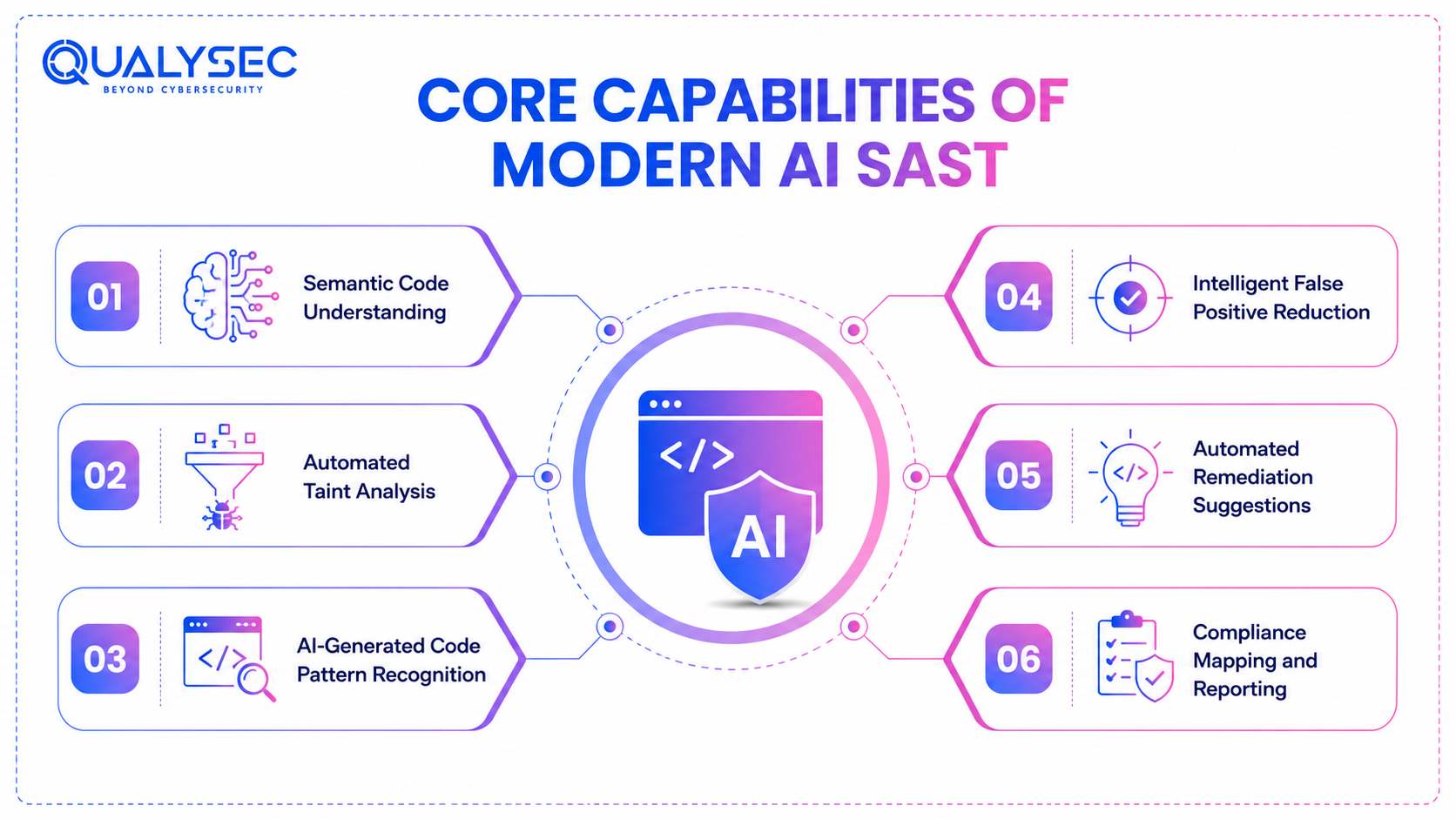
It’s important for teams to know what AI SAST can actually accomplish so they can assess platforms and plan their deployments. The following capabilities are the state of the art.
Semantic Code Understanding
AI SAST engines analyse code not only syntactically but also semantically. They establish mental models of data types, flow, and function relationships. This enables them to follow a tainted input across multiple function calls and files. It generates much fewer false positives and fewer false negatives than pattern matching.
Automated Taint Analysis
Taint analysis is a means for tracing the flow of untrusted input through code. It automates this tracking at scale. It finds all flow paths from one source of inputs to some sensitive sink. The sources are user input, API parameters, and file reads. Sinks are a database query, shell command, network request, etc. The basis for accurate detection of injection is known as taint analysis.
AI-Generated Code Pattern Recognition
Modern AI SASTs are trained with the so-called failure modes of LLMs. They understand the challenges in the structure and architecture of AI coding tools. AI models reproduce hardcoded credentials, partial input validation, and insecure default settings from training data. AI code security solutions help detect and fix these vulnerabilities early in the development process.
Intelligent False Positive Reduction
The more that analyst decisions are made, the more it will learn. If it is identified as a false positive, the model is updated. This forms a cycle that continuously fine-tunes the precision. Within the first few months of use, teams realise a dramatic reduction in noise after investing in tuning an AI SAST platform.
Automated Remediation Suggestions
The newest of these platforms go beyond finding issues. They recommend code patches for known vulnerabilities. Some can create remediation PRs automatically. This brings the gap between detection and resolution to a minimum. Developers get usable direction in the workflow they use to write code.
Compliance Mapping and Reporting
Enterprise AI SAST tools automatically map findings to regulatory and standards frameworks. These include OWASP Top 10, SANS Top 25, PCI DSS, HIPAA, ISO 27001, GDPR, and others. No manual work is required to create reports for developers and auditors. All scan runs are documented in a way that is audit-ready for compliance.
Traditional SAST vs AI SAST: A Direct Comparison
Legacy rule-based and modern AI SAST platforms have distinct differences, as outlined in the table below. Utilise it for a vendor assessment or upgrade determination.
| Dimension | Traditional SAST | AI SAST |
| Detection method | Fixed rules and pattern matching | Machine learning, semantic analysis, taint tracking |
| False positive rate | Very high; often 90%+ of alerts are noise | 35%+ reduction over traditional; precision improves over time |
| Context understanding | None; each code segment assessed in isolation | Full; traces data flow across functions and services |
| AI-generated code | Poor; misses architectural and structural flaws | Designed for; trained on LLM failure patterns |
| Remediation | Lists the problem; minimal guidance | Suggests specific code fixes; some auto-generate PRs |
| IDE integration | Slow and disruptive | Real-time, lightweight, developer-friendly |
| Multi-language support | Usually one or two languages | Broad coverage including polyglot applications |
| Learning over time | Static rules; requires manual update | Improves as analysts provide feedback on findings |
| Compliance mapping | Manual; requires custom configuration | Automated mapping to OWASP, PCI DSS, HIPAA, etc. |
This comparison isn’t meant to knock down traditional tools. However, many teams continue to use the rule-based scanners, as they know and establish them, widely support them, and they meet specific compliance requirements. It is easier to see the picture when deploying a new system or upgrading. AI SAST provides more accurate results and less background noise. The achievement gap is growing by a year.
AI SAST in the Modern DevSecOps Pipeline
The benefit of AI SAST is in its integration into the development lifecycle, rather than as a one-off audit. It is as important as the tool itself to place the pipeline.
IDE Integration: Shift Left to the Developer
The best place to find a vulnerability is when it’s written. The AI SAST plugins for IDE highlight insecure code as it is typed, before the developer saves the file. The fastest-growing SAST segment is IDE integration, growing at 21.1% CAGR to 2030. It also saves the greatest amount of remediation cost. If a flaw is discovered at this stage, it is less expensive than if discovered after deployment.
CI/CD Pipeline Scanning: Pre-Merge Enforcement
The proportion of SAST deployments that are integrated into a CI/CD pipeline is already 42.5%. Each pull request is scanned using an AI SAST scan. If the code fails the scan policy, it is not allowed to merge with insecure code. This enforcement will not allow vulnerable code to be the debt that piles up. It also provides a paper trail for auditors to check.
Code Review Augmentation
AI SAST tools can be integrated into the code review process. They provide comments on pull requests, comments on severity ratings, and possible fixes. Reviewers are able to view the security context in addition to functional changes. This ensures security is part of the developers’ normal workflow, rather than a distinct tool or process.
Integration With SIEM and Ticketing
AI Static Application Security Testing results are integrated into SIEM, Vulnerability Management, and Ticketing systems for enterprise deployments. Findings automatically import into Jira, ServiceNow or other systems. Security teams see SAST results in addition to other risk information. Remediation tracked; SLAs can be enforced.
AI SAST finds vulnerabilities in code. What works in an attack against them is shown by independent tests. Qualysec’s penetration testing can test your application’s security and detect logic errors, attack chains, and architectural flaws that static analysis cannot. Talk to Qualysec to request a penetration testing quote for your applications.
Industries Driving AI SAST Adoption
The adoption of AI SAST is not homogeneous across areas. The industries listed below are leading their adoption since their risk, regulatory, and development landscape gives the biggest incentive to take the plunge.
Banking, Financial Services, and Insurance (BFSI)
The BFSI sector will be the largest spender on application security, accounting for 24.83% of the total application security spending in 2025. Financial applications handle high-value transactions and personal information. SQL injection in a banking app, it can lead to direct monetary losses. PCI DSS and banking regulations require frequent testing, with documentation. These teams can reach compliance with AI SAST and move faster towards secure delivery.
Healthcare and Life Sciences
Healthcare had the highest rate of growth on SAST at 22.8% by 2030. Applications process protected health information in compliance with HIPAA and other security laws globally. Healthcare is the highest-cost sector for ransomware attacks, with a $10.1M average cost per incident. By embedding AI SAST into healthcare software pipelines, we take the initial step in minimising the attack surface of patient-facing systems before they go live.
Government and Defence
The market for application security in the government and public sector is expected to expand at 13.4% CAGR until 2031. In June 2025, GitLab gained FedRAMP certification for its AI Static Application Security Testing, paving the way for the formal acceptance of AI-powered scanning by the government. In many jurisdictions, authorities now require code analysis as part of the procurement process, as supply-chain attacks on government software have emerged.
SaaS and Cloud-Native Companies
AI coding tools play a pivotal role in cloud-native application development. SaaS businesses launch continuously to millions of users. AI SAST, seamlessly embedded in their CI/CD pipelines, audits every code modification before it makes it to production. The natural fit for cloud-first models is evident, with 58% of deployments on cloud-based SAST.
Retail and E-Commerce
Payment data and customer accounts are processed at scale in retail applications. The sector is hit with PCI DSS requirements and significant breach cost risk. API-aware AI SAST can be of significant benefit here: 42% of the web incidents in 2025 were through insecure API interfaces. The scanning of the application and API code prior to deployment is a direct measure that helps avoid breaches.

Can AI SAST Detect Zero-Day Vulnerabilities and AI-Generated Code Flaws?
These are amongst the most frequently asked and crucial questions regarding AI SAST capability. The straightforward answer to both is complicated and deserves a detailed explanation.
Zero-Day Vulnerability Detection
A zero-day is a vulnerability that no one has published or discovered yet, and no rule exists to match it.
It cannot be detected by traditional SAST – there is no rule for it. AI SAST is a game-changer, but not a game-killer.
In some cases, machine learning models can identify structural elements that can be exploited as vulnerabilities in code. This occurs even if you don’t have a matching rule. This detects data-flow anomalies and abnormal privilege usage. It also identifies insecure defaults, matching new classes of vulnerabilities. This is not a guaranteed detection; it’s a probabilistic detection of high-risk code.
This is where AI security testing can complement AI SAST. While AI SAST focuses on identifying risky patterns within the source code, AI security testing can assess how AI-powered applications, models, APIs, agents, and their integrations behave under adversarial conditions. Together, they provide broader coverage across both the code layer and AI application security layer.
The greatest upside is that AI SAST shortens the exposure time once a zero-day is discovered. If a new pattern is added to the model, the scan updates as soon as the pattern is added. A developer has to write the detection rule manually. In practice, the speed of the update is significant.
AI-Generated Code Analysis
AI SAST now has a specific training set of common coding assistant failure modes. There are significant differences between these patterns and human developer mistakes. AI coding tools generate confident but insecure code. They can embed hardcoded credentials, validate inputs less thoroughly, exploit chains of privilege, and have more insecure default dependencies than human developers.
AI-generated code is found to have 2.74 times more vulnerabilities than code generated by humans (Veracode). Modern AI SAST platforms take care of this. They give special attention to code sections that have been marked as AI-assisted. Some employ code provenance signals to prompt further analysis. AI-powered development is a vital and growing capability as it expands.
Limitations of AI SAST and How to Address Them
While AI SAST is a big step up from traditional scanning, it does have its limitations.
- Cannot run code. SAST doesn’t run the application by its nature. Dynamic testing is necessary for identifying runtime vulnerabilities, logic flaws that only occur under certain conditions, or misconfigurations of deployed infrastructure.
- Applies only to code within the scope of the project. The AI SAST analyses code you give the tool. Without SCA integration, it is not able to analyse the runtime behaviour of dependencies, external APIs, or third-party services.
- The quality of the models is dependent on training data. The vulnerabilities an AI SAST engine has learned are what make it so good. New classes of attacks and very new languages may partially cover the meantime, pending updates to the model.
- The architecture and business logic gaps. AI SAST is not able to assess the security of an authentication design. It is not able to ensure proper privilege limits in an entire system. It also cannot determine if a business workflow can be exploited. These need to be human-reviewed.
- Continues to give false-positive results. Although AI minimises noise, it doesn’t completely remove it. There are still some models to tune and workflows to manage for the teams.
The best answer to these restrictions is multiple defences. Automated, pre-deployment code analysis is managed by AI SAST. Dependencies are included in software composition analysis. Running systems are tested dynamically and monitored during runtime. Independent penetration testing provides the actual ability to exploit findings and uncovers the problems that automated layers cannot address.
What to Look for When Choosing an AI SAST Platform
Selecting the right AI SAST platform involves aligning features with your development workflow and risk landscape.
Language and framework coverage: Verify that the platform supports all the languages in your stack at the desired depth.
- AI-generated code support: Inquire about the platform’s approach to AI-generated code.
- False positive benchmarks: Ask for the data rather than marketing statements. Request including evidence from equivalent environments.
- Incorporation with IDE or CI/CD: Security needs to be present at the developer’s desk, as well as at the place of code development.
- Remediation capability: Ensure that the tool provides remediation pull requests or recommends fixes.
- Compliance mapping: Check automatic connections to PCI DSS, HIPAA, OWASP, and other standards.
- Learning and tuning: Know how the analysts’ feedback has enhanced the model over time.
The Future of AI SAST
AI SAST is not just a vulnerability finder but an intelligent development security partner. In the coming years, several trends will mark it, which play a significant role at the international level.
Agentic AI integration: There is a shift toward “autonomous” agents in security tooling. These agents examine code, identify issues, and provide solutions to them. Some generate pull requests automatically, before they are manually requested. It will be a first-line validator that goes through these agentic loops. Each AI code generation step will automatically be followed by an AI security review step.
Expansion of the supply chain security: Modern applications use hundreds of third-party packages. AI SAST will become more capable of examining the entire dependency tree of code defects and supply chain vulnerabilities. An early indicator is the Synopsys-Apiiro deal, which took place in January 2026. It is a blend of risk-based prioritisation, code-level analysis and supply-chain context.
Regulatory convergence: National cybersecurity rules, the EU AI Act and the NIST AI RMF are coming together. Everyone is increasingly demanding that software be automatically security-tested, with documentation. Compliance guidance is expected to reference AI SAST more frequently in the future. Companies that develop the practice today will enjoy smoother auditing discussions in the future.
Securing rapidly during development: It’s obvious which way to go. AI SAST will be as automatic and seamless as a spell checker — it will check constantly, offer suggestions on the fly, and adapt to every adjustment. The window between the creation of code and the securing of it will be seconds, not hours or days.
Conclusion
SAST has come a long way since it was a useful audit tool to become an intelligent development security system. AI SAST was what propelled that change. Machine learning, semantic analysis, taint tracking, and continuous feedback loops have revolutionised scanning.
The direction is being validated by the market numbers: $554 million in 2025 and $1.548 billion in 2030. The adoption numbers confirm the need to adopt it: 65%+ of enterprises are anticipating adopting SAST tools. A false positive reduction of more than 35% is tangible evidence of progress. With an accuracy boost of 40%, it’s clear that AI SAST is effective when used correctly.
No tool is as smart as an experienced security reviewer or penetration tester. Automated breadth at development speed is handled by AI SAST. It is not able to prove exploitability, to analyse an architecture’s security, or to mimic an expert attacker. This work is independent testing. Quickly discover most of the code-level bugs with AI SAST. Test your defences with penetration testing to prove that they work.
Looking for more than the capabilities of AI SAST? Qualysec’s AI Penetration Testing services help you determine if vulnerabilities in your applications are actually exploitable. We identify logic flaws, privilege chains, and business-layer flaws that no static analysis tool can find. For the best penetration testing quote on your applications, get in touch with Qualysec today.

Frequently Asked Questions
Q. Does AI SAST work with AI-generated code?
Yes. AI SAST tools are now based on failure patterns of the most widely used AI coding tools. These include GitHub Copilot, Claude Code, and ChatGPT. They recognize hardcoded credentials, incomplete input validation, and architectural weaknesses that AI models can introduce. AI-generated code performs better with AI SAST than human-written code, because AI SAST creates vulnerabilities at a higher rate.
Q. What is the biggest advantage of AI SAST?
The most significant benefit is that there is a massive drop in false positives, more than 35% below normal, in rule-based scanning. This changes the way teams handle security findings. Rather than dismiss noisy alerts, developers take action on high-confidence findings. Unlike many SAST tools, AI SAST is aware of the code context and data flow to ensure that it does not label a safe use of an input as a bad one.
Q. Can AI SAST detect zero-day vulnerabilities?
AI SAST is not guaranteed to detect previously unknown vulnerabilities. However, it can detect code with structural patterns, even if it is not a specific rule, that correspond to known vulnerability classes. The model automatically updates new vulnerability types that are added, without the need to write new rules. It shortens the response window once a zero-day has been published, but doesn’t end security research. It is simply a shorter timeline.
Q. What is the future of AI SAST?
AI SAST will become an independent, continuous security guard, integrated into each and every development phase. Agentic integration will set the scan at the time of code generation. They will extend awareness of supply chains to dependencies. The use of AI SAST will become an audit expectation when doing it right. The long-term direction is a security tool that is as quick and invisible as a spell checker. The depth, however, is as deep as that of a seasoned code reader.